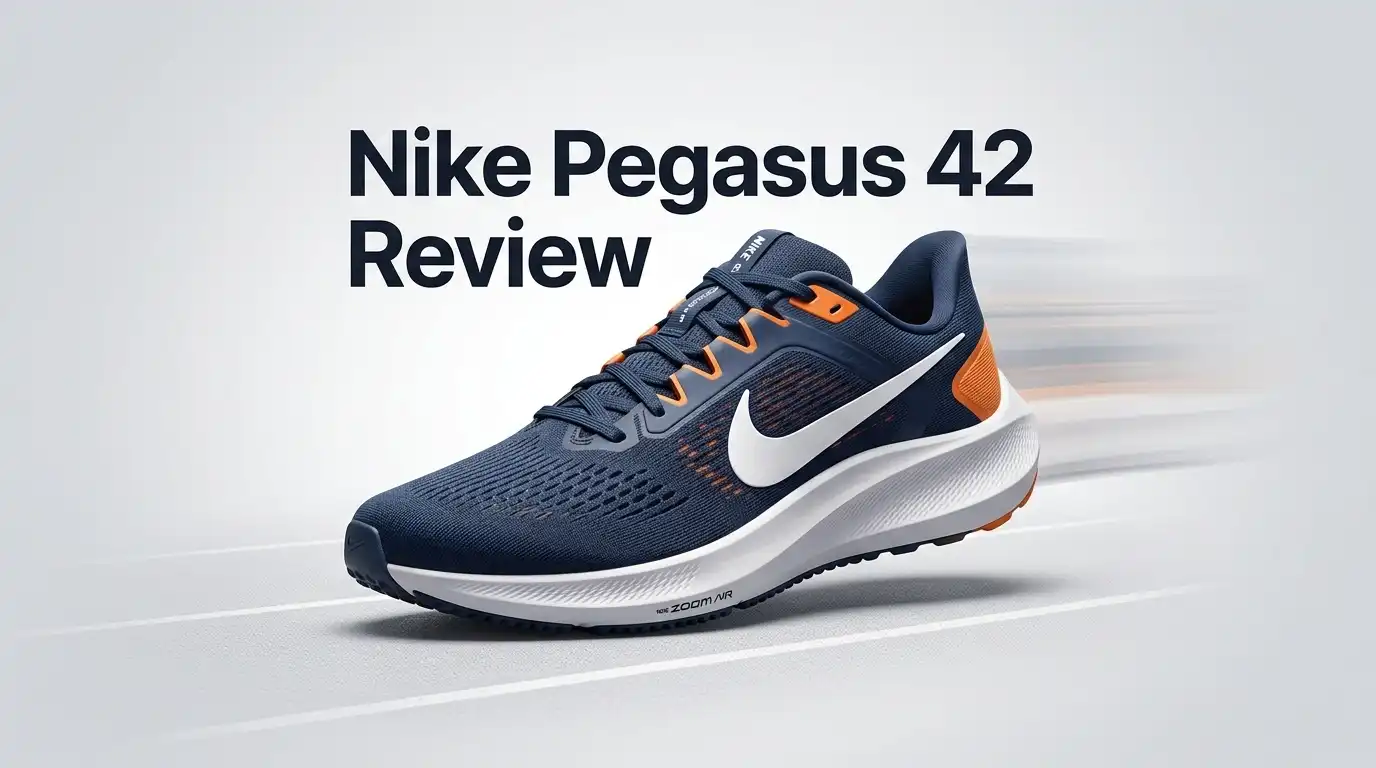
Nike Pegasus 42 Review 2026: Still Worth It?
The Nike Pegasus has been the safe pick in running stores for over forty years. Your dad probably owned a pair. Your running club probably has five people wearing one right now.
So when Nike released the Pegasus 42, runners asked one simple question: did Nike finally fix the boring ride, or is this another quiet update with a new colorway?
I put real miles into this shoe. Easy runs, recovery jogs, one long run, gym sessions, and plenty of walking. This review covers what the Pegasus 42 gets right, what it still gets wrong, and who should skip it entirely.
In A Nutshell:
- The upper is the best part. Nike redesigned the mesh, added a semi gusseted tongue, and widened the last slightly. Lockdown is excellent and breathability scored 87 BR in lab testing, well above the average of 74 BR. Your feet stay dry on hot runs.
- The ride is smooth but dull. The new full length Air Zoom unit removes the lumpy forefoot feel of the Pegasus 41. Energy return measured 57.1% in the heel, which sits right at average. You get consistency, not excitement.
- Weight went up, not down. At 10.1 oz (286g), the Pegasus 42 is heavier than the Brooks Ghost 17, HOKA Clifton 10, and Saucony Ride 18. This is the shoe’s biggest flaw in 2026.
- Traction improved a lot. Grip nearly doubled from 0.25 in version 41 to 0.45 here. Wet roads feel far safer now.
- Durability stays elite. The outsole lost only 0.8 mm of rubber in abrasion testing. Expect 400 to 500 miles easily. The toebox mesh, however, scored a weak 1 out of 5.
- It fits true to size for most, tight for some. The toebox tapers hard. Wide footed runners should size up half a size or buy the wide version.
Nike Pegasus 42 Overview

- Train better with confidence and style wearing Nike Air Zoom Pegasus 42 Sneaker. The full-length Air...
- Polyester lining.
- Ethylene vinyl acetate insole.
Last update on 2026-08-30 / Affiliate links / Images from Amazon Product Advertising API Some of the links on this website are affiliate links, which means that at no additional cost to you, I earn a commission if you click through and make a purchase. I only recommend products and services that I believe will add value to my readers. Thank you for your support!
The Pegasus 42 is Nike’s neutral daily trainer. It sits below the Vomero for cushioning and below the Pegasus Plus for speed. Nike positions it as the shoe you run in three or four times a week without thinking about it.
The specs are straightforward. Nike lists a 38 mm heel and 28 mm forefoot with a 10 mm drop. Independent lab measurements came in lower at 36 mm heel and 22 mm forefoot, which actually produces a 14 mm drop in real terms. That gap matters. It explains why the forefoot feels thin under your toes while the heel feels plush.
The midsole uses ReactX foam, the same compound Nike used in the Pegasus 41. Inside that foam sits a new full length Air Zoom unit, hidden from view, curved to follow the shape of your foot. Nike also added size specific tuning for the first time in Pegasus history. Smaller sizes get thinner air units, larger sizes get higher pressure.
The price is $145, a $5 increase over the previous model. That puts it $15 above the Pegasus 40 from two years back. The retail price sits below the category average of $157, so it still represents reasonable value on paper.
What you get is a shoe that does everything acceptably and nothing brilliantly. That has been the Pegasus formula for a decade, and Nike clearly sees no reason to break it.
Unboxing Experience And First Impressions
The box arrives in that familiar orange Nike cardboard. Nothing fancy. No extra laces, no shoe bag, no printed insert explaining the technology. You lift the lid, pull back the tissue paper, and the shoes sit there looking like Pegasus shoes have always looked.
The first thing I noticed was the weight in hand. These feel dense. Pick up a Clifton 10 in your other hand and the difference is obvious immediately. The Pegasus has that solid, packed feeling that suggests durability rather than speed.
The mesh feels soft under your fingers. Softer than version 41 by a clear margin. There is real padding around the collar and the tongue is thick at 9.1 mm, nearly double the category average of 5.8 mm. It feels expensive in the hand even if the ride does not deliver on that promise.
The reflective strips on the heel catch light well. Nike used two pieces that also cover the upper stitching, which is smart design. Night runners get visibility without an ugly plastic patch.


Last update on 2026-04-11 / Affiliate links / Images from Amazon Product Advertising API Some of the links on this website are affiliate links, which means that at no additional cost to you, I earn a commission if you click through and make a purchase. I only recommend products and services that I believe will add value to my readers. Thank you for your support!
I slipped my foot in and the heel locked immediately. No slippage. The toebox, though, felt snug across the top of my forefoot. Not painful, but noticeable. I tried a half size up in store and preferred it.
First impression verdict: premium upper, ordinary sole, heavier than expected. The unboxing sets a higher expectation than the first run delivers.
Design And Build Quality
Nike changed more on this shoe than the photos suggest. The lacing system is new. It combines punched eyelets with four side loops, which lets you adjust pressure across different parts of your midfoot. A small loop keeps the tongue centered, and the execution is clean.
The heel counter stays firm at a 4 out of 5 stiffness rating. That is deliberate. Heel strikers make up the largest group of Pegasus buyers, and Nike built the rear of this shoe around them. The extended heel collar helps you pull the shoe on, though Nike still refuses to add a simple finger loop tab.
Build quality feels genuinely good. Glue lines are clean. The overlays sit flat. Nothing rubs or creases in the wrong place after fifty miles. This is the part of the Pegasus reputation that remains fully intact.


Last update on 2026-04-11 / Affiliate links / Images from Amazon Product Advertising API Some of the links on this website are affiliate links, which means that at no additional cost to you, I earn a commission if you click through and make a purchase. I only recommend products and services that I believe will add value to my readers. Thank you for your support!
The midsole sidewalls are narrower than average. Forefoot width measured 112.3 mm against a category average of 115.1 mm, and the heel came in at 88.1 mm against 91.1 mm. Nike went narrower while the rest of the industry went wider. For everyday wear and agility, that choice works. For runners who want a wide stable platform, it does not.
Stability sits in the middle. The Pegasus 42 is not tippy, but it offers no guidance features. Runners who need support should look at the Nike Structure line instead.
Top 3 Alternative for Nike Pegasus 42

- THIS MEN’S SHOE IS FOR: The Ghost 17 is for runners and walkers alike looking for an everyday...
- SOFT & DYNAMIC CUSHIONING: The Ghost 17 offers neutral support with premium nitrogen-infused DNA...
- SMOOTH TRANSITIONS: The newly designed midsole incorporates precise flex grooves that enhance the...
Last update on 2026-06-08 / Affiliate links / Images from Amazon Product Advertising API Some of the links on this website are affiliate links, which means that at no additional cost to you, I earn a commission if you click through and make a purchase. I only recommend products and services that I believe will add value to my readers. Thank you for your support!
Brooks Ghost 17
No products found.
HOKA Clifton 10

- Neutral cushioning shoe with an hourglass shape to provide a well cushioned ride but with a nimble...
- PWRRUN+, our advanced, beaded foam that provides an exceptional blend of cushioning and durability
- More protection and durability with increased XT-900 foam coverage from heel to toe
Last update on 2026-08-30 / Affiliate links / Images from Amazon Product Advertising API Some of the links on this website are affiliate links, which means that at no additional cost to you, I earn a commission if you click through and make a purchase. I only recommend products and services that I believe will add value to my readers. Thank you for your support!
Saucony Ride 18
Midsole And Cushioning: How The Ride Actually Feels
ReactX returns unchanged. If you have run in the Pegasus 40 or 41, you already know this feeling. It is dense, slightly rubbery, and firm without being harsh. Midsole softness measured 37.6 AC, which sits close to the average of 35.6 AC.
Balanced is the honest word for it. Not soft. Not firm. It absorbs impact well enough in the heel, where shock absorption hit 131 SA, exactly average. The forefoot tells a different story at 91 SA. That thin 22 mm of forefoot stack shows up in the data and in your legs.
Energy return is where the disappointment lives. The heel returned 57.1% and the forefoot 61.2%. Both land below or near the average of 58.7%. In 2026, when supercritical foams are standard at this price, ReactX feels like technology from 2020.
Here is what that means on a run. Easy pace feels fine. Recovery pace feels fine. The moment you try to push toward tempo, the shoe fights you. There is no spring pushing you forward, no bounce rewarding a harder effort. You are doing all the work.
I ran a 23 kilometer long run in these and finished with tired legs. The cushioning is adequate but never generous. For runs beyond 20 kilometers, the Vomero 18 is a far better Nike choice.
The Full Length Air Zoom Unit Explained
This is the headline feature of the Pegasus 42. Nike replaced the separate heel and forefoot air units with one continuous curved unit running the length of the shoe. The design borrows from the Pegasus Premium, though it is not the same unit and it stays hidden inside the foam.
Does it work? Partly.
Transitions are genuinely smoother. The Pegasus 41 had a forefoot air unit that many runners described as lumpy. You could feel the edge of it under your foot. That sensation is gone. Your foot rolls from heel to toe without interruption now.
What the unit does not do is add bounce. Lab testing found no meaningful improvement in energy return or shock absorption compared to previous versions. The technology is iconic, but the performance benefit is close to zero.
There is a cost too. The air unit adds stiffness. Flexibility measured 14.6N, and the shoe no longer bends easily at the forefoot. It also adds weight, which is the last thing this shoe needed.
The size specific tuning is a genuinely thoughtful touch. A runner in size 8 and a runner in size 13 apply very different forces, so matching air pressure to size makes sense. Whether anyone can feel the difference is another question.
My honest take: the Air Zoom unit is here because it says Pegasus, not because it makes you faster.
Upper, Fit And Sizing Guide

- Responsive cushioning in the Nike Air Zoom Pegasus 42 shoe provides an energized ride for everyday...
- Polyester lining and ethylene vinyl acetate (EVA) insole.
- The full-length Air Zoom unit offers an optimal level of springiness underfoot, unlocking a level of...
Last update on 2026-08-30 / Affiliate links / Images from Amazon Product Advertising API Some of the links on this website are affiliate links, which means that at no additional cost to you, I earn a commission if you click through and make a purchase. I only recommend products and services that I believe will add value to my readers. Thank you for your support!
The upper is the clear winner on this shoe. Nike built a new engineered mesh that feels soft against bare skin and pulls moisture away fast. Breathability scored 87 BR against an average of 74 BR, and the shoe evaporated 54% of accumulated moisture in three hours of testing.
Interior width measured 96.5 mm, up from 94.6 mm on the Pegasus 41. That is a real improvement, though it still sits only slightly above the average of 95.2 mm.
The toebox is where opinions split. Width measured 72.3 mm, below the 73.2 mm average, and the shape tapers sharply toward the big toe. Toebox height is fine at 27.0 mm, so your toenails stay safe vertically. The squeeze happens side to side.
My recommendation: most runners can go true to size. If you have wide feet, if your feet swell on long runs, or if you found the Pegasus 41 tight, go up half a size or buy the wide version. Nike offers wide widths in this model.
Lockdown is excellent. The semi gusseted tongue stays put and never slides. The thick padding creates a plush collar feel, though it does make the shoe run slightly warm around the ankle.
One durability warning. The soft toebox mesh scored just 1 out of 5 in abrasion testing. Runners who scuff their toes will wear through this upper faster than the outsole.
Outsole, Traction And Durability
Nike rebuilt the outsole completely. The classic waffle pattern is mostly retired, replaced by a three zone layout. High abrasion rubber lines the perimeter. A textured forefoot section handles grip. The center of the midfoot and heel is left more exposed to save weight.
Traction has always been the Pegasus weak spot. Not anymore, or at least not badly. Grip measured 0.45 against a category average of 0.52. That is nearly double the 0.25 score of the Pegasus 41. Wet pavement, painted crosswalks, and metal drain covers all feel more secure now.
Durability is outstanding. Abrasion testing removed only 0.8 mm of rubber against an average loss of 1.1 mm. Outsole thickness sits at 2.6 mm, slightly thin, but the compound is hard enough that it barely wears.
Real world expectation: 400 to 500 miles before the outsole shows serious wear. Many runners report more. This is exactly what Pegasus buyers have relied on for decades.
Heel padding durability scored 4 out of 5, so the interior holds up too. The only weak link remains that soft toebox mesh.
The strange part is the weight. Nike used less rubber than before, kept the stack moderate, and the shoe still gained mass. Something inside this design is heavier than it should be, and the Air Zoom unit is the obvious suspect.
Weight And Speed: The Honest Problem
The Pegasus 42 weighs 10.1 oz (286g) in a men’s size 9. Some listings report 10.3 oz depending on the sample. The category average is 9.2 oz (262g).
That is a full ounce heavier than typical. In a daily trainer costing $145, that is hard to defend in 2026.
Compare it directly. The HOKA Clifton 10 is lighter. The Saucony Ride 18 is lighter. The Brooks Ghost 17 is lighter. The ASICS Gel Cumulus 28 is lighter. Every one of those shoes also delivers more cushioning per gram.
You feel it after about eight kilometers. Your legs know they are lifting something. On recovery runs at slow pace, the weight barely registers. On anything faster, it becomes the dominant sensation.
There is no forefoot rocker to help either. Nike advertises increased toe spring, but the geometry stays fairly flat compared to modern trainers built around rocker geometry. Transitions feel deliberate rather than propulsive.
The result is a shoe with a narrow use case. Easy runs, recovery runs, gym work, walking, standing all day. Push past that and better options exist at the same price.
If weight matters to you, this is your deal breaker. No amount of upper quality compensates for a heavy shoe that does not give energy back.
Nike Pegasus 42 vs Pegasus 41: What Changed?
The honest summary is that the Pegasus 42 is a small step forward, not a redesign.
What genuinely improved: traction nearly doubled, the upper got softer and more breathable, the interior got 1.9 mm wider, and the full length air unit removed the lumpy forefoot sensation of version 41. Transitions are smoother. That is real.
What stayed the same: ReactX foam is unchanged, energy return is unchanged, the 10 mm drop is unchanged, and the overall ride character is nearly identical. Heel counter stiffness is identical.
What got worse: weight increased slightly, the price went up $5, and flexibility decreased because of the new air unit.
Should you upgrade? If you bought the Pegasus 41 recently, no. The gains are too small to justify $145. Run your current pair into the ground first.
If you are on the Pegasus 39 or 40 and your pair is worn out, the 42 is a reasonable next step. The upper alone makes the newer version more comfortable for daily wear.
If you skipped the Pegasus entirely because it felt boring, nothing here will change your mind. The Pegasus 42 is still the Pegasus. Reliable, durable, unexciting.
What The Nike Pegasus 42 Does Not Do Well
Authentic reviews name the flaws directly, so here they are.
It does not go fast. The combination of heavy weight, average energy return, and flat geometry makes tempo work feel like effort. Do not buy this as your only shoe if you race or do speed sessions.
It does not cushion the forefoot properly. Twenty two millimeters of measured forefoot stack with 91 SA shock absorption is thin. Forefoot and midfoot strikers will feel road texture on long runs.
It does not suit wide feet out of the box. The taper is real. Sizing up half a size solves it, but you should know before ordering online.
It does not have a durable toebox. A 1 out of 5 abrasion score means the soft mesh will fray if you drag your toes or wear these for court sports.
It does not offer stability features. Neutral runners only. The narrow platform and lack of guidance rails make this a poor pick for overpronators.
It does not justify its price on performance. You are paying for durability, comfort, and the Nike name, not for a modern foam experience. At $145, competitors give you supercritical midsoles and lighter builds.
Knowing this list before you buy prevents disappointment. The Pegasus 42 is honest about what it is once you stop expecting it to be something else.
Pros And Cons Of The Nike Pegasus 42
Pros
- Excellent upper comfort with soft engineered mesh, thick 9.1 mm tongue padding, and a semi gusseted design that never shifts during runs.
- Outstanding breathability at 87 BR, well above the 74 BR average, with 54% moisture evaporation over three hours.
- Massive traction improvement from 0.25 to 0.45, making wet roads and painted surfaces far safer than in the Pegasus 41.
- Elite outsole durability with only 0.8 mm of rubber lost in testing, supporting 400 to 500 miles of real use.
- Smoother transitions thanks to the full length curved Air Zoom unit replacing the lumpy separate units.
- Genuinely versatile for running, gym sessions, walking, travel, and standing all day in one shoe.
- Reflective heel elements built into the design for safer night runs.
- Reasonable price at $145, sitting below the $157 category average.
- Wide widths available for runners who need extra room.
Cons
- Too heavy at 10.1 oz, a full ounce above the category average and heavier than every major competitor.
- Average energy return of 57.1% heel and 61.2% forefoot, offering no real bounce or propulsion.
- Thin forefoot cushioning measured at 22 mm rather than the claimed 27 mm.
- Narrow tapered toebox at 72.3 mm that forces many runners to size up.
- Weak toebox durability scoring only 1 out of 5 in abrasion testing.
- Dated ReactX foam that has not been updated to a supercritical compound.
- Flat geometry with minimal rocker, making faster paces feel like hard work.
- No finger loop heel tab, a small but persistent omission.
- Minimal upgrade over the Pegasus 41 for the extra $5.
Who Should Buy The Nike Pegasus 42?
This shoe fits a specific runner, and matching yourself to it honestly saves money.
Buy it if you are a heel striker. The 10 mm official drop plays out closer to 14 mm in practice, and the firm heel counter supports rearfoot landings well. This is one of the best high drop trainers available.
Buy it if you run two or three times a week. Casual runners who want one shoe for jogging, the gym, dog walks, and errands get real value here. The durability and versatility are genuine strengths.
Buy it if you are new to running. The balanced cushioning does not overwhelm beginners. The predictable ride teaches good habits. The price sits in a comfortable range for a first serious shoe.
Buy it if you value durability above all. Few shoes last as long as a Pegasus. If you hate replacing shoes, this is your pick.
Skip it if you want bounce. Look at the Adidas Adizero Evo SL or the Nike Pegasus Plus with ZoomX foam instead.
Skip it if you count grams. The HOKA Mach 6 or Adidas Supernova Rise 3 give you lighter builds at similar prices.
Skip it if you need stability. The Nike Structure 26 delivers a similar feel with real support.
Skip it if you race in it. This shoe has no interest in speed.
Price And Value In 2026
At $145, the Pegasus 42 asks for a modest amount by current standards. The average running shoe in testing databases sits at $157, and premium trainers regularly cross $180.
The value case rests entirely on durability. If you get 500 miles from a $145 shoe, your cost per mile is 29 cents. That beats a $180 shoe that lasts 350 miles. For high volume walkers and casual runners, the math strongly favors the Pegasus.
The value case falls apart on performance. Competitors at $140 to $150 offer supercritical foams, lighter weights, and better energy return. You are trading measurable performance for measurable longevity.
Nike has raised the price $15 across two versions. That trend deserves attention. The Pegasus is approaching the ceiling of what a shoe with 2020 era foam can reasonably charge.
Sales help enormously. Pegasus models discount frequently, often reaching $110 or lower once the next version approaches. At $110, this becomes an easy recommendation. At full price, it becomes a preference question.
My advice is simple. Buy it on sale, wear it for easy miles and daily life, and pair it with a lighter shoe for faster sessions. That combination works better than asking the Pegasus 42 to do everything.
Final Verdict: Is The Nike Pegasus 42 Worth Buying?
The Pegasus 42 is a good shoe that could have been a great one.
Nike fixed the traction. Nike fixed the upper. Nike fixed the lumpy forefoot. Those are three real problems solved in one version, and they deserve credit.
Nike did not fix the foam. Nike did not fix the weight. Those two failures define the experience more than any improvement. ReactX belongs in a $120 shoe in 2026, not a $145 one. Ten point one ounces belongs in a stability trainer, not a neutral daily runner.
So what is this shoe? It is a supremely reliable, comfortable, long lasting trainer for easy running and everyday wear. It will not inspire you. It will not disappoint you either. It shows up, does the miles, and asks nothing back.
My score: 7.5 out of 10. Excellent for its intended user, frustrating for anyone hoping the Pegasus becomes exciting again.
Buy it if you are a heel striking, casual to moderate volume runner who values comfort and durability. Look elsewhere if you want a shoe that makes running feel fun.
The Pegasus remains the grey rental car of running shoes. Dependable transport, zero personality. Sometimes that is exactly what you need.
Frequently Asked Questions
Does the Nike Pegasus 42 fit true to size?
Most runners fit true to size, and 97 sizing votes support that. The toebox tapers sharply at 72.3 mm, though, so runners with wide feet or feet that swell should go up half a size. Nike also offers a wide version, which solves the problem without changing length.
How many miles does the Nike Pegasus 42 last?
Expect 400 to 500 miles from the midsole and outsole. Abrasion testing removed only 0.8 mm of rubber, which is well below average wear. The limiting factor is the toebox mesh, which scored 1 out of 5 for durability and may fray earlier if you scuff your toes.
Is the Pegasus 42 good for long runs?
It handles runs up to about 20 kilometers acceptably. Beyond that, the thin 22 mm forefoot stack and 10.1 oz weight cause fatigue. The Nike Vomero 18 or Vomero Plus offer more cushioning and a forefoot rocker, making them better long run choices within the Nike lineup.
Can I use the Nike Pegasus 42 for walking and the gym?
Yes, and this is one of its strongest uses. The moderate stack keeps you connected to the ground, the upper is comfortable for all day wear, and the outsole lasts. Many buyers use the Pegasus purely as a walking and gym shoe rather than a running shoe.
Is the Pegasus 42 worth upgrading from the Pegasus 41?
Not if your Pegasus 41 still has life in it. The improvements are real but small, covering traction, upper comfort, and smoother transitions. The midsole foam, drop, and overall ride feel remain nearly identical. Wait until your current pair wears out.
Is the Nike Pegasus 42 good for beginners?
Yes. The balanced cushioning, predictable ride, true to size fit, and $145 price make it a sensible first serious running shoe. The high drop suits the heel striking pattern most new runners use naturally. Durability also means beginners are not replacing shoes quickly.
Does the Pegasus 42 work for flat feet or overpronation?
No. The Pegasus 42 is a neutral trainer with a narrow platform and no guidance features. Runners who need support should consider the Nike Structure 26, which delivers a similar ride character with genuine stability elements built into the midsole.
What is the difference between the Pegasus 42 and the Pegasus Plus?
The Pegasus Plus uses ZoomX foam, which is lighter and far bouncier than the ReactX foam in the Pegasus 42. The Plus costs more and works better for faster paces. The standard Pegasus 42 lasts longer and handles daily wear better.

Mia Smith is the founder of Shoe Storyteller, a blog that celebrates the art and stories behind shoes. With a passion for fashion and a flair for storytelling, Mia brings a unique perspective to the world of footwear.