Merrell Moab Speed 2 Review 2026: Worth Buying?
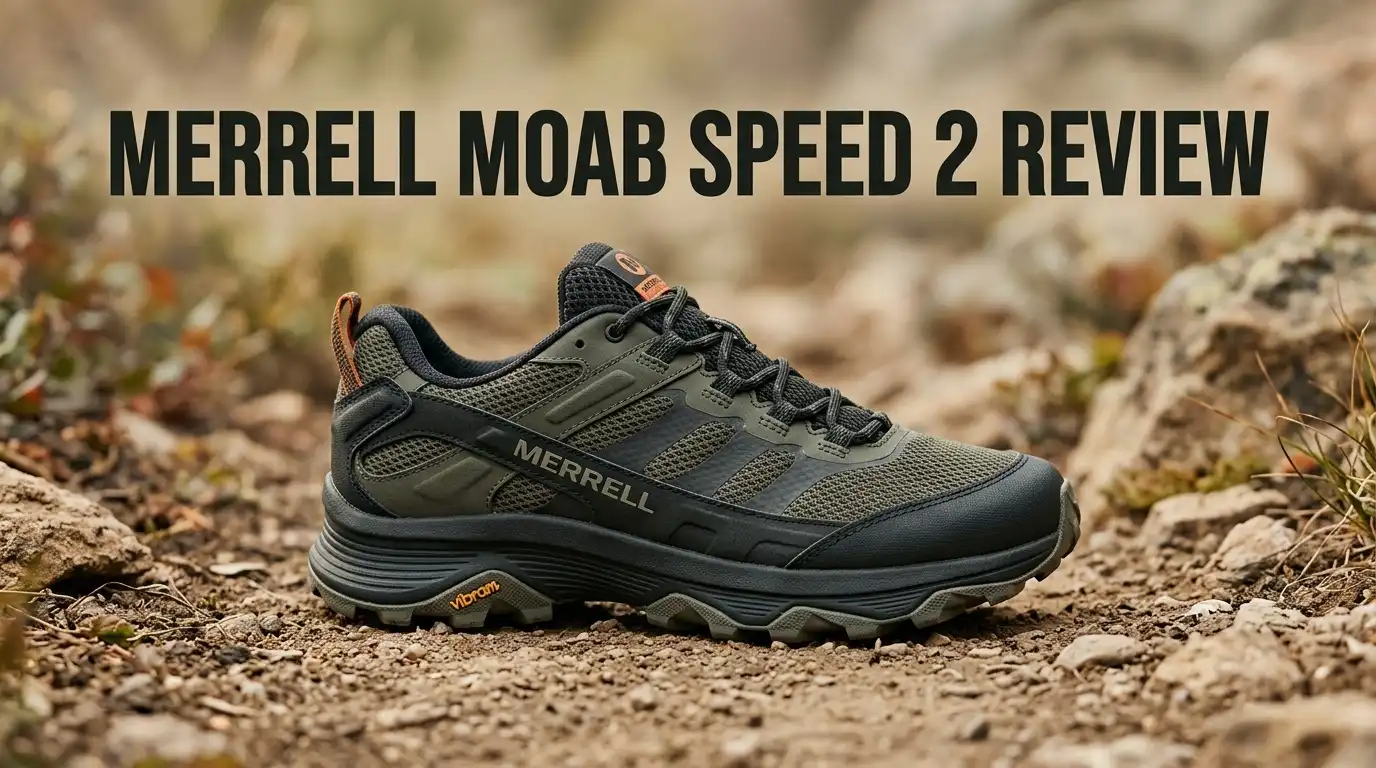
The Merrell Moab Speed 2 sits in a strange, wonderful spot. It looks like a trail runner, weighs almost nothing, and still carries the Moab name that has sold millions of pairs.
Hikers keep asking one question in 2026: does the lighter Moab actually hold up on real trails, or does the weight savings cost you support?
I put this shoe through rocky ridgelines, muddy creek crossings, gravel fire roads, and a few very boring grocery runs. I also compared lab numbers, long term owner feedback, and the closest rivals on the market.
In a Nutshell:
- It is one of the lightest hiking shoes on the market. At roughly 11.6 oz per shoe in a men’s US 9, the Moab Speed 2 feels closer to a trail runner than a traditional hiker. Your legs notice this after mile ten.
- Cushioning is genuinely excellent. Lab testing measured shock absorption well above the hiking shoe average, with a soft FloatPro foam midsole that scored about 32% softer than typical. Zero break in required.
- The FlexPlate is the secret weapon. This midfoot plate delivers top tier torsional rigidity while the forefoot still bends. You get stability without the plank feeling of stiff backpacking shoes.
- Grip is solid but not aggressive. Vibram TC5+ rubber with 3.7 mm lugs handles moderate terrain, packed dirt, wet rock, and light mud. Deep mud and steep scree are not its home.
- The weak spots are real. The heel lining wears fast, the semi gusseted tongue lets debris sneak in, and the shoe lacks the locked in security of stiffer rivals under heavy loads.
- Best use case: day hikes, fast packing with a light load, travel, and long walks. Worst use case: multi day trips with a heavy pack on technical ground.
Merrell Moab Speed 2 Overview

- 39% recycled, breathable engineered mesh and TPU upper
- Protective and abrasion resistant synthetic heel and toe cap
- Dual heel and tongue loops for ease of entry as well as carabiner compatibility
Last update on 2026-08-31 / Affiliate links / Images from Amazon Product Advertising API Some of the links on this website are affiliate links, which means that at no additional cost to you, I earn a commission if you click through and make a purchase. I only recommend products and services that I believe will add value to my readers. Thank you for your support!
The Moab Speed 2 is Merrell’s answer to a simple problem. Traditional hikers feel heavy. Trail runners feel flimsy. This shoe tries to live in the middle, and it mostly succeeds.
The upper uses breathable engineered mesh with TPU overlays, roughly 39% recycled content. A synthetic heel and toe cap guard the high wear zones. Two pull loops, one on the tongue and one on the heel, make entry fast and clip nicely to a carabiner on a pack.
Underfoot you get a full length FloatPro Foam midsole, a Merrell FlexPlate for torsional support, and a Vibram TC5+ outsole. Stated stack height is 34 mm heel and 24 mm forefoot, with a claimed 10 mm drop. Independent lab measurement found the real heel stack closer to 38.8 mm, which explains why the ride feels taller than the spec sheet suggests.
Merrell sells this shoe in several builds. The standard mesh low top runs around $140. The GTX low top costs roughly $170. The Mid GTX boot sits near $180. Wide sizing exists for the low top, and the shoe is vegan friendly.
The short version: this is a Moab that learned to run.
Unboxing and First Impressions
The box is plain Merrell cardboard, nothing fancy, no tissue paper theatre. Lift the lid and the first thing you notice is how little the shoes weigh in your hand. I actually checked the box twice to confirm both shoes were inside.
The mesh feels thinner than expected. Hold it up to a light and you can see through it in places. That worried me at first, then I found the TPU overlays wrapping the toe and heel, which is where trails actually chew shoes apart.
Laces are flat, recycled, and grippy enough to hold a knot without doubling. The tongue has almost 10 mm of padding, which is generous for a shoe this light. The collar is soft and the heel cup feels moderately firm, not rigid.
Slip them on and the step in comfort is immediate. No stiffness, no hot spots, no pressure across the instep. I walked three miles the same evening and felt nothing unusual.


Last update on 2026-04-11 / Affiliate links / Images from Amazon Product Advertising API Some of the links on this website are affiliate links, which means that at no additional cost to you, I earn a commission if you click through and make a purchase. I only recommend products and services that I believe will add value to my readers. Thank you for your support!
One small aesthetic gripe: the toebox has a lot of vertical volume, measured at over 35 mm, the tallest recorded in some lab tests. On medium width feet the extra fabric bunches slightly on top. It looks a little puffy. It does not hurt, it just looks odd in photos.
Fit and Sizing Guide
Sizing is the most common question about this shoe, and the answer is nuanced.
Merrell lists the Moab Speed 2 as true to size, and the internal length measures right around the category average at 268 mm in a men’s 9. However, a large pool of owner votes leans toward slightly small. That gap comes from foot shape rather than length.
Here is my practical advice. If you have a standard foot with medium volume, order your normal size. If you have a thick foot, high arch, or you wear thick wool socks in cold weather, go up half a size. If your feet swell badly on long descents, half a size up is also sensible.
Width is standard for a D medium, measuring about 94 mm at the widest point. The toebox itself measures roughly 75 mm at the big toe, which is wider than average with only mild tapering. Toes splay comfortably.


Last update on 2026-04-11 / Affiliate links / Images from Amazon Product Advertising API Some of the links on this website are affiliate links, which means that at no additional cost to you, I earn a commission if you click through and make a purchase. I only recommend products and services that I believe will add value to my readers. Thank you for your support!
A wide version exists and it is a legitimately good option for hikers who normally fight cramped uppers.
Heel lockdown is decent but not exceptional. The heel counter scored middle of the road for stiffness. If you have a narrow heel, use the extra lace eyelet and tie a heel lock. That single trick solved my minor lift issue on steep climbs.
Top 3 Alternatives for Merrell Moab Speed 2

- Waterproof membrane seals out water and lets moisture escape
- Pigskin leather and mesh upper
- 100% recycled laces and webbing
Last update on 2026-08-31 / Affiliate links / Images from Amazon Product Advertising API Some of the links on this website are affiliate links, which means that at no additional cost to you, I earn a commission if you click through and make a purchase. I only recommend products and services that I believe will add value to my readers. Thank you for your support!
Merrell Men’s Moab 3 Waterproof Hiking Shoe

- The Salomon X Ultra 5 GTX is a dependable, confidence-boosting hiking ally.
- EVA foam midsole.
- Advanced Chassis is a molded insert embedded in the outsole. Providing strong lateral support and...
Last update on 2026-08-31 / Affiliate links / Images from Amazon Product Advertising API Some of the links on this website are affiliate links, which means that at no additional cost to you, I earn a commission if you click through and make a purchase. I only recommend products and services that I believe will add value to my readers. Thank you for your support!
Salomon Men’s X Ultra 5 GTX Hiking Shoe

- PFC-Free water repellency treatment
- Textile
Last update on 2026-08-31 / Affiliate links / Images from Amazon Product Advertising API Some of the links on this website are affiliate links, which means that at no additional cost to you, I earn a commission if you click through and make a purchase. I only recommend products and services that I believe will add value to my readers. Thank you for your support!
HOKA Men’s Anacapa 2 Low GTX Hiking Shoe
Cushioning and Ride Feel
This is where the Moab Speed 2 earns its price. The FloatPro Foam midsole is the same family of cushioning Merrell uses in its trail running line, and it shows.
Lab shock absorption came in around 125 SA against a category average near 107 SA. Translated to plain language, the shoe soaks up impact better than most hikers. Your knees and hips feel fresher at the end of a long day, especially on hard packed trail and rock.
Durometer testing recorded the foam at about 31.8 AC, roughly a third softer than the average hiking midsole. Despite that softness, the ride never feels mushy. The firm Vibram rubber and the FlexPlate keep everything controlled.
Energy return measured a modest 41.5%, below the average of nearly 50%. So the shoe is plush but not bouncy. You will not feel propelled forward. You will feel protected and planted.
Cold weather changes things slightly. After twenty minutes in freezing conditions the foam firmed up by around 22%, which is normal but noticeable on a frosty morning start.
The insole is thick at 6.7 mm and removable, so orthotics drop in easily. For hikers who value comfort over pop, this ride is close to ideal.
Traction and Grip on the Trail
The Vibram TC5+ outsole handles moderate terrain confidently. Lugs measure about 3.7 mm deep, slightly under the 3.9 mm category average, and they are spaced widely enough to shed mud while walking.
On dry rock the grip is excellent. On wet granite and damp roots the rubber holds better than most budget compounds, though it is not sticky climbing rubber. I slipped once on a wet, sloped log, which is honestly par for any hiking shoe.
Slanted lugs around the perimeter bite on ascents and brake on descents. That design detail matters more than raw lug depth on rolling singletrack.
Loose gravel and dusty switchbacks are fine. Deep, sucking mud is not. The lugs simply are not tall enough to dig through six inches of clay. Snow performance is similarly limited without traction devices.
Outsole hardness measured 84.0 HC, a normal reading that suggests a good balance of grip and longevity. Abrasion testing produced only a 0.8 mm dent, better than average, so the rubber should last.
One caveat worth stating clearly. The outsole is thin at roughly 1.6 mm, about a millimeter under average. Wear these mostly on trail, because pavement will erase those lugs faster than you expect.
Weight and Speed on Trail
Weight is the headline stat. At 11.6 oz per shoe in a men’s US 9, the Moab Speed 2 is lighter than nearly every hiking shoe tested in lab conditions, and it is close to the average trail runner at 10.3 oz.
That number sounds abstract until you hike with it. Old hiking wisdom says a pound on your feet equals five pounds on your back. Dropping two ounces per shoe against a traditional hiker saves real energy across a 15 mile day.
I noticed the difference most on rolling terrain. Picking up the pace felt natural. Hopping between rocks felt easy. There was no swing weight fighting me on the uphill.
Flexibility testing supports this. The shoe needed only 15.2N of force to bend 30 degrees, roughly 20% more pliable than average. The forefoot moves with your foot instead of resisting it.
The trade off is honest. Flexible shoes make your foot muscles do more work over very long distances with heavy weight. On a light day pack this is a non issue. Under a 35 pound overnight load, your arches will feel it by evening.
For fast hiking, this is one of the best weight to comfort ratios available in 2026.
Breathability and the Waterproof GTX Version

- GORE-TEX waterproof membrane, exceptional breathability and waterproof performance
- Nylon ripstop and TPU upper
- Lightweight FlexPlate technology provides torsional rigidity, lateral stability, and forefoot...
Last update on 2026-08-31 / Affiliate links / Images from Amazon Product Advertising API Some of the links on this website are affiliate links, which means that at no additional cost to you, I earn a commission if you click through and make a purchase. I only recommend products and services that I believe will add value to my readers. Thank you for your support!
The mesh version breathes beautifully. Smoke transfer testing showed vapor passing through the entire upper, from toebox to collar, earning a breathability score of 4 out of 5 against a 2.3 average.
In practice that means cooler feet in summer heat and faster drying after a creek crossing. I soaked mine intentionally and they were dry to the touch in about two hours of walking on a warm afternoon.
That airflow comes with an obvious cost. These shoes offer zero water resistance. A morning of dewy grass will wet your socks. Cold rain will chill your toes.
Merrell solves this with the GTX low top and the Mid GTX boot. The GORE TEX versions add roughly one to two ounces per shoe and block liquid water reliably. Owners report solid waterproofing performance over a season of use.
The catch is heat. Waterproof membranes always trap moisture, and the GTX Moab Speed 2 runs warm above 70 degrees Fahrenheit. Sweat builds and stays.
My recommendation is simple. Buy the mesh version if you hike in dry or hot climates. Buy the GTX if you hike in the Pacific Northwest, the UK, or anywhere shoulder season means constant damp. Owning both is the honest answer for year round hikers.
Stability and Support
Light shoes usually sacrifice stability. This one does not, and the FlexPlate deserves the credit.
The plate wraps the midfoot, extends back into the heel, and reaches slightly into the forefoot. Manual torsion testing scored the shoe 5 out of 5 for rigidity, the top mark, which is remarkable for something this soft and light.
On boulders and off camber trail, my foot stayed planted. There was no wobble, no tipping sensation, no scary rolls. Hikers with flat feet or mild overpronation should feel well supported here.
Arch support is moderate and neutral. The contoured footbed sits comfortably without pushing hard into the arch, and swapping in custom orthotics is easy.
Now the limitation. This is not Salomon X Ultra 5 stability. That shoe uses a stiffer chassis and a tighter lacing system to create a genuine lockdown feeling on technical ground. The Merrell prioritizes comfort and freedom of movement instead.
The heel counter also has more give than average, scoring 3 out of 5. Under a heavy pack on side sloped trail, you will notice slightly less heel control than a traditional hiker offers.
Stability is excellent for moderate terrain and merely adequate for technical terrain with weight.
Durability After Real Miles
Durability results are split, and honesty matters here.
The good news is substantial. The toecap survived abrasion testing with only a few torn stitches and earned a perfect 5 out of 5. The Vibram outsole showed minimal wear under high speed drilling. Long term owners report the outsole and upper holding strong past 100 trail miles with no separation.
The bad news is specific. The heel lining is one of the least durable tested, failing in about four seconds under an abrasion tool and scoring 1 out of 5. On real feet, this means the interior heel fabric can wear through and expose foam within a season of heavy use.
Wearing thicker socks and avoiding heel slip both slow this down. Still, it is a genuine flaw in an otherwise well built shoe.
Reviewers have also flagged construction issues on the Mid GTX boot version specifically, which shares the same build. The low top appears more reliable.
Realistic lifespan sits around 400 to 500 miles for most hikers, which is normal for a lightweight hiker but shorter than the leather Moab 3.
Buy this shoe knowing it is a fast, comfortable consumable rather than a five year investment.
What the Moab Speed 2 Does Not Do Well
Every honest review needs this section, so here is where the shoe falls short.
Heavy pack carrying is a weakness. The flexible forefoot and moderately soft heel counter give up ground to stiffer shoes once you load 30 pounds or more. Foot fatigue arrives sooner.
Debris protection is mediocre. The tongue gusset only reaches halfway up. Small pebbles, twigs, and trail grit find their way inside on dusty singletrack. Gaiters fix this, but you should not need gaiters on a modern hiker.
The heel lining wears out. Already covered above, but it belongs on this list.
Deep mud and snow expose the lugs. At 3.7 mm they are simply too shallow for genuinely sloppy conditions.
The mesh version offers no weather protection at all. Cold rain ends the fun quickly.
Energy return is low. If you want a springy, propulsive feel for hiking fast, this foam does not deliver that sensation.
The toebox looks bulky. Extra vertical volume causes visible fabric bunching on narrow feet.
Road use kills the outsole. That thin 1.6 mm rubber layer does not love asphalt.
None of these are dealbreakers for day hikers. Several are dealbreakers for backpackers.
Pros and Cons
Pros
- Exceptionally light at around 11.6 oz per shoe, among the lightest hikers tested anywhere
- Outstanding cushioning with shock absorption well above the category average
- Zero break in period, comfortable from the first mile out of the box
- Top rated torsional rigidity thanks to the FlexPlate, rare in a shoe this soft
- Excellent breathability in the mesh version, with fast drying after water crossings
- Roomy, rounded toebox that suits hikers with wider forefeet, plus a true wide option
- Durable Vibram TC5+ outsole and a bombproof toecap that resists trail abrasion
- Removable thick insole that accepts orthotics without fuss
- Reflective heel detail and dual pull loops for easy entry and pack clipping
- Recycled and vegan materials across laces, lining, and footbed
Cons
- Heel lining wears through quickly, scoring lowest in abrasion testing
- Semi gusseted tongue lets debris in on dusty or sandy trails
- Not built for heavy packs on technical or steep terrain
- Shallow lugs struggle in deep mud and offer little in snow
- Low energy return, so the ride feels flat rather than lively
- Mesh version has no water resistance whatsoever
- Thin outsole wears faster on pavement and mixed urban use
- Sizing runs slightly small for high volume feet
Who Should Buy the Moab Speed 2
This shoe fits a clear profile, and buying it for the wrong reason causes disappointment.
Buy it if you are a day hiker. Trails under 15 miles with a pack under 20 pounds are exactly its territory. The comfort and low weight shine here.
Buy it if you hike fast. Peak baggers, trail joggers, and anyone who likes a brisk pace will love how little the shoe resists movement.
Buy it if comfort matters most. People with sensitive joints, plantar issues, or a history of hot spots benefit from the soft foam and generous toebox.
Buy it if you travel. It packs light, looks reasonably normal in a city, and doubles as a walking shoe on vacation.
Buy it if you have wide feet. The wide version plus the naturally roomy toebox is a genuinely good combination.
Skip it if you carry heavy loads. Choose the Merrell Moab 3 or the Salomon X Ultra 5 GTX instead.
Skip it if you hike wet, muddy terrain constantly. A deeper lug pattern serves you better.
Skip it if you need a shoe to last three years. Leather hikers win on lifespan.
Match the shoe to the mission and it performs brilliantly.
Price and Value in 2026
The standard mesh Moab Speed 2 sits around $140 at full retail. The GTX low top runs near $170, and the Mid GTX boot lands close to $180.
Is that fair? Compared to direct rivals, yes. The Salomon X Ultra 5 GTX costs about $170. The HOKA Anacapa 2 Low GTX asks around $180. The Merrell undercuts both in the mesh version while delivering comparable comfort.
Value also depends on lifespan. At roughly 450 miles of realistic use, you are paying about 31 cents per mile for the mesh version. The heavier Moab 3 lasts longer per dollar, but you carry more weight every single step.
Sales are frequent. Merrell rotates colorways often, and last season shades regularly drop to the $90 to $110 range. Patient shoppers do very well here.
The GTX premium of about $30 is worth paying only if you genuinely hike in wet conditions. Buying waterproof shoes for dry climates wastes money and cooks your feet.
My honest take: at full price the Moab Speed 2 is fairly priced. On sale under $110, it is one of the best value hiking shoes available in 2026.
Final Verdict
The Merrell Moab Speed 2 is a very good hiking shoe with a clearly defined purpose. It is light, comfortable, breathable, and surprisingly stable for its weight, and it needs no break in whatsoever.
The engineering is genuinely clever. Packing 38 mm of soft foam and a rigid support plate into a shoe that weighs 11.6 oz is not a small achievement, and the Vibram outsole backs it up with real grip and real durability.
The flaws are equally clear. The heel lining is fragile, debris sneaks in, and heavy pack performance falls behind stiffer competitors. These are honest limits, not manufacturing defects.
I rate it 4.3 out of 5 for day hiking and fast paced trail use. I rate it 3.2 out of 5 for backpacking with weight.
If your hiking looks like weekend trails, national park loops, gravel paths, and the occasional scramble, this shoe will make you happy. If your hiking involves a 40 pound pack and five days in the backcountry, buy something stiffer.
Verdict: worth buying, provided you buy it for the right kind of hiking.
Frequently Asked Questions
Does the Merrell Moab Speed 2 run true to size?
Mostly yes, but a large share of owners find it slightly snug. The internal length measures average for the category, so length is fine. Volume is the issue. Order your normal size for medium feet. Go up half a size if you have high volume feet, thick socks, or feet that swell on long descents. A wide version exists and fits wide forefeet well.
Is the Merrell Moab Speed 2 waterproof?
The standard mesh version is not waterproof at all. It breathes exceptionally well and dries fast, but water passes straight through. Merrell offers a GTX low top and a Mid GTX boot with a GORE TEX membrane for wet conditions. Those versions block water reliably but run noticeably warmer in summer heat.
How does the Moab Speed 2 compare to the Moab 3?
The Moab 3 uses leather, weighs more, and feels sturdier with better protection and a longer lifespan. The Speed 2 is lighter, softer, more breathable, and far more athletic feeling. Choose the Moab 3 for heavy packs and durability. Choose the Speed 2 for day hikes, speed, and comfort. Grip is comparable, though many hikers find the Speed 2 lugs bite slightly better.
Can you run in the Merrell Moab Speed 2?
You can jog in them comfortably, and many owners do exactly that on mixed trails. The soft FloatPro foam and low weight support easy paces. Energy return is low at around 41%, so they feel flat compared to a true trail runner. For regular running, a dedicated trail shoe like the Merrell Agility Peak serves you better.
How long does the Merrell Moab Speed 2 last?
Expect roughly 400 to 500 trail miles for most hikers. The Vibram outsole and toecap hold up very well under abrasion testing. The heel lining is the weak point and can wear through sooner with heavy use. Keeping them off pavement extends outsole life significantly, since the rubber layer is thinner than average.
Is the Moab Speed 2 good for wide feet?
Yes. The toebox measures wider than average at the big toe with only mild tapering, and vertical volume is the tallest recorded in lab testing. Merrell also sells a genuine wide version of the low top. Hikers with bunions, splayed toes, or general width complaints usually find this shoe accommodating.
Does the Moab Speed 2 work for backpacking?
For light overnight trips with a pack under 25 pounds, it works fine. Beyond that the flexible forefoot and moderately soft heel counter allow more foot fatigue than stiffer options. For serious multi day loads on technical terrain, the Salomon X Ultra 5 GTX or the traditional Merrell Moab 3 offer better support.

Mia Smith is the founder of Shoe Storyteller, a blog that celebrates the art and stories behind shoes. With a passion for fashion and a flair for storytelling, Mia brings a unique perspective to the world of footwear.