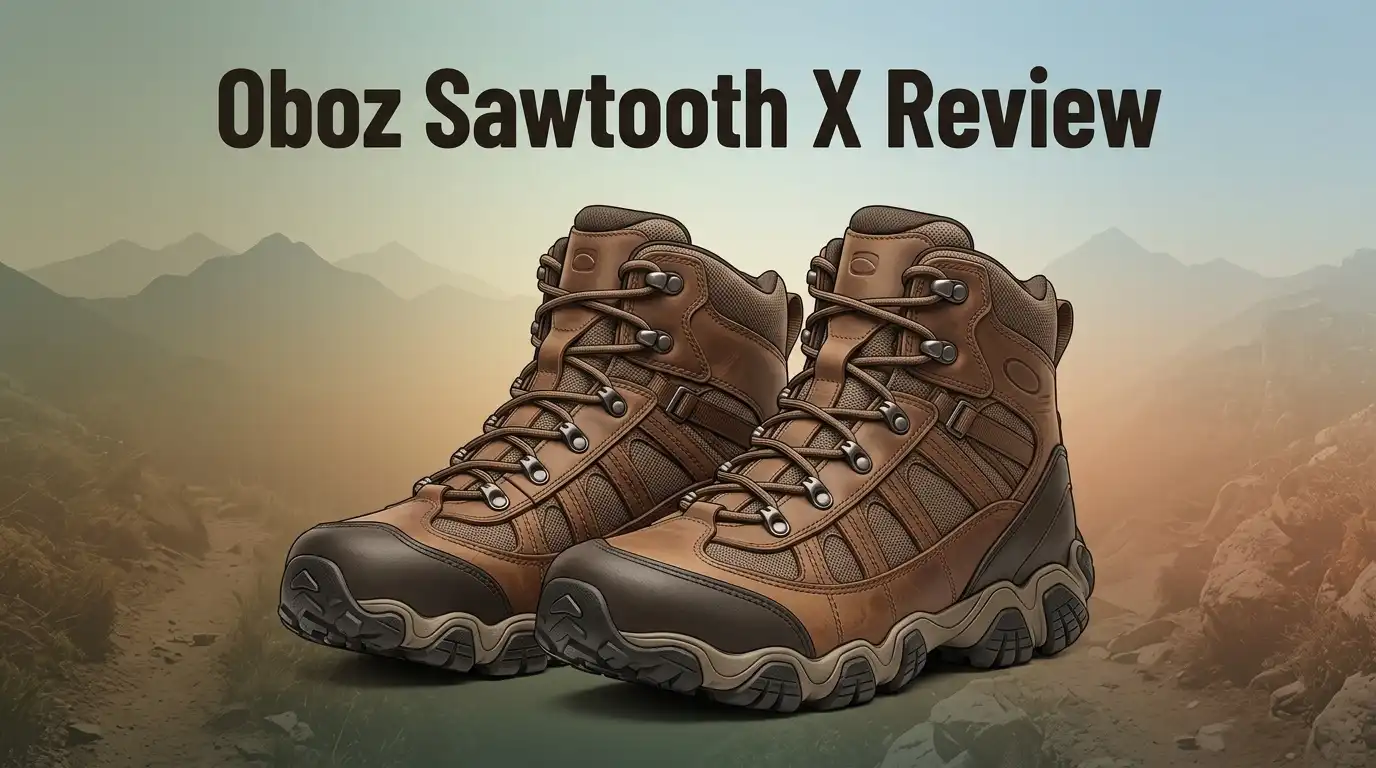
Oboz Sawtooth X Review 2026: Worth Buying?
Hiking boots make or break a trail day. A bad pair leaves you with blisters at mile four. A good pair disappears on your feet and lets you enjoy the view.
The Oboz Sawtooth X sits in the second group for most hikers, and it has quietly become one of the most recommended boots in outdoor shops across the United States.
Oboz built the Sawtooth line in Bozeman, Montana, and the “X” version marks the tenth anniversary of the original. The brand kept the formula that worked and changed small details.
In a Nutshell:
- Comfort out of the box is excellent. The O FIT insole retails for around $30 on its own, and Oboz includes it. That single part explains why the Sawtooth X feels better underfoot than most boots at this price. Almost no break in period is needed.
- Support hits the sweet spot for day hiking. A nylon shank stiffens the midfoot while the forefoot still flexes naturally. The boot handles loads up to roughly 30 pounds, though serious backpackers need something stiffer.
- Traction is good, not great. Deep lugs bite well into dirt, mud, gravel, and light snow. On smooth wet rock and talus, the Trail Tread rubber slips more than premium compounds like Vibram Megagrip.
- Durability is the headline strength. Oiled nubuck leather, double stitched seams, and a thick outsole regularly deliver 800 to 1,000 miles. That is roughly double the average boot lifespan.
- Weight is the main trade off. The Mid weighs 19.4 ounces per shoe and the Low waterproof weighs 16.9 ounces. Ounce counters will look elsewhere.
- Value is hard to beat in 2026. At $175 to $185 list, with frequent sales, the Sawtooth X undercuts the Merrell Moab 3 and KEEN Targhee 4 while outlasting both.
Oboz Sawtooth X Mid Waterproof Overview

- Our proprietary insole is what we’re known for. Molded to match the specific shape and...
- A proprietary rubberized EVA that adapts to varying terrain.
- 100% recycled polyester laces and webbing, and quick drying 100% recycling polyester lining and...
Last update on 2026-09-08 / Affiliate links / Images from Amazon Product Advertising API Some of the links on this website are affiliate links, which means that at no additional cost to you, I earn a commission if you click through and make a purchase. I only recommend products and services that I believe will add value to my readers. Thank you for your support!
The Sawtooth X Mid Waterproof is the flagship of the line. It stands 6 inches tall at the collar and wraps your ankle in padded leather and mesh. Oboz uses oiled nubuck leather across most of the upper and adds Cordura mesh panels for airflow.
The waterproof barrier is Oboz BDRY, an in house membrane. It seals out rain, slush, and shallow puddles. It breathes slightly less than Gore Tex, but it also keeps the price down by about $30 compared to Gore Tex models.
Underfoot you get a three layer setup. The O FIT insole sits on top. Below that is ACT+ rubberized EVA foam, a dual density blend that softens impact without feeling mushy. A nylon shank runs through the midfoot for torsional control.
Specifications at a glance: heel to toe drop of 8mm, stack height around 30mm at the heel, weight of 19.4 ounces per shoe in a men’s size 9, and a TPU heel counter for lockdown. Sizes run from men’s 7 to 15 and women’s 5 to 12, with half sizes and both regular and wide widths.
The lacing system deserves a mention. Oboz switched to flat laces on the X version. They hold knots better than the old round laces and resist loosening on descents. Metal eyelets at the ankle speed up lacing and reduce fraying over time.
Unboxing Experience and First Impressions
The box arrives plain and brown with the Oboz mountain logo stamped on the lid. No plastic clamshell. No excess packaging. Oboz plants a tree for every pair sold, and a small card inside mentions that program.
Lifting the lid, the first thing you notice is smell. Real oiled leather has a rich, slightly waxy scent that synthetic boots never match. The uppers arrive stuffed with paper, holding their shape rather than folded flat.
Pick one up and the weight registers immediately. These feel substantial in your hand. Not heavy like a mountaineering boot, but clearly more solid than a trail runner. Squeeze the heel counter and it barely moves. That stiffness signals the support you get later on rocky ground.
Pull out the insole and compare it to whatever came in your last pair of shoes. The difference is obvious. The O FIT insole has a molded heel cup, a firm arch, and dual density foam. Most brands ship a flat sheet of cheap foam.


Last update on 2026-04-11 / Affiliate links / Images from Amazon Product Advertising API Some of the links on this website are affiliate links, which means that at no additional cost to you, I earn a commission if you click through and make a purchase. I only recommend products and services that I believe will add value to my readers. Thank you for your support!
The leather feels supple straight away, not stiff like older Sawtooth versions. I laced up and walked around the house for twenty minutes, then took them on a 6 mile hike the next morning. No blisters. No hot spots. The collar rubbed my Achilles slightly for the first two hikes, then softened and stopped.
Oboz Sawtooth X Low Waterproof Overview

- O FIT INSOLE SUPPORT: Triple-density EVA combines cushioned heel and forefoot pods with a molded...
- KINERTIA+ CUSHIONING: Adaptive EVA cushioning and an 8 mm heel drop create a smooth, controlled...
- TRAIL TREAD HD TRACTION: A heavy-duty rubber compound and multidirectional tread provide durable...
Last update on 2026-09-08 / Affiliate links / Images from Amazon Product Advertising API Some of the links on this website are affiliate links, which means that at no additional cost to you, I earn a commission if you click through and make a purchase. I only recommend products and services that I believe will add value to my readers. Thank you for your support!
The Low version shares the same platform with a shorter collar. It weighs 16.9 ounces per shoe in the waterproof build and 15.8 ounces in the non waterproof version. That saves about 2.5 ounces per foot compared to the Mid.
Everything below the ankle stays identical. Same oiled nubuck leather. Same BDRY membrane. Same ACT+ midsole and Trail Tread outsole. Same O FIT insole. You lose ankle coverage and gain freedom of movement.
Who should pick the Low? Hikers on maintained trails, people who carry light day packs, and anyone who dislikes pressure around the ankle bone. The Low also works well as a travel shoe since it looks less bulky with jeans.


Last update on 2026-04-11 / Affiliate links / Images from Amazon Product Advertising API Some of the links on this website are affiliate links, which means that at no additional cost to you, I earn a commission if you click through and make a purchase. I only recommend products and services that I believe will add value to my readers. Thank you for your support!
One real limitation shows up in water. Independent testing measured the flood height at roughly 2.5 to 3 inches. Step into a creek deeper than that and water pours over the collar. The Mid pushes that number closer to 5 inches, which matters more than most buyers expect.
The Low also allows more heel movement than the Mid. Outdoor Gear Lab noted a shallow heel pocket that let their testers’ heels lift on steep climbs. My experience was better, but the heel shape clearly suits some feet more than others.
Both versions come in regular and wide. Oboz redesigned the wide fit for the X generation, and it is now a true wide rather than the slightly roomy regular that older models offered.
Top 3 Alternative for Oboz Sawtooth X

- Waterproof membrane seals out water and lets moisture escape Pigskin leather and mesh upper...
- Merrell is focused on merging performance, styling, and comfort to empower all people to confidently...
- Merrell Air Cushion in the heel absorbs shock and adds stability
Last update on 2026-06-08 / Affiliate links / Images from Amazon Product Advertising API Some of the links on this website are affiliate links, which means that at no additional cost to you, I earn a commission if you click through and make a purchase. I only recommend products and services that I believe will add value to my readers. Thank you for your support!
Merrell Men’s Moab 3 Mid Waterproof Hiking Boot
No products found.
KEEN Men’s Targhee 4 Mid Height Waterproof Hiking Boot

- B-DRY WATERPROOFING: The waterproof and breathable membrane blocks moisture while allowing water...
- O FIT INSOLE COMFORT: Triple-density EVA combines cushioned heel and forefoot pods, a firm molded...
- TRAIL TREAD HD TRACTION: A heavy-duty rubber compound and multidirectional tread deliver grip across...
Last update on 2026-09-08 / Affiliate links / Images from Amazon Product Advertising API Some of the links on this website are affiliate links, which means that at no additional cost to you, I earn a commission if you click through and make a purchase. I only recommend products and services that I believe will add value to my readers. Thank you for your support!
Oboz Men’s Bridger Mid BDRY Waterproof Hiking Boot
Fit and Sizing Guide
Oboz uses a standard volume last with a snug heel and a normal width forefoot. Most hikers order their usual shoe size and get a good result. I wear a 10.5 in running shoes and a 10.5 fit correctly here.
The heel is the defining feature. Oboz cinches the rearfoot more than Merrell or KEEN. That locks your foot down on descents and prevents your toes from slamming the front of the boot. Hikers who fight heel slip in other brands usually love this.
The trade off is entry. Getting your foot in takes effort the first few times. Testers have reported the heel lining wearing from repeated pull on and pull off. Use the heel pull loop and loosen the laces fully to reduce that friction.
Toe box volume is moderate. There is room for toes to spread, but this is not a foot shaped boot like Altra or Topo. If you have bunions or very wide forefeet, order the wide version rather than sizing up.
Two sizing notes worth remembering. First, the boot fits slightly short in the toe compared to Merrell, so hikers who go half a size up in Moabs may want their true size here. Second, hiking socks change everything. Try the boots with the exact socks you plan to hike in, since a thick merino sock can eat half a size of volume.
Comfort and the O FIT Insole
Comfort is where Oboz earns loyal customers. The O FIT insole delivers arch support that most stock insoles ignore. It has a deep heel cup, a firm midfoot bridge, and a softer forefoot pad.
That insole sits on ACT+ foam, which Oboz describes as rubberized EVA. In practice it feels firm at first step and softer after a mile of walking. It absorbs sharp rock strikes better than plain EVA.
I finished a 14 mile day on rocky Appalachian trail with feet that still felt usable. In lighter boots with thin midsoles, that same route usually leaves my arches aching. The cushioning is not plush like a Hoka Anacapa, but it is protective in a way plush foam is not.
The collar and tongue padding are generous. Soft leather wraps the ankle and the padding compresses to your shape within a few hikes. Owners of older Sawtooth versions consistently report that the X model feels softer around the ankle.
Two comfort complaints appear often enough to mention. Some hikers find the heel counter sits low and rubs the Achilles during the first week. Others with high arches find the insole arch too aggressive and swap in their own footbed.
Warm weather is the other limit. With so much leather in the upper and a waterproof membrane inside, these boots run hot above 80 degrees Fahrenheit. Desert hikers should consider the ventilated non waterproof version.
Support and Stability on Rough Trails
Support separates hiking boots from sneakers, and the Sawtooth X delivers a well judged amount. The nylon shank stiffens the midfoot so the boot does not twist when you step on a root or an angled rock.
Bend the boot in your hands and it flexes at the forefoot, right where your foot naturally hinges. That combination feels stable without feeling like a plank. Long rocky days are where this pays off, since your foot muscles do less work fighting uneven ground.
The TPU heel counter and the leather upper work together to keep your foot centered on the footbed. On side hill traverses, my ankle stayed over the platform instead of rolling toward the downhill edge.
Load capacity is the honest boundary. The Mid handles a day pack or a light overnight kit up to roughly 30 pounds with confidence. Push past that with a full multiday load and you will want a stiffer boot like the Oboz Bridger or a dedicated backpacking model.
Ankle support in the Mid is moderate rather than maximum. The collar rises 6 inches and restricts extreme rolling motion, but it does not immobilize your ankle. Hikers recovering from injury or carrying heavy weight should look at taller options.
The 8mm drop is worth noting for people transitioning from zero drop shoes. It feels traditional and encourages a heel first stride. Most hikers will not notice it at all.
Traction: How the Trail Tread Outsole Performs
Oboz uses its own Trail Tread rubber compound. The X generation gets deeper lugs with wider spacing than the Sawtooth II, plus a slightly softer rubber formula.
On dirt, packed soil, loose gravel, mud, and leaf litter, the grip is confident. Wide lug spacing sheds mud instead of packing it in. The lugs extend around the outsole edge, which helps when you kick steps into soft snow or scree.
The heel brake works well on descents. I dropped 1,800 feet on a wet gravel trail without a single slide. Several hikers on that same trail reported falls that week, so the tread earned its keep.
Smooth wet rock is the weak spot. Formal slide testing confirmed reduced grip on polished boulders, and one tester had a near miss on talus. Trail Tread rubber is average density, so it cannot match Vibram Megagrip on slick slabs.
Wet roots and bare granite deserve caution too. A handful of owner reports describe unexpected slipping on those surfaces, especially once the lugs wear down past halfway.
The outsole also loses aggression compared to the Oboz Bridger. If your hiking involves steep off trail scrambling or frequent stream rock hopping, the Bridger tread bites harder. For maintained trails and forest paths, Trail Tread is more than adequate.
Lug depth measures around 4mm to 5mm. Expect useful traction through roughly 400 to 500 miles before the tread noticeably rounds off.
Waterproofing and Breathability
BDRY is Oboz’s proprietary waterproof and breathable membrane. It is bonded inside the upper and pairs with the naturally water resistant oiled nubuck leather.
The waterproofing works. My pair survived a series of 12 to 15 mile hikes through slush, mud, and spring snowmelt with dry socks every time. Lab style bath testing showed no leaks after five minutes of submersion.
The limit is height, not the membrane. Water enters over the collar long before it seeps through the fabric. The Low tops out around 3 inches of standing water. The Mid gives you roughly 5 inches. Deep creek crossings still soak you.
Breathability is the honest trade off. BDRY moves less vapor than Gore Tex, and the heavy leather upper compounds the issue. My feet ran warm on 75 degree afternoons and genuinely sweaty above 85 degrees.
Cordura mesh panels help a little. So does removing the insole to dry the boots overnight. Neither fixes the underlying physics of a membrane lined leather boot.
Drying time is another consideration. Once these boots get soaked inside from sweat or a deep crossing, they take a full day or more to dry. Pack extra socks on multiday trips.
Long term, the membrane holds up well. Owners report waterproofing lasting 500 miles and beyond, especially with regular leather conditioning. Apply a nubuck safe wax two or three times a season to keep the leather from absorbing water and adding weight.
Weight and Trail Speed
Weight is the clearest weakness. The Mid Waterproof weighs 19.4 ounces per shoe, or roughly 2 pounds 7 ounces per pair in a men’s size 9. In larger sizes that climbs past 2 pounds 13 ounces.
The Low Waterproof comes in at 16.9 ounces per shoe. The non waterproof Low drops to 15.8 ounces. All three sit above the category average for their type.
Where does the weight come from? Leather, a thick outsole, a nylon shank, and a substantial insole. Every gram serves a purpose, which is why the boot lasts so long.
Old hiking wisdom says a pound on your feet equals five pounds on your back. That rule exaggerates, but the principle holds. On a 20 mile day, heavier boots cost you energy.
In practice I noticed the weight during the first mile and forgot about it afterward. On days above 15 miles, my legs felt more fatigued than in lighter trail shoes. On rocky terrain, the extra protection more than paid for the extra ounces.
Compare the numbers. The Salomon X Ultra 5 Mid weighs about 15 ounces per shoe. The Hoka Anacapa 2 Mid runs similar to the Sawtooth but with softer cushioning. The Merrell Moab 3 Mid sits close to the Sawtooth at around 18 ounces.
If you count grams and hike fast on smooth trails, look elsewhere. If you value protection and lifespan, the weight is a fair price.
Durability After Months of Miles
Durability is the strongest argument for buying Oboz. Reviewers with 10,000 plus lifetime miles consistently rank Oboz as the longest lasting brand they own.
My test pairs showed almost no wear after 200 miles. The leather scuffed but did not crack. The outsole lugs kept their edges. The insoles held their shape rather than flattening.
Owner reports back this up. Many hikers get 800 to 1,000 miles from a single pair. The average hiking boot lasts 400 to 500 miles, so the Sawtooth X roughly doubles that.
Construction details explain why. Oiled nubuck leather resists abrasion far better than mesh. The seams where the toe bumper and heel cup meet the upper are double stitched. A rubber toe cap protects the most vulnerable spot.
Two wear points deserve watching. The heel lining can abrade from pulling the boot on and off repeatedly, since the snug fit makes entry tight. The midsole foam also compresses gradually, which means the ride firms up over time even while the outsole looks fine.
Oboz backs the boot with a one year warranty against manufacturing defects. The company also runs a repair friendly attitude, though these are cemented boots rather than resoleable ones.
Basic care extends the life further. Brush off mud after each hike, condition the leather two or three times a season, and never dry them next to a heater. Direct heat cracks leather and unglues midsoles.
What the Sawtooth X Does Not Do Well
Every review should name the failures plainly. Here is where the Sawtooth X falls short.
It is not a fast and light boot. The weight is above average and always will be. Thru hikers and speed hikers should skip it entirely.
Smooth wet rock reduces confidence. Trail Tread rubber slides on polished granite and wet slabs. If your local trails involve rock slabs or stream crossings on boulders, this is a real safety consideration.
It runs hot. Leather plus a waterproof membrane traps heat. Summer desert hiking or humid southern trails will leave your socks wet from the inside.
The heel fit is polarizing. The snug heel pocket locks some feet down beautifully and irritates others. Several testers reported Achilles rub and heel movement caused by a shallow heel cup. You cannot know which camp you fall into without trying them.
Entry and exit are tight. Getting into the boot takes effort, and that friction slowly wears the heel lining.
Load capacity tops out early. Around 30 pounds, the midfoot flex starts to feel like too much. This is a day hiking and light overnight boot, not a heavy expedition boot.
Two smaller gripes. The Low version has a low flood height that surprises buyers who expect waterproof to mean fully waterproof. And BDRY breathes less than Gore Tex, which some hikers consider a downgrade even at the lower price.
Pros and Cons
Pros:
- Outstanding out of the box comfort thanks to the included O FIT insole, which alone would cost $30 separately
- Exceptional durability with many owners reaching 800 to 1,000 miles per pair
- Well balanced support from the nylon shank and TPU heel counter without feeling stiff
- Reliable BDRY waterproofing that keeps feet dry through rain, mud, and slush
- True wide sizing available in both Low and Mid, plus half sizes across the range
- Secure heel lockdown that reduces toe bang on steep descents
- Strong value at $175 to $185 with frequent seasonal discounts
- Oboz plants a tree for every pair sold
Cons:
- Heavier than most competitors, at 19.4 ounces per shoe for the Mid
- Traction slips on smooth wet rock and talus compared to Vibram Megagrip soles
- Runs warm in hot weather because of the leather upper and membrane lining
- Low version has a shallow flood height of roughly 3 inches
- Snug heel causes Achilles rub for some hikers during break in
- Tight entry can wear the heel lining over time
- Not suitable for heavy backpacking loads above 30 pounds
- BDRY breathes less than Gore Tex
Sawtooth X vs Sawtooth II: What Changed
Oboz released the X version as the tenth anniversary update. Long time owners want to know if the changes helped or hurt.
The upper uses more leather and less mesh. That boosts durability and weather resistance while reducing airflow. Hot weather hikers lost a little; wet weather hikers gained a little.
The look softened. Oboz shrank the TPU heel cup and toned down the aggressive styling. Function stayed the same and the boot simply looks cleaner.
The midsole moved to ACT+ foam with a slightly softer feel. Combined with the new outsole, the ride is more forgiving than the Sawtooth II.
The outsole is the biggest functional change. Lugs got deeper with wider spacing and softer rubber. Mud sheds better and grip on loose surfaces improved. Grip on smooth rock did not improve much.
Laces switched from round to flat. Small change, real benefit, since flat laces hold knots and stay tight through a full day.
Sizing changed in one important way. The wide fit is now a genuine wide, roomier than the old Oboz wides. Hikers who found the previous wide too narrow should retry.
The ankle padding feels softer. Multiple reviewers describe the X collar as gentler than the II.
Overall the update is a refinement, not a redesign. If you loved the Sawtooth II, you will likely be happy. If the II never fit your foot, the X probably will not either.
Price and Value in 2026
The Sawtooth X Mid Waterproof lists at $175 to $185. The Low Waterproof sits around $170 to $185. The non waterproof Low comes in lower, near $150.
Compare that to the competition. The Merrell Moab 3 Mid Waterproof lists at $175. The KEEN Targhee 4 Mid runs $180. Gore Tex boots from Salomon and La Sportiva push past $200.
The Sawtooth X matches or undercuts them all while lasting longer. That is the value argument in one sentence.
Factor in the insole. If you normally buy Superfeet or a similar aftermarket footbed for $50, the included O FIT insole saves you that expense.
Cost per mile is the number that matters. At $180 for 900 miles, you pay about 20 cents per mile. A $175 boot that dies at 450 miles costs 39 cents per mile. The Sawtooth X wins clearly.
Sales are common. Retailers regularly discount the Sawtooth X by 20 to 30 percent, especially in late summer and around holiday sales. Patient shoppers can find pairs near $130.
One caution on buying online. Fit is personal with this boot because of the snug heel. Order from a retailer with free returns, or try a pair in a shop first, then buy whichever version suits your foot.
Who Should Buy the Oboz Sawtooth X
The Sawtooth X fits a clear type of hiker. Understanding that saves you a return shipment.
Buy it if you day hike regularly on rough trails. Rocky, rooty, muddy paths are exactly what this boot handles best. The support and protection show their worth on ground that punishes lighter shoes.
Buy it if you hate replacing boots. The durability is the standout feature. One pair can cover two or three seasons of steady hiking.
Buy it if you have had heel slip problems elsewhere. The snug rearfoot and O FIT insole lock your foot down better than most brands.
Buy it if you have wide feet. The true wide sizing across the range is genuinely useful, and few competitors match it.
Buy it if you carry a day pack or a light overnight kit. Loads up to 30 pounds feel stable and controlled.
Skip it if you count ounces. Fast hikers and thru hikers will find the weight frustrating over big mileage days.
Skip it if you hike in heat. Leather and a membrane trap warmth, and your feet will notice.
Skip it if your trails involve wet rock slabs. Trail Tread rubber is the wrong tool for that surface.
Skip it if you carry heavy backpacking loads. Look at the Oboz Bridger instead for a stiffer platform.
Frequently Asked Questions
Is the Oboz Sawtooth X waterproof?
Yes, the BDRY versions use a waterproof and breathable membrane that blocks rain, mud, and slush. Testing showed no leaks after several minutes of submersion. The limit is collar height rather than the membrane, so the Low lets water in above roughly 3 inches and the Mid above roughly 5 inches. A non waterproof ventilated version also exists for hot and dry conditions.
Do Oboz Sawtooth X boots run true to size?
Most hikers order their normal shoe size and get a good fit. The boot fits slightly short in the toe compared to Merrell, so people who size up in Moabs may want their true size here. The heel runs snug and the forefoot runs standard. Wide sizes are available and now fit as a genuine wide. Always try them with your hiking socks.
How long do Oboz Sawtooth X boots last?
Expect 800 to 1,000 miles with regular care, which is roughly double the average hiking boot. The oiled nubuck leather, double stitched seams, and thick outsole all contribute. Lug depth stays useful through about 400 to 500 miles before traction noticeably drops. Conditioning the leather two or three times per season extends the lifespan further.
Is the Sawtooth X good for backpacking?
It works for light backpacking with loads up to about 30 pounds. The nylon shank and mid collar give enough support for overnight and weekend trips. Heavier multiday loads exceed what this boot handles well. For 40 pound packs, the Oboz Bridger Mid or a dedicated backpacking boot is the better choice.
Sawtooth X Low or Mid: which should I choose?
Pick the Mid if you hike rocky or off trail terrain, carry a pack, cross shallow water, or want more ankle coverage. Pick the Low if you hike maintained trails, prefer freedom of movement, or dislike ankle pressure. The Low saves about 2.5 ounces per foot. Everything below the ankle is identical between the two.
Do I need to break in the Sawtooth X?
Break in is minimal. Most hikers wear them straight onto the trail without blisters. Some report the heel collar rubbing the Achilles for the first two or three hikes before the padding softens. Wear them around the house for a few hours and take one shorter hike before committing to a long day.
How does the Sawtooth X compare to the Merrell Moab 3?
Both cost about the same and weigh about the same. The Sawtooth X offers better durability, a far better stock insole, and a more secure heel. The Moab 3 offers a roomier toe box and slightly better breathability. Oboz wins on lifespan; Merrell wins on immediate softness and forefoot room.
Are Oboz boots made in the USA?
Oboz is headquartered in Bozeman, Montana, where design and testing happen. Manufacturing takes place overseas, which is standard across the footwear industry. The company plants a tree for every pair sold through its partnership with Trees for the Future, a program that has funded millions of trees.
Final Verdict
The Oboz Sawtooth X is one of the best value hiking boots available in 2026. It delivers comfort, support, and durability that beat its price, and it does so without demanding a break in period.
It is not the lightest boot, the grippiest boot, or the most breathable boot. Those are real limitations, and hikers who prioritize any of them should shop elsewhere.
For everyone else, this is a straightforward recommendation. Buy the Mid for rough terrain and light packs. Buy the Low for maintained trails and warmer days. Try both widths, then put in the miles.
Happy hiking.

Mia Smith is the founder of Shoe Storyteller, a blog that celebrates the art and stories behind shoes. With a passion for fashion and a flair for storytelling, Mia brings a unique perspective to the world of footwear.