
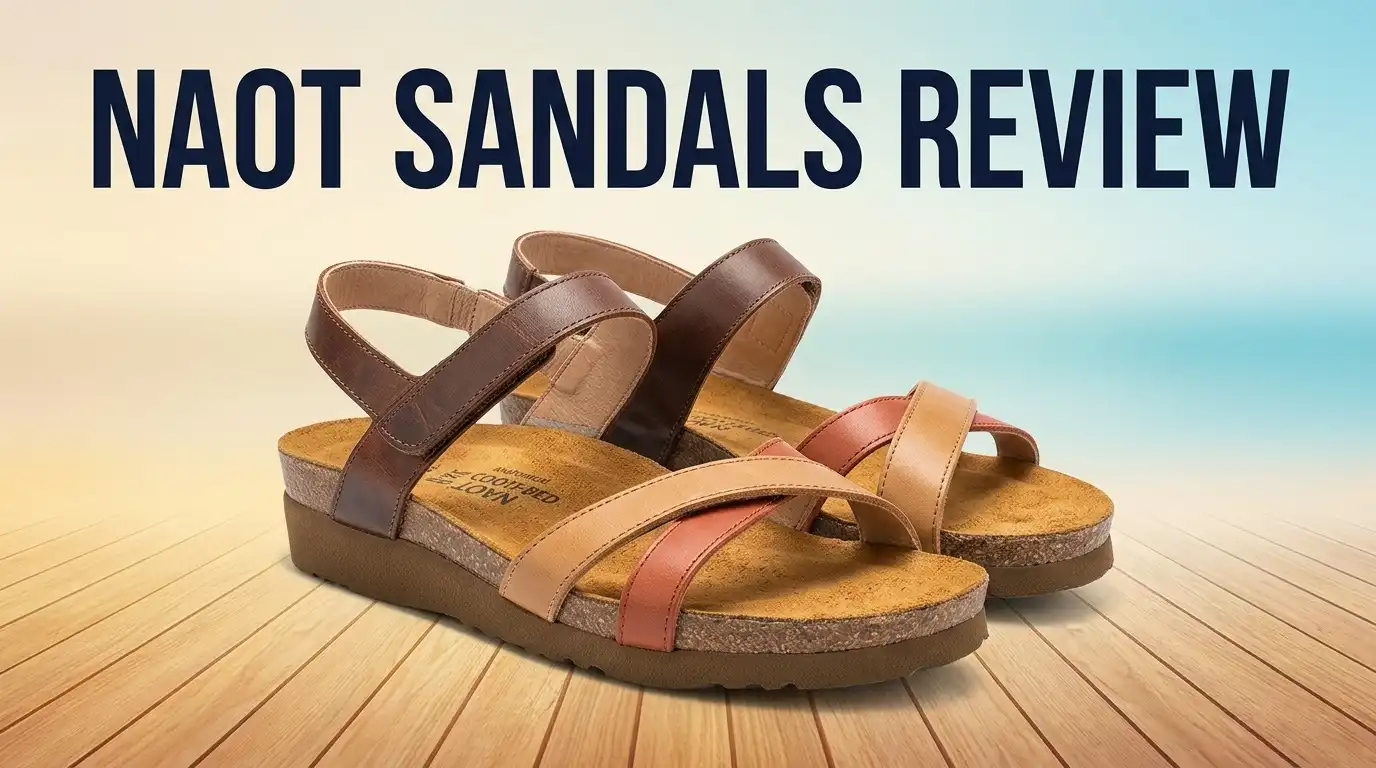
Naot Sandals Review 2026: Worth It?
Your feet carry you everywhere. They deserve better than flat foam sandals that collapse after one summer. That is the promise Naot has been making since 1942, when the brand started in Kibbutz Naot Mordechai in Israel.
But promises are cheap. Sandals that cost $150 to $200 are not.
I spent months wearing Naot sandals through airports, farmers markets, city sidewalks, and long work shifts. I tracked how the footbed changed. I noted every hot spot and every blister. I also listened to what hundreds of other owners say about sizing, smell, and sole wear.
In A Nutshell:
- The cork and latex footbed is the main reason to buy. Naot uses a suede lined footbed made from natural cork and latex. It softens with body heat and molds to your arch over two to four weeks. Most owners say the fit feels personal by week three.
- Arch support is genuinely high. Naot sits closer to a medical grade orthotic than a fashion sandal. People with plantar fasciitis, flat feet, and high arches report real relief. Flat footed wearers often need the longest adjustment window.
- The break in period is real and it is not always fun. Expect two to three weeks of short wears. Some people feel pressure under the arch on day one. This is normal, but it surprises buyers who expect instant comfort.
- Footbeds are removable and replaceable on most styles. You can buy fresh replacement footbeds for around $25 to $35. This extends sandal life by years and makes the high price easier to accept.
- Sizing runs in European numbers and trips people up. Naot uses sizes 35 through 42. Half sizes do not exist. Wide feet often need to size up one full number.
- The price is the biggest drawback. Most sandals land between $140 and $210. Sales bring them down, but full price stings.
What Makes Naot Sandals Different

- THE NAOT FOOTPRINT: Experience next-level comfort and lasting support with Naot’s signature...
- EXPERIENCE ALL-DAY COMFORT: Step into comfort with these Naot Kayla women's sandals, expertly...
- ELEVATED STYLE FOR EVERY OCCASION: Enhance your wardrobe with these versatile Naot Kayla wedge...
Last update on 2026-09-08 / Affiliate links / Images from Amazon Product Advertising API Some of the links on this website are affiliate links, which means that at no additional cost to you, I earn a commission if you click through and make a purchase. I only recommend products and services that I believe will add value to my readers. Thank you for your support!
Naot builds sandals around one idea. The footbed should copy the shape of your foot, like a footprint pressed into wet sand.
The construction backs that up. A layer of natural cork mixes with latex to form the base. Cork holds shape. Latex adds bounce. Together they create a surface that stays firm but never feels like concrete.
On top sits a suede leather cover. This layer breathes and wicks moisture. It also feels soft against bare skin, which matters in sandals.
Underneath the cork sits the detail most brands skip. Naot carves a hollow under the metatarsal bone and fills it with cork granules. This section compresses first and cushions the ball of your foot with every step.
The heel cup is deep. Your heel drops into a pocket rather than sliding across a flat pad. This stabilizes your gait and reduces side to side wobble on uneven ground.
Arch support runs high and long. It contacts the full length of your medial arch, not just a small bump.
Compare this to a typical strappy sandal and the difference is obvious within a block of walking. One supports your skeleton. The other just keeps your foot off the pavement.
Uppers use full grain or nubuck leather on nearly every style. Cheap synthetics are rare in this catalog.
Naot Kayla Review
The Kayla is the style most people recommend first, and the reason is balance.


Last update on 2026-04-11 / Affiliate links / Images from Amazon Product Advertising API Some of the links on this website are affiliate links, which means that at no additional cost to you, I earn a commission if you click through and make a purchase. I only recommend products and services that I believe will add value to my readers. Thank you for your support!
It uses three adjustable straps plus a backstrap. Two straps cross the forefoot. One wraps the ankle. This gives you four separate adjustment points, which is unusually generous for a sandal.
That adjustability solves problems other brands ignore. Narrow heels, wide forefeet, high insteps, and swollen afternoon feet all get accommodated.
The footbed is the classic Naot cork and latex build with the full anatomic contour. A polyurethane sole sits underneath. It grips well on dry pavement and stays acceptable on damp tile.
I wore the Kayla through a seven hour travel day and my arches felt fine at the end. That is not something I say about many sandals.
Weight is moderate. Each sandal feels substantial in hand but disappears underfoot after a few minutes.


Last update on 2026-04-11 / Affiliate links / Images from Amazon Product Advertising API Some of the links on this website are affiliate links, which means that at no additional cost to you, I earn a commission if you click through and make a purchase. I only recommend products and services that I believe will add value to my readers. Thank you for your support!
Style wise, the Kayla reads casual but clean. It works with jeans, linen pants, and midi dresses. It looks slightly clunky with tailored shorts.
Where it disappoints: the backstrap can rub the Achilles area during the first week. The leather softens, but a few owners never fully lose the irritation. Break the Kayla in with socks around the house if your heels are sensitive.
Color selection is strong, with metallics, neutrals, and bright seasonal shades.
Naot Dorith Review

- THE NAOT FOOTPRINT: Experience unbeatable comfort and support with Naot’s unique footbed in the...
- WHEN STYLE MET COMFORT: Looking for a sandal that’s as stylish as it is comfortable? Look no...
- THE PERFECT FIT: The ideal fit with this versatile sandal that offers adjustable comfort. Hook and...
Last update on 2026-09-12 / Affiliate links / Images from Amazon Product Advertising API Some of the links on this website are affiliate links, which means that at no additional cost to you, I earn a commission if you click through and make a purchase. I only recommend products and services that I believe will add value to my readers. Thank you for your support!
The Dorith is the flexible one in the lineup, and that changes who it suits.
It uses a gladiator inspired strap layout with multiple thin bands across the foot and a backstrap at the heel. The straps adjust with hook and loop closures hidden under the leather.
Flexibility is the headline feature. The Dorith bends more readily through the forefoot than the Kayla or the Santa Barbara. Your foot flexes naturally instead of fighting a rigid platform.
The shock absorbing sole handles hard city surfaces well. Concrete sidewalks feel noticeably less punishing.
The footbed is removable. Slide it out, air it, or swap it for a fresh one after a couple of seasons. Orthotic users can also drop in their own device on this style.
Sizing runs narrow to medium. Wide feet struggle here more than with other Naot models.
The Dorith comes in Euro sizes 35 to 42 and lands near $165 at full price, though sales appear often.
Where it disappoints: the thin straps can crease and mark over time, especially in lighter leathers. The many small straps also mean more places for sweat and dirt to collect. Cleaning takes patience.
It is also a lot of strap visually. Some people love the look. Others find it busy.
Top 3 Alternative for Naot Sandals
Not everyone clicks with Naot. These three deliver similar support with a different feel.

- Punched EVA sole
- Two adjustable straps with metal logo buckle closures
- Fit Tip: Regular widths fit best for Men; Narrow widths fit best for Women
Last update on 2026-09-12 / Affiliate links / Images from Amazon Product Advertising API Some of the links on this website are affiliate links, which means that at no additional cost to you, I earn a commission if you click through and make a purchase. I only recommend products and services that I believe will add value to my readers. Thank you for your support!
Birkenstock Arizona Soft Footbed

- Round open toe
- Contoured footbed
- Podiatrist-designed synthetic sole
Last update on 2026-06-08 / Affiliate links / Images from Amazon Product Advertising API Some of the links on this website are affiliate links, which means that at no additional cost to you, I earn a commission if you click through and make a purchase. I only recommend products and services that I believe will add value to my readers. Thank you for your support!
Vionic Women’s Tide II Toe Post Sandal

- Soft nubuck leather upper with one side bar, 3 point adjustability and neoprene lining for a soft...
- Lightweight moulded EVA footbed with soft microfibre cover for supreme cushioning and superior...
- FLUIDFORM DIP P.U midsole foam provides long lasting cushioning and outstanding everyday walking...
Last update on 2026-09-12 / Affiliate links / Images from Amazon Product Advertising API Some of the links on this website are affiliate links, which means that at no additional cost to you, I earn a commission if you click through and make a purchase. I only recommend products and services that I believe will add value to my readers. Thank you for your support!
ECCO Women’s Yucatan Sport Sandal
The Unboxing Experience
Naot keeps packaging simple, and honestly that is refreshing.
The box is sturdy brown cardboard with the logo printed on the lid. No plastic window. No glossy coating. It feels recyclable because it is.
Inside, the sandals sit sole to sole wrapped in thin tissue paper. Each one has a small paper stuffer in the toe area to hold shape during shipping.
The smell hits you first. Real leather and natural cork produce a rich, slightly earthy scent. It is pleasant. It also fades within a week of wear.
A small care card sits under the tissue. It explains footbed break in and recommends leather conditioner. The card is genuinely useful, which is rare.
Some boxes include a small dust bag on higher end styles. Most do not.
Lifting the sandal out, the weight surprises you. These feel dense compared to foam sandals. The cork base has real mass.
Run your thumb across the footbed and you feel the contours immediately. The arch ridge is pronounced. The toe bar is visible. The heel cup is deep enough to cup your palm.
Straps arrive stiff. Buckles are metal, not plastic, on most models.
One small annoyance: the price sticker sits directly on the box and peels messily. A tiny thing, but it comes up in reviews often enough to mention.
Comfort And The Break In Period
Let us be direct. Naot sandals are not comfortable on day one for most people.
The cork footbed starts firm. Your foot has not warmed it yet. Your arch has not pressed its own shape into it. Walking in brand new Naots feels like standing on a well shaped rock.
This is by design, and it is also the most common source of one star reviews.
Here is the timeline most wearers report. Days one through three feel firm with noticeable arch pressure. Days four through ten bring softening as body heat works the latex. Weeks two and three deliver the molded fit the brand advertises.
Wear them one to two hours per day at first. Increase gradually. Do not wear new Naots on a travel day.
People with flat feet feel the arch most sharply. Your arch is not used to contact. That sensation is pressure, not damage, but it takes longer to settle.
People with high arches often feel comfort almost immediately. The support meets a gap that already existed.
After break in, the comfort is excellent. The footbed holds your foot in position, spreads pressure evenly, and reduces fatigue during long standing days.
Nurses, teachers, retail workers, and travelers make up a large share of repeat customers for exactly this reason.
Cork does compress permanently over time. Expect the deep molded feel to plateau around month three.
Sizing And Fit Guide
Sizing causes more returns than any other Naot issue. Here is how to get it right.
Naot uses European sizing from 35 to 42, and sometimes 43 in select styles. There are no half sizes.
A rough conversion looks like this. Size 36 fits US 5 to 5.5. Size 37 fits US 6 to 6.5. Size 38 fits US 7 to 7.5. Size 39 fits US 8 to 8.5. Size 40 fits US 9 to 9.5. Size 41 fits US 10 to 10.5. Size 42 fits US 11 to 11.5.
When you fall between sizes, go up. A slightly roomy Naot works. A tight one does not, because the footbed contours must align with your actual arch position.
Width matters more than length here. Most Naot sandals fit narrow to medium. Wide feet should choose styles with more strap adjustment, like the Kayla or the Enid.
Check where the arch ridge sits. Stand in the sandal and feel whether the highest point of the footbed lines up with the highest point of your arch. If it sits too far forward, the size is too small.
Your heel should rest fully inside the heel cup. Your toes should stop about a quarter inch before the front edge.
Measure your foot in the afternoon. Feet swell during the day.
Durability And Long Term Wear
This is where Naot earns back some of its price.
The uppers hold up well. Full grain leather creases but rarely cracks when conditioned. Nubuck scuffs more easily and shows water spots.
Stitching quality is consistently good. Blown seams are uncommon in owner reports.
The sole is the weak link. Naot uses polyurethane on most sandals. Polyurethane grips well and cushions well, but it wears down faster than rubber on abrasive pavement.
Heavy walkers report visible heel wear within one to two seasons. Light wearers get three to five years easily.
The good news is that cobblers can resole many Naot styles. A resole runs roughly $40 to $70 and buys you several more years.
Cork footbeds compress permanently. After two heavy seasons, the arch support flattens noticeably.
Replacement footbeds solve this. Naot sells them for most styles at around $25 to $35. Swapping them takes thirty seconds and restores nearly new support. This single feature is the strongest value argument for the brand.
Buckles occasionally loosen but rarely break. Hook and loop straps lose grip after heavy dirt exposure. Brushing the loop side restores most of it.
Bottom line: with conditioning, occasional resoling, and one footbed swap, a $170 pair of Naots can realistically last five to seven years.
What Naot Sandals Do Not Do Well
Honest reviews name the failures. Here are Naot’s.
They are not instantly comfortable. If you want to buy sandals on Friday and wear them all weekend, look elsewhere. The break in requirement is real and poorly communicated at the point of sale.
They are not great for wide feet in most styles. The narrow to medium last excludes a lot of people. Only a handful of models offer enough adjustment to compensate.
The suede footbed absorbs sweat and darkens. Within one season the footbed develops a dark foot shaped stain. It is cosmetic, but it looks worn. Barefoot wear accelerates this significantly.
Odor develops on some pairs. Cork and suede absorb moisture. If you sweat heavily and wear them daily without rotation, smell becomes an issue by midsummer.
The soles are slippery on wet smooth surfaces. Polyurethane on wet tile is a genuine hazard. Do not trust these on a pool deck.
They are heavy for a sandal. Packing several pairs for travel eats luggage weight fast.
The price is high and inconsistent. The same style can sit at $185 on one site and $118 on another during a sale. Paying full price feels bad when you spot the discount a week later.
Style range is conservative. Naot leans practical. Dressy occasion sandals exist but look orthopedic next to fashion brands.
Pros And Cons
Here is the balance sheet.
Pros
- Outstanding arch support that rivals custom orthotics and helps with plantar fasciitis, flat feet, and heel pain
- Cork and latex footbed molds to your foot and creates a personalized fit within two to three weeks
- Removable and replaceable footbeds extend sandal life dramatically for a small cost
- Real leather uppers on nearly every style, with quality stitching and metal hardware
- Multiple adjustment points on many models accommodate swelling, high insteps, and narrow heels
- Deep heel cup improves stability on uneven ground
- Resoleable construction means a cobbler can refresh them instead of you replacing them
- Excellent for long standing days, which is why healthcare workers buy them repeatedly
Cons
- Firm and uncomfortable during the first one to three weeks of wear
- Narrow to medium fit excludes many wide footed buyers
- Polyurethane soles wear faster than rubber and get slick when wet
- Footbed stains and darkens from perspiration within a single season
- Odor can develop without rotation and airing
- Heavy compared to foam sandals, which matters for travel
- High price at $140 to $210, with frequent sales that punish full price buyers
- No half sizes, which forces compromise for between size feet
- Conservative styling that skews practical over fashionable
Price And Value In 2026
Naot sandals sit in the premium comfort tier. Expect $140 to $210 for most women’s styles in 2026.
Popular models land around these figures. The Dorith sits near $165. The Kayla lands close to $160. Slides like the Santa Barbara run around $150. Wedge and platform styles climb past $180.
Sales are frequent and deep. Naot’s own outlet section regularly cuts 30 to 40 percent. Third party retailers discount discontinued colors even harder. Patient shoppers routinely pay $110 to $130.
Is the price fair? That depends entirely on how you calculate cost.
Divide $170 by five years and you get $34 per year. Add a $30 footbed replacement and a $50 resole and you are still near $50 per year for the full lifespan.
Compare that to $60 foam sandals replaced every single summer. Naot wins on math.
The value collapses in two scenarios. First, if the fit is wrong, you have an expensive pair you never wear. Second, if you only wear sandals ten times per season, the durability advantage never activates.
Buy Naot if you wear sandals often and stand a lot. Skip them if sandals are occasional accessories for you.
Who Should Buy Naot Sandals
Some feet love these. Some do not.
Buy Naot if you have plantar fasciitis. The combination of deep heel cup and continuous arch contact reduces strain on the plantar fascia. Relief reports are consistent and numerous.
Buy Naot if you stand for a living. Nurses, hairstylists, teachers, retail staff, and hospitality workers get the most benefit per dollar.
Buy Naot if you have high arches. The footbed fills the gap that flat sandals leave empty.
Buy Naot if you travel and walk all day. Airport terminals and cobblestone streets punish unsupported feet.
Buy Naot if you have supinated or overpronated gait. The heel cup corrects lateral roll.
Skip Naot if you have very wide feet unless you commit to the most adjustable styles.
Skip Naot if you need immediate comfort with no adjustment window.
Skip Naot if you want lightweight beach sandals. Cork and water do not mix well, and these are not swim friendly.
Skip Naot if you need dressy evening footwear. The aesthetic is comfortable casual, not elegant.
Diabetic wearers should consult a podiatrist first. The firm footbed creates pressure points that reduced sensation cannot detect.
How To Care For Naot Sandals
Good care doubles the lifespan. It takes five minutes a month.
Rotate your pairs. Give each pair a full day to dry between wears. This single habit prevents most odor problems.
Brush the footbed weekly. Use a dry suede brush. Work against the nap to lift dirt and dead skin. This slows the darkening.
Condition the leather every two months. Any quality leather conditioner works. Apply thin, buff off, repeat seasonally.
Treat nubuck with a protector spray before first wear. Nubuck stains permanently otherwise.
Never soak them. Water destroys cork. If they get wet, blot with a towel and air dry away from heat.
Never dry them near a radiator or in direct sun. Heat cracks cork and shrinks leather.
For odor, sprinkle baking soda on the footbed overnight and brush it out in the morning. This works better than most commercial sprays.
Store them flat in a ventilated space. Plastic bins trap moisture and encourage mildew.
Replace the footbed when the arch flattens. Do not wait until support disappears entirely.
Take them to a cobbler at the first sign of sole separation. Early repair costs less and works better.
Final Verdict
Naot sandals deliver exceptional support, honest materials, and a repairable build. They are among the few sandals that genuinely help sore feet rather than just covering them.
The cork and latex footbed is the real deal. Once it molds, the fit feels custom. Long days stop hurting. That is worth a lot.
But the brand asks for patience and money. The break in period frustrates people. The narrow fit excludes people. The polyurethane soles wear faster than they should at this price.
My recommendation is conditional. If you have arch problems, stand for hours, or walk daily, buy them and push through the first three weeks. You will likely become a repeat customer.
If you want easy, light, cheap summer sandals, buy something else and save your money.
Score: 4.2 out of 5.
Frequently Asked Questions
Are Naot sandals good for plantar fasciitis?
Yes, and this is their strongest use case. The deep heel cup and full length arch contact reduce tension on the plantar fascia during each step. Many owners report noticeable relief within two to four weeks. Give the break in period time before judging results. Consult a podiatrist if pain is severe or worsening.
How long do Naot sandals take to break in?
Most wearers need two to three weeks. Wear them one to two hours daily at first, then increase slowly. The cork softens with body heat and molds to your arch shape. Flat footed wearers usually need the longest adjustment.
Do Naot sandals run true to size?
They run true to length in European sizing but narrow in width. Naot offers no half sizes, so size up when you fall between numbers. Sizes run 35 to 42, where 38 equals roughly US 7 to 7.5.
Can you replace Naot footbeds?
Yes, on most styles. Replacement footbeds cost roughly $25 to $35 and install in seconds. This restores the original arch support and is the main reason Naot sandals last five years or more.
Are Naot sandals waterproof?
No. The cork and latex footbed absorbs water and degrades when soaked. Light rain is survivable if you dry them properly. Never wear them swimming or in the shower.
Where are Naot sandals made?
Naot manufactures in Israel, at the original Kibbutz Naot Mordechai facility, and in additional overseas facilities depending on the style and season. Check individual product listings for country of origin details.
Are Naot sandals worth the price?
For frequent wearers with foot pain, yes. The cost per year drops below $50 once you account for replaceable footbeds and resoling. For occasional summer wear, the value argument weakens considerably.

Mia Smith is the founder of Shoe Storyteller, a blog that celebrates the art and stories behind shoes. With a passion for fashion and a flair for storytelling, Mia brings a unique perspective to the world of footwear.