Nike Revolution 8 Review 2026: Still Worth It?
Budget running shoes usually force a trade. You save money, and you give up comfort, grip, or durability. The Nike Revolution 8 tries to break that pattern. It sits at the bottom of Nike’s running price ladder, yet it borrows the look of shoes that cost twice as much.
I bought a pair, ran in them, walked in them, and wore them on long days when my feet were already tired. This review covers what the shoe does well, where it falls apart, and who should skip it completely. No marketing language. Just what happened on the road.
If you want a first running shoe, a gym shoe, or a daily walker under eighty dollars, keep reading. The answer is more interesting than a simple yes.
In A Nutshell:
- Price is the headline. The Revolution 8 launched around $70 and often drops to the $45 to $55 range during sales. That price makes almost every flaw easier to forgive.
- The new foam is a real upgrade. Nike swapped Phylon for a fresh EVA compound. Lab testing shows energy return jumped from under 50% to roughly 57% in the heel and 60% in the forefoot. The shoe feels livelier than the Revolution 7.
- It got lighter. The shoe weighs about 9.3 oz (264g) in a men’s US 9, roughly 6% lighter than the previous version. A thinner tongue and slimmer midsole did most of that work.
- The fit runs snug. The toebox measures below average in both width and height. Most buyers should order half a size up. Wide and extra wide options exist in some markets.
- Cushioning is thin up front. Heel stack sits near 31.8mm and forefoot stack near 23mm. Heel strikers get decent protection. Forefoot strikers and heavier runners will feel the road.
- It is not a long distance shoe. Use it for runs under six miles, gym sessions, walking, and casual wear. Push past that and your legs will complain.
Nike Revolution 8 Overview

- Mesh Upper: The mesh upper offers a comfortable, breathable feel.
- Foam Midsole: The foam midsole delivers intuitive cushioning through comfort-focused rocker...
- Cushione Outsole: The outsole has an intuitive Nike design and flex grooves in the forefoot that...

Last update on 2026-08-28 / Affiliate links / Images from Amazon Product Advertising API Some of the links on this website are affiliate links, which means that at no additional cost to you, I earn a commission if you click through and make a purchase. I only recommend products and services that I believe will add value to my readers. Thank you for your support!
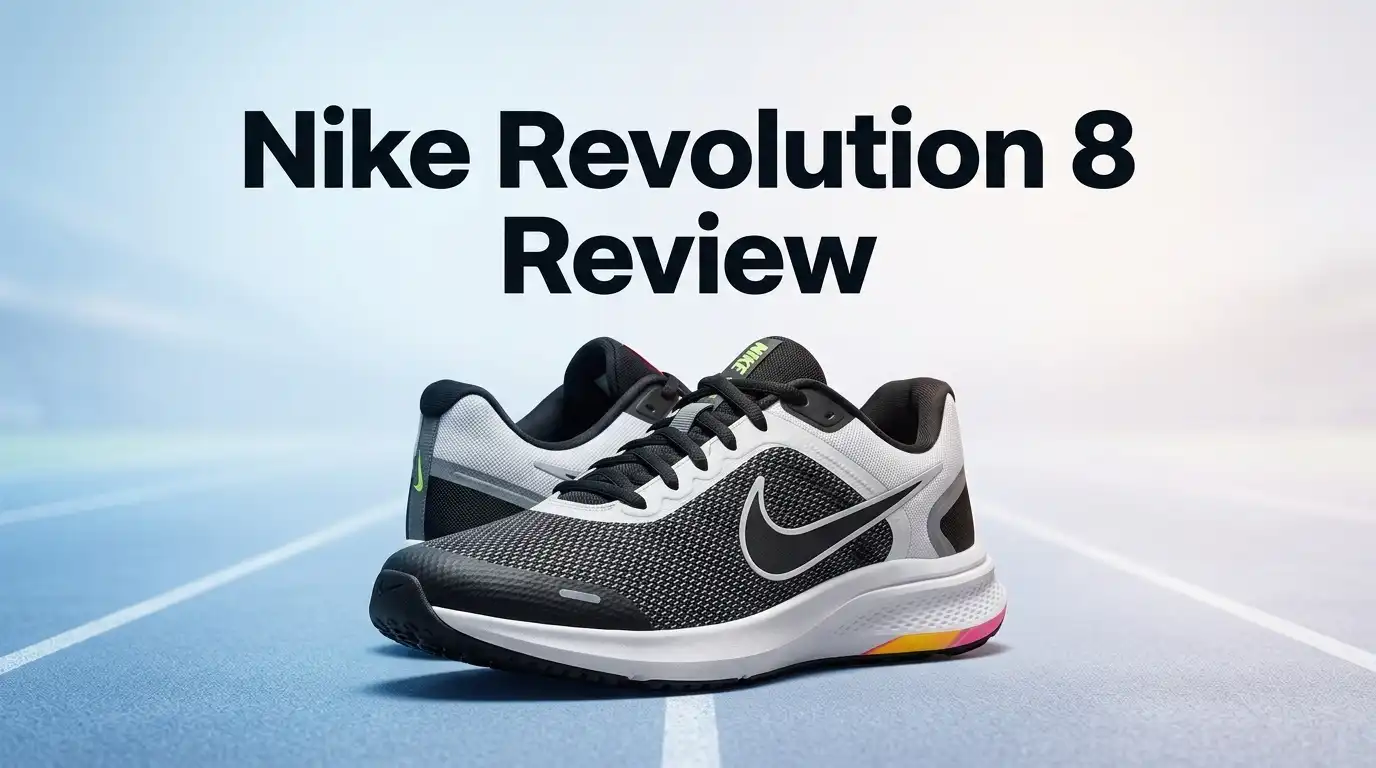
The Revolution line has always been Nike’s entry point. Version 8 keeps that role but sharpens the tools. Nike gave the shoe a rounded heel bevel, a full mesh upper, a foam midsole, and a waffle pattern outsole borrowed from decades of Nike design history.
The stated heel to toe drop is 10mm. Independent lab measurement came closer to 8.8mm, which is close enough that no runner will notice. Men’s US 10 weighs about 292g by Nike’s own spec sheet. Women’s US 8 weighs about 236g.
What surprised me most was the styling. Nike shaped the midsole to echo the Vomero 18, a shoe that costs far more. Standing in a store, most people cannot tell the difference from three feet away. That matters to buyers who want their shoe to look current.
The upper uses a single layer mesh with no ventilation holes punched through it. That choice hurts airflow slightly but helps durability a lot. The tongue is gusseted on both sides, so it never slides sideways during a run. Gusseted tongues on a $70 shoe were rare three years ago.
There is no reflective trim anywhere on the shoe. Night runners should note that.
Unboxing Experience And First Impressions
The box is plain Nike orange with no extra padding or tissue. Inside, the shoes sit nested with a single paper insert. No spare laces. No shoe bag. No dust cover. That is exactly what you expect at this price, and honestly, extras would have felt strange here.
The first thing I noticed was weight. Picking up one shoe, it felt closer to a casual sneaker than a running trainer. The Revolution 7 always had a slightly chunky feel in hand. This one does not.
Step in feel is soft around the heel collar. Nike packed real foam into the heel padding, and it hugs the ankle immediately. The insole, however, feels cheap the moment you press it. It is a thin 4.5mm EVA sheet with no contour. It is removable, so an aftermarket insole fixes this for about fifteen dollars.
Lacing is basic punched eyelets. Nothing fancy, nothing broken. The laces are flat and long enough for a heel lock knot if you need one.


Last update on 2026-04-11 / Affiliate links / Images from Amazon Product Advertising API Some of the links on this website are affiliate links, which means that at no additional cost to you, I earn a commission if you click through and make a purchase. I only recommend products and services that I believe will add value to my readers. Thank you for your support!
No break in period was required. I walked two miles the first evening with zero hot spots. That is a good sign in a budget shoe, where stiff overlays often cause rubbing during the first week.
Design And Build Quality
Build quality is the quiet strength here. Lab abrasion testing rated the toebox upper 4 out of 5 for durability, well above the 2.6 average across hundreds of running shoes. The mesh resists scuffing because it lacks the perforations that usually tear first.
Heel padding also scored 4 out of 5. That combination matters more than people admit. Most budget shoes die at the heel collar or the pinky toe, not the outsole.
The outsole rubber measures about 3.3mm thick, slightly above average. After a Dremel abrasion test, wear measured 1.0mm, which is a solid result. In plain terms, the tread will outlast the foam.
There is exposed midsole foam through the arch and a cutout in the forefoot. Both save weight. Both also collect small stones on gravel paths, which is mildly annoying.


Last update on 2026-04-11 / Affiliate links / Images from Amazon Product Advertising API Some of the links on this website are affiliate links, which means that at no additional cost to you, I earn a commission if you click through and make a purchase. I only recommend products and services that I believe will add value to my readers. Thank you for your support!
Torsional rigidity came in at 13.0 Nm, on the flexible side. The shoe twists easily in the hand. Flexibility test results hit 9.1N compared to a 15.5N average, making this one of the more bendable trainers on the market.
That flexibility is a feature for walkers and gym users, and a limitation for anyone who wants structure. Stability seekers should look elsewhere.
Top 3 Alternative for Nike Revolution 8

- Kick your stride into another gear in the Downshifter 14. We increased the amount of cushioning in...
- We increased the amount of cushioning in the midsole for more comfort and bounce.
- Internal fit band offers containment around the midfoot for a locked-in feel.
Last update on 2026-08-28 / Affiliate links / Images from Amazon Product Advertising API Some of the links on this website are affiliate links, which means that at no additional cost to you, I earn a commission if you click through and make a purchase. I only recommend products and services that I believe will add value to my readers. Thank you for your support!
Nike Men’s Downshifter 14 Road Running Shoes
No products found.
ASICS Men’s Gel Contend 9 Running Shoes

- Regular fit
- Laces
- Synthetic and textile mesh upper
Last update on 2026-08-28 / Affiliate links / Images from Amazon Product Advertising API Some of the links on this website are affiliate links, which means that at no additional cost to you, I earn a commission if you click through and make a purchase. I only recommend products and services that I believe will add value to my readers. Thank you for your support!
adidas Men’s Duramo SL 2 Running Shoes
Cushioning And Midsole Performance
Nike retired Phylon for this model. The replacement is an unnamed EVA blend, and it changed the shoe’s character.
Shock absorption in the heel measured 120 SA, up from 98 SA on the Revolution 7. The category average sits around 131 SA, so the Revolution 8 no longer feels punishing on landing. Heel strikers get the full benefit of this change.
The forefoot tells a different story. Shock absorption there measured only 82 SA. With just 23mm of stack, there is not much material to work with. On a run under four miles, this reads as good ground feel. On mile eight, it reads as a bruised forefoot.
Energy return is the real upgrade. The heel returns 57.1% and the forefoot 59.9%. Those numbers land close to shoes priced 30% to 40% higher. You feel it as a small pop on toe off, not as a springboard.
Midsole firmness measured 44.5 AC, where lower means softer and the average is 35.6 AC. This is a firm shoe. Anyone chasing a plush, sinking sensation will be disappointed.
Cold weather also softens the case. Firmness increased by 31% in cold testing, above the 22% average. Winter runners in cold climates will feel a noticeably harder ride.
Fit And Sizing Guide
This is where the Revolution 8 loses the most buyers, so read carefully.
Interior width measured 93.1mm against a 95.2mm average. Toebox width measured 71.3mm against a 73.2mm average. Toebox height measured 23.4mm against a 27.1mm average. Every single fit measurement came in below average.
In practice, the shoe feels like a sports sneaker rather than a roomy trainer. My toes touched the front in my normal Nike size after twenty minutes of walking, when feet naturally swell.
Reader and buyer feedback lines up with the lab data. A clear majority of voters report the shoe fits slightly small. Order half a size up unless you have narrow feet.
Nike does offer wide and extra wide versions, which is genuinely new for this line. Availability varies by country and by colorway, so check before you assume.
The low toebox ceiling is the harder problem. Half a size up adds length, not vertical room. Runners with high volume feet, bunions, or hammertoes should consider the adidas Runfalcon 5 or a Gel Contend instead, since both offer more headroom over the toes.
Lockdown elsewhere is good. The gusseted tongue and stiff heel counter, rated 4 out of 5, hold the midfoot and rearfoot securely.
Nike Women’s Revolution 8 Fit And Feel

- The mesh upper offers a comfortable, breathable feel.
- The foam midsole delivers intuitive cushioning through comfort-focused rocker geometry.
- The outsole has an intuitive Nike design and flex grooves in the forefoot that create a comfortable...
Last update on 2026-08-28 / Affiliate links / Images from Amazon Product Advertising API Some of the links on this website are affiliate links, which means that at no additional cost to you, I earn a commission if you click through and make a purchase. I only recommend products and services that I believe will add value to my readers. Thank you for your support!
The women’s version shares the midsole, outsole, and upper construction with the men’s model. The differences are last shape, weight, and colorway range.
Women’s US 8 weighs about 236g (8.3oz), which is light for a trainer at this price. The last is slightly narrower through the heel and midfoot, which most women with average width feet will appreciate.
The same snug toebox warning applies here, and arguably more strongly. Reviewers who wear a half size up report far fewer complaints than those who ordered true to size.
Colorway selection is broader on the women’s side. Nike ships pastel, monochrome, and brighter athletic options across the season. The white and pure platinum version shows dirt fast, but it wipes clean with a damp cloth because the mesh is tightly woven.
Cushioning behavior stays identical. Lighter runners actually get a better experience from this midsole than heavier runners do, because the thin forefoot bottoms out less under lower body weight. A runner under 150 pounds will find this shoe far more forgiving than a runner over 200 pounds.
Many buyers use this pair mainly for walking, treadmill work, and standing shifts. For those uses, the women’s Revolution 8 is one of the strongest values Nike sells right now.
Traction And Outsole Grip
Nike had a reputation for slippery outsoles a few years ago. That reputation no longer fits this shoe.
Forefoot traction measured 0.48 in lab testing, against a 0.52 average. That gap is small, and real world performance backed it up. I ran through light rain on painted crosswalk lines and pavement joints without any slide.
The waffle lug pattern does the heavy lifting. Square lugs create many small contact points, and each one bites independently. This design has worked for Nike since the 1970s for a reason.
Coverage is generous at both the heel and forefoot. The exposed foam sits only in the arch, an area that rarely touches the ground during road running.
Where it struggles is loose surfaces. Gravel paths, wet grass, and packed dirt with a dust layer all reduce confidence. This is a road shoe, and the lugs are far too shallow for trail duty.
Polished indoor floors are fine. Gym rubber is fine. Treadmill belts are fine.
Long term grip holds up well thanks to that 3.3mm rubber layer. Expect 300 to 400 miles before the tread pattern flattens noticeably, which is standard for the category.
Breathability And Warm Weather Comfort
Breathability measured 67 BR, below the 74 BR average across tested shoes. The reason is that solid mesh upper with no punched ventilation holes.
Nike traded airflow for durability, and that was a deliberate call for a shoe aimed at buyers who want longevity over performance.
In practice, the shoe handles mild and moderate temperatures fine. Below 75 degrees Fahrenheit, I never thought about my feet. Above 85 degrees with humidity, socks came off damp after a five mile run.
Drying potential measured 50% moisture evaporation after three hours in a controlled chamber, against a 53% average. So the shoe does not trap water permanently, but it will not be dry by the next morning either.
For summer runners in hot climates, this is a genuine weakness. A shoe like the Nike Interact Run or the ASICS Gel Contend 9 moves more air.
For everyone else, breathability is adequate. Walkers and gym users will never notice a problem.
One practical tip: thin synthetic running socks make a bigger difference here than in most shoes, because the upper does not help with moisture management on its own. Cotton socks turn this shoe into a swamp.
Running Performance On The Road
Here is the honest running assessment. The Revolution 8 is a competent short distance trainer and nothing more.
Runs of three to five miles feel good. The rounded heel bevel smooths landings, the new foam gives a small return on push off, and the light weight keeps your legs fresh. Easy pace and moderate pace both work.
Past six miles, the thin forefoot becomes the story. Foot fatigue arrives earlier than it does in a proper daily trainer like a Winflo or a Pegasus. That is not a defect. It is a $70 shoe doing what a $70 shoe does.
Speed work is possible but not enjoyable. The firm foam does not compress and rebound fast enough for strides or intervals. There is no plate and no rocker to help you turn over.
Stability is neutral and slightly less planted than the Revolution 7 was. Midsole width measures 112.9mm at the forefoot and 90.0mm at the heel, both marginally below average. Runners who overpronate should choose a support shoe such as the ASICS GT 1000 14 instead.
For a beginner running a couch to 5K program, this shoe is genuinely appropriate. For someone training for a half marathon, it is not.
Walking, Gym And Daily Wear
This might be the shoe’s best use case, and buyer reviews across multiple retailers say the same thing.
The high flexibility score of 9.1N means the shoe bends easily at the forefoot, matching how a foot rolls during a walking stride. Stiffer trainers fight that motion. This one does not.
Heel padding is plush enough for all day standing. Nurses, retail workers, and teachers show up repeatedly in customer feedback for this model. The lightness helps more than the cushioning does over an eight hour shift.
In the gym, the low 23mm forefoot gives good ground contact for lifting. It is not a dedicated lifting shoe, but for general strength work, machines, and light cardio it holds up. The flexible sole is less ideal for heavy squats or deadlifts, where a flat firm platform is better.
For casual wear, the Vomero inspired midsole shaping makes the shoe look more expensive than it is. It pairs fine with jeans and shorts.
The one caution is the snug toebox. All day wear amplifies fit issues that a short run would hide. Size up if this pair will spend most of its life walking rather than running.
What The Nike Revolution 8 Does Not Do Well
Every review should include this section, so here is the unfiltered list.
The forefoot cushioning is genuinely thin. At 82 SA shock absorption and 23mm of stack, midfoot and forefoot strikers will feel road impact directly. Heavier runners will bottom out.
The toebox is cramped in every dimension measured. Width, volume, and height all came in below average. This alone disqualifies the shoe for many people.
The insole is cheap. It is a flat, thin, uncontoured piece of foam. It is the single clearest place where the low price shows.
There are no reflective elements anywhere. Running before sunrise or after sunset in this shoe requires a separate reflective vest or light.
Cold weather firms the midsole by 31%, well above average. In winter, the ride becomes noticeably harsher.
The ride is firm overall at 44.5 AC. Anyone who wants a soft, plush, marshmallow feel will not enjoy this shoe. The Brooks Revel 7 delivers a softer ride at a similar price.
Breathability sits below average due to the solid mesh.
Finally, this is not a long distance shoe. Nike does not claim it is. Buyers who expect marathon comfort at a $70 price will be disappointed, and that expectation is the real problem, not the shoe.
Pros And Cons
Pros
- Excellent price. Launch price around $70 with frequent sale drops into the $45 to $55 range, against a $157 average for running shoes.
- Real energy return improvement. Roughly 57% heel and 60% forefoot, a large jump from the Revolution 7’s sub 50% numbers.
- Lighter build. About 9.3 oz (264g), a 6% reduction from the previous version.
- Strong durability scores. Toebox rated 4 out of 5, heel padding 4 out of 5, and outsole wear at 1.0mm after abrasion testing.
- Reliable grip. The waffle outsole handles wet and dry pavement with a 0.48 traction score.
- Gusseted tongue on both sides. Rare at this price and it eliminates tongue slide completely.
- Very flexible. A 9.1N flexibility result makes it comfortable for walking and casual use.
- Wide and extra wide options now exist in some markets.
- Removable insole allows a cheap upgrade to better cushioning.
Cons
- Cramped toebox in width, volume, and height. Most buyers must size up.
- Thin forefoot cushioning at 23mm and 82 SA shock absorption.
- Firm ride at 44.5 AC. No plush feel available here.
- No reflective details for low light running.
- Below average breathability at 67 BR.
- Midsole stiffens 31% in cold temperatures.
- Low value insole straight out of the box.
- Not suited to distances beyond six miles or to overpronators.
Nike Revolution 8 vs Nike Revolution 7
If you find a Revolution 7 on clearance, is it the smarter buy? Usually not, and here is why.
The single biggest difference is energy return. The Revolution 7 measured under 50%. The Revolution 8 measures 57.1% at the heel and 59.9% at the forefoot. That gap is large enough to change how the shoe feels after mile two.
Shock absorption improved as well, from 98 SA to 120 SA in the heel. Landings are simply softer.
Weight dropped about 6%. Two changes drove that. The new EVA midsole is lighter than the old Phylon, and the tongue thinned from 10.1mm to 4.3mm. The old tongue was overbuilt and nobody misses it.
The upper mesh is more breathable than the Revolution 7’s, according to Nike, though lab testing still places it below the category average.
Width availability expanded. Extra wide sizing was not offered on version 7 in most markets.
What did not improve is toebox roominess, and the Revolution 8 is slightly less laterally stable than version 7 was, since the softer foam trades a little support for comfort.
Buy the 7 only if the discount is steep, above 40%. Otherwise the 8 is the better shoe.
Price And Value Verdict
At $70 list price, the Revolution 8 competes against the Nike Downshifter 14, the ASICS Gel Contend 9, the adidas Duramo SL 2, and the Brooks Revel 7.
Against that group, its advantages are weight, durability scores, and energy return. Its disadvantages are toebox room and forefoot cushioning.
Value depends entirely on your use case. As a running shoe for a beginner logging three to five miles a few times a week, it is a strong buy. As a walking and daily wear shoe, it is one of the best values Nike currently offers. As a shoe for serious training volume, it is the wrong tool.
The comparison that matters most is against the used price of a premium trainer. A discounted Nike Winflo or Pegasus from a previous season often lands in the $80 to $95 range and delivers a better ride. If you can stretch the budget that far, do it.
If you cannot, or if you specifically want a new shoe with a warranty and full size availability, the Revolution 8 earns the money.
My rating: 4 out of 5 for the price bracket, 3 out of 5 as a running shoe overall. That split is the fairest summary I can give.
Frequently Asked Questions
Does the Nike Revolution 8 run small?
Yes. Interior width, toebox width, and toebox height all measured below average in lab testing, and a majority of buyers report a snug fit. Order half a size up unless your feet are narrow. Wide and extra wide versions are available in some markets and colorways.
Is the Nike Revolution 8 good for long distance running?
No. The forefoot stack sits at only 23mm with 82 SA shock absorption, which is thin. The shoe performs well up to about five or six miles. Beyond that, foot fatigue builds quickly, especially for heavier runners and forefoot strikers.
How much does the Nike Revolution 8 weigh?
Independent testing measured 9.3 oz (264g) in a men’s US 9. Nike lists approximately 292g for a men’s US 10 and 236g for a women’s US 8. That makes it roughly 6% lighter than the Revolution 7.
Is the Nike Revolution 8 good for walking and standing all day?
Yes. This is arguably its best use. The shoe is light, very flexible at 9.1N, and the heel collar is well padded. Many buyers use it for work shifts and daily walking. Size up if you plan long hours on your feet.
Does the Nike Revolution 8 work for flat feet or overpronation?
Not well. It is a neutral shoe with no support features and slightly below average midsole width. Runners who overpronate should choose a stability model such as the ASICS GT 1000 14 instead.
How long does the Nike Revolution 8 last?
Expect 300 to 400 miles of running or roughly a year of regular walking use. Durability testing rated the toebox and heel padding 4 out of 5, and outsole abrasion damage measured only 1.0mm, both above average results.
Can you wear the Nike Revolution 8 in the gym?
Yes, for general training. The low forefoot stack gives good ground contact for machines, cardio, and light strength work. The flexible sole makes it less suitable for heavy squats or deadlifts, where a firmer flat platform is better.
Does the Nike Revolution 8 have reflective details?
No. Nike removed reflective elements to keep the price down. Wear a reflective vest, clip on light, or headlamp if you run in low light conditions.

Mia Smith is the founder of Shoe Storyteller, a blog that celebrates the art and stories behind shoes. With a passion for fashion and a flair for storytelling, Mia brings a unique perspective to the world of footwear.