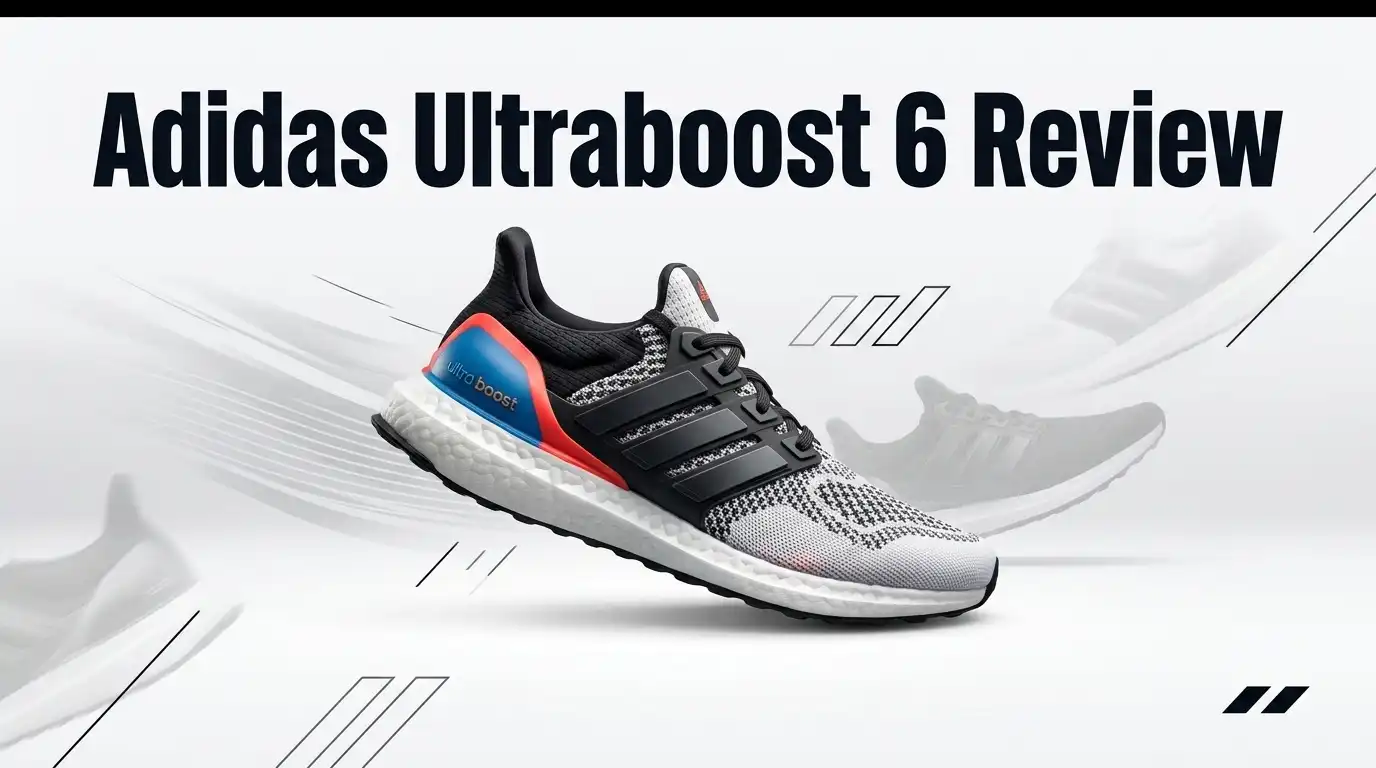
Adidas Ultraboost 6 Review 2026: Does It Exist?
You typed “Adidas Ultraboost 6” into Google. You expected a shiny new flagship. Instead you found silence, old 2021 listings, and a lot of confusion.
Here is the short answer. Adidas never released an Ultraboost 6. The number six only appears on the Ultraboost 6.0 DNA, a retro drop from 2021 that repackaged an older silhouette.
In 2026, the newest Ultraboost you can actually buy is the Ultraboost 5X, and adidas quietly pointed its running budget at a different shoe entirely.
In a Nutshell:
- The Ultraboost 6 does not exist. Adidas skipped straight past it. Release calendars listed an “Ultraboost 6X” for late 2025, but nothing arrived at retail. If a listing claims to sell an Ultraboost 6X, it is almost always a mislabelled 5X.
- The Ultraboost 5X is the current model. It weighs 9.4 oz (266 g), sits on a 34.6 mm heel and 24.2 mm forefoot in lab measurements, and carries a 10 mm drop. Retail price is $180, though it discounts to $117 constantly.
- Light Boost is a genuine upgrade. The reformulated TPU foam returned 66% energy at the heel and 70.1% at the forefoot in lab testing, which beats most daily trainers. It also runs firmer than the marketing suggests.
- Durability is the standout. The toebox, heel padding, and Continental rubber outsole all scored top marks in abrasion testing. This shoe outlasts almost everything at its price.
- The weaknesses are real. It breathes poorly, the forefoot cushioning is thin, the tongue padding is almost nonexistent, and the foam stiffens 34% in cold weather.
- Adidas replaced the Ultraboost in spirit with the Hyperboost Edge. That shoe carries 45 mm of new Hyperboost Pro foam at $200 and reviews far better as a running shoe.
What Happened to the Adidas Ultraboost 6?

- Men's responsive running shoes made in part with recycled materials
- WEIGHT: 292 g (size US 9)
- TORSION SYSTEM: Support between the heel and forefoot for a stable ride
Last update on 2026-08-28 / Affiliate links / Images from Amazon Product Advertising API Some of the links on this website are affiliate links, which means that at no additional cost to you, I earn a commission if you click through and make a purchase. I only recommend products and services that I believe will add value to my readers. Thank you for your support!
The Ultraboost naming system is a mess, and that is the honest reason your search failed.
Adidas released the Ultraboost 1.0 through 4.0 as clean sequels. Then it jumped to year names like Ultraboost 19, 20, 21 and 22. Then it switched again to Ultraboost Light, then back to numbers with the Ultraboost 5 and 5X in 2024. Six was skipped.
There was an Ultraboost 6.0, but it belongs to 2021. It arrived as the 6.0 DNA at $180 in colorways like Crew Blue and a Parley edition. Resale sites still list it, which is why old pages clutter your search results.
Solereview’s release calendar penciled an “Ultraboost 6X” for December 2025 with a new upper and sole. That shoe never reached shelves. By March 2026, buyers on running forums were openly asking whether the Hyperboost Edge had replaced it, and nobody at adidas had answered.
My read is simple. Adidas saw the Ultraboost turn into a lifestyle sneaker rather than a performance trainer. Sambas and Gazelles now drive the lifestyle business. Running money went to the Adizero line and the Hyperboost Edge. The Ultraboost sits in maintenance mode, selling on discount, waiting for a decision.
If you want the newest Ultraboost today, you want the 5X.
Adidas Ultraboost 5X Review: The Shoe You Actually Meant
The Ultraboost 5X is the real 2026 flagship of the line, and it is a better shoe than the Ultraboost has been in years.
Adidas made one big structural change. It deleted the plastic midfoot cage that defined the silhouette for a decade and replaced it with an internal support piece. That single edit cut roughly 17 grams. The shoe dropped from 10.3 oz on the Ultraboost 5 to 9.4 oz on the 5X, which is right at the average for daily trainers.
Underfoot you get Light Boost, a reworked TPU foam that adidas claims is 10% lighter than classic Boost. Lab testing measured 34.6 mm of heel stack and 24.2 mm at the forefoot, producing a 10.4 mm drop. That is a heel striker’s geometry, not a modern maximalist one.


Last update on 2026-04-11 / Affiliate links / Images from Amazon Product Advertising API Some of the links on this website are affiliate links, which means that at no additional cost to you, I earn a commission if you click through and make a purchase. I only recommend products and services that I believe will add value to my readers. Thank you for your support!
The Primeknit upper stays, and it remains the reason people love this line. It stretches, it hugs, and it needs no break in period.
Reviewers who spent years criticising the Ultraboost changed their tone here. Believe in the Run called it a great shoe for running, lifestyle, and travel after years of disappointment. RunRepeat scored it 85 out of 100.
It is still not a performance bargain. It is a premium comfort sneaker that happens to run acceptably.
Unboxing and First Impressions
The box is plain adidas cardboard, white with the three stripes logo, nothing collectible about it. Inside you get tissue paper, a silica packet, and the shoes stuffed with paper forms. No spare laces, no dust bag. At $180, that feels thin.
Lift the first shoe out and the weight surprises you in a good way. Previous Ultraboost models felt like bricks in hand. The 5X feels balanced.


Last update on 2026-04-11 / Affiliate links / Images from Amazon Product Advertising API Some of the links on this website are affiliate links, which means that at no additional cost to you, I earn a commission if you click through and make a purchase. I only recommend products and services that I believe will add value to my readers. Thank you for your support!
The Primeknit hits you next. It is soft, slightly waxy, and stretches easily when you pull the collar. There is no separate tongue, so entry works like a sock. Slide your foot in, and the knit expands, then settles. Most people are ready to walk out the door immediately.
Look closer and the details show where adidas saved money. The tongue area carries just 1.5 mm of padding against an average of 5.8 mm. Only four lace eyelets exist. The insole measures 3.1 mm, thinner than most trainers.
Flip it over and the outsole impresses. Continental rubber covers most of the surface, with lighter compound filling the midfoot and parts of the forefoot. You can see the blue Torsion System through the cutouts.
First steps feel controlled rather than plush. The foam is bouncy but firm. If you expected a marshmallow, adjust your expectations now.
Top 3 Alternative for Adidas Ultraboost 5X

- Engineered jacquard upper that offers stretch, ventilation, and durability
- Reflective details or visibility in low-light settings
- Tongue wing construction
Last update on 2026-06-07 / Affiliate links / Images from Amazon Product Advertising API Some of the links on this website are affiliate links, which means that at no additional cost to you, I earn a commission if you click through and make a purchase. I only recommend products and services that I believe will add value to my readers. Thank you for your support!
ASICS Novablast 5

- Style#: FZ5083-300
- Upgraded breathable engineered mesh upper
- ReactX foam midsole surrounds forefoot and heel Air Zoom units for an energized ride.
Last update on 2026-08-28 / Affiliate links / Images from Amazon Product Advertising API Some of the links on this website are affiliate links, which means that at no additional cost to you, I earn a commission if you click through and make a purchase. I only recommend products and services that I believe will add value to my readers. Thank you for your support!
Nike Pegasus 41

- adidas Mens trail-runners
Last update on 2026-08-28 / Affiliate links / Images from Amazon Product Advertising API Some of the links on this website are affiliate links, which means that at no additional cost to you, I earn a commission if you click through and make a purchase. I only recommend products and services that I believe will add value to my readers. Thank you for your support!
Adidas Ultraboost 1.0
Midsole and Cushioning: How Light Boost Really Feels
Light Boost is the most interesting part of this shoe, and also the most misunderstood.
Classic Boost was TPU pellets fused together. It felt soft in 2015 and outdated by 2022. Light Boost keeps the TPU base but reformulates it for lower weight and higher rebound. Think of it as Boost 2.0 with a marketing name.
The numbers back the change. Lab testing recorded 66% energy return at the heel and 70.1% at the forefoot. That forefoot figure sits in elite territory for a non racing shoe. Shock absorption measured 129 SA, which is close to the 131 average.
Here is the honest part. The shoe reads firm on foot. Midsole softness measured 38.1 AC against a 35.6 average, so it is stiffer than typical. Runners who want a pillowy landing will feel cheated.
The rocker is subtle and arrives late in the stride. That makes the shoe pleasant for walking and easy running, and slightly flat when you push the pace.
Cold weather exposes a flaw. After twenty minutes in freezer testing, Light Boost stiffened by 34%, against a 22% average. TPU is supposed to handle cold better than EVA, so this result disappoints.
For easy miles, treadmill sessions, airport days, and standing shifts, the cushioning works well. For long tempo efforts, it fades.
Fit, Sizing and Upper Comfort
The Ultraboost 5X fits true to size for most people, backed by 80 sizing votes on RunRepeat.
Width measurements came in at 96.2 mm at the widest point and 75.4 mm at the big toe, both slightly above average. The Primeknit stretches generously, so wide feet are welcome here. Very few knit shoes accommodate wide forefeet this comfortably.
Vertical space is the tradeoff. Toebox height measured 23.9 mm against a 27.1 mm average. The knit rests directly on your toes. Most testers found this harmless, but people who hate pressure on the toenails will notice it.
Lockdown depends entirely on the knit. With only four eyelets and no cage, you cannot cinch the midfoot hard. Runners with narrow, low volume feet report slight heel and midfoot slop during faster turns.
The extended heel collar helps you slide in and adds Achilles support. The internal plastic heel counter scored 3 out of 5 for stiffness, firm enough to hold your heel, unforgiving if you land crooked.
Breathability is the biggest upper complaint. Ventilation scored 3 out of 5. Microscope inspection showed the toebox ventilation holes are smaller than they look. Your feet will get warm in summer. Several long term owners mention this directly.
Traction, Outsole and Long Term Durability
This is where the Ultraboost earns its price tag.
Outsole abrasion testing produced a 0.4 mm dent against a 1.1 mm average. Continental rubber remains one of the toughest compounds in running, and adidas still uses it here. Outsole thickness measured 2.6 mm, which is reasonable given the compound.
Toebox durability scored a perfect 5 out of 5. Heel padding durability also scored 5 out of 5. Two perfect durability scores in one shoe is rare. Knit uppers usually fail early near the big toe, and this one does not.
One owner on a running forum reported 300 kilometres with no change in feel or structure. Another tester logged over thirty days of running and said the shoe still looked new.
Grip is good rather than exceptional. Wet and dry traction testing returned 0.52, exactly average. The reason is that adidas no longer covers the full outsole in Continental rubber. Sections of the midfoot and forefoot use a lighter compound to save weight.
In practice you get confident grip on dry pavement and acceptable grip in rain. Older Ultraboost models with full Continental coverage held better on wet surfaces.
If you keep shoes for years rather than months, this durability profile justifies a lot.
Running Performance: Honest Notes From the Road
The Ultraboost 5X is a decent runner and a poor value as a pure running shoe. Both statements are true.
Easy runs feel good. The 10 mm drop rolls a heel striker forward naturally. Torsional rigidity scored 4 out of 5 thanks to the Torsion System, so the platform stays stable under fatigue. Heel midsole width measured 94.5 mm, wider than average, which adds landing security.
Longitudinal flexibility measured 11.4N in a 30 degree bend test, well below the 15.5N average. That flexibility makes it excellent for walking, which matters because most Ultraboost pairs never see a running route.
Speed is where it falls apart. The forefoot carries only 24.2 mm of stack and measures 115.4 mm wide, which is merely average. Push into a tempo effort and the forefoot feels thin and harsh. The late rocker does not help you turn over.
Reviewers keep landing in the same place. Solereview scored it 86% and called it an excellent athleisure sneaker and a decent everyday trainer for recovery runs. Running Shoes Guru framed it as a premium daily trainer for people who want a sneaker that looks as good as it performs.
Use it for recovery days, gym sessions, dog walks, travel, and easy mileage. Do not race in it.
What the Adidas Ultraboost Does Not Do Well
Real reviews list the failures, so here they are without softening.
It runs hot. The knit upper traps heat. Summer runs and warm offices both expose this. If you sweat heavily, expect damp socks.
It is expensive for what it delivers. At $180 retail against a $157 category average, you pay premium money for average performance metrics. Cheaper shoes return more energy per dollar.
The forefoot is under cushioned. Midfoot and forefoot strikers get very little protection. This shoe was built around heel strikers and does not hide it.
The tongue padding is almost absent. At 1.5 mm, anyone with instep sensitivity will feel lace pressure.
Lockdown is soft. Four eyelets and a stretchy knit mean you cannot really tighten the midfoot.
Cold weather hurts it. A 34% firmness increase in freezing conditions is worse than average, which is embarrassing for a TPU foam.
The silhouette divides people. Owners with smaller feet complain the 5X looks short and bulky compared with the elongated Ultraboost 1.0. Several longtime fans simply refuse to wear it.
Availability is confusing. In the United States the 5X is common and the 5 is scarce. In Europe both exist in different colorways. Good luck comparing them in person.
Pros and Cons of the Adidas Ultraboost 5X
Pros
- Outstanding durability across every component. Perfect 5 out of 5 scores for toebox abrasion and heel padding, plus a 0.4 mm outsole wear result. This shoe survives years of use.
- Excellent energy return for a daily trainer. 70.1% at the forefoot and 66% at the heel beat most shoes in the category, and that rebound is genuinely noticeable.
- Comfortable for wide feet. The stretchy Primeknit measures above average at both the widest point and the big toe, with almost no taper.
- Meaningfully lighter than before. Removing the plastic cage dropped it to 9.4 oz, which finally puts the Ultraboost in normal territory.
- Very stable platform. A wide 94.5 mm heel and 4 out of 5 torsional rigidity keep the ride controlled and predictable.
- Discounts constantly. Retail is $180, but $117 to $139 pricing appears at multiple retailers throughout the year.
Cons
- Poor breathability. A 3 out of 5 ventilation score with restricted toebox holes means hot feet in warm weather.
- Thin forefoot cushioning. Only 24.2 mm of stack leaves forefoot strikers exposed on longer efforts.
- Firmer than advertised. A 38.1 AC softness reading undercuts the plush reputation the marketing sells.
- Minimal tongue padding. 1.5 mm against a 5.8 mm average creates lace pressure for sensitive insteps.
- Weak cold weather behaviour. Light Boost stiffened 34% in freezer testing.
- Poor value for pure performance. Similar money buys faster, bouncier, better running shoes.
Ultraboost 5X vs Ultraboost 5 vs Ultraboost 1.0
Three Ultraboost models sit on shelves right now, and choosing between them is the real decision.
The Ultraboost 5 keeps the external plastic midfoot cage. That cage improves lockdown and preserves the classic look. It weighs 10.3 oz, roughly 26 grams more than the 5X, and scored 83 in lab testing. Choose it if you value security over weight, and if you can find it in your region.
The Ultraboost 5X removes the cage and hides an internal support piece instead. You lose a little lockdown, you gain agility, and you get the same Light Boost midsole. It scored 85 and is the version widely stocked in the United States.
The Ultraboost 1.0 is the original silhouette, still in production, still beloved. It measures 34.4 mm heel and 41.3 mm forefoot in some lab teardowns and uses classic Boost rather than Light Boost. It scored 74. Buy it for looks, not for running. Owners consistently say the elongated shape flatters the foot better than the stubby 5X.
Community sentiment is blunt. Many longtime fans argue versions 1.0 through 4.0 were the peak and every update since made the shoe worse. That opinion is not universal, but it is widespread enough to take seriously.
Hyperboost Edge: The Successor Adidas Actually Built
If you want the shoe that replaced the Ultraboost in adidas’s plans, it is the Hyperboost Edge.
It launched in March 2026 at $200 with 45 mm of stack in the heel and 39 mm in the forefoot, giving a 6 mm drop. It weighs 9.6 oz for a men’s 10.5. The midsole uses Hyperboost Pro, a pelletized foam that behaves more like Lightstrike Pro than old Boost.
Believe in the Run named it their top adidas daily trainer for 2026 and said the compression and rebound beat both the Superblast 3 and the Cloudmonster 3 Hyper. That is the strongest praise adidas Boost has received in a decade.
It is not universally loved. Forum reviews split hard, with some runners calling the big stack unstable and the styling loud. The mesh upper draws the same breathability complaints as the Ultraboost. It also clicks audibly on hard floors, which annoys casual wearers.
The takeaway matters for your purchase. Adidas built its 2026 running story around Hyperboost, not Ultraboost. If you want performance, look there. If you want the Ultraboost look and knit comfort, the 5X still delivers that and nothing else does.
Price, Value and Where to Buy
Retail sits at $180 for the Ultraboost 5X, and almost nobody should pay that.
Discounts run constantly. Adidas itself lists the 5X between $117 and $153 across colorways. Foot Locker shows $139.99. JD Sports lists $125. Amazon pricing shifts by size and colorway, sometimes dropping further on odd sizes. Deep clearance events have pushed older Ultraboost stock as low as $47.
My advice is straightforward. Set a target of $130 or less and wait. The Ultraboost line never stays at full price for long, and no new model is coming to make current stock scarce.
Sizing runs true to size, so ordering online carries low risk. If you have a very high instep or narrow heel, buy from a retailer with free returns.
Watch out for listings labelled “Ultraboost 6X” on resale platforms. Those are mislabelled 5X pairs, and the descriptions usually copy adidas 5X marketing text word for word. Nothing dishonest is necessarily happening, but you are not getting a newer shoe.
For value comparison, the Adizero SL 2 costs $130, weighs 8.4 oz, and outperforms the Ultraboost as a runner by a wide margin. If running is the goal rather than style, that is where your money works harder.
Who Should Buy the Ultraboost 5X and Who Should Skip It
Buy it if you want one shoe for travel, walking, gym work, and occasional easy runs. The durability, the knit comfort, and the stable platform make it a strong all day sneaker. It suits wide feet exceptionally well.
Buy it if you are a heel striker who runs easy paces. The 10 mm drop and rear loaded cushioning fit that stride naturally.
Buy it if you keep shoes for years. Nothing on this shoe wears out quickly, and that changes the cost per mile maths considerably.
Skip it if you run fast or run far. The thin forefoot and firm foam punish tempo work and long efforts.
Skip it if you live somewhere hot. The breathability problem is real and no amount of sock choice fixes it.
Skip it if you train through winter. A 34% firmness increase in cold conditions makes it unpleasant in January.
Skip it if you loved the Ultraboost 1.0 silhouette. You will probably dislike the shorter, bulkier 5X profile, and plenty of longtime owners already do.
Skip it if performance per dollar drives your decision.** Better runners exist at lower prices.
Final Verdict on the Adidas Ultraboost in 2026
No products found.
The Adidas Ultraboost 6 is not a product. It is a search term built on a naming system that stopped making sense years ago.
What exists instead is the Ultraboost 5X, and it is the best version of this shoe in a long time. Removing the plastic cage fixed the weight problem. Light Boost fixed the deadness. The Continental outsole and Primeknit upper still deliver durability that few rivals match.
It also remains a $180 sneaker pretending to be a $180 running shoe. The forefoot is thin, the upper runs hot, and the ride is firmer than the marketing implies. Reviewers who tested it fairly landed around 85 out of 100, which reads as very good sneaker, average trainer.
Buy it on discount, wear it everywhere, and enjoy how long it lasts. Do not buy it expecting to chase personal bests.
And keep an eye on the Hyperboost Edge. That shoe is where adidas put its running ambition in 2026, and it is the honest answer to anyone asking what comes after the Ultraboost.
Frequently Asked Questions
Is there an Adidas Ultraboost 6?
No. Adidas released an Ultraboost 6.0 DNA back in 2021, but that was a retro drop, not a new generation. An Ultraboost 6X appeared on release calendars for late 2025 and never launched. The newest models available in 2026 are the Ultraboost 5 and Ultraboost 5X.
What is the difference between the Ultraboost 5 and 5X?
The 5X removes the external plastic midfoot cage and replaces it with an internal support piece. That saves about 17 grams, bringing weight to 9.4 oz versus 10.3 oz. Everything else, including the Light Boost midsole and Primeknit upper, stays essentially the same.
Does the Ultraboost 5X run true to size?
Yes. Sizing feedback strongly supports ordering your normal size. The Primeknit stretches to accommodate wide feet, though vertical toebox space is limited at 23.9 mm.
Is the Ultraboost good for running?
It works for easy runs, recovery days, and treadmill sessions, especially for heel strikers. It struggles at faster paces because the forefoot carries only 24.2 mm of stack. Serious runners get better value from the Adizero SL 2 or the Hyperboost Edge.
How long does the Ultraboost last?
Longer than most. Adidas suggests replacing running shoes every 480 to 800 kilometres, but the 5X posted perfect durability scores for toebox abrasion, heel padding, and outsole wear. Casual wearers often get years out of a pair.
Is the Ultraboost 5X worth $180?
Rarely. It discounts to $117 to $139 regularly across adidas, Foot Locker, JD Sports and Amazon. Wait for a sale and the value proposition improves dramatically.
What replaced the Ultraboost?
Functionally, the Hyperboost Edge. It launched in March 2026 at $200 with 45 mm of Hyperboost Pro foam and a 6 mm drop, and it reviews far better as a running shoe. The Ultraboost continues as a lifestyle focused option.

Mia Smith is the founder of Shoe Storyteller, a blog that celebrates the art and stories behind shoes. With a passion for fashion and a flair for storytelling, Mia brings a unique perspective to the world of footwear.