
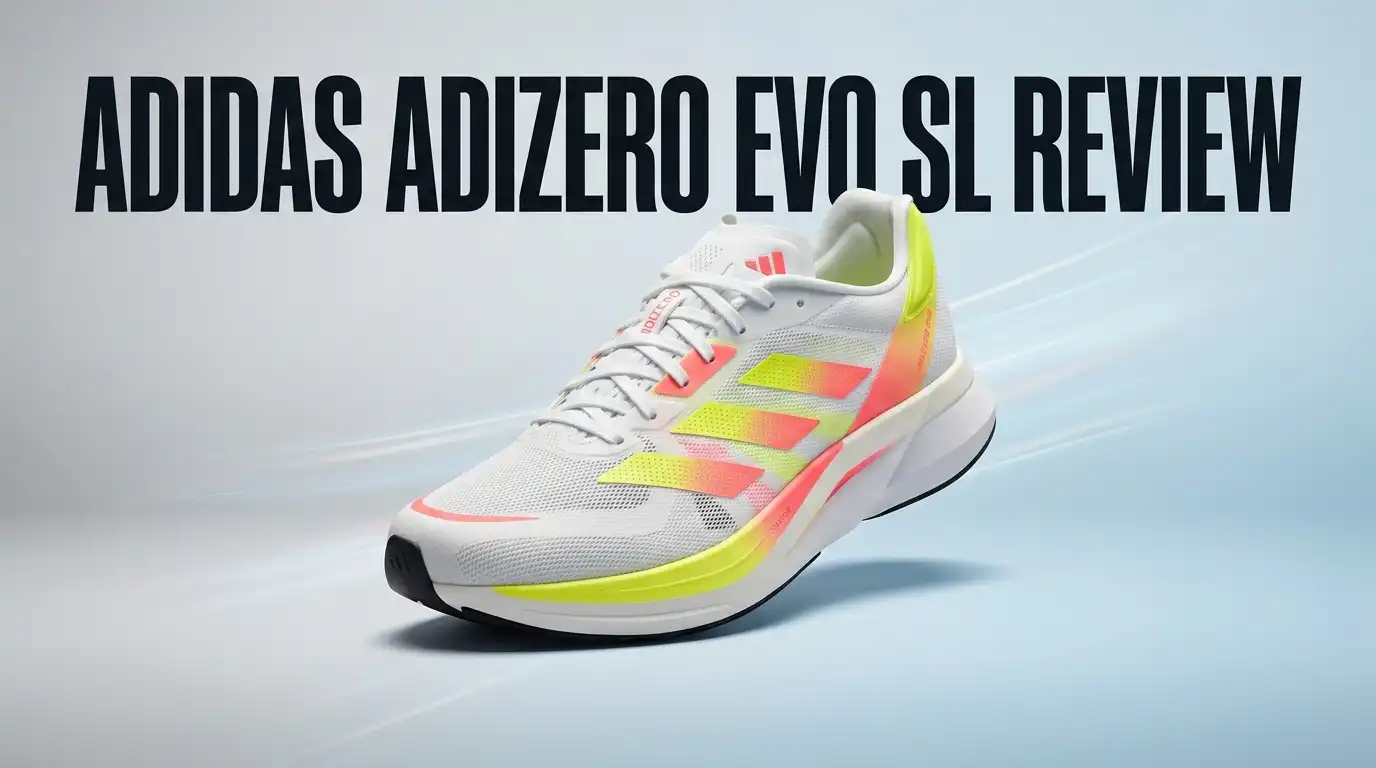
Adidas Adizero Evo SL M Review 2026: Still Worth It?
The Adizero Evo SL arrived with almost no warning and quietly became the shoe everyone wanted. Runners bought it. Non runners bought it. Store shelves emptied within hours.
Two years later, the hype has cooled, the stock has stabilised, and we can finally judge this shoe on merit instead of scarcity.
So the question in 2026 is simple. Does a plate free trainer with a full Lightstrike Pro midsole still deserve your $150, now that every brand has copied the formula?
In A Nutshell:
- The midsole is the whole story. The Evo SL uses 100% Lightstrike Pro, the same TPEE superfoam found in the Adios Pro 3 marathon racer. Lab testing measured 74.3% energy return, a number normally reserved for shoes costing double. At $150, that remains the best foam per dollar deal on the market.
- It weighs almost nothing. A men’s US 9 sits around 7.9 oz or 223 grams. That is racer territory, yet you get 39mm of heel stack and 33mm up front. Very few trainers hit that combination.
- There is no carbon plate, and that is deliberate. A small plastic shank sits under the midfoot for torsional control. The result feels natural, flexible and friendly at slow paces, which most plated super trainers never manage.
- The upper is where adidas saved money. The tongue measures roughly 1.5mm thick, has no gusset, and slides sideways. Toebox abrasion resistance scored a poor 1 out of 5 in lab testing. This is the shoe’s clear weak point.
- Stability is limited. The heel platform measures about 87mm wide, narrower than average. Neutral midfoot strikers love it. Overpronators and heavy heel strikers should look elsewhere.
- Value verdict: still excellent in 2026. Rivals have caught up on foam, but almost none match the price, the weight and the everyday versatility all at once.
What Is The Adidas Adizero Evo SL?

- Adizero EVO SL WOVE CBLACK/FTWWHT/CARBON
Last update on 2026-08-28 / Affiliate links / Images from Amazon Product Advertising API Some of the links on this website are affiliate links, which means that at no additional cost to you, I earn a commission if you click through and make a purchase. I only recommend products and services that I believe will add value to my readers. Thank you for your support!
The Evo SL is a lightweight daily trainer built around a single idea. Take the best foam adidas makes, remove the carbon plate, remove the racing price tag, and let people run in it every day.
Adidas positions it as the training sibling of the Adizero Adios Pro Evo 1, the record breaking racer that costs five times as much. The “SL” simply means Super Light. That naming is honest for once.
What makes it unusual is the purity of the build. There is no carrier foam, no thick protective skin, no plastic cage. You get a slab of Lightstrike Pro, a thin engineered mesh upper, a sliver of Continental rubber, and very little else. Every gram that does not help you run forward was removed.
Official specs sit at 39mm heel and 33mm forefoot with a 6.5mm drop. Independent lab measurements came in slightly lower at roughly 36mm and 28mm with an 8mm drop, though nobody feels that difference on the road. The price has held at $150 in the US since launch, which is remarkable in a market where super trainers routinely ask $180 or more.
Adidas also marketed it as a lifestyle sneaker, which explains why you see so many pairs in coffee shops. That dual purpose positioning is genuine. It genuinely looks good with jeans. It also genuinely runs fast. That combination is rare, and it explains the queues.
Unboxing And First Impressions
The box is standard adidas cardboard, nothing special, no premium sleeve or magnetic flap. Lift the lid and the first thing you notice is how little is inside. No spare laces, no shoe bag, no glossy insert card. Just two shoes wrapped in thin tissue.
Then you pick one up and the reaction is always the same. It feels empty. My first thought was that a display model had been packed by mistake. The pair weighs less than most people expect a shoe with this much stack to weigh, and that gap between what your eyes see and what your hand feels never quite goes away.
The finish is clean. Panel lines are tidy, the three stripes are printed rather than stitched, and the heel counter holds its shape without any obvious padding. The tongue is the first warning sign. It is a flat strip of mesh with zero foam, floppy in the hand, and it flops sideways the moment you open the shoe.
Laces are thin, flat and slightly slippery. They hold, but they are clearly a cost saving. The insole is a paper thin 2.4mm sheet that peels out easily.


Last update on 2026-04-11 / Affiliate links / Images from Amazon Product Advertising API Some of the links on this website are affiliate links, which means that at no additional cost to you, I earn a commission if you click through and make a purchase. I only recommend products and services that I believe will add value to my readers. Thank you for your support!
First step in feels firm rather than plush. Walk around the house and it feels almost ordinary. Then you run, and the foam wakes up. That contrast between standing feel and running feel catches almost everyone off guard.
Design, Build Quality And Materials
Look at the Evo SL side on and you see racing DNA. The heel is aggressively bevelled, the midsole flares gently under the forefoot, and the sidewalls stay low instead of cupping the foot. Adidas resisted the trend toward oversized, wobbly platforms, and the shoe is better for it.
The upper is a single layer of engineered mesh with almost no overlays. Adidas added a light print around the midfoot for structure and a stiffer internal insert at the heel, roughly the same cardboard style counter used in their training shoes. That heel piece adds welcome structure compared to their pure racers.
Material quality is a mixed bag, and this is where honesty matters. The midsole and outsole feel premium. The upper feels cheap. The mesh is thin and slightly rough to the touch, the tongue has no gusset, and the collar padding is minimal.
Lab abrasion testing gave the toebox a 1 out of 5 rating, the lowest possible score, which tells you the mesh will not survive toenail pressure or scuffing against walls forever. The rough texture helps slightly, but this is not a shoe you buy for five year durability.


Last update on 2026-04-11 / Affiliate links / Images from Amazon Product Advertising API Some of the links on this website are affiliate links, which means that at no additional cost to you, I earn a commission if you click through and make a purchase. I only recommend products and services that I believe will add value to my readers. Thank you for your support!
Colourways have expanded a lot since launch. Most lack reflective detailing, though a few grey and metallic options include reflective yarn in the upper. If you run before sunrise, check the specific colour before you buy, because adidas does not make this obvious.
Top 3 Alternative for Adidas Adizero Evo SL

- Regular Fit
- Engineered mesh upper
- Stack height: 39mm and 29mm?
Last update on 2026-08-28 / Affiliate links / Images from Amazon Product Advertising API Some of the links on this website are affiliate links, which means that at no additional cost to you, I earn a commission if you click through and make a purchase. I only recommend products and services that I believe will add value to my readers. Thank you for your support!
PUMA Deviate Nitro 3

- FuelCell foam delivers a propulsive feel to help drive you forward
- Sublimated prints are made using ink and heat to create images that won’t crack, peel, or fade
- FantomFit upper offers ultra-light bonded support
Last update on 2026-06-07 / Affiliate links / Images from Amazon Product Advertising API Some of the links on this website are affiliate links, which means that at no additional cost to you, I earn a commission if you click through and make a purchase. I only recommend products and services that I believe will add value to my readers. Thank you for your support!
New Balance FuelCell Rebel v4

- Light, breathable mesh makes every step feel refreshingly cool
- Durable outsole keeps up with your active lifestyle
- VERSARUN cushioning absorbs impact and reduces pressure for comfortable daily movement
Last update on 2026-06-07 / Affiliate links / Images from Amazon Product Advertising API Some of the links on this website are affiliate links, which means that at no additional cost to you, I earn a commission if you click through and make a purchase. I only recommend products and services that I believe will add value to my readers. Thank you for your support!
Saucony Endorphin Speed 4
The Lightstrike Pro Midsole And Ride Feel
This is the reason the shoe exists. Lightstrike Pro is a TPEE based superfoam, and adidas used the exact same compound found in the Adizero Adios Pro 3. Independent testing confirmed it under a microscope. No dilution, no cheaper variant hiding behind the same marketing name.
The ride is springy rather than soft. Durometer readings put it around 43.5 on the Asker C scale, which means firm for a superfoam. You do not sink in. You compress the foam, it pushes back, and you move on. Energy return sits above 74%, well clear of the daily trainer average near 58%.
Shock absorption measured 147 SA in the heel against an average of 131. In plain terms, your legs stay fresh far longer than the low weight suggests. I finished a 20 mile long run in these with less soreness than in heavier max cushioned trainers.
The forefoot rocker begins at roughly 60% of the shoe length, earlier than the Adios Pro 3. That early transition point is what makes the shoe pleasant at easy pace instead of clumsy. You roll forward naturally without needing to hit a specific speed to unlock the geometry.
Cold weather barely affects it. A freezer test showed only a 13% firmness change, far better than the 22% average. Your January runs feel the same as your July runs, which cannot be said for most EVA based trainers.
Fit And Sizing: True To Size?
The Evo SL fits true to size for the large majority of runners. Nearly a thousand user votes back this up, and my own pair matched my usual adidas size exactly. Internal length measured around 272mm in a US 9, slightly longer than average.
The fit shape is unusual and worth understanding before you order. The ball of the foot area is generous, measuring roughly 97.5mm across the widest point, which is wider than most daily trainers. Broad forefeet get real room here.
Then the toebox tapers sharply. The big toe area narrows to about 71.6mm, below the 73.2mm average. So the shoe feels roomy in the middle and pointy at the front. Runners with long second toes or wide toe splay may feel pinched over longer distances.
Toebox height is decent at 28.1mm, so there is vertical space even though the mesh does not stretch much. Volume overall is low, and that matters if you use custom orthotics. The insole is removable, but most aftermarket footbeds are twice as thick and will crowd the shoe badly.
There is no wide version in most markets. If you normally buy 2E, this is probably not your shoe. Half sizes are available and I would stay at your normal length rather than sizing up, because extra length makes the narrow toe taper feel worse rather than better.
The Upper, Tongue And Lockdown Problems
Here is where the Evo SL loses points, and no amount of foam brilliance fully covers it.
The tongue measures roughly 1.5mm thick against a 5.8mm average. It has no padding and no gusset. Two problems follow. First, the tongue migrates sideways during runs, often within the first mile. Second, the thin flat laces press directly into the top of your foot.
If you cinch the laces tight for a workout, you will feel it across the instep. I learned to leave the top eyelet slightly loose and use a runner’s loop only when necessary. Once you find the right tension the shoe disappears, but that trial period is real and annoying.
Breathability is genuinely good, scoring 76 on lab testing against a 74 average. Hot weather runs stay comfortable. Drying is a different story, with the upper releasing only 43% of trapped moisture in three hours against a 53% average. Wet feet stay wet feet.
Heel lockdown is better than expected thanks to the semi rigid internal counter. I have had no slippage even on hills, and the heel padding scored a perfect 5 out of 5 for abrasion resistance.
So the verdict on the upper is split. It breathes well, it holds the heel well, and it looks sharp. It also feels cheap, dries slowly, and needs lacing patience. Adidas clearly spent the budget on the midsole and hoped you would forgive the rest.
Outsole Grip And Long Term Durability
The outsole is a study in minimalism. A Continental rubber patch covers the forefoot with cutouts to save weight, and two Clear Rubber strips protect the heel. Rubber thickness measures about 1.6mm, roughly half the industry average.
That thin layer sounds alarming. In practice it works. A Dremel abrasion test showed only 0.6mm of wear against a 1.1mm average, meaning the compound is unusually tough despite the thin application. Real world reports back this up, with plenty of runners passing 300 miles with the outsole still intact.
Grip is good but not class leading. Traction testing scored 0.40 against a 0.52 average, which is a below average number for a Continental outsole. Dry pavement is completely secure. Wet pavement is fine at controlled pace. Wet painted lines, metal grates and slick tiles ask for caution.
Exposed foam sections between the rubber patches do wear, especially under the medial forefoot if you toe off aggressively. This is cosmetic for a long time before it becomes functional, but you will see it.
The bigger durability question is the foam itself. Pure unprotected Lightstrike Pro was once considered risky, yet the Adios Pro 3 proved otherwise over years of use. Most Evo SL owners report the bounce holding well past 250 miles, with a gradual softening rather than a sudden collapse.
Realistic lifespan sits around 350 to 450 miles for road use. The upper usually shows its age before the midsole does.
How It Runs: Easy Days, Tempo And Race Day
Easy runs are where the Evo SL surprises people. Most super trainers feel awkward below marathon pace because their geometry needs speed. This one does not. The early rocker and the plate free flexibility let you shuffle along comfortably at conversational pace.
It is not the plushest easy day shoe. The firm foam and thin insole mean you feel the road more than in a Novablast or a Glycerin. But it never punishes you, and recovery runs feel genuinely fine.
Tempo work is the sweet spot. Somewhere between marathon pace and threshold, the foam and rocker sync perfectly. The shoe feels like it is helping without dictating your form, which is exactly what a plate free design should deliver.
Track intervals work well too. The low weight and modest forefoot stack give enough ground feel to hit turns confidently, though a dedicated racing flat still feels sharper at 5K pace.
Race day depends on your goals. For a half marathon or a first marathon, the Evo SL is completely capable, and the cushioning holds up over three plus hours. For a personal best attempt, a plated racer will still return more energy per stride.
The one situation it dislikes is heavy heel striking at slow pace. The narrow heel platform and steep bevel mean pronounced heel strikers feel a slight tipping sensation. Midfoot and forefoot runners never notice this at all.
What The Adizero Evo SL Does Not Do Well
Every review should name the failures clearly, so here they are without softening.
It offers no stability support whatsoever. The heel platform is 87.3mm wide against a 91.1mm average, the sidewalls are low, and there is no medial post. Mild overpronators will feel the foam collapsing inward. This shoe is neutral only, with no exceptions.
The tongue is a genuine design flaw, not a preference issue. No gusset and 1.5mm of material means sideways migration and instep pressure. Adidas fixed similar issues on other models and chose not to here.
Upper durability is poor. A 1 out of 5 abrasion score is the bottom of the scale. If you have aggressive toenails or you brush against curbs, expect holes.
The shoe dries slowly after wet runs, so back to back rainy days mean damp shoes. Grip on wet slick surfaces is merely adequate rather than confident.
It cannot accommodate orthotics. Low internal volume plus a 2.4mm insole leaves no headroom for aftermarket footbeds.
Most colourways lack reflectivity, and there is no wide fitting for most regions. Finally, resale prices on rare colourways remain inflated, so patience matters if you want a specific look at retail price.
None of these are dealbreakers for the right runner. All of them are real.
Pros And Cons
Pros
- Full Lightstrike Pro midsole at $150, the same superfoam used in adidas marathon racers, with over 74% measured energy return.
- Exceptionally light at roughly 7.9 oz or 223 grams, lighter than many shoes with half the stack height.
- Genuinely versatile, handling easy runs, tempo work, track intervals and full marathons without complaint.
- Plate free ride feels natural and flexible, which suits runners who dislike the forced rhythm of carbon plates.
- Outsole durability is excellent despite the thin rubber, with only 0.6mm of measured wear in testing.
- Cold weather performance holds up, with only a 13% firmness change in freezing conditions.
- Looks sharp enough for casual wear, which few performance trainers manage.
- Breathability scores above average, keeping feet cool in summer heat.
Cons
- The tongue has no gusset and almost no padding, causing sideways slide and instep pressure under tight laces.
- Upper abrasion resistance scored the lowest possible rating in lab testing, so mesh holes are likely over time.
- No stability features at all, with a narrow heel platform unsuitable for overpronators.
- The toebox tapers sharply, which pinches wide or square shaped feet.
- Wet weather grip is only adequate, and the upper dries slowly.
- No room for orthotics due to very low internal volume.
- Most colourways include no reflective detailing for dark runs.
- No wide width option in most markets.
Adidas Adizero Evo SL vs The Competition
Against the PUMA Deviate Nitro 3, the choice comes down to plate preference. The PUMA gives you a carbon infused plate, PumaGrip rubber that is arguably the best outsole in running, and a more structured upper. It also weighs noticeably more and feels less lively at easy pace. Pick the PUMA if you want grip and propulsion. Pick the Evo SL if you want lightness and freedom.
Against the New Balance FuelCell Rebel v4, the two feel closest in spirit. Both are light, bouncy and plate free. The Rebel has a friendlier upper and a softer landing. The Evo SL has genuinely better foam and a smoother rocker. The Evo SL wins on performance, the Rebel wins on comfort.
Against the Saucony Endorphin Speed 4, you are choosing between a nylon plate and no plate. The Saucony feels more directed and more stable, with a considerably nicer upper and a gusseted tongue. The Evo SL is lighter and more flexible. Price is similar.
Against its own sibling, the Adizero Boston 13, the Evo SL is lighter and more forgiving. The Boston uses energy rods and feels stiffer and more aggressive, better suited to hard workouts than to easy days.
The Evo SL still holds a unique position in 2026. Nothing else combines this foam, this weight and this price in one package.
Who Should Buy The Adidas Adizero Evo SL?
No products found.
Buy it if you are a neutral runner who wants one shoe to cover most of your training. It handles easy miles, tempo efforts and races well enough that many runners genuinely rotate nothing else.
Buy it if you dislike carbon plates. The plate free ride gives you superfoam benefits without the forced cadence and calf loading that plated shoes create. Runners returning from injury often find this combination gentler.
Buy it if you are newer to running and want one quality shoe rather than three mediocre ones. The cushioning protects your legs, the low weight makes running feel easier, and $150 is fair for what you receive.
Buy it if you want a running shoe you can also wear casually without looking like you are heading to a race.
Skip it if you need stability. Overpronators will not be happy, and no lacing trick fixes a narrow heel platform.
Skip it if you have wide feet or need orthotics. The taper and low volume make both uncomfortable.
Skip it if you want maximum plush comfort for slow recovery miles. The firm foam and thin insole are not designed for that.
Skip it if you run mostly in wet conditions, because the grip and drying performance both fall short of the best options available.
Care Tips To Make Your Pair Last Longer
A few habits noticeably extend the life of this shoe, and the thin upper makes them more important than usual.
Rotate if you can. Lightstrike Pro recovers its bounce with rest, so alternating with a second pair adds real mileage. If you only own one pair, avoid running on consecutive days in wet conditions.
Never machine wash them. The thin mesh and glued midsole do not tolerate the drum. Wipe the upper with a soft brush, mild soap and cool water, then let the shoes air dry away from heat.
Remove the insole after wet runs so the interior dries faster. Given the shoe’s weak drying score, this small step makes a genuine difference. Newspaper stuffed into the toebox helps too.
Loosen the laces fully before putting them on and taking them off. Yanking the heel collar stresses the counter and stretches the upper around the eyelets, which is where seams eventually fail.
Store them at room temperature. Extreme heat, such as a car boot in summer, accelerates foam breakdown in TPEE compounds.
Finally, watch the exposed foam sections on the outsole rather than the rubber patches. Those cutout areas wear first and give you the earliest signal that the shoe is approaching retirement. When the foam under your forefoot starts flattening visibly, plan your replacement.
Frequently Asked Questions
Is the Adidas Adizero Evo SL true to size?
Yes. The Evo SL fits true to size for most runners, confirmed by close to a thousand user votes and by internal length measurements slightly above average. The forefoot is wide, but the toebox tapers sharply, so wide footed runners may still feel pinched. Stay at your normal size rather than sizing up, since extra length makes the taper feel worse.
How many miles does the Adizero Evo SL last?
Expect roughly 350 to 450 miles of road running. Outsole wear testing showed only 0.6mm of loss, which is excellent, and the Lightstrike Pro foam softens gradually rather than collapsing. The upper mesh usually fails before the midsole does, particularly around the toebox.
Does the Adizero Evo SL have a carbon plate?
No. There is no plate of any kind. A small plastic shank sits under the midfoot for torsional rigidity, similar in concept to the Nike Streakfly. That design keeps the ride flexible and natural at slow paces while still preventing excessive twisting.
Can you run a marathon in the Adizero Evo SL?
Yes. The heel shock absorption measured 147 SA, well above average, and plenty of runners have completed full marathons in this shoe comfortably. A dedicated plated racer will be faster for a personal best attempt, but the Evo SL handles the distance without leaving your legs wrecked.
Is the Adizero Evo SL good for beginners?
It is a strong beginner option provided you have a neutral gait. The cushioning is protective, the weight is low, and the versatility means one pair covers most training. Beginners who overpronate should choose a stability shoe instead, because the Evo SL offers no support features.
Is the Adizero Evo SL good for walking and casual wear?
Yes, and adidas marketed it partly that way. The clean silhouette works with everyday clothing and the foam feels comfortable for standing and walking. The only caution is the thin outsole rubber, which was not designed for constant abrasive pavement use outside of running.
Does the Adizero Evo SL work for wide feet?
Partly. The ball of the foot area measures around 97.5mm, wider than most trainers, so midfoot width is fine. The problem is the toebox, which narrows to about 71.6mm. Runners with wide toe splay or square shaped feet will likely feel compressed at the front.
What is the difference between the Evo SL and the Adios Pro 3?
Both use identical Lightstrike Pro foam. The Adios Pro 3 adds carbon Energy Rods, a taller stack, a more aggressive rocker and a racing focused upper, and it costs roughly $250. The Evo SL removes the plate and the price, trading some top end propulsion for everyday versatility.
Final Verdict
The Adizero Evo SL earned its hype honestly. Adidas gave runners genuine marathon racing foam in a lightweight trainer at a mainstream price, and two years later almost nobody has matched that value proposition.
It is not a perfect shoe. The tongue is poor, the upper will wear out, and stability seekers should walk away. Those flaws are real and adidas has had plenty of time to fix them.
But the ride quality remains outstanding. If you are a neutral runner who wants one light, bouncy, versatile shoe for almost everything, the Evo SL is still one of the smartest $150 purchases in running. Just go in knowing exactly what you are trading away.

Mia Smith is the founder of Shoe Storyteller, a blog that celebrates the art and stories behind shoes. With a passion for fashion and a flair for storytelling, Mia brings a unique perspective to the world of footwear.


