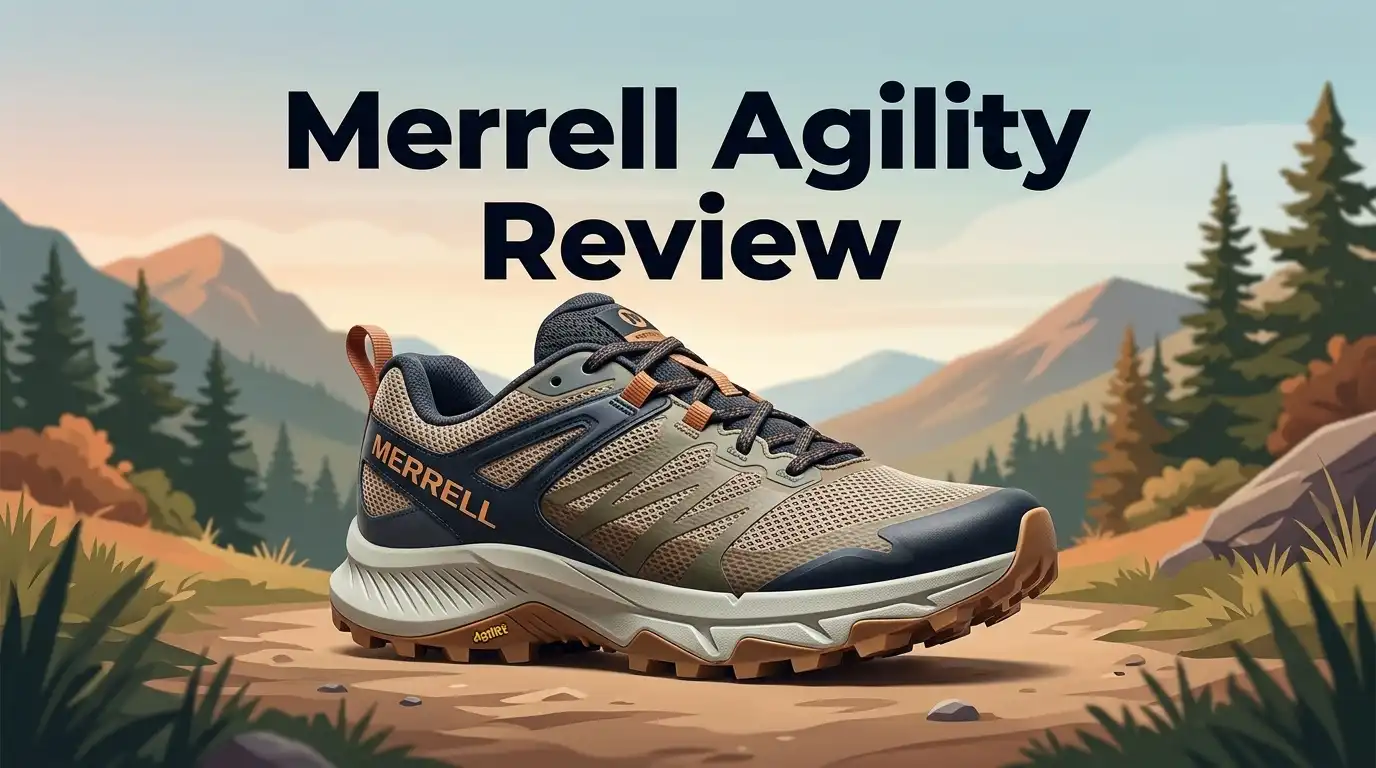
Merrell Agility Peak 5 Review 2026: Still Worth It?
Trail shoes make big promises. Most of them fold on the first slippery descent. The Merrell Agility Peak 5 does not, and that is why runners keep talking about it years after launch.
This shoe sits in an odd spot. It is not the lightest option on the shelf. It is not the softest either. But it grips wet rock like it has something to prove, and it survives mileage that destroys other shoes.
In 2026, with the Agility Peak 6 now on shelves at a higher price, the Peak 5 has become one of the smartest buys in trail running.
In a Nutshell:
- Traction is the headline feature. The Vibram Megagrip outsole uses 4.5 mm lugs spaced wide apart. That depth sits well above the 3.5 mm trail shoe average. Mud clears fast. Wet rock feels secure. This is genuinely one of the best grip packages you can buy under $150.
- The fit runs narrow. Lab measurements put the widest point at 93.7 mm and the toe area at 70.4 mm. Both numbers fall below average. Runners with wide feet should either buy the wide version or skip this shoe completely.
- Cushioning protects but does not spring. Shock absorption scores land near average at 125 SA in the heel. Energy return sits at just 48.7%, well under the 56.7% average. This shoe feels safe, not fast.
- Durability is excellent where it matters. The outsole showed only 0.7 mm of wear in abrasion testing. Owners report 500 to 2000 miles on a single pair. The heel collar padding is the weak spot and wears down early.
- Value in 2026 is strong. With the Peak 6 selling around $160 and the Gore Tex version at $185, the Peak 5 now sells at steep discounts. You get roughly 90% of the performance for a lot less money.
- Best for heel strikers on technical ground. Long descents, rocky ridgelines, and sloppy conditions suit this shoe. Smooth fire roads do not.
What Is the Merrell Agility Peak 5?

- Breathable engineered mesh and TPU upper
- SBR/mesh collar and tongue offer low water absorption and enhanced stretch properties for improved...
- FLEXconnect dual-directional flex-grooves in the midsole for enhanced ground connection
Last update on 2026-08-31 / Affiliate links / Images from Amazon Product Advertising API Some of the links on this website are affiliate links, which means that at no additional cost to you, I earn a commission if you click through and make a purchase. I only recommend products and services that I believe will add value to my readers. Thank you for your support!
The Agility Peak 5 is Merrell’s technical trail running shoe. It targets runners who spend time on rough, unpredictable ground rather than groomed paths.
Merrell built this version around three ideas: grip, protection, and durability. The midsole uses FloatPro foam, an EVA based material that balances softness and support. A rock plate runs through the midfoot and forefoot. The outsole comes from Vibram, using their Megagrip rubber compound.
The name matters here. Merrell called it “Agility” for a reason. This shoe does not chase the wide, maximalist platform trend. It stays narrow and nimble so you can carve corners and place your feet precisely on technical ground.
The stated specs read like this: 31 mm heel stack, 25 mm forefoot stack, and a 6 mm drop. Independent lab testing measured different numbers, with a 39.2 mm heel and 25.8 mm forefoot, producing a much larger 13.4 mm offset. That gap comes from different measuring standards, not from Merrell being dishonest. Either way, the heel carries far more foam than the front.
Weight lands at 10.2 oz (289 g) for a men’s US 9. Women’s pairs come in around 8.3 oz (235 g). That places the shoe slightly above the trail category average.
Two versions exist. The standard model uses breathable mesh. The Gore Tex model adds a waterproof membrane for wet climates. Both share the same midsole and outsole.
Unboxing Experience and First Impressions
The box arrives plain. Merrell uses a simple recycled cardboard box with minimal printing. No tissue paper theater. No branded extras. Some brands overdo the packaging. Merrell clearly decided the money belonged in the shoe instead.
Lift the lid and the first thing you notice is the outsole. I flipped my pair over immediately. The lugs look aggressive in a way photos do not capture. They stand tall, spaced far apart, with chevron and butterfly shapes pointing in different directions. The yellow Vibram octagon sits right there in the middle.
Pick the shoe up and it feels solid. Not heavy exactly, but dense. There is real material here. Squeeze the toe box and you feel TPU reinforcement layers under the mesh. Twist the shoe and it barely moves. That torsional stiffness is intentional.


Last update on 2026-04-11 / Affiliate links / Images from Amazon Product Advertising API Some of the links on this website are affiliate links, which means that at no additional cost to you, I earn a commission if you click through and make a purchase. I only recommend products and services that I believe will add value to my readers. Thank you for your support!
The upper mesh feels tight and slightly rough to the touch. It does not have the soft knit hand feel of a road shoe. That is fine. This is armor, not pajamas.
Slide your hand inside and the interior feels smooth with no rough seams. The insole lifts out easily since Merrell does not glue it down. That insole carries a Cleansport NXT odor treatment, which is a nice touch if you sweat heavily.
The tongue surprised me. At 3.3 mm of padding it is thin, well under the 6.4 mm average. First impression: this shoe cut weight wherever it could, then spent all of it on the outsole.
Merrell Agility Peak 5 Specs at a Glance
Numbers tell a clear story once you line them up. Here is what the Agility Peak 5 brings to the trail.
Weight: 10.2 oz (289 g) for men’s US 9. Women’s US 7 sits at 8.3 oz (235 g). Slightly above average for the category.


Last update on 2026-04-11 / Affiliate links / Images from Amazon Product Advertising API Some of the links on this website are affiliate links, which means that at no additional cost to you, I earn a commission if you click through and make a purchase. I only recommend products and services that I believe will add value to my readers. Thank you for your support!
Stack height: Merrell lists 31 mm heel and 25 mm forefoot. Lab testing found 39.2 mm and 25.8 mm using World Athletics measuring points.
Drop: Merrell states 6 mm. Lab measurement showed 13.4 mm. The truth is that the heel definitely sits noticeably higher than the forefoot.
Midsole: FloatPro EVA foam. Durometer reading of 39.5 AC, which is close to the category average of 37.7 AC. Not soft. Not firm. Balanced.
Outsole: Vibram Megagrip rubber. 4.5 mm lug depth against a 3.5 mm average. Only 31 lugs total, down sharply from 52 on the previous model. Rubber hardness measures 85.1 HC.
Rock plate: Present in the midfoot and forefoot only. The heel relies on foam thickness for protection.
Upper: Engineered mesh with TPU overlays. Breathability rated 3 out of 5 in smoke testing.
Tongue: 3.3 mm padding, semi gusseted on both sides.
Insole: 6.0 mm thick with Cleansport NXT treatment. Fully removable.
Reflective elements: None. This is a real miss for a shoe built for all conditions.
Price: Originally $140. Frequently discounted in 2026.
Top 3 Alternative for Merrell Agility Peak 5

- Unparalleled grip and precise, comfortable fit.
- Fit
- Comfort
Last update on 2026-06-08 / Affiliate links / Images from Amazon Product Advertising API Some of the links on this website are affiliate links, which means that at no additional cost to you, I earn a commission if you click through and make a purchase. I only recommend products and services that I believe will add value to my readers. Thank you for your support!
Salomon Speedcross 6

- JACQUARD KNIT UPPER
- Lining Textile
Last update on 2026-08-31 / Affiliate links / Images from Amazon Product Advertising API Some of the links on this website are affiliate links, which means that at no additional cost to you, I earn a commission if you click through and make a purchase. I only recommend products and services that I believe will add value to my readers. Thank you for your support!
Hoka Speedgoat 6

- THIS MEN’S SHOE IS FOR: The Cascadia 18 provides runners and mountain hikers with adaptable...
- COMFORT & SECURITY: DNA LOFT v2 provides soft cushioning over any terrain while the TrailTack Green...
- ADAPTABLE STABILITY: The Trail Adapt System utilizes an integrated midsole, with articulated...
Last update on 2026-08-31 / Affiliate links / Images from Amazon Product Advertising API Some of the links on this website are affiliate links, which means that at no additional cost to you, I earn a commission if you click through and make a purchase. I only recommend products and services that I believe will add value to my readers. Thank you for your support!
Brooks Cascadia 18
Fit and Sizing: Does It Run Narrow?
This is the section that matters most, because fit decides whether you love or return this shoe.
The Agility Peak 5 fits true to size in length. Internal length measures 269.8 mm in a US 9, almost exactly the 269.4 mm average. Order your normal size and the length will be right.
Width is a different conversation. The widest part of the shoe measures 93.7 mm against a 95.6 mm average. The big toe area measures 70.4 mm against a 74.2 mm average. Those gaps are small on paper and very noticeable on foot.
If you have narrow or standard width feet, this snug fit works in your favor. Your foot stays locked over the platform during sharp turns. Nothing slides on steep descents. You feel connected to the ground.
If you have wide feet, you will feel squeezed across the forefoot. Toe splay is limited. On long runs that pressure turns into hot spots and numb toes. Merrell sells a wide version and wide footed runners should buy it without hesitation.
One saving grace: toe box height measures 27.0 mm, right at average. So while the shoe pinches side to side, your toes have vertical room. That helps more than you would expect on long descents when feet swell.
Reddit users are split. Some call it painfully narrow. Others say reviews exaggerate the problem. Foot shape decides the answer, so try before you commit if you can.
Midsole and Cushioning Performance
FloatPro foam is not exciting. It is reliable. Those are different things and the difference shows up on the trail.
Shock absorption measures 125 SA in the heel and 99 SA in the forefoot. Both numbers sit close to the trail shoe average. Protection is adequate rather than plush. Sharp rocks do not reach your foot. Long descents do not beat up your quads the way a thin shoe would.
Energy return is where the shoe disappoints. Lab testing recorded 48.7% in the heel and 52.0% in the forefoot, against a 56.7% average. You feel this. The shoe absorbs your effort instead of giving it back.
Push the pace and the Agility Peak 5 does not push with you. It stays flat and steady. For hikers and ultra runners grinding out steady miles, that is fine. For anyone chasing a fast finish, it feels like running with the brakes half engaged.
The foam handles cold weather remarkably well. Softness changed only 12% in low temperature testing, compared with a 23% average. EVA usually turns to concrete in winter. This one does not. Winter runners get a real advantage here.
Stiffness measures 16.8N to bend to 30 degrees, above the 14.8N average. The shoe resists flexing. Combined with the rock plate, that means excellent protection and a slightly clunky feel during easy running on flat ground.
Vibram Megagrip Outsole and Traction
This is the reason to buy the shoe. Everything else is supporting cast.
Vibram Megagrip is widely considered the best rubber compound in trail running. Merrell paired it with 4.5 mm lugs, a full millimeter deeper than category average. Those lugs sit widely spaced across the sole in a multi directional pattern.
Wide spacing does two jobs. Mud releases instead of packing into the tread. Snow does not build up under your foot. On sloppy trails where other shoes turn into platform heels, this one keeps biting.
The lug count dropped from 52 on the Agility Peak 4 to just 31 here. Fewer, bigger, deeper lugs. That change improves mud performance and reduces weight. It slightly reduces contact area on dry hardpack and smooth rock, so pure lab grip scores took a small hit.
In real use, I never felt short on grip. Wet roots held. Loose scree held. Steep wet grass, the hardest surface in trail running, held better than I expected.
Outsole durability is outstanding. Abrasion testing produced only 0.7 mm of wear against a 0.9 mm average. One reviewer logged 2000 miles and reported the outsole still had usable life left.
The rubber layer measures just 1.4 mm thick, thinner than the 1.9 mm average. That thinness is a feature. It keeps weight down and stops the ride from feeling dead and muted.
Upper Build and Breathability
The upper is built like it expects abuse. Engineered mesh forms the base, with TPU overlays layered across every high wear zone.
Microscope inspection shows a dense weave. Abrasion testing on the toe area scored a perfect 5 out of 5. Rock scrapes and bramble hits do not open holes in this shoe. Long term owners confirm this. Uppers on the Agility Peak 5 routinely outlast the midsole.
Breathability rated 3 out of 5 in smoke testing, right around average. Merrell concentrated the airflow in the toe box, skipping any inner lining there. The midfoot is heavily structured for support, so almost no air moves through that zone.
This is a deliberate compromise. The shoe stays warm enough for winter running and stays tolerable in summer heat. It will not excel at either extreme. Desert runners will find it hot. Alpine runners will appreciate the extra insulation.
The tongue is semi gusseted on both sides. Lockdown works fine, but a fully gusseted tongue belongs on a shoe built for mud and snow. Debris finds its way in more than it should.
Tongue padding sits at just 3.3 mm. Lace pressure across the top of the foot becomes noticeable if you cinch hard.
Heel counter stiffness rated 4 out of 5. Your heel stays locked. The pull tab at the back is small but works, and it accepts a gaiter hook.
What the Agility Peak 5 Does Not Do Well
Honest reviews name the failures. Here are this shoe’s real weaknesses.
Heel collar padding wears out fast. Abrasion testing scored just 2 out of 5, below the 3.1 average. That plush collar feels great in the store and compresses within a few hundred miles. Some owners report the interior lining tearing at the heel.
No reflective elements exist anywhere on the shoe. For a trail shoe marketed for all season use, this is careless. Winter running means dark mornings and dark evenings. You get zero visibility help.
Energy return is genuinely poor. At 48.7%, this shoe sits near the bottom of the category. Fast running feels like work. If you race short trail distances, look elsewhere.
The narrow forefoot excludes a lot of runners. Merrell offers a wide version, but availability in specific colorways is limited.
It is not a road or fire road shoe. Those 4.5 mm lugs feel awkward and loud on pavement. They also wear faster on hard surfaces.
Weight could be lower. At 10.2 oz, the shoe carries more mass than the design needs. Trimming half an ounce would change how it feels at mile 20.
The thin tongue creates lace pressure. Runners who like tight lacing will notice this on longer efforts.
Stiffness reduces ground feel. Technical footwork requires more concentration than in a flexible shoe.
Pros and Cons
Here is the balanced summary after real trail testing.
Pros:
- Vibram Megagrip outsole with 4.5 mm lugs delivers outstanding traction on mud, wet rock, loose gravel, and snow. Grip is the strongest feature of this shoe by a wide margin.
- Outsole durability is exceptional. Only 0.7 mm of abrasion wear in testing, with owners reporting 500 to 2000 miles per pair.
- The upper survives serious abuse. TPU reinforcement scored a perfect 5 out of 5 in toe abrasion testing.
- Foam performs well in cold weather, softening only 12% in low temperatures compared with a 23% average.
- Rock plate protection through the midfoot and forefoot keeps sharp stones away from your foot on rough ground.
- Torsional rigidity rated 5 out of 5 provides real stability on uneven, off camber terrain.
- Heel counter locks your foot down during steep descents.
- Cleansport NXT insole treatment keeps odor under control.
Cons:
- Narrow forefoot at 93.7 mm creates pressure for wide footed runners. Toe splay is limited.
- Energy return of 48.7% is well below average. The shoe feels sluggish at faster paces.
- Heel collar padding wears down early, scoring only 2 out of 5 in durability testing.
- Zero reflective elements limit visibility during dark runs.
- Weight of 10.2 oz is heavier than comparable technical trail shoes.
- Thin 3.3 mm tongue allows lace pressure on the top of the foot.
- Semi gusseted tongue lets debris enter more easily than a full gusset would.
- Stiff ride reduces ground feel and feels clunky on smooth trails.
Real Trail Performance Over Distance
Specs describe a shoe. Miles reveal it.
On technical singletrack the Agility Peak 5 comes alive. The stiff platform lets you plant a foot on an uneven rock and stay balanced. Torsional rigidity rated 5 out of 5 means the shoe does not twist under you when your foot lands at a bad angle. That confidence changes how aggressively you run.
Descending is the shoe’s best skill. The tall heel stack absorbs impact. The heel counter holds your foot back from the toe box. Deep lugs bite into loose dirt so you can let gravity work.
Climbing works well too. The forefoot rock plate protects against sharp edges when you push off toe first. The narrow platform means your foot sits over a stable base rather than a wide floating slab.
Long distance comfort holds up better than the energy return numbers suggest. Ultra runners report all day comfort on this shoe. The combination of a 6.0 mm insole and thick heel foam keeps fatigue manageable past the four hour mark.
Where it struggles: flat, smooth, fast running. On a gravel path at a steady pace, the shoe feels heavy and stiff. You notice the weight. You notice the lack of bounce.
Mud is a highlight. Wide lug spacing sheds sludge instead of collecting it. Snow behaves the same way. Winter and shoulder season running is exactly where this shoe belongs.
Merrell Agility Peak 5 vs Agility Peak 6
The Agility Peak 6 launched in early 2026 at $160, with a Gore Tex version at $185 and a BOA version at $180. The question is whether the upgrade is worth the price gap.
Merrell fixed the biggest complaint. The Peak 6 feels less sluggish underfoot. Merrell reworked the midsole to reduce that dead, energy absorbing sensation that defined the Peak 5. Faster running feels genuinely better.
The upper also changed. Version 6 uses a more fitted, more durable construction. Lockdown improved. The fit remains on the narrow side, so wide footed runners still need the wide version.
Traction stayed excellent. Reviewers describe the Peak 6 as having one of the best traction packages available, which is unsurprising since Merrell kept the Vibram Megagrip approach.
What you lose by choosing the Peak 5: some responsiveness, some upper refinement, and access to the BOA lacing option.
What you gain: money. Substantial money. The Peak 5 originally sold for $140 and now appears regularly at discounts well below that. You can often buy two pairs of the Peak 5 for the price of one Peak 6 with Gore Tex.
My honest take: if you run fast and race often, pay for the Peak 6. If you hike, hit long steady miles, or run technical terrain at moderate pace, the Peak 5 gives you nearly the same experience for far less.
Gore Tex Version vs Standard Version
Merrell sells the Agility Peak 5 in two builds. Choosing correctly matters more than most people realize.
The standard version uses breathable engineered mesh. Water enters freely through stream crossings and drains out just as freely. Breathability rated 3 out of 5. Weight stays at 10.2 oz.
The Gore Tex version adds a waterproof membrane. Rain, snow, wet grass, and shallow puddles stay outside. Weight increases slightly. Breathability drops noticeably, because that is the unavoidable cost of a membrane.
Here is the trade off nobody enjoys. Waterproof shoes keep water out until water comes over the collar. Then they keep water in. A deep stream crossing turns a Gore Tex shoe into a bucket.
Choose Gore Tex if you run in cold, wet climates, deal with regular rain and snow, or hike more than you run. Warm feet in winter is a genuine quality of life upgrade.
Choose the standard version if you run in warm weather, cross streams regularly, or sweat heavily. Fast drainage beats waterproofing in those conditions.
The narrow fit issue applies to both versions. Lab testing on the Gore Tex model reached the same conclusion: not the best choice for average or wide feet.
Price differs too. Gore Tex builds carry a premium of roughly $20 to $40 depending on retailer and current discounts.
Who Should Buy the Merrell Agility Peak 5?
- Breathable engineered mesh and TPU upper
- SBR/mesh collar and tongue offer low water absorption and enhanced stretch properties for improved...
- FLEXconnect dual-directional flex-grooves in the midsole for enhanced ground connection
Last update on 2026-08-31 / Affiliate links / Images from Amazon Product Advertising API Some of the links on this website are affiliate links, which means that at no additional cost to you, I earn a commission if you click through and make a purchase. I only recommend products and services that I believe will add value to my readers. Thank you for your support!
This shoe suits specific runners very well and disappoints others. Match yourself honestly.
Buy this shoe if you are a heel striker. The tall heel stack, wide 93.0 mm heel platform, and stiff heel counter all favor rearfoot landings. Heel strikers get maximum benefit from this design.
Buy it if you run technical terrain. Rocky ridges, root covered singletrack, loose descents, and off camber trails all reward the stiff, grippy, protective build.
Buy it if you run in mud or snow. Wide lug spacing and cold resistant foam make this an excellent winter and shoulder season option.
Buy it if durability matters more than speed. Owners routinely report 500 plus miles. Some reach 2000. Cost per mile on this shoe is genuinely low.
Buy it if you have narrow or standard width feet. The snug fit becomes an advantage rather than a problem.
Skip it if you run on smooth paths or fire roads. A lighter, softer, more flexible shoe will serve you better.
Skip it if you have wide feet and cannot find the wide version in your size.
Skip it if you race short trail distances. The low energy return works against you when speed is the goal.
Skip it if you need reflective visibility for early morning or evening running without additional gear.
Hikers and fastpackers should pay attention here. The protection, grip, and durability profile fits hiking beautifully.
Price and Value in 2026
The Agility Peak 5 launched at $140. That was competitive at the time. In 2026, the situation has improved considerably for buyers.
Merrell has moved attention to the Agility Peak 6 at $160, with the Gore Tex build at $185 and the BOA version at $180. Retailers clearing Peak 5 inventory have pushed prices well below the original figure. Discounted pairs represent one of the better deals in trail running right now.
Value depends on cost per mile, not sticker price. A $140 shoe that lasts 300 miles costs about 47 cents per mile. The Agility Peak 5 regularly reaches 500 to 800 miles, and documented cases hit 2000. At a discounted price with 600 miles of life, you are paying under 20 cents per mile.
Compare that with the competition. The Hoka Speedgoat 6 and Salomon Speedcross 6 both sit in similar price territory at full retail. Neither offers a clear durability advantage.
The Vibram Megagrip outsole is the value driver. Cheaper trail shoes use proprietary rubber compounds that grip acceptably and wear quickly. Megagrip does both jobs better.
One caution on sizing availability. As inventory clears, wide versions and specific colorways disappear first. If you need a wide fit, act sooner rather than later.
For runners who want maximum trail capability without paying premium prices, this shoe delivers strong value in 2026.
Final Verdict
The Merrell Agility Peak 5 is a specialist that pretends to be a generalist. Understand that and you will be happy with it.
What it does brilliantly: grip, protection, and durability. The Vibram Megagrip outsole with 4.5 mm lugs handles conditions that embarrass most trail shoes. The upper survives abuse that shreds thinner materials. The rock plate keeps sharp terrain away from your foot.
What it does poorly: speed and width. Energy return of 48.7% means this shoe absorbs effort rather than returning it. The 93.7 mm forefoot excludes runners with wide feet unless they find the wide version.
My honest recommendation: buy this shoe if your trails are rough, wet, or steep, and if you value miles over minutes. It is a workhorse. It is not a racehorse.
The absence of reflective elements still bothers me. So does the heel collar padding that wears out early. Neither issue is a dealbreaker, but both are avoidable design choices.
At 2026 discount prices, the value argument becomes strong. You are getting Vibram Megagrip, a rock plate, and a heavily reinforced upper for less than many midrange trail shoes with inferior components.
Overall rating: 8 out of 10. Excellent for technical terrain and long distance durability. Below average for speed and forefoot comfort.
If your feet fit it and your trails are hard, this shoe earns its place in your rotation.
Frequently Asked Questions
Does the Merrell Agility Peak 5 run true to size?
Yes, in length. Internal length measures 269.8 mm in a US 9, almost identical to the 269.4 mm category average. Order your normal running shoe size. Width is the real question. The forefoot measures 93.7 mm at its widest point, below the 95.6 mm average. Runners with wide feet should order the wide version rather than sizing up, because sizing up creates heel slip without solving the width issue.
Is the Merrell Agility Peak 5 good for hiking?
Yes, very good. The stiff platform, rock plate, and deep Vibram Megagrip lugs all suit hiking well. Torsional rigidity rated 5 out of 5 gives you stability on uneven ground with a loaded pack. The tall heel stack absorbs impact on long descents. Many owners use this shoe for day hikes and fastpacking rather than running. The only limitation is ankle support, since this is a low cut shoe.
How many miles will the Agility Peak 5 last?
Expect 500 to 800 miles for most runners. Abrasion testing showed only 0.7 mm of outsole wear, better than the 0.9 mm average. One long term reviewer documented 2000 miles with the outsole still functional. The midsole foam will compress before the outsole wears out. The heel collar padding is the first component to fail, typically within a few hundred miles.
Should I buy the Gore Tex version?
Choose Gore Tex if you run in cold, rainy, or snowy conditions and rarely cross deep water. The membrane keeps your feet dry and warm. Choose the standard mesh version if you run in warm weather, cross streams often, or sweat heavily. The mesh drains fast and breathes better. Both versions share the same narrow fit, so the width consideration applies either way.
Is the Agility Peak 5 or Agility Peak 6 better?
The Peak 6 is the better shoe technically. It feels less sluggish, uses an improved upper, and offers a BOA lacing option. It also costs more at $160 standard and $185 for Gore Tex. The Peak 5 delivers roughly 90% of the performance at a much lower discounted price in 2026. Fast runners should choose the Peak 6. Everyone else gets better value from the Peak 5.
Can I use the Agility Peak 5 on roads?
You can, but you should not make a habit of it. The 4.5 mm lugs feel unstable and noisy on pavement. Hard surfaces wear the lugs down faster than trails do. Short road sections connecting trail segments are fine. Regular road running will destroy the traction advantage that makes this shoe worth buying.
Does it have enough cushioning for ultra distances?
Yes. Shock absorption measures 125 SA in the heel and 99 SA in the forefoot, both near average. Heel stack reaches 39.2 mm in lab measurements, providing serious protection over long distances. Ultra runners report all day comfort in this shoe. The low energy return means it will not feel fast late in a race, but protection remains excellent throughout.

Mia Smith is the founder of Shoe Storyteller, a blog that celebrates the art and stories behind shoes. With a passion for fashion and a flair for storytelling, Mia brings a unique perspective to the world of footwear.