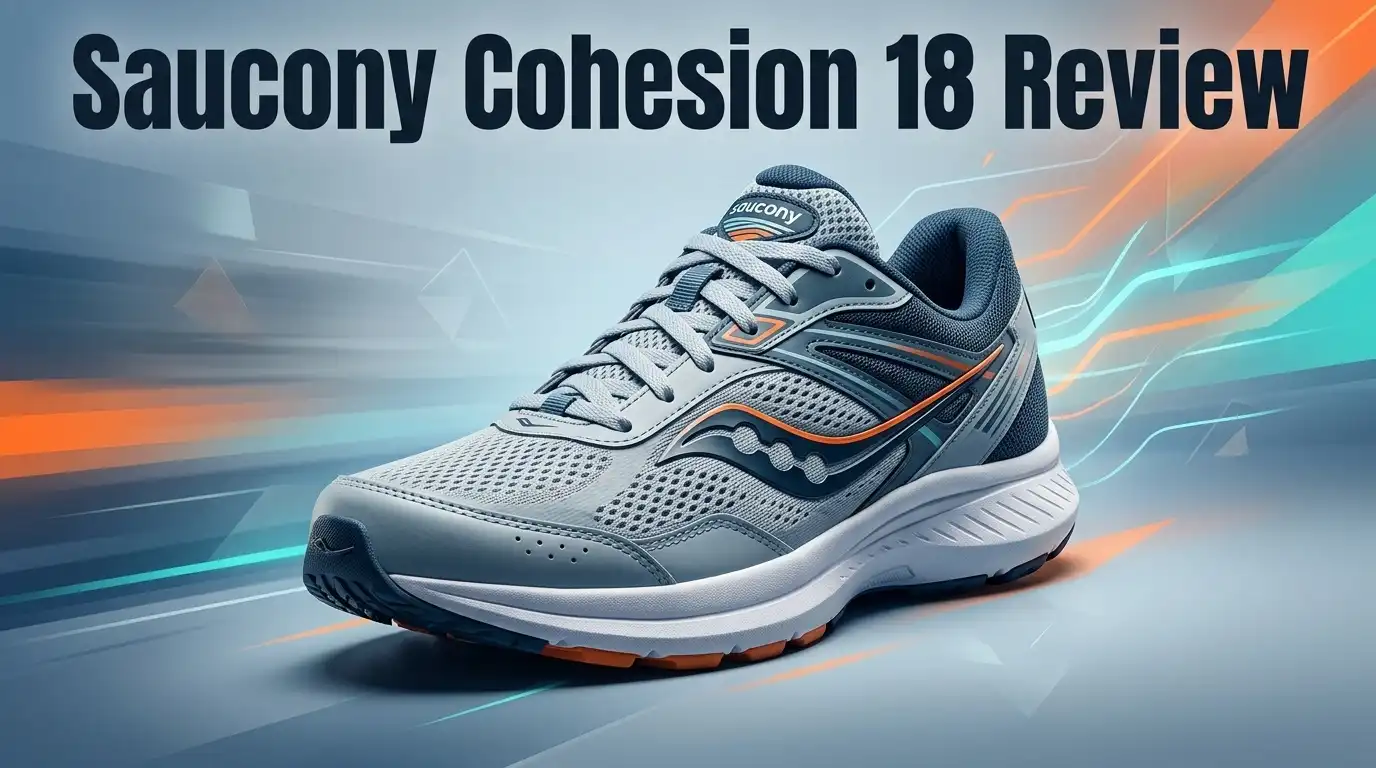
Saucony Cohesion 18 Review 2026: Still Worth It?
Cheap running shoes carry a reputation problem. Most runners assume a low price means thin foam, weak rubber, and sore knees by week three.
The Saucony Cohesion 18 sits right in the middle of that debate at around $70, and it keeps showing up on beginner shoe lists, on treadmill decks, and in high school locker rooms.
I spent weeks putting miles on this shoe and reading through what other testers found. This review covers the unboxing, the fit, the ride, the flaws, and the honest limits of a budget trainer in 2026. You will get the good parts and the parts Saucony would rather you skip.
In A Nutshell:
- Price is the headline. The Cohesion 18 sells for roughly $70, which is less than half the cost of most premium daily trainers. That price makes it one of the easiest entry points into running.
- The ride feels firm, not plush. Saucony uses VersaRun EVA foam with a 33 mm heel stack and a tall 12 mm drop. You feel the road. Some runners like that. Others find it harsh past five miles.
- Break in time is real. The upper feels stiff out of the box and the foam feels dense. Both soften after two or three runs, so do not judge the shoe on your first try on.
- Durability is a strong point. The XT 900 rubber outsole holds up well on pavement. The midsole foam wears out faster than the rubber, which is the usual budget shoe tradeoff.
- It is not a long run shoe. Shock absorption drops off during longer efforts. Short runs, walks, gym sessions, and quick intervals suit it best.
- Best buyer profile: new runners, walkers, teen athletes, and anyone who needs a second pair without spending $160.
Saucony Cohesion 18 Overview

- Our versatile neutral cushioning running shoe, designed to give you everything you need for all day...
- Enhanced cushioning with even more VersaRun foam underfoot coupled with a plush sockliner for...
- Strategically zoned XT-900 rubber maintains traction and durability while improving flexibility

Last update on 2026-08-31 / Affiliate links / Images from Amazon Product Advertising API Some of the links on this website are affiliate links, which means that at no additional cost to you, I earn a commission if you click through and make a purchase. I only recommend products and services that I believe will add value to my readers. Thank you for your support!
The Cohesion line has existed for nearly two decades. Saucony treats it as the entry shelf of the brand, the model that sits below the Ride, the Guide, and the Triumph. Version 18 keeps that job description intact.
The build is simple. You get a VersaRun EVA midsole, a breathable engineered mesh upper, a padded collar, and strategically zoned XT 900 rubber on the outsole. There is no plate, no rocker geometry, no supercritical foam, and no fancy marketing story.
Specs land like this: the men’s version weighs about 10.2 oz and the women’s version about 8.6 oz. Heel stack sits near 33 mm with a 12 mm heel to toe drop. That drop number is unusually tall by 2026 standards, since most trainers now sit between 4 mm and 8 mm.
The high drop matters more than people expect. It pushes your weight forward and takes some strain off the calves and Achilles. Heel strikers usually adapt fast. Midfoot and forefoot runners may notice the ramp angle right away.
Saucony markets this as a neutral cushioning shoe. That label is accurate but generous. The cushioning is moderate at best compared with modern foam, though the platform is wide and steady, which gives it a planted feel that beginners appreciate.
Colorways are wide, sizes run from narrow through wide in many options, and kids’ versions exist too. The Cohesion 18 is a workhorse, not a showpiece.
Unboxing Experience And First Impressions
The box is plain cardboard with the Saucony logo stamped on the lid. No tissue paper, no extra laces, no marketing card explaining foam technology. You lift the lid and there are two shoes stuffed with paper. That is the whole ceremony.
Pick the shoe up and the first thing you notice is weight. It feels heavier in hand than the number suggests, mostly because the rubber coverage is generous and the upper carries real overlays instead of thin printed film.
The mesh feels coarse under the fingers. It is not the soft knit found on $150 trainers. Squeeze the midsole and it barely dents. That density is your first clue about the ride.


Last update on 2026-04-11 / Affiliate links / Images from Amazon Product Advertising API Some of the links on this website are affiliate links, which means that at no additional cost to you, I earn a commission if you click through and make a purchase. I only recommend products and services that I believe will add value to my readers. Thank you for your support!
Slide your foot in and the collar padding feels decent. The tongue is thin but not annoying. The heel counter is stiff and holds shape well, which helps lockdown.
Here is the honest part: the first step in feel is underwhelming. One tester described it as walking on a slab of wood, and that description is fair. The forefoot shape pushes your toes outward, and pressure on the pinky toe shows up early for some feet.
I walked around the house for ten minutes and the shoe stayed stiff. After the first three mile run, it loosened noticeably. After the second run, the foam felt friendlier and the upper stopped fighting my instep.
So the unboxing does not sell you. The shoe earns its place slowly, and that is a genuinely different experience from premium models that feel great in the store.
Fit And Sizing Notes
Sizing runs true for most feet. If you wear a 10 in Nike or Brooks, order a 10 here and you will land close. Length is accurate and the heel does not slip once laced.


Last update on 2026-04-11 / Affiliate links / Images from Amazon Product Advertising API Some of the links on this website are affiliate links, which means that at no additional cost to you, I earn a commission if you click through and make a purchase. I only recommend products and services that I believe will add value to my readers. Thank you for your support!
The toe box tells a more complicated story. It offers decent length room but the shape flares outward in a way that feels odd rather than roomy. Your forefoot gets spread instead of cradled. Runners with narrow feet may swim slightly in the front while still feeling pressure on the outer edge.
Wide sizes are available and worth choosing if you normally need them. Standard width works for average and slightly wide feet, though people with high volume feet should size carefully.
Midfoot lockdown is the strongest part of the fit. The lacing holds well without pinching, and the eyelet spacing lets you adjust tension across the arch. Heel hold is secure thanks to that firm counter.
Socks change the experience more than usual with this shoe. Thin racing socks make the interior feel loose and expose seam edges. Medium thickness cushioned socks fill the space and smooth things out. I would recommend the thicker option for anyone running over three miles.
One more note on break in. The upper mesh has limited stretch, so hot spots that appear on day one may fade but rarely disappear entirely. Try before you commit if your feet have unusual shapes.
Top 3 Alternative for Saucony Cohesion 18

- Cushioning with GEL technology
- It offers a soft and comfortable fit
- GEL technology on the heel
Last update on 2026-08-31 / Affiliate links / Images from Amazon Product Advertising API Some of the links on this website are affiliate links, which means that at no additional cost to you, I earn a commission if you click through and make a purchase. I only recommend products and services that I believe will add value to my readers. Thank you for your support!
ASICS Gel Contend 9

- Hit the road with reliable fresh foam midsole that cushions every stride.
- The mesh running sneakers design maximizes breathability during your workout.
- No-sew overlays keep weight down while staying durable through miles of running.
Last update on 2026-08-30 / Affiliate links / Images from Amazon Product Advertising API Some of the links on this website are affiliate links, which means that at no additional cost to you, I earn a commission if you click through and make a purchase. I only recommend products and services that I believe will add value to my readers. Thank you for your support!
New Balance Fresh Foam Arishi V4
No products found.
Brooks Launch 12
Cushioning And Ride Feel
The Cohesion 18 rides firm. That is the single most important sentence in this review. If you expect the soft, sinking feel of modern max cushion trainers, this shoe will disappoint you within one mile.
VersaRun foam is standard EVA. It compresses less, springs back less, and transmits more road feedback than the nitrogen infused foams found in pricier shoes. You always know what surface you are on.
That firmness brings real benefits. Stability improves because your foot does not roll around on soft foam. Ground contact feels quick and controlled, which helps newer runners who are still building coordination. Turns and stops feel secure.
The tradeoff shows up as distance climbs. My legs felt fine through three miles, acceptable through four, and noticeably beaten past five. Knees take the brunt of it during longer sessions on concrete.
Interestingly, the shoe performs well during short fast efforts. During 100 meter strides and 400 meter repeats, the firm platform feels snappy, almost like a track flat. One reviewer found it faster feeling than a Saucony model costing twice as much.
Treadmill running suits it nicely too. The belt absorbs impact that concrete does not, so the firmness reads as responsive instead of harsh.
Walking is a mixed bag. Short walks feel great and the stability helps. All day standing on hard floors gets uncomfortable because the foam does not cradle your heel over hours.
Verdict on cushioning: adequate and predictable, never luxurious.
Traction And Outsole Durability
Saucony uses XT 900 carbon rubber here, the same compound found on much more expensive shoes in the lineup. That decision is the best value choice in the entire build.
Grip on dry pavement is confident. Sidewalks, bike paths, parking lots, and treadmill belts all feel secure. The tread pattern uses flex grooves and shallow lugs that bite enough without feeling grabby.
Wet performance is acceptable but not impressive. Light rain is fine. Painted crosswalk lines, metal grates, and wet leaves demand caution. The rubber does not have the sticky quality of premium wet weather compounds.
Light trail and gravel work is possible at easy paces. The lugs are too shallow for mud or loose dirt, so treat this as a road shoe that tolerates the occasional packed path.
Durability is where the Cohesion earns respect. Reviewers who have run in older Cohesion models report a full year of use without meaningful outsole damage. The rubber coverage is thick in the heel and forefoot, and the exposed foam sections are small.
The toe bumper deserves a mention. A rubber sweep protects the front of the mesh, which stops the scuffing that kills cheap shoes early.
Here is the catch. The outsole will outlive the midsole. Foam typically loses its bounce between 250 and 350 miles depending on your weight and mileage. The bottom may look fresh while the ride goes flat.
Track your miles rather than trusting the tread.
Upper Breathability And Build Quality
The engineered mesh upper does its job without drawing attention. Air moves through the forefoot well enough for summer running at easy paces, and feet stay reasonably cool during 30 to 45 minute sessions.
Push the pace or the temperature and the picture changes. The mesh is denser than premium uppers, so heat builds during long hot runs. Your socks will be damp after an August afternoon effort.
Construction quality is better than the price suggests. Stitching is clean, the overlays are bonded properly, and I found no loose threads or glue marks on my pair. Nothing looks luxurious, but nothing looks cheap either.
The collar and tongue carry modest padding. It is enough to prevent lace bite and heel rub during normal use. Runners used to plush collars will notice the difference immediately.
The heel counter is stiff and internal. Some people love that structure. Others with sensitive Achilles tendons find it rigid during the first week. Lacing the top eyelet loosely helps.
Water resistance is basically zero, which is normal for mesh trainers. Puddles soak through instantly and drying takes several hours. Do not plan winter runs in these unless the roads are dry.
Reflective detail is minimal. If you run before sunrise or after sunset, wear a reflective vest or a light. This shoe will not make you visible on its own.
Overall build grade: honest, functional, and clearly value focused.
What The Cohesion 18 Does Not Do Well
Every review should say the quiet part out loud, so here it is.
Shock absorption is the biggest weakness. The foam simply does not have the volume or the quality to protect your joints over long distances. Heavier runners and anyone with knee sensitivity will feel it fast.
The forefoot shape is awkward. The outward flare creates pressure on the small toe for many people. That is a design flaw, not a break in issue, and it appears in multiple independent tester reports.
Arch support is minimal. People who need real structure through the midfoot should look at stability models or plan to add an aftermarket insole.
The 12 mm drop is polarizing. It suits heel strikers well. Forefoot runners often feel like they are running downhill, and calf loading changes in ways that take adjustment.
Foam longevity is limited. Expect fewer total miles than you would get from a $140 trainer. Buying two cheap pairs a year may cost the same as one better pair.
It is not built for long runs or race day. Anything past 10 kilometers becomes a test of tolerance rather than a pleasant outing.
Weight is above average. At 10.2 oz for men, it is heavier than many trainers costing the same or slightly more.
None of these flaws are dealbreakers for the intended buyer. A beginner running three miles four times a week will barely notice most of them. A marathon trainee will notice all of them by week two.
Pros And Cons
Here is the clean summary for scanners.
Pros
- Excellent price at around $70, which is roughly half of most daily trainers in 2026.
- Durable XT 900 rubber outsole that resists wear on pavement and treadmills.
- Stable, wide platform that helps new runners feel planted and controlled.
- Responsive feel during short fast efforts, with an almost track flat quality on strides and intervals.
- True to size fit with wide options available in many colorways.
- Simple design with no learning curve, no rocker, and no adaptation period for the ride mechanics.
- Solid construction quality for the money, with clean stitching and a protective toe bumper.
Cons
- Low shock absorption that becomes obvious past four or five miles.
- Awkward forefoot shape that creates pinky toe pressure for some feet.
- Stiff out of the box with a noticeable break in period of two to three runs.
- Minimal arch support for runners who need structure.
- Heavier than average at 10.2 oz for men and 8.6 oz for women.
- Midsole foam wears out faster than the outsole, shortening usable life.
- Warm upper during hot weather and long sessions.
- Almost no reflective detail for low light running.
Cohesion 18 Versus The Competition
The budget trainer category has real depth in 2026, so the Cohesion faces pressure from every direction.
Against the ASICS Gel Contend 9, the Cohesion feels firmer and slightly more responsive. The ASICS offers softer heel landings thanks to its gel unit and Amplifoam midsole, and it frequently sells for less. If comfort ranks above snappiness for you, the Contend wins.
Against the New Balance Fresh Foam Arishi V4, the difference is cushioning quality. Fresh Foam feels plusher and more forgiving over distance. The Arishi also works better as a casual everyday shoe because the styling is cleaner. The Cohesion counters with better outsole durability.
Against the Brooks Launch 12, the Cohesion loses on almost every performance metric. The Launch is lighter, livelier, and far better for tempo work. It also costs roughly $110, so the comparison is not really fair on price.
Within the Saucony family, the Ride 18 sits two tiers above with far superior foam and a 35 mm stack. It costs about $140. The gap in ride quality is enormous and worth the money if your budget allows.
Compared with the Cohesion 17, version 18 brings a refreshed upper and slightly better rubber placement. The ride character is nearly identical. If you find the 17 on clearance, buy it and save the difference.
Who Should Buy It And Who Should Skip It
Buy the Cohesion 18 if you fit these profiles.
New runners testing whether running sticks as a habit will get everything they need here. There is no reason to spend $160 before you know you enjoy the sport.
Teen athletes and high school runners benefit from the low price and firm ride. Growing feet mean frequent replacement, and this shoe makes that affordable.
Walkers doing 30 to 60 minute sessions will find the stability helpful and the price appealing.
Gym users who need one shoe for treadmill work, light lifting, and elliptical sessions get good value. The wide base handles lateral movement better than soft trainers.
Runners building a rotation can use this as the third pair for short easy days while saving premium shoes for long runs.
Skip it if any of these apply to you.
Runners logging more than 25 miles per week will destroy the foam quickly and feel the impact in their joints.
Anyone training for a half marathon or marathon needs more protection for long efforts.
Heavier runners over roughly 200 pounds will compress the midsole too fast.
Runners with knee, hip, or plantar issues should invest in better cushioning. Medical costs exceed shoe savings every time.
People who need overpronation control should look at stability models instead, since this is a neutral shoe with no medial post.
Match the shoe to the job and it performs. Ask it to do more and it fails.
Care Tips And Mileage Expectations
A few habits stretch the life of any budget trainer, and they matter more here because the margin is thin.
Rotate pairs if you can. Foam needs 24 hours to decompress fully. Running in the same shoes daily accelerates midsole death by a surprising amount.
Never machine wash them. Heat and tumbling break down the glue and the foam. Use cold water, mild soap, and a soft brush on the upper, then let them air dry away from direct sun.
Remove the insole after wet runs. Airflow prevents odor and helps the interior dry faster. Newspaper stuffed inside speeds the process.
Untie the laces before taking them off. Crushing the heel counter with your other foot ruins lockdown permanently.
Track your mileage. A phone app or a simple notebook works. For this shoe, plan on replacement between 250 and 350 miles depending on your weight and running surface.
Watch for these replacement signals: unusual leg soreness after normal runs, visible midsole creasing, uneven outsole wear, and a flat dead feeling on landing.
Keep them off trails and rough terrain. The outsole is not built for it and the upper offers no protection from rocks.
One last practical tip. Buy your next pair when the current one hits 200 miles. Prices fluctuate, colorways sell out, and having a backup lets you rotate during the final stretch of the old pair’s life.
Final Verdict
The Saucony Cohesion 18 does exactly one thing well: it lets people run without spending much money. That purpose has genuine value.
The shoe is firm, a little heavy, and awkward through the forefoot. It will not thrill anyone who has run in modern foam. It also will not fall apart, will not cost you $150, and will not confuse you with complicated geometry.
My rating: 3.5 out of 5 for the intended buyer, and 2 out of 5 for experienced runners. That split matters more than a single number.
If you are starting out, walking for fitness, or building a cheap rotation piece, buy it with confidence. If you are training seriously or logging real mileage, spend more and thank yourself later.
Frequently Asked Questions
Is the Saucony Cohesion 18 good for beginners?
Yes. The stable platform, simple ride, and low price make it a sensible first running shoe. Expect a short break in period and keep early runs under five miles while your legs adapt.
How many miles will the Cohesion 18 last?
Plan for 250 to 350 miles. The rubber outsole often looks fine well past that point, but the EVA midsole loses responsiveness first. Heavier runners land at the lower end of that range.
Does the Cohesion 18 run true to size?
Yes for length. The forefoot flares outward, so people with narrow feet may want to try them on first. Wide widths are available and worth choosing if you normally need them.
Is the Cohesion 18 good for walking?
It works well for walks up to about an hour. All day standing on hard floors is less comfortable because the foam is firm and does not cradle the heel over long periods.
Can I use the Cohesion 18 for a half marathon?
You can finish one in them, but your legs will pay for it. The cushioning does not protect well past five or six miles. A more cushioned trainer is the better choice for that distance.
What is the drop on the Saucony Cohesion 18?
The heel to toe drop is 12 mm with a heel stack near 33 mm. That is high compared with most current trainers, which often sit between 4 mm and 8 mm.
Is the Cohesion 18 a stability shoe?
No. It is a neutral shoe with a wide base. The platform feels steady, but there is no medial post or guidance frame for correcting overpronation.
How does the Cohesion 18 compare to the Cohesion 17?
The differences are small. Version 18 has a refreshed upper and slightly adjusted rubber placement. The ride feels nearly identical, so buying the 17 on discount is a smart move.

Mia Smith is the founder of Shoe Storyteller, a blog that celebrates the art and stories behind shoes. With a passion for fashion and a flair for storytelling, Mia brings a unique perspective to the world of footwear.