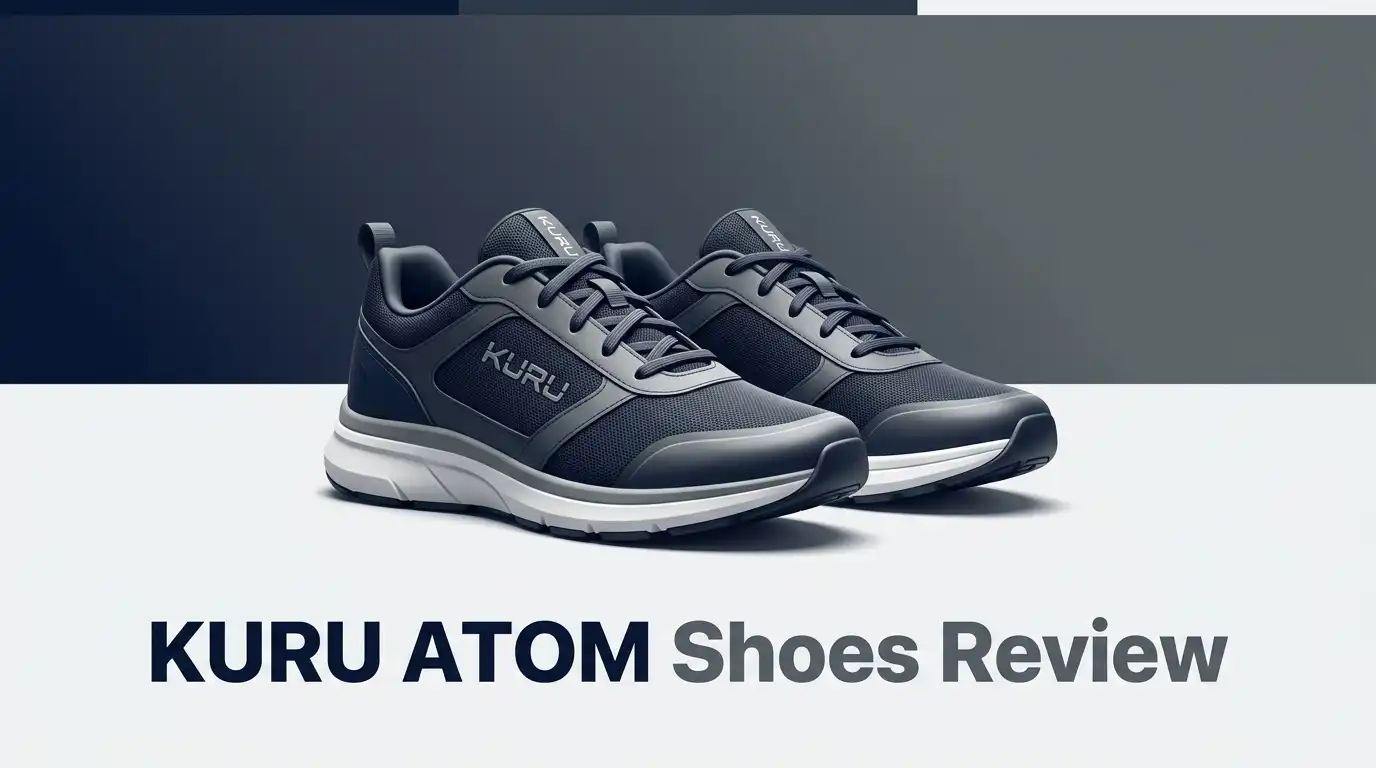
KURU ATOM Shoes Review 2026: Worth Buying?
Foot pain has a way of shrinking your life. You skip the museum. You sit out the walking tour. You dread the grocery store parking lot. KURU built its entire brand around that problem, and the ATOM is the sneaker most people land on first.
So does it actually work? I spent weeks in a pair, logged airport days, dog walks, standing shifts, and a few light runs. I also compared my notes against lab data from independent testers and hundreds of owner reviews.
The short answer is that the ATOM solves a very specific problem extremely well and fails at a few things badly. This review covers both sides with no sugar coating.
In A Nutshell:
- The ATOM is a comfort sneaker first, an athletic shoe second. KURU sells it as an athletic trainer with an 8mm heel to toe drop, but the ride feels like a supportive walking shoe. Heel strikers and standers benefit most. Fast runners will not.
- KURUSOLE is the real differentiator. A flexible plastic plate wraps under your heel and cups the fat pad with every step. Owners with plantar fasciitis and heel spurs report the biggest wins, and that shows up clearly in review patterns across forums.
- The weight is the biggest complaint. Independent lab testing weighed the ATOM 2 at roughly 12.9 oz in a men’s size 9. That is one of the heaviest cushioned sneakers on the market. You feel it after mile four.
- Breathability is poor. The knit upper scored 2 out of 5 in smoke testing. Summer heat and sweaty feet are a genuine issue. Cool weather suits this shoe far better.
- The toebox is narrower than advertised. KURU markets a wide toebox. Caliper measurements showed about 70.7mm at the big toe, slightly under the category average, with unusually low vertical room near 22mm.
- Price sits at $160 to $169 depending on the model and colorway, with a 91 day return window. That policy matters more than any marketing claim, because comfort shoes are personal.
KURU ATOM 2 Men’s Athletic Sneaker

- Active Tech for Your Feet
- Lightweight: 13.1oz
- Heel to Toe Drop: 10mm
Last update on 2026-09-01 / Affiliate links / Images from Amazon Product Advertising API Some of the links on this website are affiliate links, which means that at no additional cost to you, I earn a commission if you click through and make a purchase. I only recommend products and services that I believe will add value to my readers. Thank you for your support!
The ATOM 2 is the current version of KURU’s flagship trainer and the one most buyers should look at in 2026. KURU refreshed the foam, reshaped the heel, and swapped in a NOVAKNIT upper that stretches slightly across the forefoot.
Specs are straightforward. You get a stack height in the high thirties at the heel, a rubber outsole covering the full length except the midfoot, a removable ULTIMATE insole with light arch shaping, and a thick 9.9mm tongue that kills lace bite. Sizing runs from men’s 6.5 to 14 with a wide option in most colors.
The step in feel is the selling point. Your heel drops into a shaped cradle rather than sitting on flat foam. It feels like the shoe is holding you rather than the other way around. That sensation is unusual and it explains why KURU owners get loyal fast.
Lab numbers tell a more complicated story. Shock absorption measured 117 in the heel against a 131 average, and energy return came in near 41 percent versus a 59 percent average. Translated to plain language: the ATOM 2 is supportive and stable, not bouncy or springy. Every step feels planted and slightly dead. Some people love that. Runners chasing pace will not.
Torsional rigidity scored 4 out of 5, which means mild to moderate overpronation gets real support here even though KURU does not label it a stability shoe.
KURU ATOM Slip On for Women
- Weight: 11 oz
- Width: D+
- Heel to Toe Drop: 8 mm
Last update on 2026-09-01 / Affiliate links / Images from Amazon Product Advertising API Some of the links on this website are affiliate links, which means that at no additional cost to you, I earn a commission if you click through and make a purchase. I only recommend products and services that I believe will add value to my readers. Thank you for your support!
KURU also offers the ATOM platform in a slip on build, and it deserves separate attention because the use case differs completely.
This version trades lockdown for convenience. There are no laces to tie. An elastic gore panel across the instep lets you push your foot in and go. For anyone with arthritis in the hands, limited hip mobility, back pain that makes bending painful, or a pregnancy in the third trimester, that matters more than any lab metric.
The same KURUSOLE heel cradle sits underneath. You keep the heel pain relief and the arch shaping. The tradeoff is a slightly looser midfoot hold. If your foot is narrow, expect some heel slip during fast walking. If your foot is average or wide, the fit locks in acceptably.


Last update on 2026-04-11 / Affiliate links / Images from Amazon Product Advertising API Some of the links on this website are affiliate links, which means that at no additional cost to you, I earn a commission if you click through and make a purchase. I only recommend products and services that I believe will add value to my readers. Thank you for your support!
I would not choose the slip on for long distance walking days. The lace version simply holds better over ten thousand steps. But for errands, nursing shifts with quick changes, travel days through security lines, and gardening, the convenience is worth the compromise.
One honest warning: the elastic panel is the first part to fatigue. Owner reviews mention stretch out after eight to twelve months of daily wear. That is normal for the construction, not a defect, but it does shorten useful life compared to laced models.
Unboxing Experience And First Impressions
The box arrives plain. Recycled cardboard, matte finish, KURU logo, and no plastic clamshell. Inside you get the shoes stuffed with paper, a small card explaining KURUSOLE, and a second card about the 91 day return policy. No extra laces. No shoe bag. Nothing that feels like theater.
The first thing you notice is heft. Pick one shoe up and it feels dense in your palm. That is not a psychological trick. These genuinely weigh more than almost anything else in the cushioned category.
The second thing you notice is the heel. Press your thumb into the back of the shoe and you feel the plastic plate flex outward, then snap back. That is the KURUSOLE mechanism doing exactly what the marketing describes. It is oddly satisfying and it makes the technology feel real rather than invented.


Last update on 2026-04-11 / Affiliate links / Images from Amazon Product Advertising API Some of the links on this website are affiliate links, which means that at no additional cost to you, I earn a commission if you click through and make a purchase. I only recommend products and services that I believe will add value to my readers. Thank you for your support!
Step in feel is soft but controlled. The insole has a raised arch shelf you notice immediately. Your heel drops low into the shell.
Break in took me about three days of normal wear. The knit upper softened across the forefoot and the insole compressed into my foot shape. Do not judge this shoe on day one. Several reviewers who returned it quickly were reacting to a stiffness that fades.
Fit, Sizing And Toebox Space
Order your normal sneaker size. Length runs true. Independent measurement put forefoot width at 95.2mm in a men’s size 9, exactly on the category average, so the medium width fits a medium foot correctly.
Now the part KURU does not advertise honestly. The brand promotes a wide toebox. Caliper testing showed 70.7mm at the big toe against a 73.2mm average. That is not wide. It is slightly narrow. Toebox height measured around 22mm, well under the 27mm average.
Why does height matter? If you have hammertoes, bunions on the top joint, ingrown toenails, or thick orthotic insoles, low vertical space creates pressure on the nail bed. Several owner complaints trace directly to this.
The fix is simple. Order the wide. KURU offers wide in most ATOM colorways and the wide version adds meaningful room in both directions. Many buyers who wear medium in other brands are happier in KURU wide.
Heel hold is excellent. The moderately stiff counter plus the plastic base means almost no slip. Lockdown around the midfoot is secure without pressure points, helped by that thick tongue.
If you use custom orthotics, pull the stock insole out first. The footbed depth is generous enough to accept most prescription inserts without crowding your toes.
Top 3 Alternative for KURU ATOM Shoes

- ENGINEERED MESH
- Lining Textile
Last update on 2026-09-01 / Affiliate links / Images from Amazon Product Advertising API Some of the links on this website are affiliate links, which means that at no additional cost to you, I earn a commission if you click through and make a purchase. I only recommend products and services that I believe will add value to my readers. Thank you for your support!
HOKA Men’s Bondi 9

- THIS MEN’S SHOE IS FOR: Runners and walkers who want maximized cushion, and a maximized protective...
- PROTECTIVE CUSHIONING: A high stack of nitrogen-infused DNA Loft v3 midsole foam cushioning delivers...
- STABLE RIDE: A broad base offers inherent stability for a secure feel that doesn’t interfere with...
Last update on 2026-09-01 / Affiliate links / Images from Amazon Product Advertising API Some of the links on this website are affiliate links, which means that at no additional cost to you, I earn a commission if you click through and make a purchase. I only recommend products and services that I believe will add value to my readers. Thank you for your support!
Brooks Men’s Ghost Max 2

- Updated 4D guidance system for optimum stability
- PureGEL softer in the heel area
- FF BLAST+ Eco for superior energy recovery
Last update on 2026-09-01 / Affiliate links / Images from Amazon Product Advertising API Some of the links on this website are affiliate links, which means that at no additional cost to you, I earn a commission if you click through and make a purchase. I only recommend products and services that I believe will add value to my readers. Thank you for your support!
ASICS Men’s Gel Kayano 31
Cushioning And Ride Feel Explained
The ATOM uses an EVA based foam KURU calls KURUSOLE+ or KURUCLOUD depending on the model year. Durometer testing measured it at 20.0 HA, right at the running shoe average, which places it on the softer half of the spectrum.
Soft does not mean bouncy. This is the single most misunderstood thing about the ATOM. The foam absorbs and holds energy rather than returning it. Energy return measured under 50 percent, which is low even for a daily trainer.
The practical result is a calm, quiet, controlled ride. Your foot lands, the foam gives, the heel cradle catches you, and nothing springs back. On a twelve hour standing shift that is a feature. On a five mile run it feels like wading.
The heel curve is pronounced, similar in shape to a swallowtail design. Heel strikers get a smooth rollover. Midfoot and forefoot strikers get much less benefit because the forefoot stack sits at a modest 26mm with only moderate toe rocker.
Cold weather performance is a quiet strength. A freezer test showed the foam firming by only 21 percent, so the shoe does not turn into a brick in winter. Many cheaper EVA midsoles stiffen far more than that.
KURUSOLE And Heel Pain Relief
This is why people buy KURU, so it deserves detail.
Your heel has a natural fat pad. Age, weight gain, hard flooring, and thousands of miles flatten and displace that pad. When it spreads out, the bone sits closer to the ground and every step stings. Plantar fasciitis, heel spurs, and fat pad atrophy all involve some version of this.
KURUSOLE is a flexible thermoplastic shell that wraps up around the sides of your heel. As you load the shoe, the walls flex outward, then squeeze the fat pad back under the bone. KURU describes it as dynamic hugging. Mechanically it works like a cup keeping water from spilling sideways.
Does it help? Owner feedback strongly suggests yes for the right condition. Across plantar fasciitis communities, KURU shows up repeatedly as a shoe that let people walk without limping again. That is meaningful evidence even though it is anecdotal.
Does it help everyone? No. If your pain sits in the forefoot, the ball of the foot, or the Achilles, the ATOM does far less. Metatarsalgia sufferers often report no change. Neuropathy patients report mixed results.
The plate also creates the stiffness some reviewers dislike. Support and softness pull in opposite directions, and KURU chose support.
Weight And Breathability: Two Real Weaknesses
I want to be blunt here because most reviews are not.
Weight is a problem. Lab scales recorded 12.9 oz in a men’s size 9, heavier than famously chunky stability shoes like the Brooks Beast. KURU lists lower figures on its own product pages, closer to 10.6 oz and 11.2 oz depending on model and gender, which suggests measurement differences across sizes. Either way, this is a heavy shoe by any standard.
What that means daily: fine for standing, fine for two to three miles of walking, noticeably tiring past five miles, and genuinely unpleasant for running. Your hip flexors do extra work all day long.
Breathability is worse than the weight. The NOVAKNIT upper looks airy against light but the weave is tight. Smoke testing rated it 2 out of 5. Under a microscope the fibers pack together with very little open space.
If you live somewhere hot, plan on merino or synthetic socks and expect damp feet by afternoon. Several owner reviews mention sweating and odor buildup. This is a cool weather and indoor shoe more than a summer shoe.
The upper redeems itself in one way. The same tight weave scored a perfect 5 out of 5 for abrasion resistance, meaning it will outlast the mesh on most competitors.
Walking, Standing And Travel Performance
This is the ATOM’s home turf and it performs.
Twelve hour shifts. Nurses, teachers, retail workers, warehouse staff, and chefs make up a huge share of KURU’s customer base. The combination of a deep heel cradle, a thick 6.6mm insole, wide platform contact points, and heavy torsional rigidity means your foot barely moves inside the shoe over a long day.
Airport days. Slip on and off is easy thanks to the extended heel collar, though there is no pull tab. The shoe handles moving walkways, terminal marathons, and cramped seats fine. The weight adds to your carry on load, which is worth considering.
City walking. Traction measured 0.44 friction coefficient in the forefoot, below the 0.52 average. It grips dry pavement and damp sidewalks acceptably. Wet tile, polished stone, and painted crosswalks are where you should slow down.
Standing on concrete all day is where the low energy return stops mattering. You are not looking for rebound. You want a shoe that does not let your arch collapse and does not let your heel bruise. The ATOM delivers both.
One caution for warehouse and hospital floors: the poor ventilation compounds over a long shift. Rotate two pairs if you can.
Can You Run In The KURU ATOM?
You can. You probably should not.
The drop is the first issue. KURU lists 8mm for the ATOM and 10mm for the ATOM 2. Independent measurement of the ATOM 2 came out at 13.9mm, far above the 8.5mm category average. That is a big discrepancy and it narrows the audience to heel strikers only.
The second issue is the weight. At nearly 13 oz you are carrying almost 4 oz more per foot than an average trainer. Over a five mile run that adds up to real fatigue.
The third issue is energy return under 50 percent. Running shoes are judged partly on how much of your landing force comes back to you. The ATOM keeps most of it.
Where it can work: slow recovery jogs, run walk intervals, treadmill sessions under three miles, and couch to 5K beginners who prioritize joint comfort over pace. If plantar fasciitis is the only thing keeping you from running at all, a heavy supportive shoe beats no running.
For anything faster or longer, the Bondi 9, Ghost Max 2, or Gel Kayano 31 in the alternatives section above will serve you better at a similar price.
Durability After Months Of Wear
Durability is the ATOM’s quiet superpower and it partly justifies the price.
Toebox abrasion scored 5 out of 5. Testers drilled a rotary tool into the upper and the fabric stayed practically intact. That almost never happens with road shoes. If you drag your toes, scuff on curbs, or work around equipment, this matters.
Heel lining scored 4 out of 5. The interior fabric resists the on and off friction that shreds most sneaker collars within a year.
Outsole wear measured 1.1mm of loss after an aggressive 18 second drill, matching the daily trainer average, with a 3.2mm thick rubber layer to work through. Expect 400 to 600 miles of outsole life for most walkers.
The midsole is the limiting factor. EVA foam compresses. Owners typically report the plush feeling fading between eight and fourteen months of daily wear, sooner for heavier users. The KURUSOLE plate itself rarely fails.
The stitched knit upper holds shape better than glued mesh, and colors resist fading. My pair showed almost no cosmetic aging after three months, though creasing across the forefoot flex point appeared within two weeks. That is unavoidable.
What The KURU ATOM Does Not Do Well
Honest reviews list failures. Here are the ATOM’s.
It is not a wide toebox shoe despite the marketing. Measurements confirm it sits slightly under average width and well under average height. Buy the wide version or look elsewhere.
It does not breathe. Two out of five is a low score and hot climate buyers notice immediately.
It is not light. Nothing in the KURU lineup is, and the ATOM is among the heaviest cushioned sneakers tested anywhere.
It has no reflective elements. Dark room testing found zero reflectivity. Early morning and evening walkers on roads should add a reflective band.
The tongue is not gusseted. It has a fabric anchor at the base but it can shift sideways over long days.
There is no heel pull tab, only an extended collar. Minor, but a real annoyance for anyone with limited bending mobility.
Energy return is genuinely poor. If you want a lively shoe, this is the wrong purchase and no amount of foot pain will change that.
The price is high relative to measured performance. You are paying for the KURUSOLE concept and the return policy, not for lab superiority.
KURU ATOM vs QUANTUM vs ATOM Fusion
KURU’s lineup confuses people, so here is the plain breakdown.
The ATOM is the athletic middle ground. Lighter looking, more sneaker styled, moderate cushion, best for mixed walking and light activity. It is the default recommendation for most first time KURU buyers.
The QUANTUM is the maximum support option. More lateral stability, more cushion underfoot, wider base. Across plantar fasciitis forums, users who own both frequently say the QUANTUM feels like the more comfortable shoe. KURU itself recommends QUANTUM and CHICANE for pronation and supination.
The ATOM Fusion is the performance leaning version. It merges daily comfort with lighter movement and works better if you want one shoe for walking plus gym sessions.
Simple guidance. Choose ATOM if you want an everyday sneaker that looks normal with jeans. Choose QUANTUM if your pain is severe or you overpronate noticeably. Choose ATOM Fusion if you want the lightest KURU feel available.
The KURUSOLE plate appears in all three, so the core heel benefit stays consistent. What changes is cushioning volume, stability, and weight distribution. Try one, and if it is close but not right, the return window lets you swap models without losing money.
Price, Warranty And Return Policy
The ATOM lists around $160 and the ATOM 2 around $169 at KURU direct, with Amazon pricing fluctuating by size and color. Independent testing pegged the ATOM 2 as more expensive than the $157 running shoe average.
Is it worth it? Purely on lab metrics, no. You can buy shoes with better shock absorption, better energy return, and lower weight for less money. On heel pain relief specifically, the calculus changes. If a $169 shoe replaces $200 in custom orthotics or lets you work a full shift again, the math works.
The 91 day return and exchange window is the real value. Three months is long enough to know whether a comfort shoe actually helps. Most brands give you 30 days and require pristine condition. KURU lets you wear them.
Free shipping applies to US orders. Exchanges for a different size or width are handled without a restocking fee.
Watch for sales. KURU discounts previous colorways regularly, often 20 to 30 percent off. Amazon third party listings occasionally undercut direct pricing, though stock is inconsistent and sizes sell out fast. Check both before buying, and confirm the seller is KURU or Amazon itself.
Pros And Cons
Pros
- KURUSOLE heel cradle genuinely reduces heel pain for plantar fasciitis, heel spurs, and fat pad atrophy, backed by consistent owner reports across years of feedback.
- Outstanding durability with a perfect 5 out of 5 toebox abrasion score, 4 out of 5 lining durability, and a 3.2mm rubber outsole.
- Excellent stability with 4 out of 5 torsional rigidity and a wide 92.7mm heel platform that supports mild to moderate overpronation.
- Very comfortable interior thanks to a 6.6mm insole, a 9.9mm padded tongue, and a secure heel counter that prevents slipping.
- Wide sizing available in most colorways, plus a removable insole that accepts custom orthotics.
- 91 day return policy gives you a full season to decide, which is the most generous window in the comfort shoe category.
- Cold weather friendly with foam that firms only 21 percent in freezing conditions.
Cons
- Very heavy at roughly 12.9 oz measured, heavier than most stability trainers on the market.
- Poor breathability scoring 2 out of 5, making hot weather wear uncomfortable.
- Toebox is narrower and shorter than advertised at 70.7mm wide and 22mm tall, which can pressure hammertoes and thick toenails.
- Low energy return under 50 percent, so the ride feels flat and slow.
- Drop measured 13.9mm versus the claimed 10mm, limiting suitability to heel strikers.
- No reflective details and no heel pull tab.
- Expensive relative to measured cushioning performance.
Who Should Buy And Who Should Skip
Buy the KURU ATOM if you have plantar fasciitis, heel spurs, or thinning heel pads and standard sneakers leave you sore by noon. Buy it if you work long shifts on hard floors. Buy it if you want a supportive shoe that looks like a normal sneaker rather than an orthopedic device. Buy it if you overpronate mildly and want structure without a dedicated stability shoe. Buy it if durability matters because you destroy uppers.
Skip the KURU ATOM if you run more than three miles regularly. Skip it if you live in a hot climate and sweat heavily. Skip it if you need a truly wide toebox for bunions or hammertoes, unless you order the wide. Skip it if your pain sits in the forefoot rather than the heel. Skip it if you want a bouncy, energetic feel underfoot.
Middle ground cases. If your feet are fine and you just want a comfortable daily sneaker, the Ghost Max 2 gives you similar comfort at lower weight for less money. If you need maximum cushion, the Bondi 9 wins. The ATOM earns its price specifically through heel mechanics, not general comfort.
Final Verdict
The KURU ATOM is a specialist shoe wearing a generalist disguise.
Where it succeeds, it succeeds decisively. The heel cradle is not marketing fluff. Thousands of owners with plantar fasciitis describe walking normally again after months of pain. Durability is class leading. Stability is genuine. The return policy removes most of the risk.
Where it fails, it fails clearly. The weight is excessive, the ventilation is poor, the toebox does not match the claims, and the ride is flat. These are not nitpicks. They are the reasons a significant share of buyers return the shoe.
My honest recommendation: if heel pain is the reason you are reading this, order the ATOM in your normal size and take the wide if you have any doubt about width. Wear it for three weeks. You will know. If pain relief is not your reason, spend less elsewhere.
Rating: 3.8 out of 5 overall, and 4.5 out of 5 for heel pain relief specifically.
Prices, colorways, and stock change often, so verify current details before ordering.
Frequently Asked Questions
Do KURU ATOM shoes run true to size?
Yes. Order your normal sneaker size. Forefoot width measured 95.2mm, exactly average for a men’s size 9. If you have bunions, hammertoes, or thick orthotics, order the wide because vertical toebox room is limited at 22mm.
Are KURU ATOM shoes good for plantar fasciitis?
This is their strongest use case. The KURUSOLE plate cups your heel fat pad and reduces impact directly under the sore spot. Owner feedback across plantar fasciitis communities is consistently positive. Results vary by individual, and forefoot pain sees far less benefit.
How long do KURU ATOM shoes last?
Expect 400 to 600 miles from the outsole and eight to fourteen months of daily wear before the midsole foam loses its plush feel. The upper and lining outlast most competitors thanks to top tier abrasion resistance.
Can I run in KURU ATOM shoes?
Short slow runs only. At roughly 12.9 oz with under 50 percent energy return and a measured 13.9mm drop, the ATOM suits heel striking joggers covering short distances. Dedicated running shoes serve you better past three miles.
Is the KURU ATOM or QUANTUM better?
The QUANTUM offers more cushion and more lateral stability, and owners who have both often prefer it. The ATOM is lighter feeling and more sneaker styled. Choose QUANTUM for severe pain or pronation, ATOM for everyday versatility.
Do KURU ATOM shoes fit orthotics?
Yes. The stock ULTIMATE insole removes easily and the footbed is deep enough for most prescription inserts. Check toe clearance after inserting because vertical space is tighter than average.
Are KURU shoes worth the price?
Purely on lab performance, cheaper shoes measure better. On heel pain relief, the KURUSOLE design offers something competitors do not, and the 91 day return window lets you test that claim at low risk.
Do KURU ATOM shoes get hot?
Yes. Breathability scored 2 out of 5 because the NOVAKNIT weave is tight. Hot climate wearers report sweaty feet. Moisture wicking socks help, and rotating two pairs helps more.

Mia Smith is the founder of Shoe Storyteller, a blog that celebrates the art and stories behind shoes. With a passion for fashion and a flair for storytelling, Mia brings a unique perspective to the world of footwear.