Hoka Challenger ATR 6 Women’s Review 2026: Still Worth It?
The Hoka Challenger ATR 6 refuses to disappear. Newer versions sit on store shelves, yet runners keep hunting for this one. Why? Because it hits a sweet spot that later models changed. Soft foam. Light weight. A flat outsole that works on gravel roads and dirt singletrack.
This review covers the women’s version in detail. You will read about the unboxing moment, the real fit issues, the traction limits, and the things this shoe simply does not handle well.
No sugar coating. If you are shopping for a road to trail shoe in 2026, this guide will tell you whether the Challenger ATR 6 deserves your money or whether you should spend it elsewhere.
Key Takeaways:
- Best use case: The Challenger ATR 6 shines on buffed dirt trails, gravel paths, canal roads, and pavement. It is a road to trail crossover shoe first and a technical mountain shoe never.
- Cushioning level: Compression molded EVA gives a soft but firmer ride than older Hoka models. A 5mm heel to toe drop suits both heel strikers and midfoot strikers. Long runs feel easy on the joints.
- Weight: Roughly 8.9 oz in a women’s size 9. That is light for a shoe with this much foam underfoot. You get protection without the brick feeling.
- The fit problem: The toe box tapers at the tip while the midfoot runs wide. Narrow footed runners report heel slip. Wide footed runners report squished toes. A wide option exists and helps.
- Traction ceiling: The 4mm lugs sit in wide paddle shaped islands. Grip feels great on dry dirt and rock. Mud shedding is poor. Snow and slick clay expose the limits quickly.
- Value in 2026: Because it is an older model, prices have dropped hard. You often pay far less than you would for the Challenger 7 or Challenger 8 while getting most of the same experience.
What Is the Hoka Challenger ATR 6?

- Outer Material: Synthetic
- Closure: laces
- Heel Type:Flat
Last update on 2026-09-25 / Affiliate links / Images from Amazon Product Advertising API Some of the links on this website are affiliate links, which means that at no additional cost to you, I earn a commission if you click through and make a purchase. I only recommend products and services that I believe will add value to my readers. Thank you for your support!
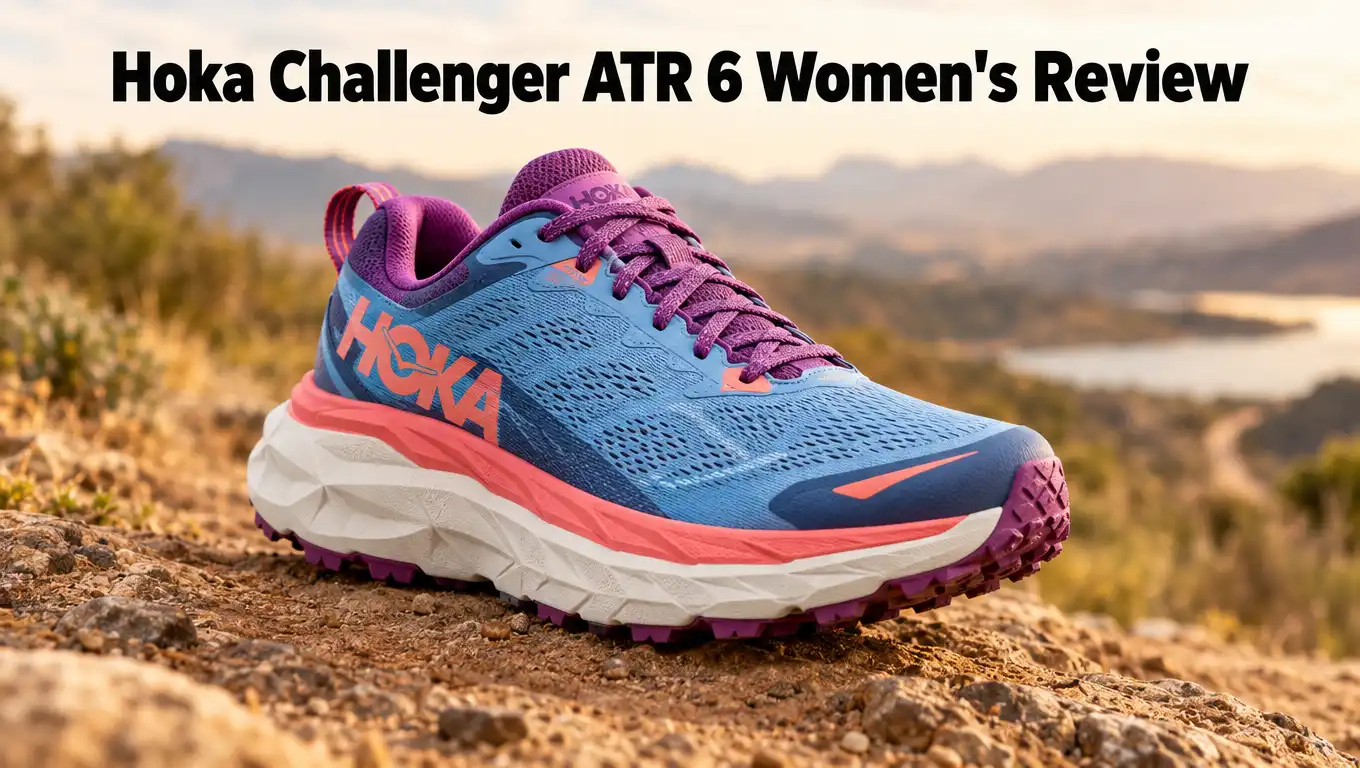
The Challenger ATR 6 is a women’s all terrain running shoe from Hoka. ATR stands for all terrain. Hoka built this line for runners who start on pavement, cut through a park, hit a dirt trail, and finish back on the sidewalk. The sixth version arrived as a full redesign rather than a small refresh.
Hoka widened the landing platform. They added TPU overlays for structure. They reshaped the outsole with zonal lug clusters. The result is a shoe that feels more planted than earlier Challengers.
It carries a 5mm drop and a thick stack of CMEVA foam. Ultra runners adopted it fast because it protects the feet across many hours without feeling heavy. It is not a race shoe and it is not a mountain shoe. It is a daily mileage machine.
Unboxing Experience and First Impressions
The box arrives in classic Hoka style. Simple cardboard, bold logo, tissue paper folded over the shoes. Nothing fancy. You lift the lid and the first thing you notice is the midsole. It looks enormous. Photos never prepare you for that slab of foam.
Pick one up and the second surprise hits. It weighs almost nothing. Your brain expects heft from that much material and it never comes. The mesh upper feels thin between your fingers, almost papery, with faint texture across the toe box. The laces are flat and slightly stretchy.
Slide your foot in and the heel collar hugs gently. The footbed feels soft but not mushy. My first walk around the kitchen felt cushioned and slightly tall, like standing on a firm gym mat. No break in pain. No hot spots.
Key Specifications at a Glance
Here are the numbers that matter. Hoka lists the stack at roughly 29mm in the heel and 24mm in the forefoot, giving a 5mm heel to toe drop. Independent testers measured a women’s size 9 at about 8.9 oz, or 252 grams. The men’s size 9 lands near 9.6 oz.
The midsole uses compression molded EVA. The outsole uses a soft rubber compound with 4mm lug depth arranged in zonal clusters. The upper is a dual layer engineered mesh with TPU reinforcement. It ships in regular and wide widths. A Gore Tex version also exists for wet climates.
The important takeaway: this is a maximum cushion shoe in a low weight package. That ratio is the entire reason the shoe developed a cult following among long distance runners.


Last update on 2026-04-11 / Affiliate links / Images from Amazon Product Advertising API Some of the links on this website are affiliate links, which means that at no additional cost to you, I earn a commission if you click through and make a purchase. I only recommend products and services that I believe will add value to my readers. Thank you for your support!
Top 3 Alternative for Hoka Challenger ATR 6

- ENGINEERED MESH
- Lining Textile
Last update on 2026-09-25 / Affiliate links / Images from Amazon Product Advertising API Some of the links on this website are affiliate links, which means that at no additional cost to you, I earn a commission if you click through and make a purchase. I only recommend products and services that I believe will add value to my readers. Thank you for your support!
Hoka Women’s Challenger 7

- Synthetic mesh upper provides maximum breathability
- Reinforced tongue with strategically placed holes for breathability
- Midsole with new lightweight foam that improves responsiveness
Last update on 2026-09-25 / Affiliate links / Images from Amazon Product Advertising API Some of the links on this website are affiliate links, which means that at no additional cost to you, I earn a commission if you click through and make a purchase. I only recommend products and services that I believe will add value to my readers. Thank you for your support!
Hoka Women’s Speedgoat 5

- Synthetic, Textile
- Polyurethane
Last update on 2026-09-25 / Affiliate links / Images from Amazon Product Advertising API Some of the links on this website are affiliate links, which means that at no additional cost to you, I earn a commission if you click through and make a purchase. I only recommend products and services that I believe will add value to my readers. Thank you for your support!


Last update on 2026-04-11 / Affiliate links / Images from Amazon Product Advertising API Some of the links on this website are affiliate links, which means that at no additional cost to you, I earn a commission if you click through and make a purchase. I only recommend products and services that I believe will add value to my readers. Thank you for your support!
Hoka Women’s Torrent 4
Midsole Cushioning and Ride Feel
The midsole defines this shoe. Hoka packed in compression molded EVA and shaped it with their signature rocker geometry. Your foot rolls forward instead of bending hard at the toes. That rocker does real work on tired legs late in a long run.
Compared to the Challenger ATR 5, this foam feels firmer and more responsive. Some runners loved the old marshmallow softness and miss it. Others prefer this version because it bottoms out less on hard ground. I fall into the second group.
Rocks, roots, and sharp gravel disappear underfoot. You feel almost nothing through the heel. Forefoot strikers still sense some texture, which many riders actually want. Impact stays low. After 15 miles on crushed limestone my knees felt fresh, which is the whole point of buying a shoe like this.
Outsole Traction on Trail and Road
Flip the shoe over and you see wide paddle shaped rubber zones separated by deep channels. Hoka lists 4mm lugs. Measured individually, the raised rubber sits closer to 2mm with the channels adding the rest of the depth. That design choice explains everything about how this shoe grips.
On hard packed dirt, gravel, dry rock, and pavement the traction feels excellent and quiet. The soft rubber sticks well. The flat surface area rolls smoothly on asphalt without the clunky lug slap you get from aggressive trail shoes.
Push into wet clay or deep mud and the story changes fast. Mud packs into the channels and stays there. Once the outsole fills, you are sliding on a flat pad. Snow gives similar trouble. Steep wet grass is genuinely risky.
Upper Design, Breathability and Lockdown
The upper uses a dual layer engineered mesh with printed TPU overlays running along both sides. It breathes well. During summer runs in warm weather my feet stayed cooler than they did in heavier trail shoes. Dust and small debris stay out thanks to the tight weave.
Lockdown is decent but not perfect. The gusseted tongue keeps grit away and stays centered. The lacing system is basic and works fine for most feet. Runners with low volume feet often need to use the extra eyelet and cinch the top tightly.
Water drains slowly. Cross a creek and the mesh holds moisture longer than you would like. The Gore Tex model solves rain but traps heat, so pick based on your climate rather than buying waterproof out of habit.
Fit and Sizing for Women
Sizing runs true to size for most women. Order your normal running size and you should be fine. Toe length is generous, so there is room for swelling on long efforts.
The shape is where opinions split. The forefoot is wide at the ball of the foot then tapers noticeably at the very front. Women with wide feet report pressure across the toes near the tip. Women with narrow feet report the opposite problem, a loose arch area and heel lift on steep descents.
I noticed my foot sliding forward on downhills until I tightened the laces properly. After that the slide reduced but never vanished completely. A wide version is available and genuinely helps broad feet. Try both widths if you can. This shoe fits some feet beautifully and frustrates others.
Comfort Over Long Distances
Comfort is the strongest argument for this shoe. Hour three is where it proves itself. The foam keeps absorbing impact long after your legs stop cooperating. The rocker keeps you moving forward with less effort from your calves.
Ultra runners picked up the Challenger line for exactly this reason. Fatigue arrives later than it does in a firmer, lower stack shoe. Feet stay quieter. Hot spots stay rare because the interior has soft padding and few harsh seams.
It also works brilliantly as a walking and standing shoe. Nurses, teachers, and travelers buy it for all day comfort rather than running. If you spend ten hours on concrete, this shoe will treat you kindly. That versatility is a real part of its value in 2026.
Stability and Support
Older Hoka models earned criticism for feeling tippy. Tall foam plus a narrow base equals wobble. Hoka addressed that here. The sixth version uses a broader landing platform in both the heel and forefoot, and the sidewalls slope outward.
When your foot lands, the foam compresses and the base flattens wider. That creates a more planted feeling than earlier Challengers delivered. Testers who disliked previous versions found this one noticeably calmer on uneven ground.
It is still a neutral shoe. There is no medial post and no guidance frame. Runners who need real pronation control should look elsewhere. On moderately technical ground it holds its line well. On loose scree, off camber rock, or trailless terrain the height works against you and ankle rolls become a genuine risk.
Weight and Speed
At roughly 8.9 oz in a women’s size 9, this shoe is light for its category. Many trail shoes with less cushioning weigh more. Hoka achieved that through thin mesh and a lightweight foam formula.
On foot it does not feel bulky. It also does not feel fast. The rocker helps turnover at easy and moderate paces. Push into a hard tempo effort and the soft foam absorbs some of your energy instead of returning it.
Think steady miles, not speed work. A 10 minute mile feels wonderful. A 6:30 mile feels vague and disconnected. There is no carbon plate and no snappy return, which is fine because this shoe never claimed to be a racer. Buy it for volume and comfort, not for a personal best attempt.
Durability After Real Mileage
The midsole outlasts the outsole. Most runners report the foam holding its feel well past 300 miles, with noticeable flattening somewhere between 350 and 450 miles depending on body weight and terrain.
The soft rubber outsole is the weak link. That sticky compound grips beautifully and wears quickly, especially if you log heavy pavement miles. Expect smoothing on the lateral heel first.
Upper durability is mixed. The mesh is thin. Sharp rock scrapes can nick it, and the area near the small toe sometimes thins out. The TPU overlays hold up well and the toe bumper handles normal kicks. Treat this as a 350 to 400 mile shoe rather than a 600 mile workhorse, and price your purchase with that expectation.
What the Challenger ATR 6 Does Not Do Well
Honest reviews list the failures. This shoe has several.
Mud handling is genuinely poor. The channels clog and refuse to clear. Snow traction is weak. Wet rock feels slippery compared to shoes using stickier climbing style rubber.
Ground feel barely exists. If you like sensing the trail, you will hate this. Technical terrain exposes the height, and quick foot placements on rocky descents feel imprecise.
The fit frustrates a sizeable group of runners. Heel slip for narrow feet and toe squeeze for wide feet both show up repeatedly in owner feedback. Some runners also mention a short break in period where the upper feels stiff.
Finally, it drains water slowly and it is not a speed shoe. Know these limits before you buy.
Pros and Cons
Pros
- Outstanding cushioning that protects your legs across very long runs and all day standing.
- Surprisingly light weight for the amount of foam underfoot.
- Smooth rocker geometry that keeps you rolling forward when your legs get tired.
- Genuinely versatile on pavement, gravel, and dry dirt trails without changing shoes.
- Improved stability over earlier Challenger versions thanks to the wider base.
- Breathable upper that keeps feet cool in warm weather.
- Strong value in 2026 because the older model sells at reduced prices.
- Available in wide widths and in a Gore Tex version.
Cons
- Mud clogs the outsole channels and traction drops sharply.
- Poor grip on snow, wet clay, and slick rock.
- Almost no ground feel, which hurts on technical terrain.
- Fit issues at both ends: heel lift for narrow feet, toe pressure for wide feet.
- Soft outsole rubber wears faster than average on pavement.
- Not responsive enough for fast tempo running or racing.
Challenger ATR 6 vs Challenger 7 and Challenger 8
The Challenger 7 arrived with a simplified single layer mesh upper, a softer foam, and a slightly taller stack. Hoka also redesigned the outsole with a gravel tire inspired pattern. Many runners call the 7 more comfortable out of the box with a cleaner fit through the midfoot.
The Challenger 8 continued that direction with further refinement of the upper and cushioning.
So why choose the 6? Price. Older stock sells well below current models. The ride difference is real but modest. If you liked the firmer, more grounded feel of the 6, the newer versions may feel too soft for you.
Buy the 6 for value. Buy the 7 or 8 if you want the latest upper comfort and can find your size easily.
Who Should Buy the Hoka Challenger ATR 6?
- Outer Material: Synthetic
- Closure: laces
- Heel Type:Flat
Last update on 2026-09-25 / Affiliate links / Images from Amazon Product Advertising API Some of the links on this website are affiliate links, which means that at no additional cost to you, I earn a commission if you click through and make a purchase. I only recommend products and services that I believe will add value to my readers. Thank you for your support!
This shoe suits a specific runner. You log steady miles. You mix pavement, bike paths, and mellow dirt trails in the same run. You want your legs to survive the week. Cushioning matters more to you than ground feel.
It also suits marathon and ultra runners who train on non technical routes, plus walkers and workers who stand for long shifts.
Skip it if you run technical mountain trails, race on steep terrain, need pronation support, or run mostly in mud and snow. A Speedgoat handles rough ground far better. A Torrent handles speed far better.
If you have narrow heels, try before you buy. If you have wide feet, order the wide width. Sizing decisions make or break your experience with this shoe.
Care and Cleaning Tips
Treat the upper gently and it lasts longer. Knock loose dirt off after every trail run. For deeper cleaning, use cool water, a soft brush, and mild soap. Scrub the outsole channels with an old toothbrush to clear packed mud before it hardens.
Never put these in the washing machine or dryer. Heat breaks down the midsole foam and weakens the adhesive holding the outsole. Remove the insoles and let everything air dry away from direct sun.
Stuff damp shoes with newspaper to speed drying and reduce odor. Rotating two pairs extends the life of both, because foam needs 24 hours to recover between runs. Store them somewhere dry rather than in a hot car trunk, where the foam degrades faster than most people expect.
Final Verdict
The Hoka Challenger ATR 6 earns a recommendation with clear boundaries. It delivers plush protection, low weight, and honest versatility across roads and moderate trails. Long runs feel easier. Recovery days feel kinder. All day wear feels comfortable.
It also has real flaws. Mud defeats it. Technical terrain unsettles it. The fit divides opinion sharply between narrow and wide feet. The outsole rubber wears quickly on pavement.
In 2026, the value equation tips heavily in its favor. You get roughly 85 percent of the newer Challenger experience for a much lower price. If your running looks like gravel roads, park paths, and rolling dirt singletrack, this shoe will serve you well for hundreds of miles. If your running looks like alpine scrambles, buy something else.
Frequently Asked Questions
Is the Hoka Challenger ATR 6 true to size?
Yes, for most women. Order your usual running size. Toe length is generous. The shape matters more than the length here, so consider the wide version if your forefoot is broad.
Can I use the Challenger ATR 6 on pavement?
Absolutely. The flat outsole and soft rubber roll smoothly on asphalt. This is one of the best road to trail crossover shoes Hoka has made. Expect faster outsole wear with heavy road mileage.
How many miles will the Challenger ATR 6 last?
Plan on 350 to 400 miles. Lighter runners on soft surfaces may reach 450. The outsole rubber usually shows wear before the midsole loses its cushioning.
Is it good for hiking?
Yes for day hikes on maintained trails. The cushioning handles long approaches well. It offers no ankle support and limited grip on wet rock, so it is not the right choice for scrambling or heavy pack carries.
Does it work for plantar fasciitis or knee pain?
Many runners with joint pain find the cushioning and rocker helpful because impact forces drop. It is a neutral shoe with no arch control. Speak with a podiatrist or physical therapist about your specific situation before relying on any shoe as treatment.
Is the Gore Tex version worth it?
Only if you run in consistent rain, snow, or wet grass. The waterproof membrane blocks water but reduces breathability and adds warmth. In hot climates the standard model is the better choice.
Can I still buy the Challenger ATR 6 in 2026?
Stock is limited since Hoka has moved on to newer versions. Sizes and colors sell out in waves. Check availability often and grab your size when you see it at a good price.

Mia Smith is the founder of Shoe Storyteller, a blog that celebrates the art and stories behind shoes. With a passion for fashion and a flair for storytelling, Mia brings a unique perspective to the world of footwear.