Hoka Mafate X Review 2026: Too Much Shoe?
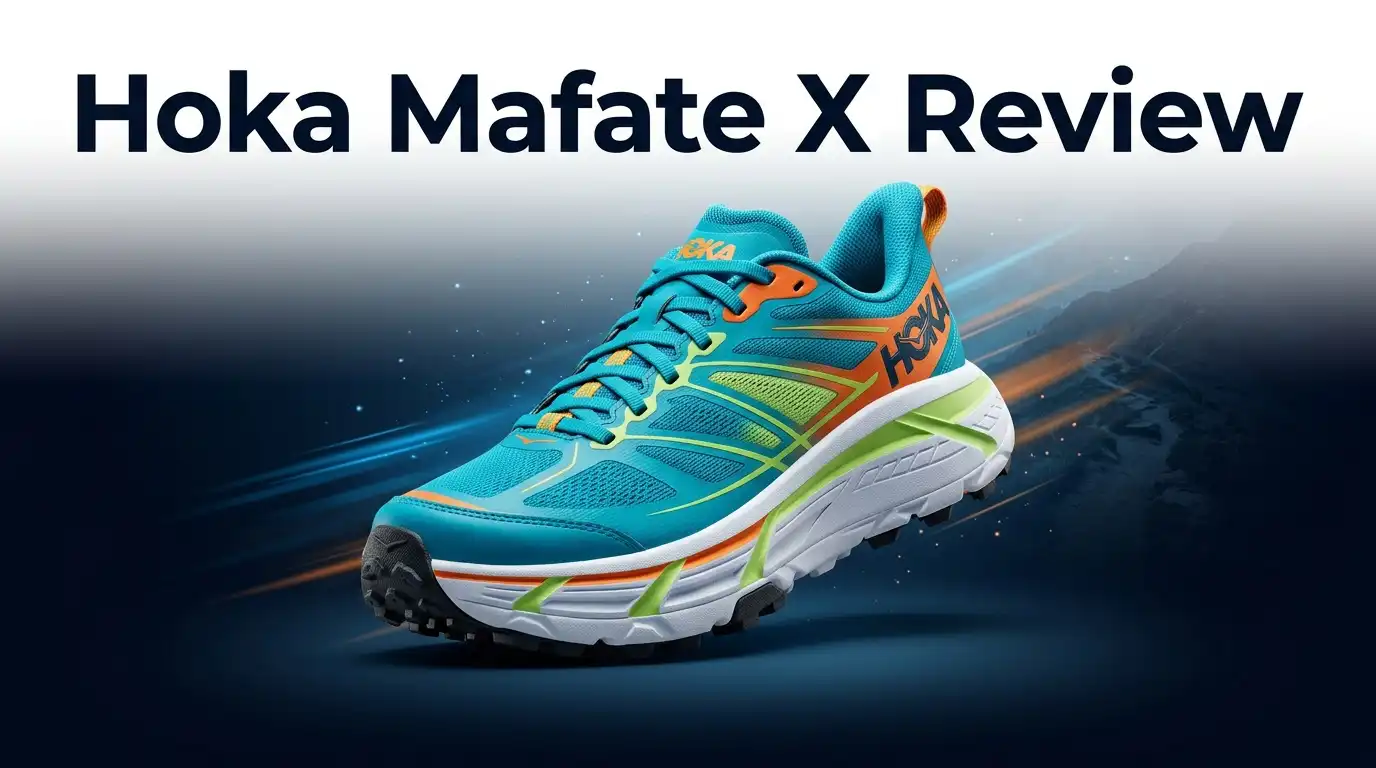
Hoka built a shoe that looks like a cartoon. The Mafate X stands almost 50 mm tall in the heel. It hides a carbon fiber plate, PEBA foam, and a Vibram Megagrip outsole under your foot. It also costs $225.
That combination raises a fair question. Does all that engineering actually help you run better on dirt? Or does it just add weight and price?
I put real miles on this shoe across gravel roads, groomed singletrack, and a few rocky sections it clearly did not enjoy. This review covers the ride, the fit, the unboxing, the grip, and the flaws that Hoka’s marketing pages skip. You will know by the end whether the Mafate X belongs in your rotation or on someone else’s feet.
In A Nutshell:
- The cushion is the main event. With 49 mm of heel stack and 41 mm in the forefoot, the Mafate X blocks almost all ground feel. Lab testing measured 136 shock absorption in the heel, well above the 123 trail shoe average. Your legs stay fresher on long efforts.
- The weight is the main problem. At roughly 12.1 oz (343 g) in a men’s US 10, this is one of the heaviest trail shoes on sale. You feel it on climbs and in tight turns.
- Grip beats expectations. The Vibram Megagrip outsole scored 0.72 in standardized traction testing against a 0.64 average, even with shallow 3.0 mm lugs. The taco shaped lugs look odd and work fine.
- Stability surprises people. A 121 mm forefoot platform, a stiff heel counter, and the forked carbon plate keep the shoe planted. It still gets sketchy on technical rock.
- It is a smooth trail specialist, not an all terrain shoe. Gravel roads, rail trails, buffed singletrack, and 100 mile pace all suit it. Steep technical mountain running does not.
- Value is the weak spot. At $225 against a $157 category average, you pay super shoe money for a comfort shoe experience.
What Is The Hoka Mafate X?

- WOVEN TEXTILE
- Lining Textile
Last update on 2026-09-24 / Affiliate links / Images from Amazon Product Advertising API Some of the links on this website are affiliate links, which means that at no additional cost to you, I earn a commission if you click through and make a purchase. I only recommend products and services that I believe will add value to my readers. Thank you for your support!
The Mafate X is Hoka’s max stack trail shoe, launched in 2025 and still selling at $225 in 2026. It carries the Mafate name but shares very little with older Mafate Speed models. Those were mid stack, flexible, aggressive shoes. This one is a different animal entirely.
Think of it as the trail version of the Skyward X. Hoka took its tallest allowable midsole, added a carbon fiber plate, wrapped a PEBA core inside a supercritical EVA frame, and bolted on Vibram rubber. The result targets ultra distance runners who want zero ground feel.
Hoka positions it for 100 mile races, gravel grinding, and long recovery days. That framing matters. This is not a Speedgoat replacement and not a mountain racing shoe. It solves one problem very well: keeping your feet comfortable after hour eight, nine, and ten on forgiving surfaces. Judge it on that job and it makes sense.
Unboxing The Hoka Mafate X
The box arrives heavier than you expect for running shoes. Lift the lid and the shoes sit there looking almost architectural. The midsole sidewall has sculpted cutouts and pods that catch light. My pair came in the black and cement colorway, and photos undersell how tall it looks in person.
First reaction from everyone I showed them to was the same. They laughed. Then they picked one up and said, “that is heavy.”
The tissue paper hides one nice detail. The insole is TPEE foam rather than cheap EVA, and it feels silky under your thumb. The tongue has two articulated padding layers instead of one thick slab.
Step in and the collar padding wraps your ankle immediately. Standing up feels strange for about ten seconds while your brain adjusts to the height. Then it feels plush and oddly stable. The first walk across a kitchen floor sells the shoe better than any spec sheet.
Hoka Mafate X Specs And Technology
The numbers explain most of this shoe’s personality. Here is what Hoka lists and what independent labs measured.
Stack height sits at 49 mm heel and 41 mm forefoot with an 8 mm drop. That drop is unusual for Hoka, which historically favored 4 mm and 5 mm geometry. Lab measurements put the real drop closer to 10.6 mm, which helps heel strikers.


Last update on 2026-04-11 / Affiliate links / Images from Amazon Product Advertising API Some of the links on this website are affiliate links, which means that at no additional cost to you, I earn a commission if you click through and make a purchase. I only recommend products and services that I believe will add value to my readers. Thank you for your support!
The midsole uses two foams. A PEBA layer sits above the plate, closer to your foot, measuring a plush 31.2 on the Asker C scale. Below it, nitrogen infused supercritical EVA handles ground contact at a firmer 39.3. That split gives softness where you feel it and structure where you need it.
The plate is not a solid carbon sheet. It is a forked design with cutouts under the heel and forefoot, allowing slight lateral movement on uneven ground. Outsole rubber is Vibram Megagrip at 3.0 mm lug depth with 2.3 mm thickness. Energy return hit 68.2% in the forefoot, strong for any trail shoe.
Pros And Cons Of The Hoka Mafate X
Honest summary after real miles. The good parts are genuinely good and the bad parts are genuinely annoying.
Pros
- Cushioning protects your feet completely. Sharp rocks, gravel, and root chatter all disappear under 49 mm of foam and a plate.
- Vibram Megagrip delivers reliable traction on wet rock, dirt, and loose gravel despite shallow lugs.
- Stability is far better than the height suggests, thanks to a wide 121 mm forefoot and a rigid heel counter.
- The rocker geometry rolls you forward smoothly on flats and downhills.
- Breathability scored 4 out of 5 in smoke testing, rare for a trail upper.
- Outsole durability is excellent, with only 0.8 mm of rubber loss in abrasion testing.
- PEBA foam stiffened just 9% in cold testing, so winter performance holds up.
- Toe protection works without stealing forefoot room.
Cons


Last update on 2026-04-11 / Affiliate links / Images from Amazon Product Advertising API Some of the links on this website are affiliate links, which means that at no additional cost to you, I earn a commission if you click through and make a purchase. I only recommend products and services that I believe will add value to my readers. Thank you for your support!
- Heavy at roughly 12.1 oz for a men’s 10, which kills any fast intentions.
- Bottom heavy balance makes climbing feel like lugging bricks uphill.
- Heel lock is poor for some runners, with real heel lift even with a runner’s knot.
- Toebox tapers to 72.8 mm, narrow for wide feet.
- Upper mesh durability scored only 2 out of 5 and can tear on rough terrain.
- Extreme stiffness feels unnatural when walking or hiking.
- Price of $225 sits far above the category average.
- Semi gusseted tongue lets debris sneak in.
Top 3 Alternative for Hoka Mafate X

- KNIT COLLAR
- Lining Textile
Last update on 2026-09-24 / Affiliate links / Images from Amazon Product Advertising API Some of the links on this website are affiliate links, which means that at no additional cost to you, I earn a commission if you click through and make a purchase. I only recommend products and services that I believe will add value to my readers. Thank you for your support!
Hoka Tecton X 3

- Textile, Synthetic
- Polyurethane
Last update on 2026-09-24 / Affiliate links / Images from Amazon Product Advertising API Some of the links on this website are affiliate links, which means that at no additional cost to you, I earn a commission if you click through and make a purchase. I only recommend products and services that I believe will add value to my readers. Thank you for your support!
Hoka Speedgoat 6 GTX

- Max cushion from street to summit
- If you’re going to pack just one pair on your next adventure, this is it. Known as the Swiss army...
- Gusseted tongue
Last update on 2026-09-24 / Affiliate links / Images from Amazon Product Advertising API Some of the links on this website are affiliate links, which means that at no additional cost to you, I earn a commission if you click through and make a purchase. I only recommend products and services that I believe will add value to my readers. Thank you for your support!
Hoka Stinson 7
Fit And Sizing Guide
Most buyers report the Mafate X runs slightly small. Order your normal running size if you have average feet, and consider a half size up if you plan long efforts where feet swell.
The fit follows the classic Hoka shape. Measured width at the widest point came in at 98.1 mm, wider than the 95.6 mm average. That sounds promising. The toebox then tapers hard to 72.8 mm, below the 74.2 mm average.
Translation: the midfoot feels roomy, the toes feel snug. Runners with wide feet or those who need generous toe splay should look elsewhere. Altra and Topo serve that crowd better.
Toebox height measures 25.0 mm, slightly low. The upper fabric carries reinforcements and does not stretch, so any tight spot stays tight.
Midfoot lockdown is firm and secure. The punched eyelets take tension well and will not tear like fabric loops. Heel fit is the wildcard. Some runners get a perfect lock and others fight heel lift for the life of the shoe.
Cushioning And Ride Feel On Trail
Step off a curb in these and you understand the appeal. Nothing reaches your foot. Gravel, packed dirt, embedded rocks, all of it turns into vague suggestions underfoot.
The feel is not marshmallow soft, which surprised me. It lands in the medium soft range. The firmer EVA carrier and the plate keep the foam from collapsing, so you get protection without that wobbly sinking sensation.
The forefoot rocker does heavy lifting. Once you reach cruising speed on flat ground, the shoe rolls through toe off with a mild pop. Downhills feel fantastic. You can bomb gravel descents with almost no impact reaching your quads.
Where the ride falls apart is uphill and at faster paces. The shoe never feels quick. It feels like a comfortable truck. Try to push tempo and the mass fights you.
For a 50 mile shuffle or a recovery run the day after a race, the ride is close to perfect. For anything sharper, it feels like the wrong tool.
Grip And Outsole Performance
Hoka and Vibram made a strange choice here. The lugs look like tiny tacos and pizza slices rather than standard chevrons. Runners mocked the design online before anyone ran in it.
The design works. Standardized traction testing returned 0.72 against a 0.64 average across 45 trail shoes. That puts the Mafate X in the upper tier for grip.
The layout is smart. Heel lugs face backward with wide surfaces for braking on descents. Forefoot lugs turn into sharper triangles facing forward for climbing and push off. The midfoot uses flat foam pods that save weight and allow slight flex.
Lug depth of 3.0 mm caps its range. Deep mud, wet grass, and loose scree remain outside its comfort zone. Deeper lugs would not fix that anyway, since the stack height already rules out true technical terrain.
Rubber coverage is partial, with exposed foam in low wear zones. Abrasion testing showed only 0.8 mm of wear, so longevity looks strong.
Stability On Uneven Ground
A 49 mm shoe should feel like running on stilts. It mostly does not, and that is the engineering win here.
Hoka stacked several stability features. The forefoot platform measures 121.2 mm wide and the heel 102.1 mm, both far above average and comparable to road stability shoes. A plastic piece in the heel keeps the rearfoot centered. The heel counter scored a maximum 5 out of 5 for stiffness. Torsional rigidity hit 23.4 Nm, near the top of the category.
On gravel roads and smooth singletrack, the shoe feels planted and confident. I never sensed an ankle roll coming on those surfaces.
Technical terrain tells a different story. Once you hit rock gardens, angled roots, or off camber trail at speed, the height becomes a liability. You start making constant small corrections to stay upright. Some testers reported real instability there while others managed fine.
Your ankle strength and running style decide this one.
The Weight Problem Nobody Can Ignore
This is the deal breaker for many runners, so let me be direct about it.
A men’s US 10 weighs around 12.1 oz (343 g). Some pairs weigh more. Lab scales recorded 11.8 oz for a sample size. Compare that to the trail shoe average of 10.1 oz and you see the gap.
Direct competitors in the max cushion space all sit lighter. The Speedland GS:PDX, New Balance Hierro v9, Brooks Caldera 8, and Nike Zegama 2 all land under 12 oz. Only the discontinued Hoka TenNine weighed more.
Worse than the raw number is the distribution. The Mafate X is bottom heavy. A light upper sits on a huge foam block, and the balance feels disjointed. Going uphill you stop running in the shoe and start carrying the shoe.
The rocker and plate mask some of this on flats. They cannot mask it on climbs, in switchbacks, or during the last miles of a hard effort. Weight alone removes this shoe from race day for many runners.
Upper, Tongue, And Heel Lock
The upper is a woven textile mesh with reinforcement panels. Under a microscope it shows tiny ventilation holes, and smoke testing gave it 4 out of 5 for airflow. For a trail shoe that is impressive.
The cost of that airflow is durability. Toebox abrasion resistance scored only 2 out of 5. Those small holes tear when they meet sharp rock. Keep this shoe on friendly surfaces and it lasts. Drag it through granite and expect wear.
Heel padding is generous and scored a perfect 5 for durability. The collar feels structured rather than sloppy.
Heel lock is the real complaint. Multiple testers described significant heel lift on climbs and descents, with a runner’s knot failing to solve it. Cinching the laces to the point of cutting circulation still left movement. The likely cause is the stiffness of 49 mm of foam plus a plate resisting foot flexion.
The tongue is semi gusseted, so fine dirt finds its way in. A full gusset belongs on a shoe at this price.
Durability After Long Miles
Durability splits cleanly into two stories here.
The bottom half holds up beautifully. Vibram Megagrip resists wear better than most compounds, and the 2.3 mm outsole thickness protects the supercritical EVA from abrasion. Heel padding shows no early breakdown. The PEBA layer sits above the plate, shielded from ground contact, so it should retain bounce longer than a bottom loaded superfoam.
The top half worries me. That breathable mesh is thin where it counts, and the 2 out of 5 abrasion score reflects real vulnerability. If your trails include sharp rock, scree, or thorny brush, expect scuffs and possible tears earlier than you would like on a $225 shoe.
Expected lifespan on gravel and groomed trail should reach 400 to 500 miles based on the outsole wear rate. On rough terrain, the upper becomes your limiting factor, not the foam or rubber.
Rotate this shoe for long easy days and it repays you.
Hoka Mafate X vs Hoka Tecton X 3
These two shoes overlap on paper and feel nothing alike on foot.
The Tecton X 3 weighs far less and uses dual carbon plates with winglets for stability. It costs $275, more than the Mafate X. It feels like an actual racing shoe. You can run fast in it, handle technical ground, and cover 100 kilometers without the shoe fighting you.
The Mafate X wins on pure comfort and protection. Nothing in the Tecton line blocks impact like 49 mm of stack. It also fits slightly more generously in the forefoot.
Choose the Tecton X 3 if you race or run technical mountain trails. It delivers similar cushioning at much lower weight and stays nimble.
Choose the Mafate X if comfort is your only metric. Twenty four hour efforts, gravel grinding, recovery runs, and runners coming from road shoes like the Bondi will prefer it.
Different tools for different days. The Tecton X 3 is the more versatile shoe by a clear margin.
Who Should Buy The Hoka Mafate X
This shoe fits a narrow but real group of runners.
Buy it if you spend most trail time on gravel roads, rail trails, or buffed singletrack and want maximum protection. Buy it if you are a heel striker who benefits from the taller drop and deep rearfoot cushion. Buy it if you run 100 mile races where pace stops mattering and foot comfort decides your finish. Buy it if you love the Bondi or Skyward X and want a dirt capable version.
Skip it if price matters. The Mafate 5 and ASICS Trabuco Max 4 deliver similar comfort for much less money.
Skip it if you race, run technical mountain terrain, need a nimble shoe, have wide feet, or plan to hike in it. The stiffness makes walking feel awkward.
Skip it if you want one trail shoe for everything. The Mafate X is a specialist, and specialists work best alongside other shoes in a rotation.
Price And Value In 2026
At $225, the Mafate X ranks near the top of trail shoe pricing. The category average sits around $157. Only a handful of shoes cost more.
You do get premium materials for that money. PEBA superfoam, a carbon fiber plate, Vibram Megagrip rubber, a TPEE insole, and reflective details all appear here. Nothing feels cheap.
The value question is whether those materials serve a purpose. A carbon plate usually promises speed. In a 12 oz shoe built for smooth trails at easy pace, the plate mostly adds stability and stiffness. You are paying super shoe prices for a comfort shoe outcome.
Look for sales. Hoka discounts older colorways regularly, and a $170 Mafate X changes the math considerably. Amazon and Running Warehouse both cycle through markdowns as new colors land.
If your calves and feet fall apart on long runs, the comfort may justify the cost. For most runners, cheaper max cushion options make more sense.
Final Verdict On The Hoka Mafate X

- WOVEN TEXTILE
- Lining Textile
Last update on 2026-09-24 / Affiliate links / Images from Amazon Product Advertising API Some of the links on this website are affiliate links, which means that at no additional cost to you, I earn a commission if you click through and make a purchase. I only recommend products and services that I believe will add value to my readers. Thank you for your support!
The Mafate X is a fascinating shoe that solves one problem brilliantly and ignores everything else.
The comfort is genuine. Protection is absolute. Grip and stability both exceed what the spec sheet suggests. Hoka clearly cared about the details, from the silky insole to the layered tongue to the clever outsole geometry.
Then you pick it up and remember it weighs 12 oz. You take it uphill and feel the balance problem. You cinch the laces and still fight heel lift. You check the price and see $225.
My rating: 7 out of 10. Excellent at its narrow job, frustrating everywhere else.
Buy it for long slow days on forgiving surfaces where your feet usually hurt. Buy it as a recovery shoe if you already own something fast. Do not buy it expecting a do everything trail shoe, and do not buy it for race day.
The Tecton X 3 remains the better all around choice for most trail runners.
Frequently Asked Questions
Is The Hoka Mafate X True To Size?
It runs slightly small based on buyer feedback. Order your usual running size if your feet are average width. Consider a half size up for ultra distance efforts where swelling happens, since the toebox tapers to 72.8 mm and the upper does not stretch.
How Much Does The Hoka Mafate X Weigh?
A men’s US 10 weighs about 12.1 oz (343 g). A women’s US 8 weighs about 10.3 oz (292 g). Lab scales recorded 11.8 oz for a test sample. This ranks among the heaviest trail shoes currently available.
Can You Use The Mafate X On Technical Trails?
It handles moderate technical ground better than expected because of the wide platform and stiff plate. Steep rock gardens, scree, and off camber terrain remain risky at this stack height. Shallow 3.0 mm lugs also limit performance in deep mud.
Does The Carbon Plate Make You Faster?
Not meaningfully. The forked plate adds stability, stiffness, and a mild pop at toe off. The shoe’s weight cancels any speed benefit. Treat the plate as a protection and structure feature rather than a propulsion system.
How Long Does The Hoka Mafate X Last?
Expect 400 to 500 miles on gravel and groomed trail. Outsole testing showed only 0.8 mm of rubber wear, which is excellent. The breathable upper mesh scored 2 out of 5 for abrasion resistance and may tear first on rough terrain.
Is The Mafate X Good For Walking Or Hiking?
Not really. Torsional rigidity measured 23.4 Nm and the shoe barely bends, which makes walking feel unnatural. Hoka sells a separate Mafate X Hike boot built around the same midsole if hiking is your goal.
What Is The Difference Between The Mafate X And Mafate 5?
The Mafate X stands about 4 mm taller, adds a carbon plate and PEBA foam, and costs considerably more. The Mafate 5 feels softer and mushier, weighs less, and offers better value. The X fits slightly wider and feels more stable.
Does The Mafate X Have Heel Slippage Problems?
Some runners experience noticeable heel lift that lacing tricks do not fix. The stiffness of the tall midsole and plate appears to cause it. Try the shoe on before committing, or order from a retailer with a generous return window.

Mia Smith is the founder of Shoe Storyteller, a blog that celebrates the art and stories behind shoes. With a passion for fashion and a flair for storytelling, Mia brings a unique perspective to the world of footwear.