
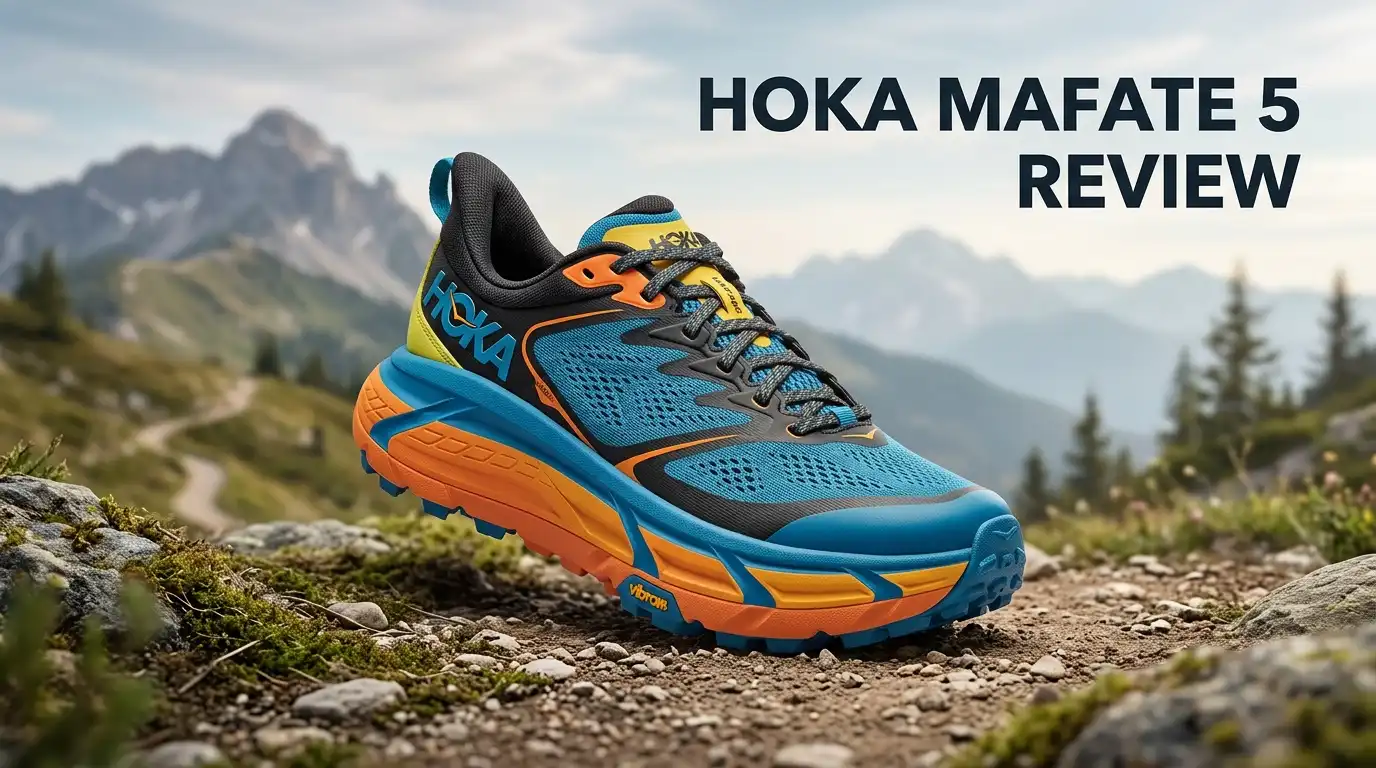
Hoka Mafate 5 Review 2026: Worth Buying?
Trail runners love arguing about shoes, and the Hoka Mafate 5 started one of the loudest arguments of the past year.
Hoka dropped the word “Speed” from the name, added a pile of foam, raised the drop, and rebuilt the upper from scratch. Some runners called it the comfiest trail shoe they have ever worn. Others sent them straight back. So which camp is right?
This review covers the good, the frustrating, and the stuff Hoka would rather you skipped. If you are deciding whether to spend $185 on a max cushion trail shoe in 2026, read on before you click buy.
In a Nutshell:
- The cushioning is the headline. The Mafate 5 stacks roughly 44mm at the heel and 36mm at the forefoot for men, with a dual density EVA midsole. Soft supercritical foam sits on top, firmer foam sits below. Long days feel shorter.
- This is a heavy shoe. A men’s US 9 weighs about 11.1 to 11.7 ounces (314 to 332 grams). That is a big jump over the Mafate Speed 4. It runs smoother than the number suggests, but it is still a lot of shoe.
- Grip is excellent and rarely questioned. Vibram Megagrip with 5mm multidirectional lugs bites into wet roots, granite slabs, and loose dirt with real confidence.
- The tongue is the weak point. It is short, thin, and not gusseted. Some testers report it sliding sideways and pressing laces into the top of the foot.
- The heel can feel tippy. High stack plus soft foam equals occasional lateral roll for heavier heel strikers on technical ground.
- Best for long slow efforts. Ultras, fastpacking, thru hiking, and all day comfort. Not a nimble shoe for fast technical racing.
Hoka Mafate 5

- Warp knit upper with anti-fray treatment
- TPU cage
- Gaiter attachment points
Last update on 2026-09-24 / Affiliate links / Images from Amazon Product Advertising API Some of the links on this website are affiliate links, which means that at no additional cost to you, I earn a commission if you click through and make a purchase. I only recommend products and services that I believe will add value to my readers. Thank you for your support!
The Hoka Mafate 5 is a max cushion trail running shoe built for long distance efforts on rough ground. Hoka positions it as the workhorse for 100 mile races, mountain days, and rugged terrain where protection matters more than pace. It retails at $185 and arrived in July 2025, replacing the very popular Mafate Speed 4.
The build is straightforward once you break it down. A dual density EVA midsole handles cushioning. A curved TPU plate sits between the two foam layers. A Vibram Megagrip outsole handles traction. A warp knit upper with a TPU cage handles containment and durability.
The important thing to understand is that this is not an update. It is a replacement. Hoka raised the stack, doubled the drop from 4mm to 8mm, changed the upper material, and dropped “Speed” from the name. Runners who loved the Speed 4 should walk into this shoe expecting something different. Those who wanted more foam underfoot got exactly what they asked for.
Unboxing Experience and First Impressions
The box is standard Hoka, nothing fancy, just recycled cardboard and a simple sleeve. Lift the lid and the first reaction is almost always the same: these things are big. The midsole flares out in a way that photos never quite capture. My test pair came in a loud blue and black colorway that friends noticed from across a parking lot.
Pick one up and the weight registers immediately. The shoe feels bottom heavy in hand. That first impression is misleading though, because it runs lighter than it holds.
Slide your foot in and the plushness is obvious on step one. There is a soft, pillowy sink into the heel that most trail shoes simply do not offer. The toe box has room without feeling sloppy. The laces are plain flat laces, which is a relief after years of fiddly quick lace systems.
One thing stood out right away: the tongue is paper thin and short. Straight from the box it can bite the front of the ankle if you wear low socks.
Key Specs and Numbers That Matter
Here are the figures that actually influence how this shoe runs. Stated stack heights sit at roughly 44.8mm heel and 36.8mm forefoot for men, with women’s versions around 43mm and 35mm. The drop is 8mm, double the 4mm of the previous model.
Weight varies by source and size. A men’s US 9 lands near 11.1 ounces (314 grams). A men’s US 10.5 comes closer to 11.9 ounces. Women’s pairs sit around 8.1 ounces per shoe. Price holds steady at $185, matching the Speed 4.


Last update on 2026-04-11 / Affiliate links / Images from Amazon Product Advertising API Some of the links on this website are affiliate links, which means that at no additional cost to you, I earn a commission if you click through and make a purchase. I only recommend products and services that I believe will add value to my readers. Thank you for your support!
The outsole uses Vibram Megagrip rubber with Traction Lug technology and 5mm lugs. Rubber coverage is partial, with exposed foam in the middle sections to save weight. The midsole combines supercritical EVA on top with compression molded EVA below.
The upper is warp knit mesh with anti fray treatment, a TPU frame, gaiter attachment points, and reflective detailing. Sizing runs true. Most testers stayed in their normal trail size with no issues.
Top 3 Alternative for Hoka Mafate 5

- WOVEN TEXTILE
- Lining Textile
Last update on 2026-09-24 / Affiliate links / Images from Amazon Product Advertising API Some of the links on this website are affiliate links, which means that at no additional cost to you, I earn a commission if you click through and make a purchase. I only recommend products and services that I believe will add value to my readers. Thank you for your support!
Hoka Mafate X

- Textile, Synthetic
- Polyurethane
Last update on 2026-09-24 / Affiliate links / Images from Amazon Product Advertising API Some of the links on this website are affiliate links, which means that at no additional cost to you, I earn a commission if you click through and make a purchase. I only recommend products and services that I believe will add value to my readers. Thank you for your support!


Last update on 2026-04-11 / Affiliate links / Images from Amazon Product Advertising API Some of the links on this website are affiliate links, which means that at no additional cost to you, I earn a commission if you click through and make a purchase. I only recommend products and services that I believe will add value to my readers. Thank you for your support!
Hoka Speedgoat 6 GTX

- Unparalleled grip and precise, comfortable fit.
- Fit
- Comfort
Last update on 2026-09-24 / Affiliate links / Images from Amazon Product Advertising API Some of the links on this website are affiliate links, which means that at no additional cost to you, I earn a commission if you click through and make a purchase. I only recommend products and services that I believe will add value to my readers. Thank you for your support!
Salomon Speedcross 6
Midsole and Cushioning Performance
This is where the Mafate 5 earns its money. The dual density setup pairs a thick layer of supercritical EVA on top with a firmer compression molded EVA base. The result is a ride that feels soft without collapsing.
On smooth dirt the midsole feels genuinely pillowy. On rocky ground the firmer bottom layer stops sharp objects from reaching your foot. I finished long runs with noticeably fresher legs than I do in firmer trail shoes. That matters more as mileage climbs past the three hour mark.
The forefoot deserves special credit. It is high, but it never feels disconnected. The combination of two foams plus the plate gives enough structure to push off properly. Toe off is smooth rather than mushy.
The 8mm drop also works in the shoe’s favor. With this much stack, a low drop would create a clunky, unbalanced feel. The extra drop keeps transitions natural.
The tradeoff is precision. You feel the ground through a thick filter, which some runners dislike.
Rocker Integrity Technology Explained
Hoka gave this feature a fancy name, but the idea is simple and genuinely useful. A curved TPU plate sits sandwiched between the two midsole foams. You can actually see it peeking out on the sides of the forefoot.
Its job is to hold the rocker shape over time. Most max stack trail shoes flatten out after a few hundred miles. The foam compresses, the rocker geometry disappears, and the smooth ride you paid for slowly dies. The plate resists that flattening.
It also doubles as a stability element. The plate stops the soft top foam from folding sideways under the forefoot, which keeps things controlled on uneven ground.
The plate is not a propulsion device. This is not a carbon race shoe and it does not snap you forward. Think of it as structural insurance rather than free speed.
Honestly, more brands should copy this. It addresses a real complaint about expensive trail shoes losing their character halfway through their lifespan. It is quiet, sensible engineering.
Vibram Megagrip Outsole and Traction
Grip is the least controversial part of this shoe. The Vibram Megagrip compound with 5mm multidirectional lugs delivers exactly what you expect from the name. Wet roots, damp granite, loose gravel, and packed dirt all felt secure.
The lugs are noticeably chunkier than the ones on the Speedgoat 6. Lined up side by side, the Mafate looks like the aggressive older sibling. On rocky terrain those lugs increase surface contact and hold well.
Mud is a different story. The lug spacing is tighter than a dedicated mud shoe, so sloppy ground packs between the lugs and adds weight underfoot. If your local trails turn into soup every winter, a Salomon Speedcross style outsole will serve you better.
Some runners complain about the exposed foam sections. In practice this did not cause grip problems or early wear in testing. The rubber sits under the actual contact points. The exposed foam is a weight saving measure, and it works.
Upper, Fit and Sizing Notes
The upper changed completely. Gone is the thick jacquard material from the Speed 4. In its place sits a thinner warp knit mesh wrapped with a TPU cage and strategic overlays.
The new upper breathes better and accommodates more foot shapes. Runners with average to slightly wide feet reported room to spare without any sloppiness. The dynamic vamp helps here, flexing with the foot rather than clamping down.
Lockdown is good. Cinch the laces and the midfoot stays put even on fast descents. Sizing runs true, so order your usual trail size.
Durability of the upper impressed everyone who tested it. One reviewer put roughly 100 miles on granite slabs in Yosemite with zero visible wear. That is a real endorsement given how quickly abrasive rock destroys knit uppers.
Gaiter attachment points are included, which is thoughtful for anyone doing dusty ultras or fastpacking trips. Reflective detailing helps for those pre dawn starts.
The Tongue Problem Nobody Loves
Every honest review of this shoe mentions the tongue, and this one will too. It is the single most criticized component.
The tongue is short, thin, and attaches in a U shape to a piece of fabric anchored near the base of the laces. It is not gusseted. That combination creates two possible problems depending on your foot.
First, the top edge can bite into the front of the ankle, especially with low cut socks. It softens after a few runs, but the first outings can be uncomfortable.
Second, and more seriously, some runners report it sliding sideways during runs. Once it shifts, the laces press directly into the top of the foot. On a three hour mountain day that becomes a genuine problem.
Not everyone experiences the sliding. Foot shape matters. My advice is simple: try this shoe on in a store with your usual socks before committing. For a shoe built for all day efforts, this is a strange corner to cut.
Weight and What It Costs You
Let us be blunt. The Mafate 5 is heavy. At roughly 11.1 to 11.7 ounces for a men’s US 9, it gained a serious amount over the Speed 4, which sat around 10.3 ounces.
Context helps though. Comparable max stack trail shoes land in the same neighborhood. The New Balance Hierro v9, Speedland GS series, and Merrell MTL Adapt all sit near or above this weight. The Mafate 5 is not an outlier in its category.
It also runs lighter than it feels in hand. The rocker geometry and plate keep transitions efficient, so the mass does not drag on you the way the scale suggests. Several testers independently made this exact observation.
That said, weight still costs you something. Quick foot placement on technical ground is harder. Picking up the pace takes more effort. If you run sub three hour marathons on trail, this is not your racing shoe.
Removing the word “Speed” from the name was an honest move by Hoka.
Stability on Technical Terrain
Stability is where opinions genuinely split, and both sides have a point.
The forefoot is stable. The wide platform, the TPU plate, and the firmer bottom foam combine to create a controlled, planted feel through toe off. Fast descents on moderate terrain felt confident and secure.
The heel is the question mark. With roughly 44mm of soft foam and no plate coverage in the rear, some runners feel lateral tipping. One tester who logged 100km on wet roots and rocky mountain terrain found it unstable enough that he returned the shoe.
Other testers, including runners who raced a hundred miler in them, never felt tippy at all.
The pattern seems clear. Heavy heel strikers and runners who move fast over technical ground are most likely to notice the roll. Midfoot and forefoot runners, and anyone moving at a steady ultra pace, mostly do not.
Your running style matters more than usual with this shoe. Test it on real terrain if you can.
Mafate 5 vs Mafate Speed 4
This comparison drives most of the online debate, so it deserves its own section.
The Mafate Speed 4 was, for many runners, one of the best trail shoes Hoka ever built. It combined generous cushioning with a stable platform and a manageable 10.3 ounce weight. People raced in it. People trained in it. People bought backup pairs.
The Mafate 5 changed almost everything. Stack went from 33mm heel to roughly 44mm. Drop went from 4mm to 8mm. Weight climbed over an ounce. The upper material changed. The midsole recipe changed.
If you loved the Speed 4 for its balance of comfort and agility, the Mafate 5 will disappoint you. It is a different tool entirely.
If you always wished the Speed 4 had more foam for those hundred mile days, the Mafate 5 delivers that and more.
Reception on Hoka’s own site has been mixed, with recommendation rates noticeably lower than previous Mafate models. That tells you something real about expectations.
Mafate 5 vs Mafate X
The Mafate X launched before the Mafate 5 and occupies the premium slot at $225 to $250 depending on region. It is the flagship.
The Mafate X uses a PEBA top layer and a forked carbon fiber plate, with stack pushing near 50mm. It is the plusher, bouncier, more expensive option. It is also heavier and stiffer.
The Mafate 5 uses supercritical EVA and a TPU plate. It costs $185. It is lighter than the X and more flexible through the forefoot.
Here is the practical difference. The Mafate X feels like a super shoe for trail, with real energy return and a stiff, rolling ride. The Mafate 5 feels like a comfort cruiser built to absorb punishment for many hours.
Choose the X if you want maximum plushness and bounce for long gravel and ultra efforts and the price does not bother you. Choose the 5 if you want a more natural ride and a friendlier price.
Durability After Real Miles
- Warp knit upper with anti-fray treatment
- TPU cage
- Gaiter attachment points
Last update on 2026-09-24 / Affiliate links / Images from Amazon Product Advertising API Some of the links on this website are affiliate links, which means that at no additional cost to you, I earn a commission if you click through and make a purchase. I only recommend products and services that I believe will add value to my readers. Thank you for your support!
Durability is one area where the Mafate 5 quietly excels, and it goes a long way toward justifying the price.
Testers who logged 100 miles or more reported minimal outsole wear. Vibram Megagrip rubber holds up well, and the lug depth of 5mm gives you plenty of material to grind through. Even runners on abrasive granite found little visible loss.
The upper is equally tough. The warp knit mesh carries an anti fray treatment, and the TPU cage protects the high wear zones. One reviewer specifically compared it to trail shoes that granite had shredded in the past and reported zero notable wear after a hundred miles.
Midsole longevity should benefit from the plate, which fights the rocker flattening problem that plagues max stack shoes.
Realistic expectations: plan on 400 to 500 miles of useful life, possibly more if you mostly run soft surfaces. For a $185 shoe, that is respectable value. The exposed foam sections did not show meaningful damage in testing.
What the Hoka Mafate 5 Does Not Do Well
Authentic reviews cover the negatives clearly, so here they are without softening.
This shoe is not nimble. Quick foot placement on rocky, rooty, technical singletrack is harder than it should be. You plan your steps further ahead and you accept slower descents.
It is not a racing shoe for competitive runners. At nearly 12 ounces, faster athletes will reach for lighter options. Hoka knows this, which is why “Speed” vanished from the name.
The tongue design is a genuine flaw, not a nitpick. Short, thin, ungusseted, and prone to shifting for some foot shapes.
Heel stability is inconsistent across users. Heavier heel strikers may feel lateral roll on uneven ground.
Mud clearance is average. Lug spacing is built for rock, not for deep slop.
Breathability is merely okay. One tester found sweat and dirt pooling near the outer toe box in hot conditions, though feet never felt overheated.
Finally, $185 is a lot of money for recreational midpack runners.
Pros and Cons of the Hoka Mafate 5
Pros
- Outstanding underfoot comfort that makes long days genuinely more enjoyable, with a soft supercritical EVA top layer and roughly 44mm of heel stack.
- Vibram Megagrip with 5mm multidirectional lugs grips wet rock, roots, dirt, and gravel with real confidence.
- Excellent durability across the outsole, upper, and midsole, with testers reporting minimal wear after 100 miles on abrasive terrain.
- Rocker Integrity Technology keeps the rocker shape and smooth transitions alive deep into the shoe’s lifespan.
- Accommodating fit with a roomy toe box, secure midfoot lockdown, and true to size sizing.
- Breathable warp knit upper with gaiter attachment points, a TPU protective cage, and reflective detailing.
- It runs noticeably lighter and smoother than the spec sheet suggests.
Cons
- Heavy. Roughly 11.1 to 11.7 ounces for a men’s US 9, well above the previous Mafate Speed 4.
- The tongue is short, thin, and ungusseted, and it can shift sideways or bite the ankle.
- Heel can feel tippy for heavier heel strikers on technical descents.
- Clumsy for fast, technical foot placement.
- Mud clearance is only average due to tighter lug spacing.
- $185 is steep for recreational runners, and this is not a true successor to the Speed 4.
Who Should Buy the Hoka Mafate 5
This shoe fits a clear profile, and being honest about that profile saves everyone money.
Buy it if you run long and slow. Ultra runners, hundred mile trainees, and anyone spending four or more hours on foot will appreciate what the midsole does for their legs late in the day.
Buy it if you mix running and hiking. Many trail runners power hike the steep stuff and run the runnable stuff. The Mafate 5 handles that blend better than almost anything else. It also makes a strong fastpacking or thru hiking shoe.
Buy it if you are a heavier runner who wants protection and a wide, supportive platform. The extra cushioning works harder for you.
Skip it if you race short trail events, if you love minimal or lightweight shoes, if your trails are technically demanding and you run them fast, or if you adored the Mafate Speed 4 and want the same experience again.
Runners who prioritize ground feel should look elsewhere entirely.
Price and Value in 2026
The Mafate 5 holds at $185, unchanged from the Speed 4. In a market where premium trail shoes regularly cross $200, that price looks reasonable rather than cheap.
Value depends on how you use it. If you are logging big weekly mileage and the cushioning keeps you healthy, $185 spread across 450 miles works out fine. The durability supports that math.
If you are a midpack recreational runner doing two or three trail runs a week, the value case is weaker. Plenty of capable trail shoes sit in the $130 to $160 range and will serve casual use perfectly well.
Discounts are already appearing as the shoe matures in the market. Watching for sales is smart, since the Mafate 5 shows up discounted more often than Hoka’s newest releases.
Compared directly to the Mafate X at $225 or more, the Mafate 5 is the better value for most runners. You lose the PEBA foam and carbon plate, but you save real money and gain a more natural ride.
Final Verdict
The Hoka Mafate 5 is a genuinely good shoe wearing a name that set the wrong expectations. Judged on its own merits, it is one of the most comfortable max cushion trail shoes available, with excellent grip, impressive durability, and a smoother ride than its weight suggests.
Judged as a Mafate Speed 4 successor, it disappoints. It is heavier, taller, and less agile. The runners returning them are not wrong to feel let down.
My honest take: if you want a protective companion for long mountain days, ultra distances, fastpacking, or mixed running and hiking, this shoe delivers and then some. It is worth the $185.
If you want a versatile trail shoe that can also move fast on technical ground, look at the Speedgoat 6 or wait to see whether Hoka releases a lighter Mafate variant.
Try the tongue in store. That one small component decides how much you enjoy this shoe. Everything else about it is solid.
Frequently Asked Questions
Does the Hoka Mafate 5 run true to size?
Yes. Nearly every tester stayed in their usual trail running size with good results. The toe box is roomier than the Mafate Speed 4, which helps runners with bunions or wider forefeet. If you are between sizes, go up, since feet swell on long efforts.
Is the Hoka Mafate 5 good for hiking?
It is one of the better running shoes for hiking. The high stack absorbs impact on long descents, the Vibram Megagrip outsole handles rock and scree, and the upper survives abrasive terrain. Several testers recommended it for thru hiking and fastpacking specifically.
How much does the Hoka Mafate 5 weigh?
A men’s US 9 weighs roughly 11.1 ounces (314 grams), with larger sizes climbing toward 11.9 ounces. Women’s versions come in near 8.1 ounces per shoe. This is significantly heavier than the Mafate Speed 4.
Is the Mafate 5 waterproof?
No. The standard Mafate 5 uses a breathable warp knit mesh upper with no waterproof membrane. It drains well and dries reasonably fast, but your feet will get wet in stream crossings and heavy rain.
How many miles will the Hoka Mafate 5 last?
Expect 400 to 500 miles for most runners, and potentially more on softer surfaces. Testers reported minimal outsole and upper wear at the 100 mile mark, which points to above average longevity for a trail shoe.
Mafate 5 or Speedgoat 6, which should I pick?
Pick the Speedgoat 6 if you want a lighter, more agile shoe for varied trail running. Pick the Mafate 5 if you want maximum cushioning for very long efforts. The Speedgoat is the better all rounder. The Mafate is the better distance cruiser.

Mia Smith is the founder of Shoe Storyteller, a blog that celebrates the art and stories behind shoes. With a passion for fashion and a flair for storytelling, Mia brings a unique perspective to the world of footwear.