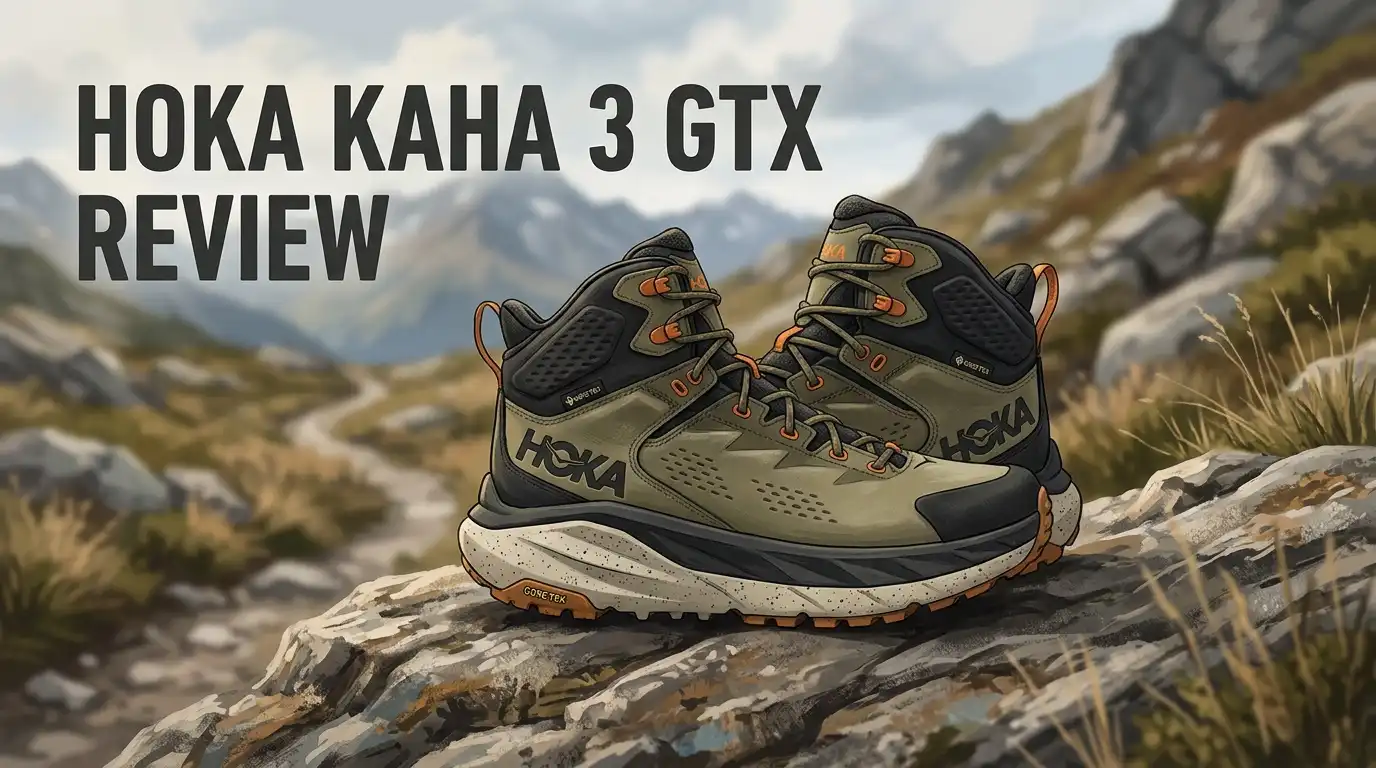
Hoka Kaha 3 GTX Review 2026: Still Worth It?
Hiking boots ask you to pick a side. You either get soft cushioning or you get real support. The Hoka Kaha 3 GTX tries to give you both, and it charges $240 for the privilege.
I put this boot through wet granite, loose scree, mud, creek crossings, and two multi day trips with a loaded pack. Some of it impressed me. Some of it annoyed me. This review covers both.
If you want to know whether the Kaha 3 GTX deserves your money in 2026, keep reading. I cover fit, grip, weight, waterproofing, durability, and the three areas where this boot clearly falls short.
In a Nutshell:
- Comfort is the headline feature. Lab testing puts shock absorption at 120 SA against a 92 SA average for hiking boots. That is one of the highest readings ever recorded in a hiker. Long descents feel noticeably softer on your knees and heels.
- Stability is excellent, which surprises people. The Kaha 3 GTX scored a perfect 5 out of 5 for torsional rigidity and 5 out of 5 for heel counter stiffness. A soft boot that still locks your ankle down is rare.
- The lugs got shallower and that matters. Measured lug depth is only 3.2mm, down from 4.9mm on the Kaha 2. Grip on wet rock is strong. Grip in deep mud and soft ground is weak.
- It runs warm and heavy. Breathability scored the lowest possible 1 out of 5. Weight sits around 19.4oz per boot in a men’s US 9. This is a cool weather and shoulder season boot.
- Fit runs slightly small with no wide option. Most testers vote slightly small. Wide feet and bunions will struggle here.
- Best for: day hikes, multi day backpacking, mixed and hard packed terrain. Skip it for: technical scrambling, summer heat, and deep mud.
Hoka Kaha 3 GTX

- Pinnacle Plushness with Weather-Ready Capabilities
Last update on 2026-09-22 / Affiliate links / Images from Amazon Product Advertising API Some of the links on this website are affiliate links, which means that at no additional cost to you, I earn a commission if you click through and make a purchase. I only recommend products and services that I believe will add value to my readers. Thank you for your support!
The Kaha 3 GTX is Hoka’s flagship backpacking boot. It sits at the top of the hiking line, above the lighter Anacapa 2 Mid GTX and the low cut Kaha 3 Low.
The build starts with a nubuck leather upper from a Gold rated Leather Working Group tannery. Hoka lines it with GORE TEX Invisible Fit, which bonds the membrane directly to the upper instead of hanging it loose inside.
Underneath sits a dual density EVA midsole with 30% sugarcane content. The softer foam sits on top, closest to your foot. A firmer carrier foam sits below to keep things from feeling sloppy.
A one piece Vibram Megagrip outsole handles traction. Hoka adds its MetaRocker geometry, the Hubble Heel, and the SwallowTail heel design.
Hoka calls it “cushier and more durable than ever before.” Half of that claim holds up. I will explain which half later in this review.
Unboxing Experience and First Impressions
The box arrives plain and recycled, nothing fancy. Inside, the boots sit wrapped in thin paper with a small card about the Leather Working Group certification.
My first reaction was weight in the hand. These feel substantial. Pick one up and the chunky heel flare catches your eye immediately.
The nubuck feels genuinely nice. It has a soft nap and a matte finish. Run your thumb across it and you can tell this is not cheap suede pretending to be leather.
The interior surprised me most. The tongue is fully gusseted on both sides, so it feels more like a sock than a flap. The insole measures 6.9mm thick, which is one of the thickest sockliners in any hiking boot.


Last update on 2026-04-11 / Affiliate links / Images from Amazon Product Advertising API Some of the links on this website are affiliate links, which means that at no additional cost to you, I earn a commission if you click through and make a purchase. I only recommend products and services that I believe will add value to my readers. Thank you for your support!
I laced them and walked around the kitchen. Zero break in stiffness underfoot. The collar needed two or three hikes to soften, but the sole felt ready on day one.
Key Specifications Summary
Here are the numbers that matter, pulled from Hoka’s listing and independent lab measurements.
Weight lands at 19.4oz (550g) for a men’s US 9. Hoka’s own site lists 20oz. The pair comes in around 2 pounds 1.6 ounces. That is heavier than the Kaha 2 by roughly one ounce.
Stack height measures 41.9mm at the heel and 30.4mm at the forefoot. Both sit far above the hiking boot average.
Drop is where things get odd. Hoka advertises 7mm to 8mm. Caliper testing puts the actual figure closer to 11.5mm. Heel strikers will like that. Low drop fans will not.


Last update on 2026-04-11 / Affiliate links / Images from Amazon Product Advertising API Some of the links on this website are affiliate links, which means that at no additional cost to you, I earn a commission if you click through and make a purchase. I only recommend products and services that I believe will add value to my readers. Thank you for your support!
Lug depth measures 3.2mm against an advertised 4mm. Outsole thickness is 2.4mm excluding lugs.
Stiffness scored 35.2N, above the 30.7N average. Midsole softness reads 35.6 AC on the top layer, which is much softer than the 47.6 AC average.
Retail price is $240. You can often find it discounted by now.
Top 3 Alternative for Hoka Kaha 3 GTX

- The stable & supportive backpacking shoe that delivers a smooth ride
- Smooth ride
- Enhanced support
Last update on 2026-09-22 / Affiliate links / Images from Amazon Product Advertising API Some of the links on this website are affiliate links, which means that at no additional cost to you, I earn a commission if you click through and make a purchase. I only recommend products and services that I believe will add value to my readers. Thank you for your support!
Salomon Quest 4 GTX

- Waterproof membrane seals out water and lets moisture escape Pigskin leather and mesh upper...
- Merrell is focused on merging performance, styling, and comfort to empower all people to confidently...
- Merrell Air Cushion in the heel absorbs shock and adds stability
Last update on 2026-06-08 / Affiliate links / Images from Amazon Product Advertising API Some of the links on this website are affiliate links, which means that at no additional cost to you, I earn a commission if you click through and make a purchase. I only recommend products and services that I believe will add value to my readers. Thank you for your support!
Merrell Moab 3 Mid Waterproof

- PFC-Free water repellency treatment
- Textile
Last update on 2026-09-12 / Affiliate links / Images from Amazon Product Advertising API Some of the links on this website are affiliate links, which means that at no additional cost to you, I earn a commission if you click through and make a purchase. I only recommend products and services that I believe will add value to my readers. Thank you for your support!
HOKA Anacapa 2 Mid GTX
Fit and Sizing: What Size Should You Order?
Sizing votes lean toward slightly small. Out of 37 tester votes, the majority said order up.
My advice is simple. If you wear thick wool socks or plan long steep descents with a heavy pack, go half a size up. If you wear thin socks and hike moderate trails, stay true to size.
Interior width measures 92.5mm at the ball of the foot. The average hiking boot measures 93.8mm. So the Kaha 3 GTX is marginally narrower than average, not dramatically so.
Toebox width comes in at 70.6mm, which is normal. Toebox height measures 28.0mm, slightly above average. Your toes get good vertical room.
Here is the real problem. Hoka does not offer a wide version of this boot. No 2E, no 4E. If you have wide feet, bunions, or a high volume forefoot, this boot will pinch. Several hikers have reported a cramped toebox even after break in.
Heel lockdown is excellent. Three metal quick lace hooks at the collar let you cinch the ankle without strangling the midfoot.
Cushioning and Ride Feel on the Trail
This is the reason to buy the Kaha 3 GTX.
Shock absorption measured 120 SA in lab testing. The hiking boot average is 92 SA. The previous Kaha 2 scored 114 SA. Hoka went softer and it worked.
What does that feel like? On a long rocky descent, your heels stop complaining. Foot fatigue arrives hours later than it does in a firm traditional boot. Hikers with plantar fasciitis, joint pain, or old injuries will feel the difference immediately.
Energy return improved too, jumping from 38.5% on the Kaha 2 to 49.5% here. Hoka promised “a bit more bounce” and delivered. Do not expect a springy running shoe though. The boot still feels planted.
The MetaRocker geometry adds a rolling motion that moves you forward. Combined with the high stack, it smooths out ground texture.
The tradeoff is trail feel. You lose almost all of it. I could not tell a small rock from a root underfoot. Some hikers love that isolation. Others hate flying blind.
Traction and Grip: Where It Wins and Loses
The Vibram Megagrip outsole delivers on smooth wet surfaces. Friction testing against wet concrete returned a coefficient of 0.65, which is high.
On wet granite slabs, I trusted these boots completely. The shallow lugs actually help here because more rubber contacts the rock surface.
Then the terrain changes and the story flips.
Lug depth is only 3.2mm. The Kaha 2 had 4.9mm. That is a 35% reduction in bite. In thick mud, wet clay, and soft soil, the tread packs up and slides.
One hiker documented weak grip on wet stone steps and steep descents during the Inca Trail. Other hikers on the same trail in rainy season reported no issues at all. Terrain and technique clearly matter.
My own take: these grip hard packed dirt, rock, and gravel very well. They struggle on soft ground, snow, and anything greasy. If your local trails turn to soup in spring, look at a deeper lugged boot.
The chevron and linear tread pattern handles steep ascents and descents smoothly.
Waterproofing and Breathability Trade Off
The GORE TEX Invisible Fit membrane works. I crossed ankle deep creeks, stood in puddles, and hiked through steady rain. My socks stayed dry every time.
Invisible Fit bonds the membrane to the upper rather than leaving it as a separate bootie. The result feels less bulky and more like a normal lining.
Now the bad news. Breathability scored 1 out of 5, the lowest possible rating. Smoke testing found zero perforations in the toebox. Microscope shots showed the tongue fabric is tightly woven with almost no airflow.
Thick nubuck leather plus a waterproof membrane equals a warm boot. That is basic physics.
I would not wear these above 70°F (20°C). At 80°F my feet turned into a swamp within two hours. Merino socks help but they cannot fix the fundamental design.
For cold weather, shoulder season, wet spring hiking, and mountain trips, this warmth becomes a feature. For a summer desert hike, it becomes a problem.
Stability and Support With a Heavy Pack
Soft boots usually feel unstable. This one does not, and that combination is the Kaha 3 GTX’s real trick.
Torsional rigidity scored a perfect 5 out of 5. The boot refused to twist in manual testing. A stiff leather upper, rubberized overlays, and a wide platform work together.
Heel counter stiffness also scored 5 out of 5, up from just 2 out of 5 on the Kaha 2. Hoka added a higher midsole topline and an extra rubberized overlay at the heel base.
At the same time, the top of the collar stays flexible right where your Achilles sits. No shin bang, no Achilles rub. The strange collar tongue from the Kaha 2 is gone. Good riddance.
Midsole width measures 115mm at the forefoot and 96.4mm at the heel. The heel is 10mm narrower than the Kaha 2, which means fewer rocks catching that extended tail.
I carried a 35 pound pack for three days. My ankles never felt loose.
Durability After Real Trail Miles
Hoka claims the Kaha 3 is “more durable than ever before.” Testing does not support that claim.
Dremel abrasion testing on the toebox nubuck left slightly more damage on the Kaha 3 than on the Kaha 2. The reason is simple. The Kaha 2’s rubber rand extended further back and shielded more of the toebox.
Toebox durability still scored 4 out of 5, which is good. The nubuck will not shred against rocks or brush. It is just not an improvement.
Heel lining durability also scored 4 out of 5, better than most competitors.
Outsole wear measured 1.1mm of damage after an 18 second drill session at 10,000 RPM. The average boot loses 0.8mm. So the rubber is marginally softer than average.
I consider that a fair trade. Softer rubber grips wet rock better. You sacrifice some outsole life for real world confidence.
There are no reflective elements anywhere on the boot.
Hoka Kaha 3 GTX vs Kaha 2 GTX
Should Kaha 2 owners upgrade? Here is the honest comparison.
The Kaha 3 wins on cushioning (120 SA vs 114 SA), energy return (49.5% vs 38.5%), heel counter support (5/5 vs 2/5), and looks. The ankle cuff also rises to about 7.5 inches for more coverage.
The Kaha 3 wins on comfort during very long days. Multiple hikers who own both pairs say the Kaha 2 feels less comfortable past mile fifteen.
The Kaha 2 wins on grip in soft terrain thanks to those 4.9mm lugs. It also wins on weight by roughly one ounce per boot, and on toebox protection.
My verdict: upgrade if comfort and support are your priority. Stay put if you hike muddy or technical ground.
The Kaha 3 also looks far better. The Kaha 2 was blocky and polarizing. The Kaha 3 looks streamlined and normal.
What the Kaha 3 GTX Does Not Do Well
Every review should list the failures plainly. Here are mine.
It is not a technical boot. The wide platform and tall stack kill precision. On exposed scrambles where you need to place your toe on a two inch ledge, this boot feels like a marshmallow. You cannot feel the edge.
It is not a summer boot. Zero ventilation means overheating above 70°F.
It is not a mud boot. Shallow 3.2mm lugs pack and slip.
It is not a wide foot boot. No wide sizing exists.
The midsole firms up in cold. Freezer testing showed the soft foam getting 46% firmer after 20 minutes. The average boot firms up only 20%. Winter hikers lose some of the cushioning they paid for.
The advertised drop is wrong. Hoka says 7mm to 8mm. Measured drop is 11.5mm. That is a meaningful difference for anyone with Achilles or calf sensitivity.
Also worth noting: tongue padding measured 10.4mm, which is actually below average despite the plush marketing.
Pros and Cons
Pros
- Highest tier shock absorption at 120 SA, well above the 92 SA average
- Perfect 5 out of 5 torsional rigidity and heel counter stiffness
- Vibram Megagrip bites hard on wet rock with a 0.65 friction score
- GORE TEX Invisible Fit kept my feet fully dry through creek crossings
- Achilles friendly collar eliminates the shin rub of the Kaha 2
- Thick 6.9mm removable insole works with custom orthotics
- Gold rated nubuck leather feels premium and wears well
- Sustainable materials including 30% sugarcane EVA and recycled polyester
- Much better looking than the previous generation
Cons
- Breathability scored the lowest possible 1 out of 5
- Lug depth dropped to 3.2mm, hurting grip in mud and soft ground
- Weighs 19.4oz per boot, heavier than the Kaha 2
- No wide sizing available at all
- Actual drop is 11.5mm, not the advertised 8mm
- Midsole gets 46% firmer in cold weather
- Toebox durability slightly worse than the Kaha 2
- Almost no trail feel or ground feedback
- $240 price sits above the $208 category average
- No reflective elements for low light hiking
Who Should Buy the Hoka Kaha 3 GTX?
Buy this boot if you carry a pack on multi day trips and want your feet to survive the week. The cushioning genuinely reduces fatigue.
Buy it if you have plantar fasciitis, joint pain, knee issues, or an injury history. This is one of the most forgiving boots on the market.
Buy it if your trails are rocky, hard packed, or mixed. Buy it if you hike in cool or wet conditions.
Skip it if you hike short easy day trails with a light pack. The Anacapa 2 Mid GTX does that job for less money and less weight.
Skip it if your routes involve real scrambling or via ferrata. You need a precision boot.
Skip it if you have wide feet, or if you hike in hot weather most of the year.
At $240, the price is defensible. Comparable boots from Scarpa, LOWA, and Salomon sit in the same range. You are paying for materials and comfort, not for technical performance.
Final Verdict: Is It Worth It in 2026?
The Hoka Kaha 3 GTX earns a place in my rotation. It is the boot I grab when I know I will be walking for eight hours.
It does one thing better than almost anything else: it protects your feet across long distances. The combination of 120 SA shock absorption with perfect torsional rigidity is genuinely uncommon.
It also has clear limits. Shallow lugs, zero breathability, real weight, and no wide sizing. Hoka narrowed the use case of this boot compared to the Kaha 2, and buyers deserve to know that.
Score: 8.5 out of 10 for comfort focused backpacking. 6 out of 10 for technical or summer hiking.
Order a half size up if you plan steep descents. Try them on your own carpet first and use the return window.
If comfort is your top priority, this boot is an easy recommendation.
Frequently Asked Questions
Does the Hoka Kaha 3 GTX run small?
Most testers vote slightly small. Interior width measures 92.5mm, just under the 93.8mm average. Order half a size up if you wear thick socks or plan long descents with a heavy pack. Stay true to size for thin socks and moderate trails.
Is the Hoka Kaha 3 GTX actually waterproof?
Yes. The GORE TEX Invisible Fit membrane handled rain, puddles, and ankle deep creek crossings without leaking. The fully gusseted tongue also blocks water entry from the top.
How much does the Hoka Kaha 3 GTX weigh?
Roughly 19.4oz (550g) per boot in a men’s US 9. That works out to about 2 pounds 1.6 ounces per pair. Hoka’s website lists 20oz. It is about one ounce heavier than the Kaha 2.
Is the Kaha 3 GTX good for wide feet?
No. Hoka offers no wide version of this boot. The toebox measures 70.6mm, which is average, and several hikers report a cramped feel. Look at the Altra Olympus Mid GTX or the KEEN Targhee IV instead.
How long does break in take?
The midsole feels ready on day one. The leather collar and upper need roughly two to four hikes to soften. Full comfort arrived around mile twenty for me.
Can I wear the Kaha 3 GTX in summer?
I would not. Breathability scored 1 out of 5 with zero ventilation holes. Above 70°F your feet will overheat. Choose a mesh hiker for warm weather.
Is the Kaha 3 GTX good for muddy trails?
Not really. Lug depth is only 3.2mm, down from 4.9mm on the Kaha 2. Grip on wet rock is excellent, but soft mud clogs the shallow tread. Pick the Salomon Quest 4 GTX for mud.
What is the difference between the Kaha 3 GTX and the Kaha 3 Low GTX?
The Low is a mid cut shoe at 17.1oz with an 8mm drop and a $220 price. The full Kaha 3 GTX is a taller boot at 19.4oz with more ankle coverage and a stiffer heel counter. Choose the Low for day hiking and the mid for loaded backpacking.

Mia Smith is the founder of Shoe Storyteller, a blog that celebrates the art and stories behind shoes. With a passion for fashion and a flair for storytelling, Mia brings a unique perspective to the world of footwear.