Hoka Anacapa Breeze Low Review 2026: Worth It?
Hot weather hiking punishes your feet. Sweaty socks, hot spots, and sore arches can end a good day early. The Hoka Anacapa Breeze Low promises a fix. It takes the popular Anacapa hiking platform and swaps the leather and waterproof lining for an airy mesh upper.
I have walked, commuted, and travelled in this shoe. Below you get the full picture, including the parts Hoka does not advertise. This review covers comfort, grip, sizing, heat management, durability, and value. You will also see honest negatives, because no shoe wins everywhere.
If you want a plush, breezy trail shoe that still looks acceptable in a coffee shop, keep reading.
In a Nutshell:
- Comfort is the headline. The thick compression molded EVA midsole soaks up rocks and hard packed dirt. Feet stay fresh far longer than they do in thin, firm hikers. People with plantar fasciitis or ball of foot pain often notice the difference on day one.
- Breathability is genuinely strong. The engineered air mesh upper uses recycled yarns and lets heat escape fast. This is a summer shoe first and everything else second.
- Grip holds up well. A Vibram Megagrip outsole with roughly 5 mm lugs bites into loose dirt, gravel, and damp roots. Wet slab rock remains the weak spot.
- It is not waterproof, at all. Puddles, creeks, and dewy grass soak straight through. That is the tradeoff for airflow, and it dries quickly in return.
- Technical terrain is not its home. The wide, tall platform feels planted on trails and paths, yet it feels clumsy on scrambles and narrow rocky ledges.
- Price sits in premium territory. Expect roughly 150 to 165 USD at full price, with frequent discounts on older colours.
What Is the Hoka Anacapa Breeze Low?

- Engineered air mesh with 100% rPET yarn
- Textile
Last update on 2026-09-20 / Affiliate links / Images from Amazon Product Advertising API Some of the links on this website are affiliate links, which means that at no additional cost to you, I earn a commission if you click through and make a purchase. I only recommend products and services that I believe will add value to my readers. Thank you for your support!
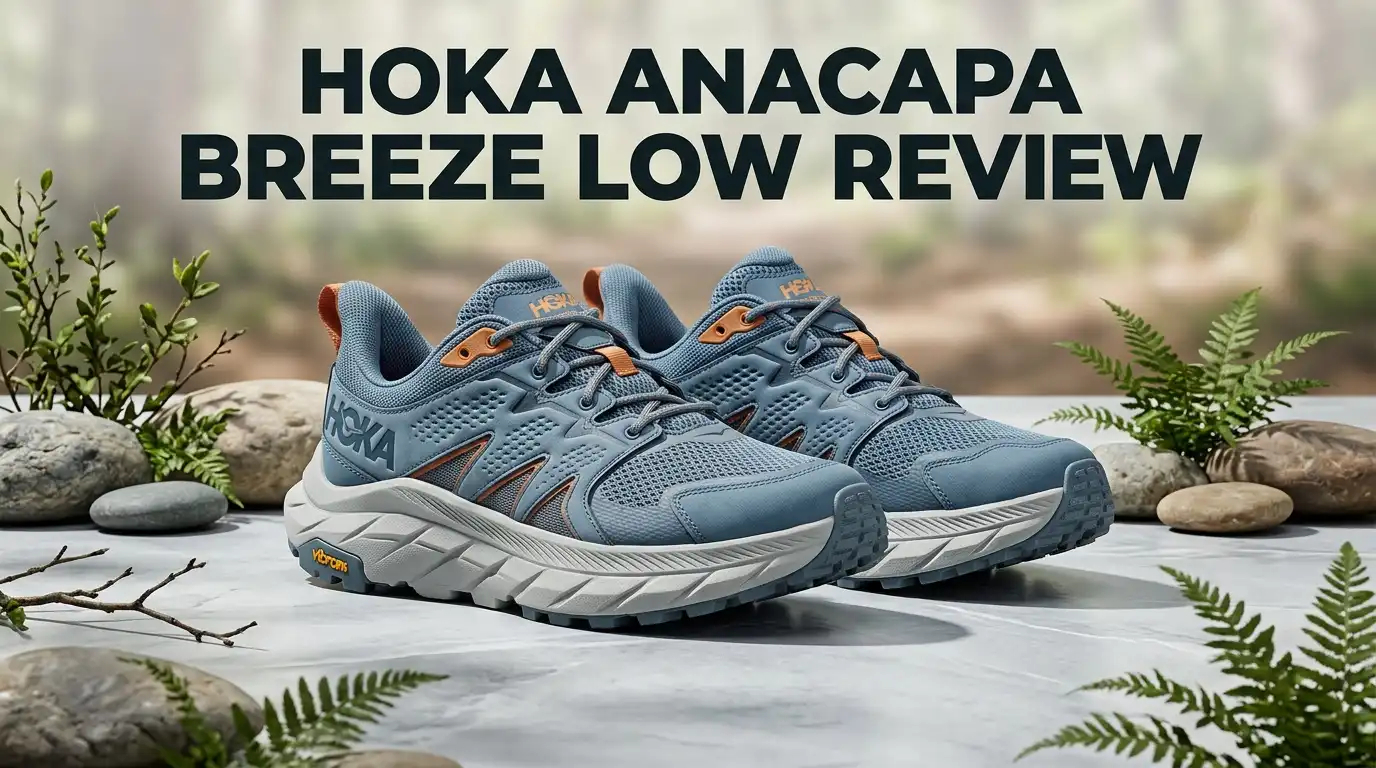
The Anacapa Breeze Low is the warm weather version of Hoka’s Anacapa hiking shoe. Hoka built the original Anacapa around nubuck leather and a Gore Tex liner. The Breeze removes both.
In their place sits an engineered air mesh upper made with recycled polyester yarns. The geometry stays the same. You still get the tall stack, the extended heel that Hoka calls the swallowtail, and the Vibram Megagrip outsole.
Think of it as a hiking shoe built for July, not January.
The shoe targets three users. Day hikers who move fast in heat. Travellers who want one shoe for airports, cities, and light trails. Workers on their feet who like maximum cushioning under the heel.
Hoka lists a claimed 8 mm heel to toe drop and a weight near 12.4 ounces per shoe in a standard men’s sample. Real world weights land around 353 grams in a men’s size 8 and 289 grams in a women’s size 6. That is light for this much foam.
Unboxing Experience: First Impressions Out of the Box
The box is plain Hoka cardboard, no frills, recycled stock with the wordmark on the lid. Lift the lid and the smell hits first. It is that clean foam and mesh scent, not the chemical punch you get from cheap synthetics.
Each shoe sits in thin tissue. There is no dust bag, no extra laces, and no insole card. Hoka keeps packaging minimal, which fits the recycled materials story.
Pick one up and the weight surprises you. The sole looks like a slab of pool noodle, yet the shoe feels lighter than it looks. I said “that is it?” out loud when I first lifted the pair.
The mesh feels soft and slightly stretchy under your thumb. You can see light through it if you hold it up to a window. That single test tells you how much air moves through this upper.


Last update on 2026-04-11 / Affiliate links / Images from Amazon Product Advertising API Some of the links on this website are affiliate links, which means that at no additional cost to you, I earn a commission if you click through and make a purchase. I only recommend products and services that I believe will add value to my readers. Thank you for your support!
Laces are flat and lightly waxed. The tongue is padded and gusseted. First step inside feels springy and a little tippy until your brain adjusts to the stack height.
Design and Build Quality
Hoka designed the Anacapa Breeze Low around one idea: keep the platform, lose the heat. The upper uses engineered air mesh with 100 percent recycled yarns, backed by welded overlays instead of heavy stitching.
The midsole is compression molded EVA. It is thick, wide, and slightly firmer than Hoka’s road shoes. Hoka calls the cushioning balanced rather than plush, and that description is fair.
The swallowtail heel extends past the ankle. It looks odd in photos. On trail it smooths out heel landings and helps your foot roll forward with less effort.
Build quality is good, not flawless. The toe cap is a thin rubber bumper rather than a full rand. Kick a root hard and you feel it.


Last update on 2026-04-11 / Affiliate links / Images from Amazon Product Advertising API Some of the links on this website are affiliate links, which means that at no additional cost to you, I earn a commission if you click through and make a purchase. I only recommend products and services that I believe will add value to my readers. Thank you for your support!
A section of foam sits exposed in the midfoot outsole. That saves weight. It also wears faster than rubber, and you will see scuffing there before anywhere else. Budget owners should note that detail.
The eco credentials are real. Recycled polyester, recycled yarns, and a partly plant based liner appear across the line.
Comfort and Cushioning on Long Days
This is where the shoe earns its money. The stack height sits well above the hiking shoe average, and the difference shows after mile eight.
Sharp gravel disappears underfoot. Root networks feel like gentle bumps. Your legs simply stay fresher. Testers who log big days in maximal hikers consistently report less end of day soreness, and my experience matched that.
The insole is thicker than most stock footbeds. It adds a soft top layer without feeling mushy. You can swap it for orthotics, though a thinner replacement changes the volume noticeably.
The rocker shape does most of the quiet work. Your foot rolls from heel to toe rather than flexing hard at the ball. That reduces calf fatigue on long flat stretches.
There is a break in period for the brain, not the shoe. The first hour feels tall and slightly bouncy. After a few outings that sensation disappears completely.
People with heel pain, arch pain, or metatarsal soreness tend to love this platform. People who like ground feel will hate it.
Top 3 Alternative for Hoka Anacapa Breeze Low

Last update on 2026-09-20 / Affiliate links / Images from Amazon Product Advertising API Some of the links on this website are affiliate links, which means that at no additional cost to you, I earn a commission if you click through and make a purchase. I only recommend products and services that I believe will add value to my readers. Thank you for your support!
HOKA Men’s Anacapa 2 Low GTX

- 39% recycled, breathable engineered mesh and TPU upper
- Protective and abrasion resistant synthetic heel and toe cap
- Dual heel and tongue loops for ease of entry as well as carabiner compatibility

Last update on 2026-09-20 / Affiliate links / Images from Amazon Product Advertising API Some of the links on this website are affiliate links, which means that at no additional cost to you, I earn a commission if you click through and make a purchase. I only recommend products and services that I believe will add value to my readers. Thank you for your support!
Merrell Men’s Moab Speed 2 Hiking Shoe

- JACQUARD KNIT UPPER
- Lining Textile
Last update on 2026-08-31 / Affiliate links / Images from Amazon Product Advertising API Some of the links on this website are affiliate links, which means that at no additional cost to you, I earn a commission if you click through and make a purchase. I only recommend products and services that I believe will add value to my readers. Thank you for your support!
HOKA Men’s Speedgoat 6
Breathability in Hot Weather
Airflow is the entire point of the Breeze, and it delivers. The mesh is open enough that you can feel a breeze across your foot when you walk into wind.
On a 90 degree afternoon my socks stayed damp rather than soaked. In a waterproof hiker on the same route they finish wringing wet. That single change prevents most hot weather blisters.
Drying speed matters just as much. Step through a shallow creek and the shoe sheds water fast. Twenty to thirty minutes of walking in sun usually gets the upper close to dry.
There is a cost. Fine dust and sand pass through the mesh. Desert trails and beach paths will put grit inside the shoe. Low gaiters solve this if you hike in sandy terrain often.
Cold mornings feel cold. Wind cuts through the upper easily, so autumn and winter use needs thicker socks. Below roughly 50 degrees this shoe stops being the right tool.
Summer travellers get the best of it. Airport queues, city walking, and dusty ruins all feel manageable.
Traction and Grip on Trails
The outsole uses Vibram Megagrip rubber with multidirectional lugs around 5 mm deep. That is deeper than the hiking shoe average, and it shows.
Loose dirt, pine duff, gravel, and packed clay all feel secure. The wide forefoot places a lot of rubber on the ground, which helps on off camber sections.
Braking on descents is solid. Slanted heel lugs catch as you step down, even without a dedicated heel brake block. I never felt like I was skating on dry ground.
Mud clears reasonably well because the lugs sit spaced apart. Deep clay will still pack in, as it does with every hiking shoe.
Wet rock is the honest weak point. Megagrip is good on damp stone, yet the tall stack reduces the feedback you need to trust a smeared foot placement. On slick granite slabs I slowed down noticeably.
Grass slopes after rain also feel sketchy. The lugs bite, but the cushioning muffles what your foot senses, so confidence drops.
Fit and Sizing Guide
Most wearers find the Anacapa family fits true to size in length. Order your normal Hoka size and you will usually be right.
Width is a different story. The interior runs narrower than the average hiking shoe, particularly through the midfoot. Lab measurements on the Anacapa platform show a forefoot volume below category average.
If you have wide feet or bunions, buy the wide version. Hoka offers 2E for men and D for women, and those add meaningful room.
The toe box shape helps. It tapers gently rather than sharply, so your little toe gets space even when the overall width feels snug. Toe box height is generous too.
The gusseted tongue blocks debris and stays centred. Padding is thick, which some people love and others find warm.
Laces loosen on long descents. Double knot them. One extra eyelet up top lets you lock your heel with a runner’s loop if you get any lift.
Half sizes matter here. Between sizes, go up rather than down, since feet swell in heat.
Weight and Stability on the Trail
At roughly 12.4 ounces per shoe, the Breeze Low is light for a maximal hiker. It undercuts the Gore Tex Anacapa 2 Low by a meaningful margin, which matters over thousands of steps.
Stability comes from width, not stiffness. The forefoot platform measures among the widest in the hiking shoe category, so the foot sits inside a broad base rather than perched on top of foam.
Sidewalls rise around the midsole and stop your foot spilling sideways. Torsional rigidity is high, which means the shoe resists twisting on uneven ground.
The heel counter is moderate. It holds without gripping. That suits day hiking with a light pack, and it suits travel walking even better.
Here is the honest limit. Tall plus wide equals awkward on technical terrain. Narrow rock ledges, boulder hopping, and steep scree all expose the platform. You cannot feel edges precisely.
Carrying heavy loads over 30 pounds also pushes the shoe past comfort. The foam compresses and the ankle wants support the low cut cannot give.
Durability: How Long Do They Last?
Expect a normal lifespan, not an exceptional one. Most owners report 400 to 600 miles before the midsole flattens noticeably.
The Vibram rubber sections hold up well. Abrasion testing on the Anacapa platform shows tread loss in line with the category average, which is a good result.
The exposed foam in the midfoot is the weak link. That area scuffs, chips, and wears faster than the rubber around it. On rocky trails you will see damage within months.
Mesh durability is adequate rather than tough. Sharp branches and scree can snag the upper, and the thin toe bumper does not protect much. A few Reddit owners report faster than expected wear on the upper with heavy festival or daily use.
Heel padding shows scuffing over time too. Nothing catastrophic, just cosmetic wear inside the collar.
Care extends life. Rinse dust out, air dry away from heat, and rotate with a second pair if you walk daily.
What the Anacapa Breeze Low Does Not Do Well
Authentic reviews name the flaws, so here they are plainly.
It does not handle water. No membrane, no water resistance, no protection from morning dew. Wet grass will soak your socks within minutes.
It does not suit technical scrambling. The high stack removes ground feel. On exposed rock you want precision, and this shoe gives you a cushioned guess instead.
It does not stop dust or sand. Open mesh works both ways. Sandy trails deposit grit right against your skin.
It does not stay warm. Below roughly 50 degrees the airflow becomes a liability rather than a feature.
It does not fit wide feet in standard width. Many buyers return their first pair for this reason alone. Check the wide option before ordering.
It does not feel soft in the cold. The EVA firms up significantly in low temperatures, so early morning steps feel harsher than expected.
Finally, the look divides people. The chunky sole reads as orthopaedic to some eyes.
Pros and Cons of the Hoka Anacapa Breeze Low
Here is the balance sheet in plain terms.
Pros
- Outstanding all day cushioning that reduces foot and leg fatigue on long, flat, or hard packed routes.
- Excellent breathability from the recycled air mesh upper, ideal for summer hiking and hot climate travel.
- Reliable Vibram Megagrip traction with deep multidirectional lugs on dirt, gravel, and loose terrain.
- Light for a maximal shoe, roughly 12.4 ounces per shoe, several ounces lighter than the Gore Tex Anacapa 2 Low.
- Very stable platform thanks to an extremely wide base, high torsional rigidity, and raised sidewalls.
- Smooth rocker and swallowtail heel that make heel to toe transitions feel effortless over big mileage.
- Strong sustainability story with recycled yarns, recycled polyester, and partly plant based lining materials.
- Fast drying after creek crossings, unlike waterproof hiking shoes that trap moisture inside.
Cons
- Zero water protection, so wet conditions soak your feet immediately.
- Poor precision on technical rock, scrambles, and narrow ledges due to the tall, broad platform.
- Mesh lets dust and sand inside on desert or beach terrain.
- Runs narrow in standard width, forcing many buyers into the wide version.
- Exposed midfoot foam wears quickly compared with the rubber sections of the outsole.
- Cold weather performance is weak, both for warmth and for midsole softness.
- Premium price around 150 to 165 USD, with limited sizing and colour availability on some retailers.
Price and Value in 2026
Retail sits near 155 USD, with typical street prices between 140 and 165 USD depending on colour and size. Older colourways regularly drop below 100 USD during clearance events.
That puts the Breeze Low in the same bracket as the Salomon X Ultra 5 and above the Merrell Moab Speed 2. You pay a premium for the cushioning platform.
Is the value there? It depends entirely on your use case. If your feet hurt at the end of long days, this shoe solves a real problem, and 155 USD is cheap against that.
If you hike technical terrain in wet climates, you are buying the wrong tool at a high price.
Amazon stock is inconsistent. Many listings show limited sizes, and some pages sit unavailable. Checking Hoka direct or a specialty retailer often gives better size coverage.
Watch for discounts in late summer when the new season colours arrive. Patience saves 40 USD here regularly.
Who Should Buy the Hoka Anacapa Breeze Low?
- Engineered air mesh with 100% rPET yarn
- Textile
Last update on 2026-09-20 / Affiliate links / Images from Amazon Product Advertising API Some of the links on this website are affiliate links, which means that at no additional cost to you, I earn a commission if you click through and make a purchase. I only recommend products and services that I believe will add value to my readers. Thank you for your support!
Buy this shoe if you hike in heat and value comfort over precision. Summer day hikers on established trails get the most from it.
It suits travellers well. One pair handles airports, cobblestones, museum floors, and a light trail day without complaint.
People with plantar fasciitis, metatarsalgia, or general foot fatigue should shortlist it. The cushioning genuinely reduces impact stress.
Nurses, teachers, and anyone on hard floors for ten hours will also appreciate the platform, even though Hoka markets it for trails.
Skip it if you hike wet, cold, or technical ground. Choose the Anacapa 2 Low GTX for waterproofing, or a lower stack shoe like the Salomon X Ultra for rocky precision.
Skip it too if you want ground feel. This shoe deliberately isolates you from the trail, and no amount of break in changes that.
Wide footed buyers should order the wide version first and save themselves a return.
Final Verdict
The Hoka Anacapa Breeze Low is a specialist that pretends to be an all rounder. In its lane, which is hot weather hiking on non technical terrain, it is close to unbeatable.
Cushioning, breathability, and stability form a strong trio. Grip on dirt is confident. Weight stays reasonable for the foam on offer.
The flaws are real and predictable. No waterproofing. Awkward on rock. Narrow in standard width. Exposed foam that wears early.
Score: 4.2 out of 5 for summer hikers and travellers. Around 3 out of 5 for technical or wet weather use.
Match the shoe to your terrain and you will love it. Buy it as a do everything hiker and you will feel let down by the first creek crossing.
Frequently Asked Questions
Is the Hoka Anacapa Breeze Low waterproof?
No. The Breeze uses open air mesh with no membrane. Water passes straight through. The upside is fast drying, usually within thirty minutes of walking in warm conditions. If you need dry feet, choose the Anacapa 2 Low GTX with its Gore Tex liner instead.
Does the Anacapa Breeze Low run true to size?
Length runs true to size for most wearers. Width runs narrow compared with average hiking shoes. If you have wide feet, high volume feet, or bunions, order the wide version. Hoka offers 2E for men and D for women, which adds roughly 6 to 8 mm of room.
How long do the Anacapa Breeze Low shoes last?
Most owners get 400 to 600 miles before the midsole feels flat. The Vibram rubber sections last well. The exposed foam in the midfoot outsole wears faster and usually shows damage first. Daily street wear typically shortens life compared with trail use on softer surfaces.
Can I use the Anacapa Breeze Low for backpacking?
Light backpacking works fine, up to about 25 to 30 pounds of pack weight. Beyond that the low cut and soft foam start to feel unsupportive. For heavier loads, look at the Anacapa Breeze Mid or the Anacapa 2 Mid GTX for added ankle support.
Is the Anacapa Breeze Low good for walking all day in cities?
Yes, very good. The cushioning and rocker reduce fatigue on pavement, and the mesh keeps feet cool in summer heat. Many travellers use it as a single shoe for trips. The chunky look is the main drawback if you want something dressier.
What is the difference between the Breeze and the Anacapa 2 Low GTX?
The Breeze uses breathable mesh with no waterproofing and weighs roughly six ounces less per pair. The Anacapa 2 Low GTX uses nubuck leather panels with a Gore Tex Invisible Fit membrane. Choose the Breeze for heat and the GTX for wet or cold conditions.

Mia Smith is the founder of Shoe Storyteller, a blog that celebrates the art and stories behind shoes. With a passion for fashion and a flair for storytelling, Mia brings a unique perspective to the world of footwear.