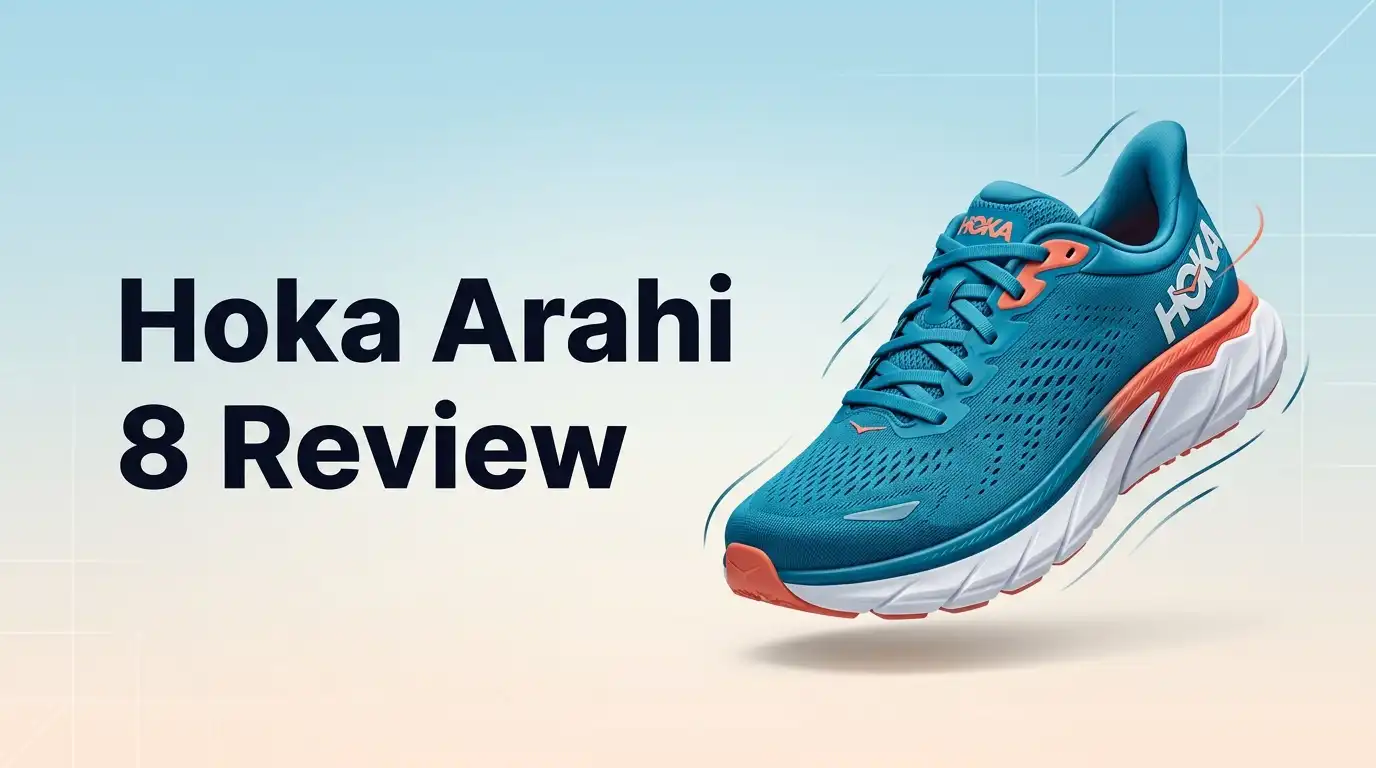
Hoka Arahi 8 Review 2026: Worth Buying?
Stability shoes used to feel stiff, heavy, and a little boring. The Hoka Arahi 8 wants to change that story. It arrives with a taller stack, a softer foam, and a brand new support frame that Hoka built from scratch.
Runners who need mild pronation control now have a shoe that feels closer to a plush daily trainer than a corrective device.
I logged road miles, treadmill sessions, and long walking days in this shoe. I also dug into lab data, owner feedback, and comparisons with the previous model. This review covers the ride, the fit, the weak spots, and the value in 2026. You will get the honest picture, including the parts Hoka got wrong.
In A Nutshell:
- The Arahi 8 is a mild stability shoe with a soft ride. Hoka swapped the firm foam of the Arahi 7 for a softer compression molded EVA, so landings feel cushioned instead of flat and punishing.
- The new H Frame replaces the old J Frame. A firmer foam sidewall sits on both sides of the midsole. It controls inward roll without the plastic post feel that many runners dislike.
- Weight dropped while cushioning grew. Lab testing put the men’s size 9 at roughly 9.1 oz or 259 g, which is lighter than version 7 despite the extra foam underfoot.
- The drop went up. Hoka lists 8 mm, and independent measurement showed even more. Heel strikers benefit. Midfoot and forefoot runners may need an adjustment period.
- The fit got wider and friendlier. Toebox width grew by several millimeters over the Arahi 7, so wide feet finally get breathing room in a Hoka.
- Breathability is the clear weak spot. The double layer jacquard mesh blocks airflow, which makes hot summer runs sweaty. Cold weather runners will actually like this.
- Durability is excellent. The upper, heel lining, and outsole all scored top marks in abrasion testing, so 400 plus miles is a fair expectation.
Hoka Arahi 8 Overview

- JACQUARD KNIT UPPER
- Lining Textile
Last update on 2026-09-20 / Affiliate links / Images from Amazon Product Advertising API Some of the links on this website are affiliate links, which means that at no additional cost to you, I earn a commission if you click through and make a purchase. I only recommend products and services that I believe will add value to my readers. Thank you for your support!
The Arahi 8 is Hoka’s lightweight stability trainer. It sits between the neutral Clifton and the maximum support Gaviota. Hoka built this version as a full reset rather than a small refresh.
The midsole uses a taller stack of around 39 mm in the heel and 28 mm in the forefoot. That extra material gives you real protection on long runs. The Arahi 7 never felt this cushioned.
Support comes from the H Frame system, a firmer foam structure that wraps the sides of the midsole. It works quietly. You feel guided instead of corrected.
An early stage Meta Rocker moves you forward through each step. The heel bevel is deeper than before, which smooths out heel landings.
Retail price sits at $150, and that number places it right in the middle of the daily trainer market. For a shoe with this much foam and this much durability, the price feels fair rather than greedy.
Unboxing Experience And First Impressions
The box arrives in Hoka’s familiar recycled cardboard with the simple logo print. No tissue paper theater, no extra laces, no shoe bag. You get the shoes and a small info card. That is it.
Pull the shoes out and the first thing you notice is the tongue. It is thick, plush, and almost pillow like at nearly 12 mm. It feels premium in the hand.
The second thing you notice is the weight, or the lack of it. The shoe looks chunky because of the tall sidewalls, yet it feels light when you lift it.
The mesh feels dense and slightly rubbery to the touch. It does not have that airy, papery feel you get from summer racers.


Last update on 2026-04-11 / Affiliate links / Images from Amazon Product Advertising API Some of the links on this website are affiliate links, which means that at no additional cost to you, I earn a commission if you click through and make a purchase. I only recommend products and services that I believe will add value to my readers. Thank you for your support!
First step in, the interior feels roomy and soft. The heel collar hugs the ankle without pinching. My immediate reaction was simple: this feels like a comfort shoe first and a stability shoe second.
Key Specs You Should Know
Numbers tell part of the story, so here are the ones that matter. Weight lands near 9.1 oz or 259 g for a men’s size 9, and around 7.7 oz or 218 g for a women’s size 8.
Stack height measures roughly 39 mm at the heel and 28 mm at the forefoot. Hoka lists the drop at 8 mm, a big jump from the 5 mm the Arahi line used for years.
The midsole is compression molded EVA with a firmer EVA frame for support. Energy return is modest at around 54 percent in the heel, so this foam absorbs more than it springs.
Torsional rigidity tested near 19.5 Nm, which is very high. The shoe barely twists.


Last update on 2026-04-11 / Affiliate links / Images from Amazon Product Advertising API Some of the links on this website are affiliate links, which means that at no additional cost to you, I earn a commission if you click through and make a purchase. I only recommend products and services that I believe will add value to my readers. Thank you for your support!
The outsole carries about 3.3 mm of rubber in high wear zones. Insole thickness sits at a standard 4.5 mm and the insole is removable, which matters if you wear custom orthotics.
Top 3 Alternative for Hoka Arahi 8

- THIS MEN’S SHOE IS FOR: The Adrenaline GTS 25 is perfect for runners and walkers seeking reliable...
- GUIDERAILS HOLISTIC SUPPORT SYSTEM: Our innovative technology - known as “GTS” for “Go-To...
- SOFT & DYNAMIC CUSHIONING: Even more premium nitrogen-infused DNA Loft v3 cushioning delivers...
Last update on 2026-09-22 / Affiliate links / Images from Amazon Product Advertising API Some of the links on this website are affiliate links, which means that at no additional cost to you, I earn a commission if you click through and make a purchase. I only recommend products and services that I believe will add value to my readers. Thank you for your support!
Brooks Adrenaline GTS 25

- Jacquard mesh upper: Offers a supportive and comfortable foothold
- At least 50% of the shoe's main upper material is made with recycled content to reduce waste and...
- The sockliner is produced with the solution dyeing process that reduces water usage by approximately...
Last update on 2026-09-20 / Affiliate links / Images from Amazon Product Advertising API Some of the links on this website are affiliate links, which means that at no additional cost to you, I earn a commission if you click through and make a purchase. I only recommend products and services that I believe will add value to my readers. Thank you for your support!
ASICS GT 2000 13

- Reflective details
- Heel pull webbing
- Comfort collar
Last update on 2026-09-22 / Affiliate links / Images from Amazon Product Advertising API Some of the links on this website are affiliate links, which means that at no additional cost to you, I earn a commission if you click through and make a purchase. I only recommend products and services that I believe will add value to my readers. Thank you for your support!
Hoka Gaviota 6
Midsole Feel And Cushioning Quality
This is where the Arahi 8 wins people over. The Arahi 7 was firm, flat, and a bit harsh on tired legs. The Arahi 8 softens everything.
Heel shock absorption jumped dramatically in lab testing, moving from a below average score to an above average one. You feel that on pavement after mile eight.
The foam is soft but not mushy. It compresses, holds, then releases you forward through the rocker. Think plush and controlled rather than bouncy.
Energy return stays average because Hoka stuck with standard EVA instead of the supercritical foam used in the Mach line. So this shoe protects legs, it does not add speed.
One honest note: EVA stiffens in the cold. Testing showed the foam firmed up by about 31 percent after freezer exposure. Winter runners in very cold regions will notice a firmer ride on frosty mornings.
H Frame Stability System Explained
Hoka retired the J Frame and introduced the H Frame. Picture the letter H from above. Firmer foam runs along both sides of the midsole and connects through the middle.
The old J Frame only guarded the medial side. The new design supports both sides, which helps runners who wobble outward as well as inward.
The support foam measures noticeably firmer than the main midsole. You do not feel a hard wall under your arch. You feel a gentle cradle that stops your foot from tipping.
Combine that with high torsional rigidity and a wide heel platform and the result is steady. Fatigue late in a run does not turn into sloppy form.
This is mild to moderate stability, not maximum support. Severe overpronators will want the Gaviota 6 instead. For everyone else with a mild pronation pattern, the Arahi 8 delivers plenty.
Fit, Sizing And Toebox Room
The Arahi 8 runs true to size for most feet. Order your normal Hoka size and you will be fine.
The big change is width. Toebox width measured about 73.6 mm compared to roughly 70 mm on the Arahi 7. That is a real difference, not a marketing claim.
Toe height is generous too, with around 27.6 mm of vertical clearance. No pressure on the top of the toes, even with thicker socks.
Midfoot lockdown is secure through the standard lacing and reinforced eyelets. An extra top eyelet lets you lock the heel if you need it.
Here is a caution for people who always buy wide. Several owners with wide feet found the standard width already roomy and the wide version too sloppy. Try the regular width first if you are between options. The medial arch area also feels flat, so high arch runners may want an aftermarket insole.
Upper, Tongue And Breathability
The upper uses a double layer jacquard mesh. It feels soft, structured, and very well finished. Around the heel the padding is generous and the extended heel tab makes entry easy.
Now for the bad news. Breathability is poor. Smoke testing scored this upper a 2 out of 5, and light barely passes through the weave.
On a cool morning that traps a pleasant warmth. On a humid July afternoon your socks will be soaked. This is a cold weather friendly shoe, not a summer specialist.
The tongue is thick and comfortable, but it is not gusseted. It slides sideways on longer runs, which forces the occasional mid run fix. A small miss on a $150 shoe.
Reflective detailing is generous, which many brands skip entirely. Early morning and evening runners get real visibility here without paying extra for a special version.
Outsole Grip And Durability
Durability is the quiet star of this shoe. In abrasion testing the toebox scored a perfect 5 out of 5. The heel lining also scored 5 out of 5.
Outsole wear was equally impressive, with only 0.5 mm of indentation against an average of 1.1 mm. This shoe should comfortably clear 400 to 500 miles for most runners.
Rubber coverage sits in the high pressure zones, with exposed foam in the middle to save weight. The layout follows classic Hoka logic and it works.
Grip is the weaker half of this story. Friction testing returned a 0.50 coefficient, slightly below average. Dry roads are fine. Wet paint lines, metal grates, and slick tile need care.
The shoe also feels stiff underfoot, scoring on the rigid side of the bend test. That stiffness supports the rocker, but it means almost no natural flex in the forefoot.
How The Hoka Arahi 8 Runs
Easy miles are this shoe’s home. At a relaxed pace the rocker rolls you through each stride and the soft foam soaks up road shock.
Long runs feel protected. My legs felt fresher at the end of a two hour effort than they ever did in the Arahi 7. Heel strikers gain the most from the raised drop.
Tempo work is where it fades. The foam is soft without being springy, and the shoe feels sluggish once you push toward 5K pace. This is a cruiser, not a sports car.
Walking and standing all day is a genuine strength. Nurses, teachers, and travelers will love the cushioning and the stability combination.
Treadmill running works well too. The heat trapping upper is the only complaint indoors, so run with a fan if you can.
Hoka Arahi 8 vs Arahi 7

- JACQUARD KNIT UPPER
- Lining Textile
Last update on 2026-09-20 / Affiliate links / Images from Amazon Product Advertising API Some of the links on this website are affiliate links, which means that at no additional cost to you, I earn a commission if you click through and make a purchase. I only recommend products and services that I believe will add value to my readers. Thank you for your support!
The Arahi 7 was a firm, low drop, narrow fitting shoe. Loyal fans liked its snappy, grounded feel. The Arahi 8 goes in the opposite direction on almost every point.
Cushioning is the headline. Heel shock absorption improved by roughly 30 percent, which turns a harsh trainer into a genuine long run option.
Drop moved from 5 mm to a listed 8 mm. Stack height climbed several millimeters at the heel. Fit widened by about 3.6 mm in the toebox.
Support switched from the J Frame to the H Frame, and the ride feels less corrective and more guided.
Weight actually went down slightly, which is rare when a shoe gains this much foam.
So who should stay with version 7? Runners who loved the firm, low ride and the locked down fit. Everyone else will find version 8 a clear upgrade in comfort and versatility.
Pros And Cons
Pros
- Soft, protective cushioning that handles long runs with ease
- Light for a stability shoe at roughly 9.1 oz or 259 g
- New H Frame support feels natural rather than corrective
- Wider toebox and true to size fit that suits more foot shapes
- Outstanding durability scores across upper, lining, and outsole
- Very plush tongue and comfortable heel collar
- Generous reflective details for low light running
- Fair $150 price for the build quality on offer
Cons
- Poor breathability makes hot weather runs sweaty
- Tongue is not gusseted and shifts during runs
- Wet grip is below average on slick surfaces
- Modest energy return, so faster paces feel dull
- Foam firms up noticeably in cold temperatures
- Flat medial arch offers little natural arch support
- Stiff forefoot limits ground feel and flexibility
- Not enough support for severe overpronation
What The Arahi 8 Does Not Do Well
Honest reviews name the flaws, so here they are in plain terms. This shoe is not fast. The EVA foam gives back little energy, and the stiff platform does not reward a quick turnover.
It is not breathable. If you run in heat and humidity, expect damp socks and warm feet. A light colorway will not fix the weave.
It is not a maximum support shoe. The marketing word is stability, but the midsole width and firmness sit close to a neutral trainer. Runners who need serious pronation control should size up in support and look at the Gaviota line.
It also lacks arch support in the traditional sense. Several owners noted the footbed feels flat. Custom orthotics fit fine since the insole comes out.
Finally, the grip on wet roads is average at best. That matters in rainy climates. Know these limits and the shoe will not disappoint you.
Price And Value In 2026
At $150 the Arahi 8 sits right at the market average for a daily stability trainer. Competitors like the Adrenaline GTS 24 and the GT 2000 13 land in the same range.
Value depends on mileage. With outsole wear measured at half the average and a near bulletproof upper, this shoe stretches its cost per mile further than most rivals.
Discounts appear regularly, especially on older colorways, and the 7 often drops below $110 when stock clears.
For runners who also want one shoe for work shifts, travel, and walking, the value climbs higher. The comfort translates well off the run.
My verdict on value: strong, provided you do not need it for hot weather racing. You are buying long term comfort and durability, not speed. Judge it on those terms and the price makes sense.
Final Verdict
The Hoka Arahi 8 is the best version of this shoe yet. Hoka listened to the main complaint about the Arahi 7, which was the firm and flat ride, and fixed it properly.
You get soft cushioning, a light feel, wide fit options, and support that stays out of the way. Durability is excellent, and the build quality feels worth the money.
The weak points are real though. Poor airflow, average wet grip, a floating tongue, and a dull response at speed all hold it back from a perfect score.
Buy it if you want a comfortable stability trainer for easy miles, long runs, walking, and daily wear.
Skip it if you run in high heat, need maximum pronation control, or want a shoe for tempo sessions.
For most runners with a mild pronation pattern, this is an easy recommendation in 2026.
Frequently Asked Questions
Is the Hoka Arahi 8 true to size?
Yes. Most runners get the correct fit in their usual size. The toebox is wider than the Arahi 7, so people who normally buy wide should try the standard width first.
Is the Arahi 8 good for flat feet?
It helps with mild overpronation thanks to the H Frame. The footbed itself feels flat, so runners who need strong arch support should add a supportive insole or consider the Gaviota 6.
How many miles will the Arahi 8 last?
Expect 400 to 500 miles for most runners. Abrasion testing showed excellent wear resistance on both the upper and the outsole, which puts it above average for durability.
Can I use the Arahi 8 for walking and standing all day?
Yes. The soft cushioning, plush tongue, and stable platform make it a strong choice for long shifts, travel days, and general walking.
Is the Arahi 8 good for hot weather?
No. The double layer mesh blocks airflow and traps heat. Choose a more ventilated stability shoe if you train in hot and humid conditions.
What is the difference between the H Frame and J Frame?
The old J Frame only supported the inner side of the foot. The H Frame adds firmer foam to both sides, which creates more balanced support and allows a softer main midsole.

Mia Smith is the founder of Shoe Storyteller, a blog that celebrates the art and stories behind shoes. With a passion for fashion and a flair for storytelling, Mia brings a unique perspective to the world of footwear.