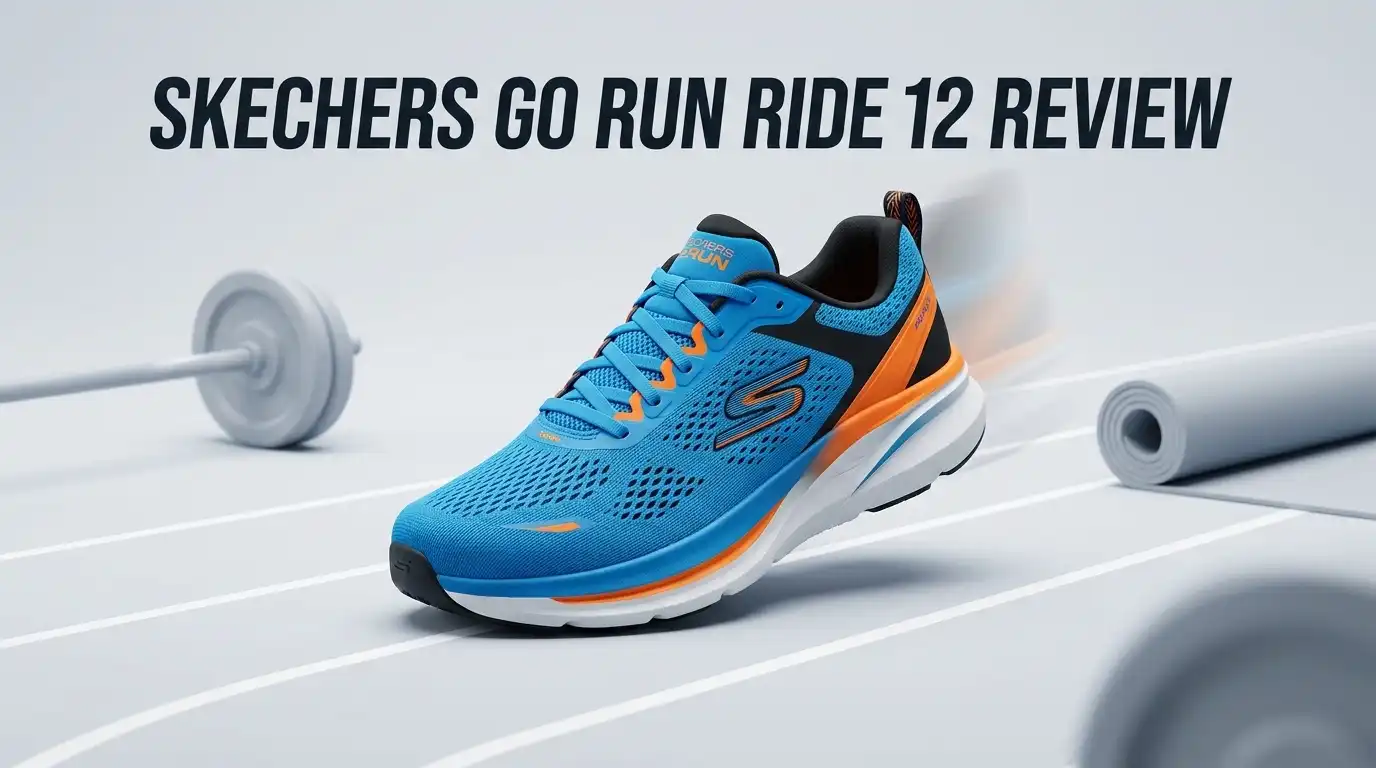
Skechers Go Run Ride 12 Review 2026: Worth Buying?
Skechers keeps surprising runners who still think of the brand as a mall shoe company. The Go Run Ride line has quietly become one of the best value daily trainers on the market, and version 12 pushes that reputation further.
This shoe carries a carbon infused plate, supercritical foam, and a Goodyear rubber outsole at a price that undercuts most big brand competitors.
So the real question is simple. Does the Go Run Ride 12 deserve a spot in your rotation, or is it just a spec sheet with good marketing?
In a Nutshell:
- The ride is soft but stable. Hyper Burst Ice sits under your heel and Hyper Burst Pro fills out the rest, so landings feel cushioned without that sinking marshmallow sensation. This is a genuine daily trainer, not a recovery slipper.
- The weight is excellent. Roughly 9.7 ounces in a men’s size 9 and about 7.8 ounces in a women’s size 7. That is light for a shoe with a 36mm heel and 30mm forefoot stack.
- The Arch Fit insole is polarizing. It carries an APMA Seal of Acceptance and helps runners with medium to high arches. Flat footed runners often pull it out on day one.
- The plate adds snap, not rocket fuel. The carbon infused H plate stiffens the forefoot and helps toe off, though it will never feel like a racing super shoe.
- Naming confusion is real. In the United States, Amazon sells this shoe under the Aero Spark label while the rest of the world sees Go Run Ride 12. Same shoe, same style number family.
- Value is the headline. Around 100 to 135 dollars depending on colorway and sale timing, which is 30 to 60 dollars less than rival daily trainers with similar tech.
What Is the Skechers Go Run Ride 12?

- HYPER BURST ICE cushioning features dual-density HYPER BURST technology for a soft and stable run
- Carbon-infused H-plate delivers exceptional stability and energy return with an ultra-high...
- Patented Skechers Arch Fit insole system, this design has been granted the Seal of Acceptance by the...
Last update on 2026-08-30 / Affiliate links / Images from Amazon Product Advertising API Some of the links on this website are affiliate links, which means that at no additional cost to you, I earn a commission if you click through and make a purchase. I only recommend products and services that I believe will add value to my readers. Thank you for your support!
The Go Run Ride 12 is a neutral daily trainer built for road miles. Skechers positions it as the workhorse of the performance line, sitting between the plush Max Road models and the faster Speed series. It handles easy runs, moderate long runs, and the occasional tempo effort.
The build sheet reads like a premium shoe. You get dual density supercritical foam, a carbon infused H plate in the forefoot, Hyper Arc rocker geometry, and a full coverage Goodyear rubber outsole. Skechers also drops in the patented Arch Fit insole, which holds an APMA Seal of Acceptance.
Stack height measures 36mm at the heel and 30mm at the forefoot, giving a 6mm offset. That offset works for both heel strikers and midfoot runners, which is exactly what a daily trainer should do.
One important note before you shop. Skechers uses regional naming for this model, so American buyers see the Aero Spark badge on Amazon while European and Australian listings say Go Run Ride 12. The style numbers sit in the same 246 family, and the tech is identical. Check the tech bullets, not the name, when you order.
Unboxing Experience and First Look
The box arrives plain. Skechers uses a simple brown and grey carton with the performance logo stamped on the side, and there is no fancy tissue paper or magnetic flap. That is honest packaging for a shoe at this price, and I would rather they spend the money on foam.
Lift the lid and the shoes sit face to face with a thin paper wrap. My Navy and Orange pair looked sharper in person than in the product photos. The orange midsole accents catch light in a way the flat catalog images completely miss.
Pick one up and the weight surprises you. It feels lighter than it looks, mostly because the midsole is tall and wide but the foam is genuinely low density. My first thought was that the shoe feels hollow in a good way.
Squeeze the midsole and you feel the difference between the two foam layers. The top layer near the heel gives easily under thumb pressure. The lower layer pushes back harder.
Inside, the Arch Fit insole is noticeable right away. It has a molded shape with a raised arch and a deep heel cup, so it does not lie flat like a standard sockliner. Runners who prefer flat insoles will notice this immediately.


Last update on 2026-04-11 / Affiliate links / Images from Amazon Product Advertising API Some of the links on this website are affiliate links, which means that at no additional cost to you, I earn a commission if you click through and make a purchase. I only recommend products and services that I believe will add value to my readers. Thank you for your support!
Specs and Technology at a Glance
Here is the technical picture in plain language.
Hyper Burst Ice is the newer foam sitting in the upper midsole layer. Skechers uses a supercritical foaming process, which means gas gets forced into the foam under pressure to create tiny uniform cells. The result is a soft landing with quick recovery.
Hyper Burst Pro forms the base layer. It is firmer and more durable, and it stops the shoe from bottoming out on hard landings. This dual density sandwich is the whole reason the ride feels stable despite being soft.
The carbon infused H plate sits in the forefoot only. It is not a full length plate, so you keep flexibility at the midfoot while gaining stiffness where you push off. Skechers claims a high stiffness to weight ratio, and the shoe does feel snappy through the last third of the gait cycle.
Hyper Arc describes the rocker shape of the outsole. The curved geometry rolls you forward and reduces the effort needed to transition from landing to toe off.


Last update on 2026-04-11 / Affiliate links / Images from Amazon Product Advertising API Some of the links on this website are affiliate links, which means that at no additional cost to you, I earn a commission if you click through and make a purchase. I only recommend products and services that I believe will add value to my readers. Thank you for your support!
The Goodyear rubber outsole covers most of the ground contact area. Goodyear developed this compound specifically for Skechers, and it grips wet pavement better than standard blown rubber. Weight lands near 9.7 ounces for men and 7.8 ounces for women.
Top 3 Alternative for Skechers Go Run Ride 12

- HYPER BURST ICE cushioning features dual-density HYPER BURST technology for a soft and stable run
- Carbon-infused H-plate delivers exceptional stability and energy return with an ultra-high...
- Patented Skechers Arch Fit insole system, this design has been granted the Seal of Acceptance by the...
Last update on 2026-08-30 / Affiliate links / Images from Amazon Product Advertising API Some of the links on this website are affiliate links, which means that at no additional cost to you, I earn a commission if you click through and make a purchase. I only recommend products and services that I believe will add value to my readers. Thank you for your support!
Skechers Men’s Aero Burst Running Shoe

- Lightweight gore & strap sneaker
- Machine washable, lightweight
- MENS Running Shoes
Last update on 2026-08-30 / Affiliate links / Images from Amazon Product Advertising API Some of the links on this website are affiliate links, which means that at no additional cost to you, I earn a commission if you click through and make a purchase. I only recommend products and services that I believe will add value to my readers. Thank you for your support!
Skechers Men’s Go Run Ride 11

- HYPER BURST ICE cushioning features dual-density HYPER BURST technology for a soft and stable run
- Carbon-infused H-plate delivers exceptional stability and energy return with an ultra-high...
- Patented Skechers Arch Fit insole system, this design has been granted the Seal of Acceptance by the...
Last update on 2026-08-30 / Affiliate links / Images from Amazon Product Advertising API Some of the links on this website are affiliate links, which means that at no additional cost to you, I earn a commission if you click through and make a purchase. I only recommend products and services that I believe will add value to my readers. Thank you for your support!
Skechers Men’s Aero Burst Hands Free Slip Ins
Fit, Sizing, and Upper Comfort
The Go Run Ride 12 runs true to size for most feet. I ordered my normal size 9 and got a thumbnail of space in front of the big toe. Runners between sizes should go up, since the toe box tapers noticeably near the pinky toe.
Width is the main sizing story. The midfoot fits snug and the forefoot is medium at best. Wide footed runners will feel the upper pressing on the outer edge, especially past mile six when feet swell.
The engineered mesh upper breathes well. Air moves through the forefoot panels without any hot spots, and I never finished a summer run with soaked socks. The mesh has just enough stretch to accommodate movement without feeling sloppy.
Heel lockdown works nicely. The collar has moderate padding and a gusseted tongue keeps everything centered, so I never needed a runner’s loop lacing trick.
The Arch Fit insole deserves its own warning. If you have medium or high arches, it feels supportive and reduces foot fatigue on long efforts. If you have flat feet or a low arch, that raised ridge can create pressure under the mid foot. Swapping in a flat insole solves it, though you lose a small amount of stack.
Midsole Feel and Cushioning Quality
This is where the shoe earns its money. Step in and the foam feels soft under the heel with a firm platform underneath, which produces a landing that absorbs impact without swallowing your foot.
Easy pace running feels genuinely pleasant. The rocker does most of the work, and your legs feel fresher at the end of an hour than the price tag suggests they should. Impact protection stays consistent even when form gets sloppy late in a run.
Energy return sits at a fair middle level. You will not get the explosive bounce of a nitrogen infused super trainer, but you also will not feel like you are running in dead foam. The rebound is honest rather than dramatic.
Speed up and the plate wakes up. Around 7:30 to 8:30 per mile pace, the forefoot stiffness starts contributing and the toe off feels crisp. Several runners have reported setting 5K personal bests in this shoe at exactly that pace band.
Stability comes from geometry, not from posts. The midsole flares slightly at the heel and the sidewalls rise around your foot, so mild pronation gets handled naturally. Severe overpronators still need a dedicated stability shoe.
Outsole Grip and Durability
Goodyear rubber remains one of the most underrated features in running footwear. The compound is the same family used in car tires, and it delivers real traction on wet asphalt, painted crosswalk lines, and damp concrete.
I ran a park loop during steady rain and never felt a slip. The grip inspires enough confidence that you stop thinking about the ground and just run. Wet metal grates are still slick, because physics applies to every shoe.
Coverage is generous. Rubber protects the full heel, the lateral edge, and the entire forefoot, with only small exposed foam windows in the midfoot arch area.
Durability looks strong so far. After roughly 90 miles, my pair shows light smoothing on the lateral heel and nothing more. Skechers users regularly report 400 to 500 miles from Goodyear outsoles, which beats the industry average.
Gravel and packed dirt are manageable but not ideal. The lugs are shallow and tuned for road, so loose trail surfaces will feel sketchy. Treadmill running works perfectly, and the outsole does not squeak on belts.
One small gripe. The exposed midsole foam in the arch picks up small stones, and you will occasionally need to dig one out.
Daily Runs, Long Runs, and Tempo Testing
I tested this shoe across four types of runs, and the results were clear.
Easy runs are the sweet spot. At 9:00 to 10:30 per mile, the cushioning and rocker combine into a ride that just disappears under you. No pressure points, no harshness, no fighting the shoe.
Long runs hold up well through about 13 miles. Past that point, the snug forefoot starts to matter as feet swell. Runners with narrow or medium feet will happily push to 16 or 18 miles.
Tempo efforts work better than expected. The plate and rocker give you enough return to hold a comfortably hard pace, though the shoe never feels truly fast. Think of it as a trainer that can pick up the pace, not a shoe that begs for it.
Intervals and track work are a poor match. The stack height and softer heel make sharp turns feel vague, and there are better tools for that job.
Walking and standing comfort deserves a mention. The Arch Fit insole and rocker make this shoe genuinely comfortable for gym sessions, travel days, and long hours on your feet. Many buyers use it more for walking than running, and it handles that role beautifully.
What the Skechers Go Run Ride 12 Does Not Do Well
Honest reviews name the flaws, so here they are.
The forefoot is too narrow for many runners. This is the single biggest complaint across the Go Run Ride line, and version 12 did not fix it. Wide feet should look elsewhere or size up half a size.
Wide sizes are hard to find. Skechers offers wide options in some models but availability for this one is inconsistent, which frustrates buyers who need them.
The Arch Fit insole is not universal. It solves problems for some runners and creates them for others. There is no middle ground, and you often cannot tell which camp you are in until mile four.
Colorway availability is messy. Regional naming, limited stock, and rotating retailers make it genuinely annoying to find a specific size and color. I spent longer hunting for stock than I did testing the shoe.
It is not a fast shoe. The plate helps, but do not buy this expecting race day performance. Under six minute mile pace, the softness works against you.
Aesthetics divide opinion. Some colorways look sharp while others read as generic gym shoe. The Skechers logo still carries baggage for runners who care about brand image at the start line.
Pros and Cons of the Skechers Go Run Ride 12
Pros
- Excellent cushioning to weight ratio, with a 36mm heel stack under 10 ounces
- Dual density supercritical foam that stays soft without feeling unstable
- Goodyear rubber outsole with strong wet weather grip and long durability
- Carbon infused forefoot plate that adds real snap at moderate paces
- Smooth Hyper Arc rocker that reduces leg fatigue on longer efforts
- APMA accepted Arch Fit insole that suits medium and high arches
- Breathable engineered mesh upper with reliable heel lockdown
- Machine washable construction, which is rare in performance running shoes
- Strong value, often 30 to 60 dollars cheaper than rival daily trainers
Cons
- Narrow forefoot that limits comfort for wide footed runners
- Limited availability of wide sizes across retailers
- Arch Fit insole creates pressure points for flat footed runners
- Confusing regional naming between Go Run Ride 12 and Aero Spark
- Not suited to fast interval work or race day efforts
- Small stones can lodge in exposed midsole channels
- Energy return is good but not class leading
- Brand perception still lags behind performance reality
Skechers Go Run Ride 12 vs Go Run Ride 11
The Ride 11 was already a strong shoe, so the jump is evolutionary rather than revolutionary.
Weight improved. The Ride 11 landed around 10.1 ounces in a men’s size 9. Version 12 trims that to roughly 9.7 ounces, which you feel over long distances.
Foam changed meaningfully. The Ride 11 used a single Hyper Burst setup. The Ride 12 layers Hyper Burst Ice over Hyper Burst Pro, and the newer combination feels softer on landing while staying more controlled on toe off.
The plate stayed similar. Both shoes use a carbon infused forefoot plate rather than a full length plate. Neither one transforms the ride, and both add a useful pop.
The upper is slightly better. Version 12 breathes more freely and the tongue sits flatter, though the narrow forefoot carried over unchanged.
Price is comparable. Both models launched near the 125 to 135 dollar mark and both drop regularly on sale.
Should you upgrade from the 11? Probably not if your current pair still has life. The improvements are real but incremental. If you are buying fresh, take the 12. If you find the Ride 11 heavily discounted, it remains a fine purchase.
Who Should Buy the Skechers Go Run Ride 12?
- HYPER BURST ICE cushioning features dual-density HYPER BURST technology for a soft and stable run
- Carbon-infused H-plate delivers exceptional stability and energy return with an ultra-high...
- Patented Skechers Arch Fit insole system, this design has been granted the Seal of Acceptance by the...
Last update on 2026-08-30 / Affiliate links / Images from Amazon Product Advertising API Some of the links on this website are affiliate links, which means that at no additional cost to you, I earn a commission if you click through and make a purchase. I only recommend products and services that I believe will add value to my readers. Thank you for your support!
This shoe fits a specific runner very well.
Buy it if you run 15 to 40 miles per week at easy to moderate paces and want one shoe that handles almost everything. It covers daily miles, long runs, treadmill sessions, and gym work without complaint.
Buy it if you value cushioning with structure. The dual density midsole gives comfort without the wobble that plagues many soft trainers.
Buy it if you have narrow or medium width feet and a medium to high arch. The fit and the insole were built for exactly that foot shape.
Buy it if you want premium technology on a normal budget. You get supercritical foam, a plate, and a Goodyear outsole for less than most brands charge for foam alone.
Skip it if you have wide feet. No amount of break in fixes the forefoot taper.
Skip it if you need real stability support for significant overpronation. The geometry helps mildly and nothing more.
Skip it if you want a race shoe. This is a trainer, and it is honest about that. Buy it as your everyday workhorse and it will not disappoint you.
Price, Value, and Care Tips
Retail price sits between 125 and 135 dollars depending on region and colorway. Real world pricing runs lower, and I regularly see pairs between 95 and 115 dollars on Amazon and at running retailers.
That pricing is the shoe’s strongest argument. Comparable daily trainers with supercritical foam and plates run 145 to 170 dollars, so you are saving roughly a third for a very similar experience.
Care is refreshingly simple. The Go Run Ride 12 is machine washable, which almost no performance running shoe can claim. Remove the insole and laces, use cold water on a gentle cycle, and skip the dryer completely.
Air drying takes about 24 hours. Stuff the shoes with newspaper to hold their shape and speed the process, and keep them away from direct heat sources that warp the midsole foam.
Rotate if you can. Running the same pair every day compresses the foam faster, and giving each pair a rest day extends total life noticeably.
Expect 400 to 500 miles before the cushioning goes flat. Track your mileage, because the outsole often looks fine long after the foam has given up.
Final Verdict: Is It Worth It in 2026?
Yes, for the right foot. The Skechers Go Run Ride 12 delivers a genuinely good daily training experience at a price that makes rival brands look overpriced.
The cushioning is soft and controlled. The rocker is smooth. The outsole grips in the rain and lasts hundreds of miles. The whole package feels considerably more expensive than it costs.
The flaws are real and worth respecting. The narrow forefoot rules out a chunk of runners, the Arch Fit insole is a gamble, and the shoe has no ambitions above tempo pace.
I would score it around 8.5 out of 10 as a daily trainer, dropping to 6 out of 10 for anyone with wide feet.
Order it, run in it indoors for 20 minutes, and check the forefoot pressure before you take it outside. If your feet fit, you have found one of the best value trainers available. If they do not, return it and try the Aero Burst instead.
Frequently Asked Questions
Is the Skechers Go Run Ride 12 true to size?
Yes for most runners. Order your normal running size and expect a snug forefoot. Runners between sizes or with wide feet should go up half a size.
Why does Amazon call it the Aero Spark instead of the Go Run Ride 12?
Skechers uses different names in different markets. The United States listing uses Aero Spark while European, Australian, and Middle Eastern listings use Go Run Ride 12. The technology, style numbers, and construction are the same.
How much does the Go Run Ride 12 weigh?
About 9.7 ounces in a men’s size 9 and about 7.8 ounces in a women’s size 7. That is light for a shoe with a 36mm heel stack.
What is the drop on the Go Run Ride 12?
The stack measures 36mm at the heel and 30mm at the forefoot, producing a 6mm offset. That works for heel strikers and midfoot strikers alike.
Can I use the Go Run Ride 12 for walking and standing all day?
Yes. The Arch Fit insole and rocker geometry make it comfortable for walking, gym sessions, travel, and long hours on your feet. Many owners buy it primarily for that reason.
Does the Go Run Ride 12 work for flat feet?
Partly. The molded Arch Fit insole often creates pressure under a flat arch. Remove it and replace it with a flat insole or your own orthotic, and the shoe becomes comfortable again.
How many miles will the Go Run Ride 12 last?
Expect 400 to 500 miles. The Goodyear rubber outsole usually outlives the midsole foam, so watch for a flatter, harsher ride rather than visible tread wear.
Is the carbon plate full length?
No. The carbon infused H plate sits in the forefoot only. It stiffens toe off while leaving the midfoot flexible, which keeps the shoe comfortable for easy running.
Can I put the Go Run Ride 12 in the washing machine?
Yes. Remove the laces and insole, wash cold on a gentle cycle, and air dry away from heat. Never put them in a dryer.
Is it better than the Go Run Ride 11?
Slightly. Version 12 is lighter, softer on landing, and breathes better. The upgrade is worthwhile for new buyers but not urgent if your Ride 11 still has miles left.

Mia Smith is the founder of Shoe Storyteller, a blog that celebrates the art and stories behind shoes. With a passion for fashion and a flair for storytelling, Mia brings a unique perspective to the world of footwear.