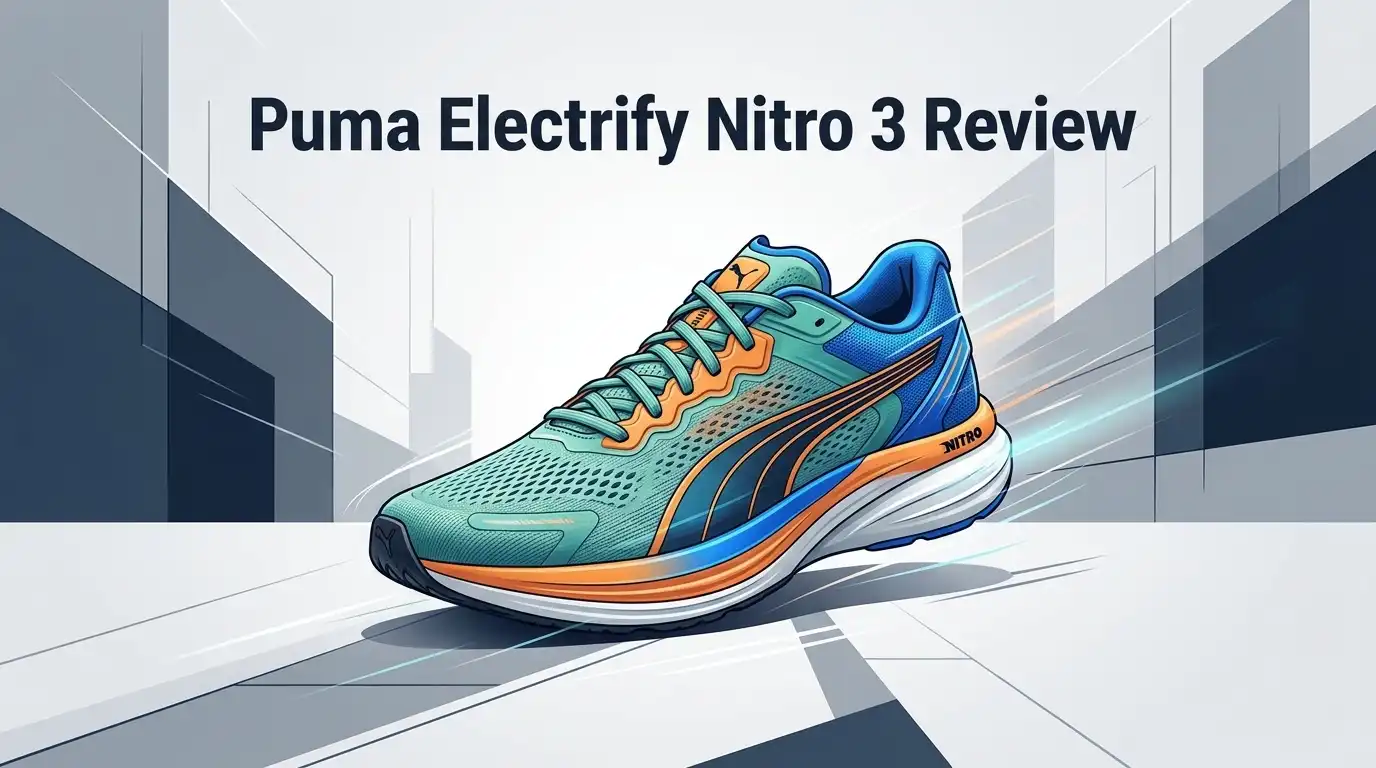
Puma Electrify Nitro 3 Review 2026: Worth Buying?
Running shoes keep getting more expensive every year. Foam gets fancier, plates get stiffer, and price tags climb past $180 without much shame. So it feels good to find a shoe that skips the drama and just runs.
The Puma Electrify Nitro 3 sits in that quiet corner of the market. It costs far less than a super trainer, yet it still carries real Nitro foam and a proper PUMAGRIP outsole.
I logged easy miles, treadmill sessions, dog walks, and a few faster efforts in this shoe. Some parts surprised me. Other parts reminded me exactly why it costs what it costs.
In a Nutshell:
- The Electrify Nitro 3 is a value daily trainer, not a performance shoe. It carries a dual midsole with Nitro foam in the heel and Profoamlite through the rest of the platform. The ride feels steady and controlled rather than soft or bouncy. Think dependable, not exciting.
- Specs are simple and honest. Stack height sits at 35mm in the heel and 25mm in the forefoot, which gives a 10mm drop. Weight lands near 280g in a UK 8. That places it slightly heavier than Puma’s pricier Velocity line.
- PUMAGRIP is the standout feature. Puma uses the same outsole rubber family found on shoes that cost twice as much. Traction on dry roads, sidewalks, and treadmill belts feels planted and secure.
- Fit runs true to size for most runners. The midfoot lockdown is genuinely good. Wide footed runners may still feel pinched, since the standard last leans regular rather than generous.
- It is not fast, and it is not plush. This shoe has no snap for tempo work and no sink in softness for long recovery days. Runners who want either of those extremes will feel disappointed within a week.
- Best buyer profile: beginners, walkers, treadmill users, and experienced runners who need a cheap second pair for easy mileage.
What Is the Puma Electrify Nitro 3?

- Engineered mesh upper
- TPU heel spoiler
- NITRO foam midsole and PROFOAMLITE EVA foam in the midsole
Last update on 2026-08-30 / Affiliate links / Images from Amazon Product Advertising API Some of the links on this website are affiliate links, which means that at no additional cost to you, I earn a commission if you click through and make a purchase. I only recommend products and services that I believe will add value to my readers. Thank you for your support!
The Puma Electrify Nitro 3 is the entry level cushioned trainer in Puma’s road running family. It sits below the Velocity Nitro, the Deviate Nitro, and the Magnify Nitro. Puma builds it for one job: everyday running at a price most people can accept without flinching.
The shoe uses a dual density midsole. Puma places nitrogen infused Nitro foam in the heel, where impact forces peak. The rest of the midsole uses Profoamlite, a firmer and more durable compound that keeps the price down and the shape stable. This combination explains the ride personality perfectly. Landings feel cushioned. Toe off feels flat and businesslike.
The upper uses engineered mesh with reflective details for early morning and evening visibility. Underfoot, PUMAGRIP rubber covers the high wear zones. Puma recommends the shoe for neutral pronators who log short to moderate distances.
The word “electrify” oversells things a bit. Nothing about this shoe feels electric. It feels calm, predictable, and easy to trust. In a market crowded with shoes chasing energy return numbers, that restraint has value.
Price is the real headline. The Electrify Nitro 3 frequently drops well below $80 in the United States, and Puma discounts it aggressively in Europe too. For a shoe carrying legitimate Nitro foam and PUMAGRIP rubber, that number looks strong on paper. Whether it holds up in practice is what the rest of this review answers.
Unboxing Experience and First Look
The box arrives plain. Puma ships the Electrify Nitro 3 in standard red cardboard with no tissue paper, no extra laces, and no printed insert card. You get shoes, a size sticker, and nothing else. Premium trainers often include spare laces or a small booklet. This one skips all of it, and honestly, that matches the price.
Pulling the pair out reveals the first pleasant surprise. The shoes look better in person than in product photos. The mesh has a slight sheen, the Formstrip logo sits cleanly on the sidewall, and the reflective hits catch light nicely under a phone flashlight. My pair came in black with subtle contrast stitching, and it passed the casual wear test without effort.
Pick one up and you notice the weight immediately. These are not light shoes. At roughly 280g in a UK 8, they feel substantial in hand compared with a Velocity Nitro or a Nike Pegasus. The heft comes from the Profoamlite midsole and the generous rubber coverage.
The step in feel is soft and welcoming. The collar padding is modest but well placed. The tongue is thin, gusseted lightly, and does not slide sideways. The insole is removable, which matters if you use custom orthotics.


Last update on 2026-04-11 / Affiliate links / Images from Amazon Product Advertising API Some of the links on this website are affiliate links, which means that at no additional cost to you, I earn a commission if you click through and make a purchase. I only recommend products and services that I believe will add value to my readers. Thank you for your support!
One small annoyance: the laces are flat, slightly waxy, and prone to loosening on the first run. I retied mine twice during my initial thirty minutes. A runner’s knot fixed the problem permanently after that.
Key Specs and Features Explained
Numbers tell you plenty about how a shoe will behave. Here is what Puma lists for the Electrify Nitro 3, translated into plain language.
Stack height measures 35mm at the heel and 25mm at the forefoot. That is moderate by 2026 standards. Many daily trainers now push past 38mm. The lower stack means you sit closer to the ground, which improves stability and ground feel while reducing pure impact protection.
Drop sits at 10mm. That is a traditional number. Heel strikers will feel right at home. Forefoot strikers and runners used to 5mm platforms may notice their calves working differently for the first few runs.
Weight comes in around 280g for a men’s UK 8, roughly 9.9 ounces. Women’s pairs run lighter. This is the shoe’s weakest specification. Competitors at the same price often come in an ounce lighter.


Last update on 2026-04-11 / Affiliate links / Images from Amazon Product Advertising API Some of the links on this website are affiliate links, which means that at no additional cost to you, I earn a commission if you click through and make a purchase. I only recommend products and services that I believe will add value to my readers. Thank you for your support!
Midsole combines Nitro nitrogen infused foam in the heel with Profoamlite elsewhere. Nitro handles shock. Profoamlite handles durability and cost control.
Outsole uses PUMAGRIP rubber, the same compound family Puma puts on its race day shoes. This is the single most premium component on the entire shoe.
Upper is engineered mesh with reflective detailing and a regular fit last. Puma classifies it for neutral pronators.
Put together, the spec sheet describes a stable, moderately cushioned, slightly heavy road trainer built for consistency instead of speed.
Top 3 Alternative for Puma Electrify Nitro 3

- Regular width
- Textile upper
- Lace closure
Last update on 2026-08-30 / Affiliate links / Images from Amazon Product Advertising API Some of the links on this website are affiliate links, which means that at no additional cost to you, I earn a commission if you click through and make a purchase. I only recommend products and services that I believe will add value to my readers. Thank you for your support!
Puma Electrify Nitro 4

Last update on 2026-08-30 / Affiliate links / Images from Amazon Product Advertising API Some of the links on this website are affiliate links, which means that at no additional cost to you, I earn a commission if you click through and make a purchase. I only recommend products and services that I believe will add value to my readers. Thank you for your support!
Puma Deviate Nitro 3

- FF BLAST PLUS technology: Cushioning provides lightweight impact absorption and a responsive rebound
- PureGEL technology .: Helps provide lightweight cushioning and softer landings
- Engineered mesh upper: Helps improve breathability and comfort
Last update on 2026-08-30 / Affiliate links / Images from Amazon Product Advertising API Some of the links on this website are affiliate links, which means that at no additional cost to you, I earn a commission if you click through and make a purchase. I only recommend products and services that I believe will add value to my readers. Thank you for your support!
ASICS Gel Cumulus 26
Midsole Feel: Nitro Foam and Profoamlite
The midsole defines this shoe, so it deserves close attention. Puma splits the platform into two materials, and you can feel the seam in the ride.
The heel holds the Nitro foam. Nitrogen injection makes the compound lighter and softer than standard EVA. Landing on your heel produces a cushioned thud rather than a sharp impact. It absorbs road shock competently on concrete and asphalt.
Forward of the heel, Profoamlite takes over. This compound is noticeably firmer. It resists compression, holds its shape over hundreds of miles, and costs Puma less to produce. The result is a midfoot and forefoot that feel flat, dense, and unresponsive.
The transition between the two zones is the interesting part. On easy runs, it feels smooth and unremarkable, which is exactly what you want. Push the pace and the contrast becomes obvious. Your heel gets a soft welcome. Your forefoot gets a firm shove into the ground with nothing given back.
Compared with the Velocity Nitro 3, which uses Nitro foam more generously, the Electrify feels distinctly duller. Compared with cheap EVA trainers from big box stores, it feels far more refined and far less dead.
Long term compression is well controlled. After roughly 150 miles, my pair still measured close to its original height and never developed that pancake feeling budget shoes often reach by mile 100. Profoamlite is boring, but it lasts.
Fit and Sizing Guide
The Electrify Nitro 3 fits true to size for the majority of runners. Order your normal running shoe size and you will likely be fine. I wear a US 10 in most brands and the US 10 fit correctly with about a thumbnail of space ahead of my longest toe.
Length feels accurate with no surprises. Puma has been consistent across the Nitro line, so if a Velocity or Deviate fits you, this will too.
Width is where things get more particular. The last is regular, leaning slightly narrow through the midfoot. Runners with wide forefeet or high volume feet will feel squeezed across the ball of the foot. Puma offers wide options in some Nitro models, but availability for the Electrify 3 is patchy. If your feet need a 2E, look elsewhere or shop carefully.
Heel hold is secure. The internal counter is firm without pressing on the Achilles, and I recorded zero heel slip across every run. This is a strong point.
Midfoot lockdown impressed me most. The lacing spreads tension evenly, the tongue stays put, and the upper wraps the arch cleanly. Cornering feels planted rather than sloppy.
Toe box height is adequate but not generous. Runners with tall toes or bunions may feel pressure on the top of the mesh during longer efforts. Foot swell at mile eight or nine makes this more noticeable.
Puma Electrify Nitro 3 for Women

- Engineered mesh upper
- Thermoplastic Polyurethane heel spoiler
- Heel fit: rolled collar to keep the heel secure and comfortable
Last update on 2026-08-30 / Affiliate links / Images from Amazon Product Advertising API Some of the links on this website are affiliate links, which means that at no additional cost to you, I earn a commission if you click through and make a purchase. I only recommend products and services that I believe will add value to my readers. Thank you for your support!
Puma builds the women’s Electrify Nitro 3 on a different last with adjusted proportions rather than simply shrinking the men’s version. The heel is narrower, the forefoot volume is lower, and the overall weight drops by roughly 30 grams depending on size.
That weight reduction changes the character of the shoe noticeably. The women’s pair feels livelier underfoot because there is less material to push through on toe off. Runners who found the men’s version sluggish may find the women’s build more agreeable.
Colorways lean brighter across the women’s range, with white, coral, and mint options appearing regularly alongside the standard black. Reflective detailing carries over identically, which matters for anyone running before sunrise or after dusk.
Sizing feedback from women runners tracks the same pattern as the men’s shoe. True to size for length, slightly snug through the midfoot. Runners who normally size up half a size in Nike or ASICS should stick with their true size here rather than adding room automatically.
The narrower heel counter improves lockdown for people who struggle with slippage in unisex builds. My testing partner, who typically deals with heel lift in Brooks trainers, reported none in this pair across three weeks of use.
Everything else stays identical. Same dual midsole, same PUMAGRIP outsole, same 10mm drop, same strengths, and the same weaknesses around forefoot responsiveness. The women’s version is not a different shoe. It is a better tuned version of the same idea.
Upper Design and Breathability
The engineered mesh upper does its job without showing off. Puma uses a single layer mesh across most of the shoe, with reinforced overlays at the eyestay and a printed toe bumper for abrasion protection.
Breathability rates as good, not exceptional. The mesh has visible perforations across the forefoot and midfoot, and air moves through them adequately. On runs in the mid seventies Fahrenheit, my feet stayed comfortable. Push into the nineties with humidity and the upper starts holding heat. It is warmer than an ASICS Gel Cumulus and cooler than most winter oriented trainers.
The collar padding is modest. Puma uses just enough foam around the ankle to prevent rubbing without adding bulk. The Achilles notch is shaped correctly and never pressed against my tendon.
The tongue measures thin and lightly padded. It stays centered during runs thanks to small side attachments. Lace pressure over the top of the foot is minimal, though runners with high insteps may want to skip the top eyelet.
Reflective details appear on the heel and along the Formstrip. They are functional rather than extensive. Under car headlights they light up clearly from behind, which covers the most important angle.
Build quality holds up well. After extended use, my pair showed light creasing at the flex point and no fraying at the eyelets or collar edge. For a shoe in this price bracket, the upper construction is genuinely solid. Nothing here feels cheap or disposable.
Outsole Grip and Traction
PUMAGRIP is the reason to buy this shoe. Puma developed this rubber compound for its performance models, and putting it on an entry level trainer feels almost generous.
Dry road traction is excellent. The rubber bites into asphalt and concrete with confidence. Sharp turns, sudden stops, and downhill sections all felt secure across my testing. I never experienced a single slip on dry ground.
Wet weather performance is good but not flawless. On damp pavement and light rain, grip held firm. On painted crosswalk lines, metal drain covers, and wet leaves, the shoe behaved like most road trainers and slid a little. Treat those surfaces with the same caution you would in any road shoe.
Treadmill use is easy. The rubber does not squeak, drag, or feel sticky on a moving belt. Gym runners will have no complaints.
Light gravel and packed dirt are within range. The outsole has enough texture to handle a park path or a crushed limestone trail. Anything muddier or more technical exceeds what this shoe was built for.
Coverage is generous. Puma lays rubber across the entire heel, the lateral edge, and the full forefoot, with exposed foam only in the central flex groove. That coverage adds weight, and it is one reason the shoe tips the scale at 280g.
The tradeoff is worth it. Grip and outsole durability are the two areas where this shoe outperforms its price bracket by a clear margin.
Ride Quality on Easy Runs
Easy running is where the Electrify Nitro 3 belongs. At conversational pace, roughly one to two minutes slower than threshold, the shoe disappears underfoot in the best way.
Landings feel cushioned and quiet. The Nitro heel absorbs impact cleanly without the mushy sink some soft trainers produce. Your foot lands, the foam compresses briefly, and the shoe moves on.
Transitions are smooth. There is no aggressive rocker and no plate forcing your foot forward. The geometry lets you roll through naturally at your own rhythm. Runners who dislike shoes that dictate their stride will appreciate this.
Stability is a real strength. The moderate 35mm stack keeps your foot close to the ground, the platform is wide through the midfoot, and the firm Profoamlite resists lateral collapse. Tired legs at mile eight still felt supported rather than wobbly. This is a genuinely stable neutral trainer.
Recovery runs the day after hard sessions worked well. The cushioning takes enough edge off the road to protect sore legs without the vagueness of a max cushion shoe.
Where it starts to fade is distance. Beyond about ten miles, the firmer forefoot begins to feel harsh under the ball of the foot. Marathon length runs are not this shoe’s territory. For runs between three and eight miles, it performs exactly as intended, day after day, without complaint or surprise.
Can It Handle Speed Workouts?
Short answer: not really. Longer answer: it can survive them, but it will not help.
The Electrify Nitro 3 has no propulsion mechanism. There is no carbon plate, no nylon plate, no aggressive rocker, and no highly resilient foam under the forefoot. When you push the pace, the shoe simply gets out of the way and lets you do all the work.
Strides after an easy run feel fine. Twenty seconds of turnover does not expose the shoe’s limits. Anything longer does. During a set of half mile repeats, I felt the weight on every leg swing and felt the firm forefoot punish each landing without giving anything back.
The 10mm drop actually helps a little here. It encourages a heel to midfoot landing pattern that keeps you off the harshest part of the platform. But that is damage control, not performance.
Tempo running at marathon pace is the upper limit of comfort. Push into threshold or interval territory and the shoe becomes an obstacle. Your legs will fatigue faster than they would in a lighter, more responsive trainer.
Verdict on speed: treat this as an easy day shoe exclusively. If you run workouts more than once a week, budget for a second pair with lower weight and livelier foam. The Electrify Nitro 3 pairs well with a dedicated speed shoe. It cannot replace one.
Durability After Extended Mileage
Durability is this shoe’s quiet superpower. Budget trainers usually die in one of three ways: the outsole wears through, the foam pancakes, or the upper tears. This one resists all three.
Outsole wear is minimal. After roughly 150 miles across pavement, sidewalk, and treadmill, my pair showed light smoothing at the lateral heel and almost nothing elsewhere. PUMAGRIP is famously durable, and it lives up to that reputation here. I would comfortably project 400 to 500 miles of outsole life for a neutral runner.
Midsole compression is well controlled. Profoamlite is firm and dense by design, which makes it resistant to permanent flattening. The heel Nitro softened slightly over time, but the change was gradual rather than sudden. The ride at mile 150 felt recognizably similar to the ride at mile 20.
Upper integrity held up completely. No fraying at the eyelets, no tearing at the flex crease, no collar breakdown. Light creasing appeared where the forefoot bends, which is normal and cosmetic.
The insole is the weakest component. Mine flattened noticeably within the first 100 miles and lost most of its initial cushion. Replacing it with an aftermarket insole for around fifteen dollars restored the step in feel completely.
Overall durability rating: strong. For a shoe that often sells under $80, getting 400 plus miles represents genuine value per mile. This is not a shoe that falls apart quickly.
What the Electrify Nitro 3 Does Not Do Well
Honest reviews name the problems clearly. Here are the real weaknesses I found.
It is heavy. At roughly 280g in a UK 8, this shoe carries more weight than many competitors at the same price. You feel it during the final third of any run longer than an hour, and you feel it badly during any attempt at speed.
The forefoot is dead. Profoamlite prioritizes durability over feel, and it shows. Toe off provides zero energy return. The shoe absorbs your effort rather than recycling any of it.
It is not soft. Runners coming from plush max cushion trainers will find this firm, even harsh, under the ball of the foot after mile eight.
The fit is narrow for wide feet. The regular last leaves little room across the forefoot, and wide size availability is inconsistent.
The insole flattens early. Expect to replace it within a few months if you run regularly.
Warm weather breathability is only average. The mesh handles mild conditions but retains heat in genuine summer humidity.
Long runs expose the platform. Beyond ten miles, the firm forefoot becomes uncomfortable for most runners.
None of these problems are dealbreakers at the price. All of them would be dealbreakers at $150. Know what you are buying.
Pros and Cons
Here is the balanced summary.
Pros
- PUMAGRIP outsole delivers premium level traction on dry roads, damp pavement, and treadmill belts, matching shoes that cost twice as much.
- Outstanding durability across the outsole, midsole, and upper, with realistic mileage expectations of 400 to 500 miles for most runners.
- Excellent midfoot lockdown and heel hold with zero slippage, which is rare in this price bracket.
- Genuinely stable ride thanks to the moderate 35mm stack and firm Profoamlite platform, making it friendly for beginners and tired legs.
- Strong value with frequent discounts pushing the price well below $80 in the United States.
- True to size fit with predictable sizing across the Puma Nitro family, which reduces online ordering risk.
- Versatile enough for walking, gym work, and casual wear, so one pair covers multiple uses.
Cons
- Heavy at roughly 280g, which becomes noticeable on longer efforts and any attempt at faster running.
- Forefoot feels flat and unresponsive because Profoamlite prioritizes durability over energy return.
- No speed capability whatsoever, with no plate, no rocker, and no bounce to assist turnover.
- Narrow forefoot fit that will frustrate wide footed runners, with limited wide size availability.
- Insole compresses quickly, often within the first 100 miles.
- Average hot weather breathability compared with lighter mesh competitors.
- Uncomfortable beyond ten miles for most runners due to forefoot firmness.
Electrify Nitro 3 vs Velocity Nitro 3 vs Electrify Nitro 4
Choosing between Puma models confuses a lot of buyers. Here is how the closest relatives compare.
Electrify Nitro 3 vs Velocity Nitro 3. The Velocity is the better running shoe, full stop. It weighs about 264g, uses more Nitro foam throughout the midsole, and offers a 36mm heel with a 26mm forefoot. The ride is livelier and smoother at every pace. It also costs considerably more at $135 list. If you run more than twenty miles a week, the Velocity justifies the upgrade. If you run three times weekly for thirty minutes, the Electrify is enough.
Electrify Nitro 3 vs Electrify Nitro 4. The version 4 refines rather than reinvents. Puma adjusted the upper for better breathability and trimmed a small amount of weight. The midsole formula stays similar in character. The main reason to buy the 3 over the 4 is price. Older models discount heavily once the replacement lands, and the performance gap is modest.
Electrify Nitro 3 vs Deviate Nitro 3. These are not competitors. The Deviate carries a carbon plate, a 39mm stack, and a genuine performance ride at a much higher price. It is a workout and race shoe. The Electrify is an easy day shoe. Many runners own both and rotate between them.
The pattern is simple. More money buys lighter weight and more responsive foam. Durability and grip stay consistent across the whole line.
Who Should Buy It and Who Should Skip It
Buy the Puma Electrify Nitro 3 if you are:
A new runner building a habit. The stability, the durability, and the low price make this an easy first shoe that will not punish mistakes or fall apart during your first training block.
A casual runner logging three to fifteen miles per week. The shoe handles that volume comfortably and lasts a long time at that mileage.
A walker or treadmill user. The cushioning, grip, and support all work well for steady low impact use, and the shoe looks fine with regular clothes.
A runner building a rotation on a limited budget. Pair this with one lighter shoe for workouts and you have a functional two shoe setup for under $200.
Skip it if you are:
A runner who wants bounce. The forefoot returns nothing. You will find it dull within a week.
A wide footed runner. The fit is regular leaning narrow, and forcing it will cause hot spots.
A high mileage runner logging forty plus miles weekly. The weight and firmness accumulate into fatigue over that volume.
A marathon trainer. Long runs past ten miles expose the forefoot firmness clearly.
Someone chasing premium materials and finish. The Electrify Nitro 3 is functional, not refined. It never pretends otherwise, and neither should your expectations.
Price and Value Verdict
List price sits around $110 in Europe and roughly $100 in the United States, but almost nobody pays that. Puma discounts this model constantly. Real world prices frequently land between $55 and $80, and I have seen it under $50 during seasonal sales.
At $50 to $70, this shoe is a clear win. You get premium outsole rubber, real Nitro foam in the heel, secure lockdown, and 400 plus miles of realistic life. Cost per mile works out to roughly fifteen cents, which beats almost anything in road running.
At $80 to $100, the calculation shifts. At that price you start competing with the ASICS Gel Cumulus, the Nike Pegasus on discount, and the Puma Velocity Nitro 3 on clearance. All three offer lighter weight and better forefoot feel. The Electrify Nitro 3 only wins at that level if you specifically want its stability and durability.
At full list price, skip it. Nothing about this shoe justifies $110 when the Velocity Nitro sits just above it with a meaningfully better ride.
My overall rating lands at 7.5 out of 10 as a value daily trainer. The score reflects what the shoe is trying to do, not what a $180 super trainer achieves. It sets modest goals and hits them reliably.
Final verdict: buy it on sale, use it for easy miles, and expect competence rather than excitement. That is a fair trade.
Frequently Asked Questions
Is the Puma Electrify Nitro 3 good for beginners?
Yes. The stability, moderate cushioning, secure fit, and low price make it one of the better first running shoes available. Beginners rarely need responsive foam or low weight. They need something comfortable and durable that will not break down during a first training block. This shoe delivers that.
Does the Puma Electrify Nitro 3 run true to size?
Yes for length. Order your normal running shoe size. The fit is regular leaning narrow through the forefoot, so runners with wide feet should consider a wide option where available or look at a different model. Heel and midfoot lockdown are secure at true size.
How many miles will the Electrify Nitro 3 last?
Expect 400 to 500 miles for most neutral runners. The PUMAGRIP outsole resists wear extremely well and the Profoamlite midsole resists compression. The insole flattens sooner, often around 100 miles, but replacing it is cheap and restores most of the original step in feel.
Can I use the Electrify Nitro 3 for the gym or walking?
Yes. The stable platform and grippy outsole work well for treadmill sessions, walking, elliptical work, and light gym use. It is less suited to heavy lifting because the heel cushioning compresses under load, and it is not built for lateral sports like tennis or basketball.
Is the Electrify Nitro 3 waterproof?
No. The engineered mesh upper is breathable and drains reasonably well, but water passes straight through it. Puma does not offer a waterproof membrane version of this model. For wet conditions, wool socks and quick drying help more than anything the shoe provides.
Should I buy the Electrify Nitro 3 or the Nitro 4?
Buy whichever is cheaper at the time. The Nitro 4 improves breathability and trims a little weight, but the core ride is similar. Version 3 discounts more heavily now that its replacement exists, which usually makes it the better value purchase.
Is the Electrify Nitro 3 good for flat feet or overpronation?
Puma classifies it for neutral pronators. The firm Profoamlite midsole does provide more inherent stability than most soft trainers, so mild overpronators often manage fine. Runners who need genuine motion control or a guidance rail should look at dedicated stability models instead.

Mia Smith is the founder of Shoe Storyteller, a blog that celebrates the art and stories behind shoes. With a passion for fashion and a flair for storytelling, Mia brings a unique perspective to the world of footwear.