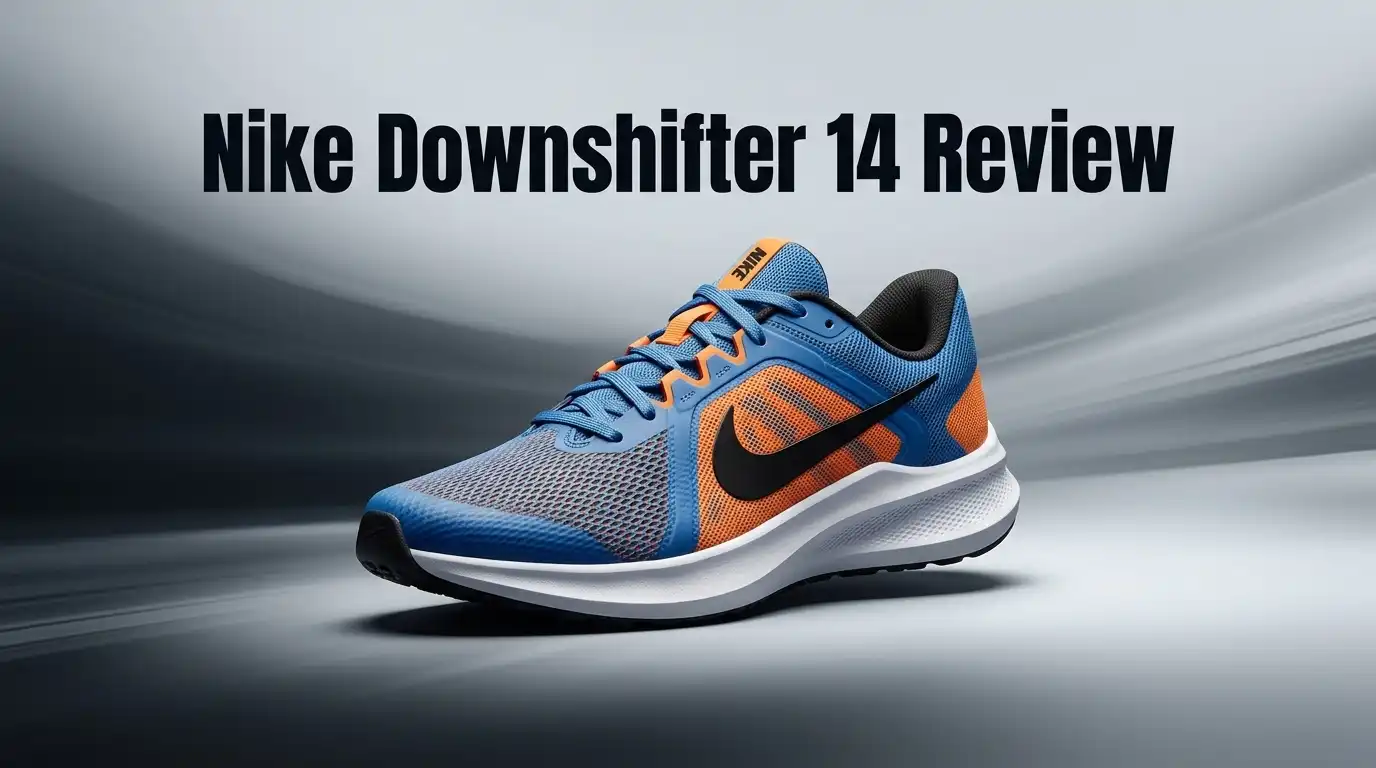
Nike Downshifter 14 Review 2026: Worth Buying?
The Nike Downshifter 14 sits at the very bottom of Nike’s running shoe ladder, and that is exactly why people keep asking about it. It costs around $80.
It carries the swoosh. It shows up in almost every big box shoe aisle. But cheap shoes make big promises, and runners want to know if this one holds up after 100 miles or falls apart after three weeks.
I spent time with this shoe on pavement, on treadmill belts, and on long grocery store walks. I also pulled lab data from independent testing labs that cut this shoe in half.
In A Nutshell:
- The price is the main selling point. At roughly $80 retail, the Downshifter 14 costs about half the average running shoe price. Everything else about this shoe flows from that number. Nike spent money on rubber and comfort padding, then saved money on foam quality and airflow.
- Traction improved dramatically over the Downshifter 13. Lab grip scores nearly doubled, jumping from a weak 0.36 to a strong 0.69. Wet pavement no longer feels like a gamble. This is the single biggest upgrade in the model.
- The ride feels firm and flat, not bouncy. Energy return measures around 50 percent in the heel, well below the 58 percent average. The EVA foam gives very little back. Short runs feel fine. Long runs feel like work.
- It weighs a lot. At 11.1 ounces (315 grams) in a men’s US 9, this shoe carries nearly two extra ounces compared to the average trainer. Your legs notice that weight after mile four.
- Durability is excellent for the money. A 4.1 mm rubber outsole and a tough toebox mean this shoe survives daily abuse. It will likely outlast shoes that cost twice as much.
- Best use case is walking, gym work, standing shifts, and short easy runs. It is not a mileage builder. Runners training for a half marathon should look elsewhere.
Nike Downshifter 14 Overview

- Kick your stride into another gear in the Downshifter 14. We increased the amount of cushioning in...
- We increased the amount of cushioning in the midsole for more comfort and bounce.
- Internal fit band offers containment around the midfoot for a locked-in feel.

Last update on 2026-08-28 / Affiliate links / Images from Amazon Product Advertising API Some of the links on this website are affiliate links, which means that at no additional cost to you, I earn a commission if you click through and make a purchase. I only recommend products and services that I believe will add value to my readers. Thank you for your support!
The Downshifter line has existed for years as Nike’s entry point. The fourteenth version keeps that job. Nike markets it as a road running shoe, but the truth is broader and more useful. This is a general purpose sneaker that happens to run.
The build is simple. A single density EVA foam midsole sits under your foot. A generous rubber outsole covers the bottom. An engineered mesh upper wraps the top, with an internal fit band around the midfoot for security. Nike lists the drop at 8 mm. Independent measurement came in at 7.4 mm, which is close enough to trust.
Stack height measures 31.1 mm at the heel and 23.7 mm at the forefoot. Those numbers sit below the modern average of 35.5 mm and 27.1 mm. Nike did not chase the max cushion trend here. You stay closer to the ground, which some runners genuinely prefer.
The shoe comes in men’s and women’s versions with wide options in some markets. Colorways range from safe blacks and whites to brighter blue and green combinations. Nike also gave it a fully gusseted tongue, a feature usually reserved for shoes above $130. That detail alone shows the design team was paying attention.
What you get is a plain, sturdy, honest shoe. No plate. No fancy foam. No marketing gimmick. Just a functional trainer built to a price.
Unboxing Experience And First Impressions
The box arrives plain. Standard Nike orange and white cardboard, no premium tissue paper, no extra laces, no dust bag. You lift the lid and the shoes sit there in thin paper. That is it. For $80, nobody expects a ceremony, and Nike does not give you one.
Pick the shoe up and the first thing you notice is heft. It feels dense in your hand. Not cheap dense, but solid dense, like a work shoe. The rubber outsole is thick and you can feel that thickness immediately.
Slide your foot in and the step in comfort genuinely surprises you. The heel collar is plush and heavily padded. The tongue measures about 6.9 mm thick, above average, and it sits flat against the instep without pinching. That first step feels far more expensive than the price tag suggests.
The mesh upper looks dense rather than airy. Hold it to a light and very little passes through. That is your first clue about breathability, and it turns out to be accurate.


Last update on 2026-04-11 / Affiliate links / Images from Amazon Product Advertising API Some of the links on this website are affiliate links, which means that at no additional cost to you, I earn a commission if you click through and make a purchase. I only recommend products and services that I believe will add value to my readers. Thank you for your support!
Lacing takes a moment because Nike used a mixed loop layout with four eyelet loops. Once you cinch it down, the midfoot locks in cleanly. No heel slip on my pair. No hot spots on the first walk.
First impression verdict: comfortable, sturdy, and heavier than expected.
Design And Build Quality
Nike made deliberate choices here, and you can see the logic once you understand the budget.
The outsole is the star. Nike laid down 4.1 mm of rubber, well above the 3.1 mm average. It splits into two zones. Most of the surface uses a grippy compound. The lateral heel area uses a harder, tougher formula where wear happens fastest. A long channel runs down the middle of the outsole, which sheds water and lets the shoe flex naturally.
The midsole is plain EVA. No React foam. No ReactX. No Air unit. This is the cheapest reliable foam in the industry and Nike used it without apology. Midsole sidewalls rise slightly around the heel to add a bit of cradle.


Last update on 2026-04-11 / Affiliate links / Images from Amazon Product Advertising API Some of the links on this website are affiliate links, which means that at no additional cost to you, I earn a commission if you click through and make a purchase. I only recommend products and services that I believe will add value to my readers. Thank you for your support!
The heel bevel deserves a mention because it is aggressive. Nike carved a significant curve into the rear of the shoe, clearly aimed at heavy heel strikers. Transitions from landing to midstance feel smoother than they have any right to be at this price.
The upper uses layered engineered mesh with an internal band across the midfoot. Stitching on my pair was clean. The heel finish looks slightly rough around the collar edges, a small cosmetic flaw.
Torsional rigidity measures 9.8 Nm, well under the 14.5 Nm average. The shoe twists easily, which helps comfort but limits support.
Build quality overall: better than the price suggests, with obvious material compromises.
Top 3 Alternatives For Nike Downshifter 14

- There’s a little more room in the forefoot compared to the 6, as well, so your toes don’t feel...
- soft cushioning
- We added puffs to the heel that are visible on the outside of the shoe
Last update on 2026-08-28 / Affiliate links / Images from Amazon Product Advertising API Some of the links on this website are affiliate links, which means that at no additional cost to you, I earn a commission if you click through and make a purchase. I only recommend products and services that I believe will add value to my readers. Thank you for your support!
Nike Revolution 7 Men’s Road Running Shoes

- adidas Mens Galaxy 7 Running
Last update on 2026-08-28 / Affiliate links / Images from Amazon Product Advertising API Some of the links on this website are affiliate links, which means that at no additional cost to you, I earn a commission if you click through and make a purchase. I only recommend products and services that I believe will add value to my readers. Thank you for your support!
adidas Men’s Galaxy 7 Running Shoes

- Runs Small
- PureGEL technology: Softer, updated version of our GEL technology. Approximately 65% softer vs...
- Engineered mesh upper: A lightweight, breathable meshmaterial helps reduce the need for...
Last update on 2026-08-28 / Affiliate links / Images from Amazon Product Advertising API Some of the links on this website are affiliate links, which means that at no additional cost to you, I earn a commission if you click through and make a purchase. I only recommend products and services that I believe will add value to my readers. Thank you for your support!
ASICS Men’s Gel Excite 11 Running Shoes
Cushioning And Ride Feel
This is where the Downshifter 14 shows its price. Let me be direct with you.
The midsole measures 40.3 on the durometer scale, where the average sits at 35.6. Higher means firmer. This shoe rides firm, close to what running shoes felt like fifteen years ago. Some people love that. Most modern runners do not.
Shock absorption improved 9 percent over the previous model, landing at 121 SA in the heel and 92 SA in the forefoot. The average sits at 131 SA. So you get less impact protection than a typical trainer, and the forefoot in particular runs thin. Push harder and the cushioning drops off noticeably.
Energy return sits at 50.1 percent in the heel and 57.4 percent in the forefoot, compared to a 58.7 percent average. In plain language, the foam absorbs your energy and gives back very little. The ride feels flat and lifeless once you pick up the pace.
Cold weather makes it worse. The foam firmed up 27 percent after twenty minutes in a freezer, above the 22 percent average. Winter runners will feel a harder shoe.
Here is the fair counterpoint. The thick rubber and low stack combine into a stable, predictable platform. For a 20 minute jog, a walk, or a gym session, that firmness reads as controlled rather than harsh. Push past 5 miles and your calves will file a complaint.
Fit And Sizing Guide
The Downshifter 14 fits true to size in length. Buy your normal Nike size and the length will be correct. Internal length measured 264.4 mm in a US 9, slightly under the 269.3 mm average, but on foot it reads accurate.
Width is where problems start. Overall width measured 91.2 mm against a 95.2 mm average. That is a notably snug shoe. The toebox measured 71.3 mm compared to 73.2 mm average, confirming the tapered shape Nike has used for decades.
If you have wide feet, this shoe will squeeze you. The midfoot in particular runs very narrow. Testers with a wider arch area reported real pressure. A wide version exists but is not sold in every region, and availability is inconsistent.
Toebox height measures 27.3 mm, right at average. Vertical room is fine. Horizontal room is not.
Heel lockdown works well thanks to the padded collar and a heel counter rated 3 out of 5 for stiffness, a comfortable middle ground. The gusseted tongue prevents sliding and keeps debris out.
My sizing advice is simple. Normal or narrow feet, order true to size. Wide feet, try them in store or pick a different model entirely. Half sizes do not solve a width problem, and going up a size only creates heel slip.
Sock thickness matters here. Thin socks give you noticeably more comfort than cushioned athletic socks.
Traction And Outsole Durability
Here is the good news section, and it is genuinely good.
The Downshifter 13 had embarrassing grip. Lab testing scored it 0.36, which meant slippery wet sidewalks and nervous corners. Nike heard the complaints. The Downshifter 14 scores 0.69 on the same test, against an average of 0.52. That is nearly double the grip of last year’s model and well above the category average.
On wet pavement the shoe holds. On painted crosswalk lines, it holds. On smooth gym flooring, it holds. On loose gravel and mud it struggles, but this is a road shoe and nobody should expect otherwise.
Durability numbers are equally strong. After a standardized abrasion test, the outsole showed only 0.8 mm of wear compared to a 1.1 mm average. Combined with the 4.1 mm rubber thickness, this outsole will last a long time.
Toebox durability rated 4 out of 5, well above the 2.6 average. The dense upper mesh resists tearing where big toes usually punch through. Heel padding durability rated 3 out of 5, decent but not remarkable. That interior heel lining will fuzz up before anything else fails.
The tradeoff is honest. All that rubber adds weight and firmness. Nike traded a lively ride for a shoe that survives. For someone buying one pair to wear for a year, that is the correct trade.
Breathability And Upper Comfort
The upper is comfortable and poorly ventilated. Both things are true.
Independent smoke testing rated breathability 2 out of 5 against a 3.6 average. Almost no air escaped through the mesh. Under a microscope, the reason became clear. The ventilation holes exist, but a secondary inner layer blocks most of them.
In summer heat, your feet will get warm. This is not a shoe for July runs in humid climates. Sweaty socks are the normal outcome after 30 minutes in high temperatures. Runners in cooler climates will actually appreciate the warmth.
The tongue is the exception. Nike used a more breathable mesh there, and it helps a little. Not enough to fix the problem, but the gesture is appreciated.
Comfort itself is strong. The heel collar padding feels genuinely plush. The tongue thickness at 6.9 mm sits above average and spreads lace pressure across the instep. The four loop lacing setup relieves the pinch point most cheap shoes create at the top of the foot.
The insole measures 4.5 mm, average thickness, and it removes easily. Despite the Comfort Footbed branding, it is a standard foam sheet. If you use orthotics, they will drop right in.
One more gap worth naming: there are no reflective elements anywhere on this shoe. For a trainer aimed at beginners who often run at dawn or dusk, that omission is hard to defend.
Weight And Performance On The Run
Weight is the Downshifter 14’s biggest problem, and there is no way to spin it.
The shoe weighs 11.1 ounces (315 grams) in a men’s US 9. The category average is 9.2 ounces (262 grams). That is nearly two extra ounces on each foot. For a shoe with below average stack height, that number makes no sense until you remember the thick rubber and dense upper.
On the run, the weight shows up as a labored feeling. Your cadence drops. Your stride shortens. Turnover feels sluggish compared to a lighter trainer, even a cheap one.
Flexibility helps offset this somewhat. The shoe scored 11.3N on the flex test against a 15.5N average, meaning it bends easily and does not fight your foot. That aggressive heel bevel smooths out landings for heel strikers. Combined, these traits make short runs pleasant.
Stability is a genuine strength. The firm foam, the low stack, and the broad forefoot platform (111.9 mm) create a controlled ride. You will not roll an ankle in these. Note that this is stability from geometry, not from support features. Runners who need real overpronation correction should look at a dedicated stability shoe.
Realistic performance ceiling: 3 to 5 easy miles feels fine. Anything beyond that leaves your legs beat up. Speed work is off the table.
Nike Downshifter 14 Versus Downshifter 13
If you own the Downshifter 13 and wonder whether to upgrade, the answer depends on one thing.
Traction is the deciding factor. The 13 scored 0.36 on grip testing, a genuinely poor result that led to real complaints about wet surfaces. The 14 scores 0.69. That is the largest year over year improvement in the shoe’s history, and it fixes the model’s worst flaw.
Everything else changed only slightly. Shock absorption improved 9 percent. Stability got marginally better thanks to midsole sidewalls and a more aggressive heel bevel. Flexibility stayed nearly identical at 11.3N versus the previous 11.4N range. The upper became denser, which improved durability and hurt breathability.
Weight is worth noting carefully because published numbers vary by source and by shoe size. Nike lists 358 grams for a men’s US 10. Independent labs measured 315 grams in a US 9. Either way, both generations are heavy shoes and neither one is light.
Here is my honest recommendation. If you can find the Downshifter 13 on clearance for $45 and you run mostly indoors or on dry surfaces, buy the older model and save the money. If you run outdoors in any weather, pay the difference for the 14. Wet grip is a safety feature, not a luxury.
For everyone else, the differences are too small to justify replacing a functional pair.
Nike Downshifter 14 For Women

- Kick your stride into another gear in the Downshifter 14. We increased the amount of cushioning in...
- We increased the amount of cushioning in the midsole for more comfort and bounce.
- Internal fit band offers containment around the midfoot for a locked-in feel.
Last update on 2026-08-28 / Affiliate links / Images from Amazon Product Advertising API Some of the links on this website are affiliate links, which means that at no additional cost to you, I earn a commission if you click through and make a purchase. I only recommend products and services that I believe will add value to my readers. Thank you for your support!
The women’s Downshifter 14 uses the same platform with a scaled last and a lighter build. Nike lists the weight at approximately 276 grams for a US 8, which is meaningfully lighter than the men’s version but still heavy for the category.
The same strengths carry over. Grip is strong. The outsole is thick and durable. Step in comfort from the padded heel collar and thick tongue feels better than the price suggests. The gusseted tongue is present on the women’s model too.
The same weaknesses carry over as well. The upper runs warm. The midsole is firm and returns little energy. The narrow fit is arguably more noticeable in the women’s last, and buyers with wide feet report the same midfoot squeeze.
Colorways skew toward more variety than the men’s line, with several bright and pastel options alongside the standard black and white.
Who should consider it? Women who want one affordable sneaker for walking, standing shifts, gym classes, and occasional short runs. Nurses, teachers, retail workers, and casual walkers will get real value here.
Who should skip it? Anyone training for distance, anyone with wide feet, and anyone who prefers soft, plush cushioning. The women’s version does not solve any of the platform’s core limitations. It inherits all of them at a lower weight.
What The Nike Downshifter 14 Does Not Do Well
An honest review names failures clearly. Here they are without softening.
It is not a distance running shoe. Energy return of 50 percent and below average shock absorption mean your legs take a beating past 5 miles. Beginners building mileage will feel unnecessary fatigue and soreness.
It is too heavy. At 11.1 ounces, this shoe carries more weight than trainers with far more foam. There is no performance justification for that number.
It runs hot. A 2 out of 5 breathability score is poor. Summer runners in warm climates will regret this purchase.
It fits narrow. Width of 91.2 mm and a tapered 71.3 mm toebox exclude a large group of buyers. The wide version has spotty availability.
It has no reflective elements. Beginners often run in low light. Nike saved a few cents and created a real safety gap.
It has no heel pull tab. Small annoyance, but getting the shoe on takes an extra second.
It offers no real support features. Overpronators get nothing here beyond a firm base.
The foam feels dated. Compared to modern budget shoes from adidas, ASICS, and New Balance, the ride quality is a generation behind.
None of these are dealbreakers if you buy the shoe for what it actually is. They become dealbreakers the moment you expect it to be a real running trainer.
Pros And Cons Of Nike Downshifter 14
Pros
- Excellent price at around $80, roughly half the average running shoe cost, which makes it accessible for beginners and budget buyers.
- Dramatically improved traction with a 0.69 grip score, well above the 0.52 category average and nearly double the previous model.
- Outstanding outsole durability thanks to 4.1 mm of rubber and only 0.8 mm of wear in abrasion testing.
- Strong toebox durability rated 4 out of 5, far above the 2.6 average, so the upper resists tearing.
- Plush step in comfort from a heavily padded heel collar and a 6.9 mm thick tongue.
- Fully gusseted tongue on both sides, a premium feature rarely found under $100.
- Very flexible construction at 11.3N, which keeps the shoe comfortable for all day wear.
- Stable, controlled platform from the firm midsole and low stack, good for beginners nervous about ankle roll.
- Aggressive heel bevel that smooths transitions for heel strikers.
- True to size length with no guesswork required.
Cons
- Heavy at 11.1 ounces, nearly two ounces above average, which makes running feel labored.
- Poor breathability rated 2 out of 5, so feet overheat in warm weather.
- Low energy return around 50 percent, producing a flat and lifeless ride.
- Below average shock absorption, especially in the thin forefoot.
- Narrow fit at 91.2 mm width with a tapered toebox that excludes wide footed buyers.
- No reflective elements anywhere on the shoe.
- No heel pull tab for easy entry.
- Firm ride that stiffens 27 percent in cold weather.
- Not suitable for distance training or speed work.
- Basic insole despite Comfort Footbed branding.
Who Should Buy The Nike Downshifter 14
Buy this shoe if you fit one of these profiles.
You want one affordable sneaker that does everything acceptably. Walking the dog, gym sessions, standing at work, a short jog once a week. The Downshifter 14 handles all of it and survives the abuse.
You run in cool or cold weather. The dense upper that hurts summer performance becomes an asset in autumn and winter. Warmer feet on a 40 degree morning is a genuine benefit.
You prefer a firm, grounded ride. Some runners hate soft foam and want to feel the road. This shoe delivers that old school sensation at a low price.
You are on a tight budget and need something safe. A beginner running 2 miles three times a week will be fine here, and the strong grip removes the slip risk that plagued the previous version.
You destroy shoes quickly. The 4.1 mm outsole and tough toebox mean this pair outlasts many pricier options.
Skip this shoe if you have wide feet, if you run more than 15 miles per week, if you live somewhere hot, if you need pronation support, or if you value a soft and bouncy ride. In those cases the Revolution 7, adidas Galaxy 7, or ASICS Gel Excite 11 serve you better for similar money.
Final Verdict
The Nike Downshifter 14 is a good shoe pretending to be a running shoe. Understand that sentence and your purchase decision becomes easy.
As a general purpose sneaker, it earns a solid recommendation. The traction upgrade is real and significant. Durability is excellent for $80. Step in comfort punches above the price. The gusseted tongue and heel bevel show genuine design care. Wear these for walking, gym work, errands, and long shifts on your feet, and you will get honest value for a long time.
As a running shoe, it is mediocre. The weight is too high. The foam is too dead. The forefoot is too thin. Anyone building mileage will feel the shoe fighting them, and the missing reflective elements are a real oversight for the beginner audience Nike targets.
My rating: 7 out of 10 as a daily wear sneaker, 5 out of 10 as a running shoe.
The right buyer here is clear. Someone who needs one durable, comfortable, affordable pair for mixed daily use. Someone who runs occasionally rather than seriously. If that describes you, the Downshifter 14 is a sensible $80. If you are training for anything, spend $30 more and buy a real trainer.
Frequently Asked Questions
Is the Nike Downshifter 14 good for running?
It is acceptable for short, easy runs of 3 to 5 miles. Beyond that, the heavy 11.1 ounce build, the firm EVA foam, and the low energy return of about 50 percent leave your legs sore. It works for beginners running a few miles a few times per week. Serious mileage requires a better shoe.
Does the Nike Downshifter 14 run true to size?
Yes, the length runs true to size. Order your normal Nike size. The width is the issue. At 91.2 mm overall width and 71.3 mm at the toebox, this shoe fits narrow. Buyers with wide feet should look for the wide version where available or choose another model.
How long does the Nike Downshifter 14 last?
The outsole is one of the most durable in the budget category, with 4.1 mm of rubber and only 0.8 mm of wear in abrasion testing. Expect 300 to 400 miles of running or well over a year of casual daily wear. The heel lining will show wear before the outsole does.
Is the Nike Downshifter 14 good for walking?
Yes, this is arguably its best use. The firm and stable platform, the flexible construction, the strong grip, and the plush heel padding suit walking well. The weight matters less at walking pace. Nurses, teachers, and retail workers get real value here.
What is the difference between the Downshifter 13 and 14?
Traction is the main change. The 13 scored a poor 0.36 on grip testing while the 14 scores 0.69. Shock absorption improved 9 percent and stability improved slightly. Everything else is nearly identical. If the 13 is deeply discounted and you run on dry surfaces, it remains a reasonable buy.
Is the Nike Downshifter 14 good for flat feet?
Not really. This is a neutral shoe with no arch support features and low torsional rigidity at 9.8 Nm. The firm midsole provides some inherent stability, but runners who need real pronation control should choose a dedicated stability shoe or add a supportive insole.
Does the Nike Downshifter 14 breathe well?
No. Breathability scored 2 out of 5 against a 3.6 average. The mesh has ventilation holes, but an inner layer blocks most airflow. Feet run warm in summer. This becomes an advantage in cold weather running.
Can you use the Nike Downshifter 14 for the gym?
Yes. The firm platform, wide forefoot base, and grippy outsole handle treadmill work, light lifting, and cardio classes well. The flexibility suits bodyweight movement. It is not a dedicated cross training shoe, but it covers general gym use comfortably.

Mia Smith is the founder of Shoe Storyteller, a blog that celebrates the art and stories behind shoes. With a passion for fashion and a flair for storytelling, Mia brings a unique perspective to the world of footwear.