Adidas Runfalcon 5 Review 2026: Worth Buying?
Running shoes keep getting more expensive every single year. Flagship trainers now cross the $180 mark without blinking. So a shoe that still sells for around $65 feels almost suspicious. The Adidas Runfalcon 5 sits in that rare price bracket, and it sells in huge numbers because of it.
But cheap does not always mean smart. Some budget shoes give you honest value. Others fall apart in three months and cost you more in the long run.
I spent time with this shoe, studied lab data, and read through thousands of owner reviews. The picture that came out is interesting, and a little bit mixed.
Key Takeaways:
- Price is the headline feature. The Runfalcon 5 costs around $65 at full price and often drops to $45 during sales. The average running shoe now costs roughly $157, so you are paying less than half.
- The ride is firm, not plush. Adidas uses a Cloudfoam EVA midsole that measures firmer than average in lab testing. If you want a soft marshmallow feel, this shoe will disappoint you. Runners who like ground contact will feel right at home.
- Grip is the weakest link. Traction testing put this shoe near the very bottom of the pack. On wet pavement, painted lines, or polished floors, you need to slow down and pay attention.
- Durability scores are poor. The toebox lining, heel lining, and outsole rubber all showed heavy wear in abrasion testing. Expect a shorter lifespan than a $130 trainer.
- The fit is roomy and forgiving. Internal width measured wider than average, and the shoe runs true to size for most people. Wide footed runners get real relief here.
- Best use case is walking, gym work, and short easy jogs. It handles daily wear beautifully. It is not built for marathon training or fast tempo sessions.
Adidas Runfalcon 5 Overview

- Wide
- Lace-up closure
- Mesh upper
Last update on 2026-08-28 / Affiliate links / Images from Amazon Product Advertising API Some of the links on this website are affiliate links, which means that at no additional cost to you, I earn a commission if you click through and make a purchase. I only recommend products and services that I believe will add value to my readers. Thank you for your support!
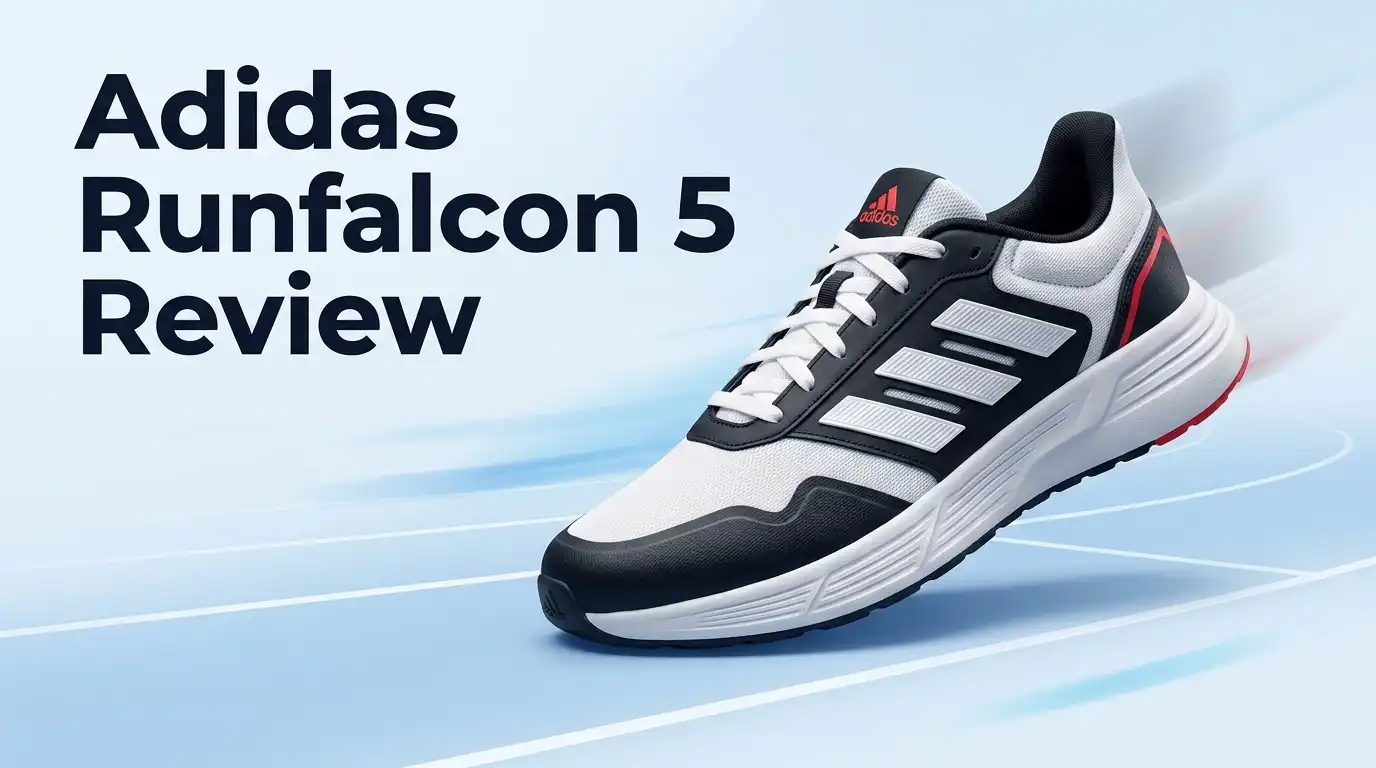
The Runfalcon line has been Adidas’s entry level running shoe for years. Version 5 keeps that role but borrows styling cues from much pricier models. Look at the heel and you will spot a plastic clip that looks lifted straight from the Ultraboost. Look at the silhouette and you will see hints of the Adizero SL.
Here are the core specs. The heel stack measures about 31 mm and the forefoot sits near 22 mm. That gives you a drop of roughly 9.4 mm, close to the advertised 10 mm. Weight lands at 9.7 oz or 275 g in a men’s size 9. That is slightly heavier than average but still under the psychological 10 oz line.
The midsole uses Cloudfoam EVA. The outsole uses Adiwear rubber with full length coverage. The upper is a dual layer engineered mesh. Inside you get a removable Ortholite insole, which is a genuinely nice touch at this price.
Adidas positions this shoe as a neutral daily trainer for beginners. That framing is accurate. It is not a stability shoe. It is not a race shoe. It is a simple, flexible, low cost trainer built for people who run a few kilometres a week and want the rest of their money back.
The value equation is the whole story here. Everything this shoe does well and everything it does badly traces back to the price tag.
Unboxing The Adidas Runfalcon 5
The unboxing is exactly what you expect from a budget Adidas shoe, and there is a certain charm in that honesty.
The box arrives plain. White cardboard, black Adidas wordmark, a small spec sticker on the end panel. No fancy inserts, no tissue paper theatrics, no QR code sending you to a brand film. You lift the lid and the shoes sit there wrapped in thin paper.
First impression when you pick one up is lightness. The shoe feels airy in hand, lighter than the number on the spec sheet suggests. The upper mesh has a slightly plasticky texture, and you can feel the two layers when you rub it between your fingers. It does not feel premium. It does feel sturdy.
The heel clip is the visual highlight. Those two plastic pieces cradling the heel genuinely elevate the look. From three feet away, this reads as a much more expensive shoe.


Last update on 2026-04-11 / Affiliate links / Images from Amazon Product Advertising API Some of the links on this website are affiliate links, which means that at no additional cost to you, I earn a commission if you click through and make a purchase. I only recommend products and services that I believe will add value to my readers. Thank you for your support!
Squeeze the midsole and you immediately notice the firmness. There is very little give. This is your first honest warning that the ride will be firm.
The tongue is surprisingly thick. Three layers of foam create almost 10 mm of padding, which is nearly double the average. It feels plush and a bit oversized against the rest of the shoe.
Laces are flat, standard length, nothing special. Insole pops out easily if you use custom orthotics.
Cushioning And Ride Feel
This is where opinions split hardest, so let me be direct. The Runfalcon 5 is a firm shoe.
Lab testing measured the midsole at 40.5 on the durometer scale, where the average running shoe sits around 35.6. Higher number means firmer foam. You feel that difference on your first run.


Last update on 2026-04-11 / Affiliate links / Images from Amazon Product Advertising API Some of the links on this website are affiliate links, which means that at no additional cost to you, I earn a commission if you click through and make a purchase. I only recommend products and services that I believe will add value to my readers. Thank you for your support!
Shock absorption measured 112 units against an average of 131. Energy return came in at 52.2 percent against an average of 58.7 percent. Both numbers sit well below the typical modern trainer. That is the honest trade off you accept for a $65 price.
What does this feel like in practice? Road texture comes through clearly. Small stones register underfoot. On smooth asphalt the ride feels controlled and stable. On rough concrete it feels harsh after about 5 km.
The forefoot is the thin spot. At roughly 22 mm, there is not much foam between your metatarsals and the ground. Forefoot strikers will notice fatigue early. Heel strikers get a better deal, since the 31 mm heel handles impact reasonably well.
One genuine positive appeared in cold weather testing. The foam only stiffened by 17 percent after freezing, compared to a 22 percent average. Winter runners will appreciate that consistency.
The Ortholite insole adds a thin layer of softness on top. Removing it makes the shoe noticeably harsher, so keep it in unless you have a better replacement.
Top 3 Alternative for Adidas Runfalcon 5

- Regular fit
- Laces
- Synthetic and textile mesh upper
Last update on 2026-08-28 / Affiliate links / Images from Amazon Product Advertising API Some of the links on this website are affiliate links, which means that at no additional cost to you, I earn a commission if you click through and make a purchase. I only recommend products and services that I believe will add value to my readers. Thank you for your support!
Adidas Duramo SL 2

- Outer Material: Synthetic
- Closure: laces
- Sole material: Rubber
Last update on 2026-08-28 / Affiliate links / Images from Amazon Product Advertising API Some of the links on this website are affiliate links, which means that at no additional cost to you, I earn a commission if you click through and make a purchase. I only recommend products and services that I believe will add value to my readers. Thank you for your support!
Nike Revolution 7

- Runs Small
- Rearfoot GEL technology cushioning: Improves impact absorption and creates a softer feeling at...
- Jacquard mesh upper: Improves airflow
Last update on 2026-08-28 / Affiliate links / Images from Amazon Product Advertising API Some of the links on this website are affiliate links, which means that at no additional cost to you, I earn a commission if you click through and make a purchase. I only recommend products and services that I believe will add value to my readers. Thank you for your support!
ASICS Gel Contend 9
Fit And Sizing Guide
Good news here. The Runfalcon 5 fits true to size for the large majority of wearers. Order your normal Adidas size and you will be fine.
Interior measurements back this up. Internal length came in at 272 mm, slightly longer than the 269 mm average. You get a comfortable thumbnail of space in front of your big toe without any sloppiness.
Width is where this shoe shines. The widest interior point measured 98.9 mm against a 95.2 mm average. That is genuinely spacious for a mainstream trainer. Runners with wide or high volume feet often struggle to find affordable options, and this one delivers.
The toebox tapers a little more than the midfoot. Big toe area measured 71.3 mm, slightly under the 73.2 mm average. So the shape is roomy in the middle and moderately pointed at the front. People with wide forefeet and a long second toe may feel a pinch.
Toebox height came in at 26.6 mm, which is standard. No issues with pressure on the top of your toes.
Lockdown is solid. The heel clip holds your rearfoot in place well, and the thick tongue means lace pressure never bites.
One caveat. The tongue is not gusseted. It slides sideways during longer runs. Tightening the laces firmly fixes most of the movement, but it is a small annoyance.
Adidas also sells a dedicated wide version if the standard fit still feels tight.
Breathability And Upper Comfort
The upper is a dual layer engineered mesh, and the second layer is exactly why breathability disappoints.
Testing scored the Runfalcon 5 at 3 out of 5 for airflow, below the 3.6 average for road shoes. Under a microscope, the outer mesh shows visible gaps, but the inner layer blocks most of that air path. There are no large ventilation holes anywhere on the shoe.
What this means in real life is simple. On a cool morning run, your feet stay perfectly comfortable. On a humid summer afternoon, they get warm and stay warm. Sweat builds up and takes longer to clear.
Interestingly, many owner reviews praise the breathability. That gap between lab data and user perception makes sense. Compared to a cheap gym sneaker or a casual lifestyle shoe, this upper breathes well. Compared to a modern running mesh, it lags behind.
Comfort against the skin is good. The interior lining is smooth, the collar padding is generous, and I found no hot spots or rubbing during break in. Most people can wear these straight out of the box without blisters.
The heel collar padding deserves a mention. It is soft and thick, which feels great initially. The problem is what sits under that softness, and I will cover that in the durability section.
If you live somewhere hot, size up half a size and wear thin socks.
Traction And Outsole Performance
Here comes the biggest surprise, and not a pleasant one.
The Runfalcon 5 scored 0.12 in standardised traction testing. The average running shoe scores 0.52. The worst shoe on record scores 0.11. That puts this outsole almost at the very bottom of hundreds of tested models.
Let me translate that number. On dry, clean asphalt, the shoe grips well enough for easy paces. Push harder into a corner and you feel the rear slip slightly. Step on a painted crosswalk line, a wet manhole cover, or a polished gym floor, and the shoe becomes genuinely slippery.
This is a real safety consideration, not a nitpick. If you run in rainy conditions, this shoe is a poor match. If you do gym classes with lateral movement, look elsewhere.
The design itself looks sensible on paper. Adiwear rubber covers the full length of the outsole, with no exposed midsole foam. Adidas even used denser rubber in the medial heel and lateral forefoot where wear concentrates. The engineering intent is good.
Thickness measured 2.7 mm against a 3.1 mm average. Slightly thin.
My recommendation is to treat grip as this shoe’s hard limit. Use it for walking, treadmill work, dry weather jogs, and daily errands. Do not use it for wet roads, trails, or anything requiring quick direction changes.
Stability And Support
The Runfalcon 5 is a neutral shoe with a few borrowed stability details.
The star element is the heel counter. Two rigid plastic pieces cradle the rear of your foot and hold it centred. This design comes straight from the Ultraboost family, and it works. Heel hold feels secure and confident. Counter stiffness scored 3 out of 5, which is exactly average and appropriate here.
Torsional rigidity tells a different story. The shoe scored 2 out of 5, well under the 3.6 average. This is a very flexible platform that twists easily in the hand. Flexibility feels natural for walking and slow jogging. It offers almost no resistance to excessive foot roll.
Midsole width supports the same conclusion. The forefoot measured 109.8 mm against a 115.1 mm average, so the base is narrow up front. The heel measured 91.7 mm, right at average, which suits heel strikers.
Flexibility testing needed only 12.0 N to bend the shoe 30 degrees, compared to a 15.5 N average. Easy to bend, easy to walk in, low structure.
Put all of this together and the verdict is clear. Runners with neutral gait will be comfortable. Runners with moderate or severe overpronation need a proper stability shoe. This one will not correct anything.
Beginners with unknown gait should get a quick assessment before committing to serious mileage in these.
Durability: The Real Weak Point
I want to be completely straight with you here, because this section matters more than any other.
Abrasion testing produced three bad results in a row. Toebox durability scored 1 out of 5 against a 2.6 average. Heel padding durability scored 1 out of 5 against a 3.4 average. Outsole wear measured 1.5 mm of damage against a 1.1 mm average.
That is a clean sweep of poor scores.
The heel result concerns me most. The collar has generous padding, but the lining covering it is thin and weak. Every time you slide your foot in without untying the laces, you scrape that lining. Owners frequently report a hole forming at the heel within a few months. If you kick your shoes off at the door and shove your feet back in later, this will happen to you.
The toebox lining faces the same issue from the inside, especially if your toenails are long.
Outsole wear is more predictable. Expect visible tread loss around 300 to 400 km for most runners, sooner if you are heavier or run on rough concrete.
Realistic lifespan is roughly 300 to 500 km of running, or six to twelve months of casual daily wear.
At $65 that maths still works out. At $130 it would be unacceptable. Adjust your expectations accordingly and you will not feel cheated.
What The Runfalcon 5 Does Not Do Well
Every review should have a section like this. Here is the unfiltered list.
It does not grip wet surfaces. I have said it three times because it genuinely matters. Rain changes this shoe from adequate to risky.
It does not feel plush. If you are coming from a soft foam shoe, the firmness will feel like a downgrade. Your legs will notice on runs over 8 km.
It does not last long. Every durability metric fell below average. Plan on replacing these sooner than a mid range trainer.
It does not breathe well in heat. The dual layer mesh traps warmth. Summer runners in humid climates will have damp socks.
It does not offer any premium extras. No reflective elements for night visibility. No gusseted tongue. No heel pull tab, which makes putting the shoe on slightly awkward. These omissions are understandable at the price, but they are still omissions.
It does not support overpronators. The narrow forefoot base and low torsional rigidity give you almost no correction.
It does not perform at speed. Energy return of 52 percent means the shoe gives very little back. Tempo runs feel like hard work.
It does not have much forefoot cushioning. At 22 mm, forefoot strikers will feel the road too clearly.
None of this makes the shoe bad. It makes it specific. Know the limits and buy accordingly.
Pros And Cons
Here is the balanced breakdown.
Pros
- Outstanding price. At roughly $65 full price and often $45 on sale, this is one of the cheapest legitimate running shoes from a major brand.
- Roomy interior width. The 98.9 mm interior measurement gives wide footed runners genuine comfort without paying for a specialty model.
- Light for the category. At 9.7 oz, it stays under the 10 oz threshold despite the low cost.
- Excellent cold weather consistency. The foam only stiffens 17 percent in freezing conditions, better than most EVA midsoles.
- Removable Ortholite insole. A quality branded insole at this price is unexpected, and it swaps out easily for orthotics.
- Secure heel lockdown. The Ultraboost style plastic heel clip holds your foot firmly in place.
- Very flexible and comfortable for walking. Low bend resistance makes this a genuinely pleasant all day shoe.
- Sharp looks. The design punches well above its price bracket visually.
Cons
- Terrible traction scores. At 0.12, grip ranks near the bottom of every shoe tested. Wet surfaces are a real hazard.
- Poor durability across the board. Toebox, heel lining, and outsole all scored below average in abrasion testing.
- Firm, low energy ride. Shock absorption and energy return both fall under the category average.
- Limited breathability. The dual layer mesh restricts airflow, making hot weather uncomfortable.
- Thin forefoot cushioning. Only 22 mm of stack up front leads to early fatigue for forefoot strikers.
- No reflective details. Night runners get zero visibility help.
- No gusseted tongue. The thick tongue slides sideways during runs.
Adidas Runfalcon 5 Price And Value

- Men's everyday running shoes made in part with recycled materials
- WEIGHT: 304 g (size US 9)
- SNUG FIT: Adjustable laces provide a secure fit

Last update on 2026-08-28 / Affiliate links / Images from Amazon Product Advertising API Some of the links on this website are affiliate links, which means that at no additional cost to you, I earn a commission if you click through and make a purchase. I only recommend products and services that I believe will add value to my readers. Thank you for your support!
Let us talk numbers, because value is the entire argument for this shoe.
Full retail sits at $65. The average running shoe in the current market costs about $157. Adidas held the Runfalcon price steady across generations while nearly every competitor raised theirs. That restraint deserves credit.
Sale pricing is where it gets interesting. Adidas regularly discounts this model to $45 or $51. Amazon and other retailers often go lower on specific colourways. At $45, the value conversation basically ends. Nothing else from a major brand competes at that number.
Now apply the durability reality. If the shoe lasts 400 km and costs $50, your cost per kilometre is about 12 cents. A $150 shoe lasting 800 km works out to roughly 19 cents per kilometre. The Runfalcon 5 still wins on pure maths, even with its short lifespan.
But cost per kilometre is not the only factor. A better cushioned shoe protects your legs more effectively over high mileage. If you run 50 km a week, invest in something with more foam and better rubber.
If you run 15 km a week and walk a lot, this shoe makes complete financial sense.
My advice is simple. Buy it on sale, use it for the right purposes, and replace it without regret when it wears out.
Who Should Buy And Who Should Skip
Buy the Runfalcon 5 if you are:
A beginner runner testing whether running suits you. Spending $50 instead of $150 on your first pair is a smart decision. You can upgrade later once you know your gait and mileage.
A walker who covers a lot of ground daily. The flexibility, roomy fit, and light weight make this a genuinely good walking shoe.
A heel striker on a budget. The 31 mm heel and 9.4 mm drop suit that landing pattern well.
Someone with wide feet. The interior width is a real advantage over most trainers at any price.
A gym user doing treadmill work and light cardio. Indoor conditions remove the wet grip problem entirely.
Someone needing a beater shoe for errands, travel, or yard work.
Skip the Runfalcon 5 if you are:
A high mileage runner logging 40 km or more per week. Durability and cushioning will not keep up.
An overpronator. The neutral, flexible platform offers no correction.
A wet weather runner. The traction score makes this a legitimate safety concern.
Someone who loves soft foam. The firm ride will frustrate you within a week.
A hot climate runner. The upper traps too much heat.
A forefoot striker. The thin front stack will punish you on longer runs.
Final Verdict
The Adidas Runfalcon 5 is a shoe that knows exactly what it is.
It costs $65. It looks good. It fits wide feet comfortably. It walks beautifully. It handles easy jogs on dry pavement without complaint. For millions of people who want a decent shoe without a painful price tag, that combination is genuinely enough.
Then there are the compromises, and they are real ones. Grip ranks near the bottom of every tested shoe. Durability scored poorly in three separate areas. The foam is firm and gives little energy back. The upper traps heat.
My honest score is 7 out of 10. That number reflects strong value and specific, meaningful weaknesses.
Here is the framing that makes sense. Do not compare the Runfalcon 5 to a $150 trainer, because it will lose that fight badly. Compare it to other $65 shoes, and it holds its ground.
Buy it as a walking shoe, a beginner shoe, a gym shoe, or a second pair. Do not buy it as your only shoe for serious training.
If your weekly mileage grows past 30 km, or if you race, put your money toward something with better foam and better rubber. Your legs will thank you.
For everyone else, this remains one of the safest low cost purchases in running right now.
Frequently Asked Questions
Is the Adidas Runfalcon 5 good for running?
Yes, for easy and short runs on dry surfaces. The shoe handles distances up to about 8 km comfortably for most people. Beyond that, the firm foam and thin forefoot start causing fatigue. It is not suitable for tempo work, racing, or high mileage training.
Does the Adidas Runfalcon 5 run true to size?
Yes. Around 88 percent of owners report a true to size fit. Order your usual Adidas size. If you have very wide feet, Adidas also offers a dedicated wide version of this model.
How long does the Adidas Runfalcon 5 last?
Expect roughly 300 to 500 km of running, or six to twelve months of casual daily wear. Durability testing showed below average results for the toebox, heel lining, and outsole rubber. Heavier runners and rough surfaces will shorten that range.
Is the Runfalcon 5 good for walking?
Yes, this is arguably its best use. The shoe is flexible, light, roomy, and comfortable straight out of the box. Walkers put less stress on the outsole and midsole, so the durability weaknesses matter far less.
Is the Adidas Runfalcon 5 waterproof?
No. The mesh upper is not water resistant and soaks through quickly in rain. The outsole also grips poorly on wet surfaces, so rainy conditions are best avoided in this model.
What is the difference between the Runfalcon 4 and Runfalcon 5?
Version 5 increased the forefoot stack height, which addressed a common complaint about the thin front end on earlier models. The heel counter design also changed, borrowing plastic side clips from the Ultraboost line for better heel lockdown.
Is the Runfalcon 5 good for flat feet?
Not particularly. It is a neutral shoe with low torsional rigidity and a narrow forefoot base. People with flat feet who overpronate should look at a dedicated stability model instead.
Can I use the Runfalcon 5 for gym workouts?
Yes for treadmill running and light cardio. Avoid it for heavy lifting, since the flexible sole offers little stability, and avoid it for lateral movement sports because of the weak traction.

Mia Smith is the founder of Shoe Storyteller, a blog that celebrates the art and stories behind shoes. With a passion for fashion and a flair for storytelling, Mia brings a unique perspective to the world of footwear.