Hoka Stinson Tarmac Review 2026: Still Worth It?
The Hoka Stinson Tarmac holds a strange place in running history. It arrived as the road focused cousin of the Stinson trail line, and it carried a midsole so tall that strangers stopped runners on the street to ask about it.
More than a decade later, people still hunt for this shoe. Some want the original pair back. Others want to know if the modern Stinson family carries the same magic.
This review covers the cushioning, the fit, the weak spots, and the honest answer on whether you should spend money here in 2026. I will also tell you where this shoe falls apart, because no shoe earns a perfect score.
In A Nutshell:
- The cushioning remains the headline feature. The Stinson Tarmac uses an oversized EVA midsole with a 5.5mm heel to toe drop. Your legs feel noticeably fresher the day after long efforts, which is why walkers and heavy runners keep buying it.
- The weight is real and you will feel it. At roughly 11.8oz in a men’s size 9, this shoe never feels fast. Tempo days and race days belong to a different pair.
- Stability comes from geometry, not posts. Your foot sits deep inside the foam in what Hoka calls a bucket seat. The wide base and stiff build control side to side wobble very well.
- Sizing runs true for most feet, but width varies. Many owners report that going a half size up solves forefoot crowding, especially with thicker socks.
- It is a road shoe first. The smooth outsole handles pavement, gravel paths, and dry hard packed dirt. Mud, wet rock, and snow will embarrass it.
- Availability is the biggest problem in 2026. The Tarmac is discontinued, so stock is limited and prices swing. The Stinson 7 and Stinson 8 are the living replacements, and both sit near $175 to $180.
Hoka Stinson Tarmac Review 2026

- Claimed Weight: (single) [size 8.5] 10.2 oz
- Midsole: EVA, Control Bucket Seating
- Closure: Quick Fit system
Last update on 2026-10-07 / Affiliate links / Images from Amazon Product Advertising API Some of the links on this website are affiliate links, which means that at no additional cost to you, I earn a commission if you click through and make a purchase. I only recommend products and services that I believe will add value to my readers. Thank you for your support!
The Stinson Tarmac was built for one job. Hoka wanted a shoe that could absorb road impact without punishing your knees or hips. The brand took the chunky Stinson platform, shaved the lugs off, narrowed the forefoot slightly, and added a smoother rubber layer for pavement contact.
The result rides like running on a soft lawn while staying on concrete. That sounds like marketing language, but the sensation is accurate. Landings feel muted. Push off feels like a gentle roll rather than a snap.
The shoe rewards slow and steady mileage. Recovery runs, long weekend efforts, dog walks, and hospital shifts all suit it. Fast intervals do not. The midsole swallows energy instead of returning it, so quick pace changes feel sluggish and heavy underfoot.
The Unboxing Experience
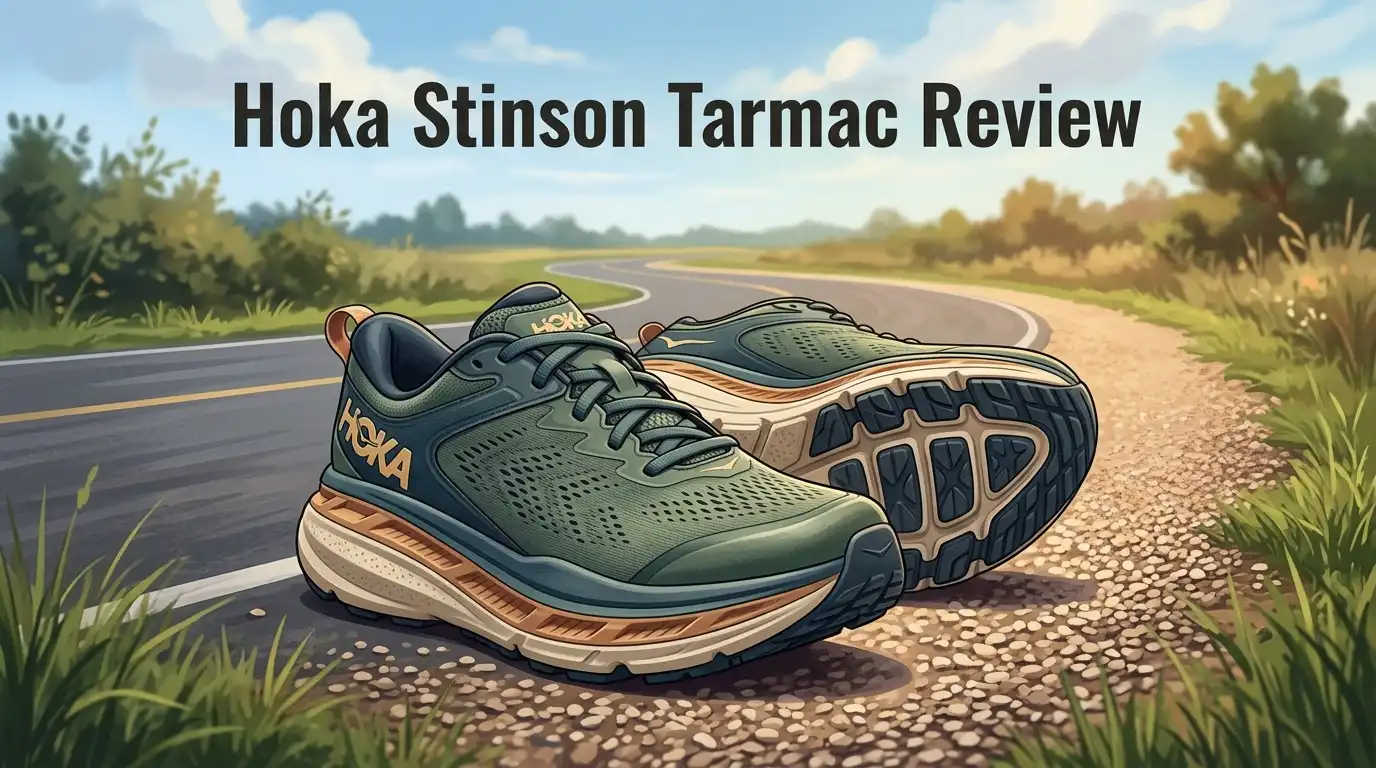
Opening the box produces a genuine reaction. The shoes look larger than the box suggests, and the first thought is usually that cannot be a running shoe. The midsole dominates everything. From the side, the foam looks nearly twice as tall as a standard trainer.
The box itself is plain Hoka cardboard with the mountain logo. Inside you get the shoes, thin paper wrap, and nothing else. No extra laces, no shoe bag, no insole upgrades. For a premium price, the packaging feels bare.
Pick the shoes up and the weight registers immediately in your hand. They feel dense and solid rather than airy. The quick pull lace system sits ready to go, so the first fit takes about four seconds. That small detail still feels clever in 2026.
Design And Build Quality
The upper uses a densely woven mesh with horizontal overlays rather than vertical ones. This choice matters more than it sounds. Horizontal stitching allows the forefoot to flex instead of locking the foot in place. Seams are reduced to a single line across the toe area, which cuts rubbing and hot spots.
The heel counter is firm and tall. It holds the rearfoot still, which helps anyone who rolls inward during the gait cycle. The toe bumper is reinforced enough to survive curb strikes and parking lot abuse.
Build quality across the shoe feels serious. Glue lines are clean, the collar padding holds its shape, and the lace cage resists stretching. This is not a shoe that falls apart in 200 miles. The materials are old school by modern standards, but they last.


Last update on 2026-04-11 / Affiliate links / Images from Amazon Product Advertising API Some of the links on this website are affiliate links, which means that at no additional cost to you, I earn a commission if you click through and make a purchase. I only recommend products and services that I believe will add value to my readers. Thank you for your support!
Top 3 Alternative for Hoka Stinson Tarmac

- ENGINEERED MESH
- Lining Textile
Last update on 2026-06-07 / Affiliate links / Images from Amazon Product Advertising API Some of the links on this website are affiliate links, which means that at no additional cost to you, I earn a commission if you click through and make a purchase. I only recommend products and services that I believe will add value to my readers. Thank you for your support!
Hoka Men’s Bondi 9
No products found.
Hoka Men’s Clifton 10

- Synthetic, Textile
- Polyurethane
Last update on 2026-10-07 / Affiliate links / Images from Amazon Product Advertising API Some of the links on this website are affiliate links, which means that at no additional cost to you, I earn a commission if you click through and make a purchase. I only recommend products and services that I believe will add value to my readers. Thank you for your support!


Last update on 2026-04-11 / Affiliate links / Images from Amazon Product Advertising API Some of the links on this website are affiliate links, which means that at no additional cost to you, I earn a commission if you click through and make a purchase. I only recommend products and services that I believe will add value to my readers. Thank you for your support!
Hoka Men’s Stinson 7
Cushioning And Ride Feel
The midsole is the entire reason this shoe exists. Hoka used a soft EVA compound in an oversized volume, then shaped it with a gentle rocker. You land, the foam compresses, and the curved sole rolls you forward.
Lab testing on the newer Stinson models shows above average shock absorption with below average energy return. That tells the real story. This platform protects your joints but does not spring you forward. The Tarmac behaves the same way.
The rocker takes two or three runs to learn. Once your stride adapts, the motion feels smooth and almost automatic. Heel strikers adapt fastest. Forefoot runners sometimes find the ride awkward because the forefoot foam sits lower and firmer than the heel.
Softness holds up in cold weather reasonably well, though EVA always stiffens somewhat below freezing.
Fit And Sizing Guide
The Tarmac fits close to true to size in length for most people. The deep bucket seat midsole creates a snug sensation around the arch and midfoot, which some runners love and others find tight.
The forefoot is narrower than the Bondi of the same era. Hoka did this on purpose to stop forefoot cramping on pavement. If you have wide feet, order a half size up or look at the newer Stinson 8, which measures notably roomier in the toebox.
The quick pull laces tighten evenly and stay put. The tongue has moderate padding and does not bite the instep. Thick socks reduce the already modest volume, so test your usual sock before deciding on size. Heel lock is excellent thanks to the stiff counter and well shaped collar.
Weight And Stack Height Numbers
Numbers explain a lot about this shoe. The Stinson Tarmac weighs about 11.8oz in a men’s size 9 and uses a 5.5mm heel to toe drop. That weight sat high even in 2012, and it sits high today.
For context, the Stinson 7 came in at roughly 12.1oz, and the Stinson 8 trimmed that to about 11.3oz with a 41.9mm heel stack and 33.3mm forefoot stack. The family has always traded weight for protection.
Independent measurement often shows the real drop closer to 8mm than the stated figure, because Hoka measures the forefoot nearer the midfoot. That extra effective drop suits heel strikers and anyone with tight calves. Runners who want a low and natural feel should walk away now.
Outsole Grip On Road And Light Trail
The Tarmac outsole is smooth with no lugs. Blue rubber zones cover the high wear areas, and the heel uses a decoupled design that softens initial contact. On dry pavement, grip is confident and quiet.
Gravel bike paths, packed dirt, and crushed limestone all work fine. The wide base gives genuine downhill confidence because the shoe simply refuses to tip. Wet grass, mud, and slick rock are a different story. The flat rubber slides, and the stiff platform gives no feedback before it slips.
Recent lab testing on the Stinson 8 measured forefoot traction at 0.59 against a 0.67 average, and that model still uses Hoka’s own rubber rather than Vibram. The lesson applies to the whole line. Grip is the weakest engineering area.
Who Should Buy The Hoka Stinson Tarmac
This shoe suits specific people extremely well. Heavier runners get a platform that does not bottom out. Overpronators get support without a hard medial post digging into the arch. People with knee or hip pain get shock attenuation that often makes daily movement tolerable again.
Nurses, warehouse staff, teachers, and anyone standing for ten hours get real value here. The foam volume and wide base reduce fatigue in a way thinner shoes cannot match.
Ultra runners and long distance walkers also benefit. The shoe protects your legs deep into hour five or six, which matters more than speed in those events.
Skip it if you are a light and efficient runner chasing personal records, or if you train mostly on technical mountain trails. The weight and grip will frustrate you quickly.
What The Hoka Stinson Tarmac Does Not Do Well
Honest reviews list failures, so here they are.
The shoe is heavy. You notice it on every stride and especially on hills. Picking up the pace feels like dragging weights.
Energy return is poor. Modern foams like supercritical nitrogen injected midsoles bounce far better. The Stinson platform absorbs and dampens instead. Fast running feels dead.
Grip is mediocre on anything slick. The flat rubber was never meant for wet surfaces.
The shoe is extremely stiff. Torsional rigidity on newer Stinson models measured near the top of the entire test pool. Your foot does not move much inside this shoe, which some runners find restrictive.
Ventilation is average. The dense mesh traps heat on summer afternoons. Reflective detailing is nearly absent, which is a miss for a shoe aimed at early morning walkers.
Pros And Cons
Here is the balanced summary.
Pros
- Outstanding impact protection that keeps legs fresh the next day
- Very wide and stable base that controls overpronation without a medial post
- Smooth progressive rocker that rolls you forward once learned
- Durable upper with reinforced overlays and clean construction
- Quick pull lace system that dials in fit in seconds
- Comfortable for long standing shifts, walking, and recovery mileage
- Strong outsole wear resistance over high mileage
Cons
- Heavy at roughly 11.8oz, which limits pace and agility
- Low energy return from basic EVA foam
- Weak traction on wet rock, mud, and snow
- Very stiff platform with little natural foot movement
- Narrow forefoot compared with newer Stinson versions
- Discontinued, so sizes and colors are hard to find
- Minimal reflective elements and average breathability
Hoka Stinson Tarmac Vs Stinson 8
The Stinson 8 is the modern answer, and it differs in meaningful ways. It carries a 41.9mm heel stack, a dual density midsole with a softer bottom layer and firmer top layer, and a much wider toebox measuring around 77.6mm. Wide footed runners will prefer the 8 immediately.
The 8 also drops weight to about 11.3oz and adds 3.3mm lugs, which makes it a road to trail hybrid rather than a pure pavement shoe. Traction improves on dirt but still trails Vibram equipped rivals.
The Tarmac keeps one advantage. Its smooth outsole rides quieter and cleaner on pure asphalt. If you only run roads, the older design feels more natural underfoot. If you mix surfaces, the Stinson 8 is the smarter purchase at around $180.
Durability And Long Term Performance
Durability is a genuine strength. The outsole rubber on this family resists wear well, with lab testing on the Stinson 8 showing only 0.7mm of damage against a 0.9mm average. The Tarmac behaves similarly because it uses the same philosophy of full coverage rubber.
The EVA midsole is the limiting factor. Expect the foam to lose noticeable softness between 350 and 450 miles. Walkers often get more than 500 miles because impact forces are lower.
Upper failures are rare. The horizontal overlays and single toe seam hold up far better than lightweight knit uppers. Heel collar padding is the most common wear point, usually showing fraying after heavy use. Keep an eye on midsole creasing, since deep lines signal the foam has given up.
Price And Where To Buy In 2026
Pricing is complicated because the Tarmac is discontinued. Remaining pairs appear through third party sellers, clearance outlets, and secondhand listings. Prices range widely, and rare sizes command a premium from collectors.
Current Stinson models sit at $175 for the Stinson 7 and around $180 for the Stinson 8. That price sits above the $160 trail shoe average, which is hard to justify given the basic EVA foam and non Vibram outsole.
My advice is simple. Buy the Tarmac only if you loved the original and found your exact size at a fair price. Everyone else should buy the current Stinson, or save money with a Bondi 9 for pure road use. Watch holiday sales, since Hoka discounts older colorways aggressively.
Care And Maintenance Tips
Good care extends the life of this shoe. Remove the insole and let it dry separately after wet runs. Never put the shoes in a dryer, because heat destroys EVA foam structure and glue bonds.
Clean the upper with cool water, mild soap, and a soft brush. The mesh releases dirt easily. Hoka lists this style as machine washable, but hand cleaning is gentler and produces the same result.
Rotate your pairs if you run more than 30 miles per week. Foam needs 24 hours to rebound fully, and rotation adds real mileage to both shoes.
Store them indoors at room temperature. Cold garages stiffen the midsole, and direct sunlight fades and weakens the upper fabric. Replace laces rather than the whole shoe when the quick pull cord frays.
Final Verdict
The Hoka Stinson Tarmac earns respect rather than excitement. It protects your joints, holds you steady, and keeps working long after lighter shoes collapse. For heavy runners, overpronators, long shift workers, and anyone managing knee pain, that combination is worth real money.
The shoe also has clear limits. It is heavy, stiff, slow, and slippery on wet ground. The foam technology is a generation behind current supercritical midsoles.
My rating is 4 out of 5 for comfort focused buyers and 2.5 out of 5 for performance runners. If you can find your size at a discount, grab it. If not, the Stinson 8 delivers the same protection with a roomier fit and better versatility.
FAQs
Is the Hoka Stinson Tarmac still available in 2026?
No, Hoka discontinued the Tarmac years ago. You can still find pairs through third party sellers and clearance channels, but sizes and colors are limited. The Stinson 7 and Stinson 8 are the current replacements.
Does the Stinson Tarmac run true to size?
It runs true to size in length for most feet. The forefoot is narrower than newer Stinson models, so wide footed runners should order a half size up or choose the Stinson 8 instead.
Can I use the Stinson Tarmac on trails?
Yes, on easy trails. Dry dirt, gravel, and crushed stone work well. The smooth outsole has no real lugs, so skip mud, wet rock, and technical mountain terrain.
How many miles does the Stinson Tarmac last?
Expect 350 to 450 miles of running before the EVA midsole softens noticeably. Walkers often reach 500 miles or more because impact forces are lower.
Is the Stinson Tarmac good for plantar fasciitis or knee pain?
Many users report relief thanks to the deep cushioning, stiff platform, and stable wide base. Results vary by person, so speak with a podiatrist about your specific condition before relying on footwear alone.
How much does the Hoka Stinson Tarmac weigh?
It weighs roughly 11.8oz in a men’s size 9 with a 5.5mm heel to toe drop. That makes it a heavy trainer by modern standards.
Is the Stinson Tarmac machine washable?
Hoka lists the style as machine washable, but hand cleaning with cool water and mild soap is safer. Always air dry, since heat damages the midsole foam.

Mia Smith is the founder of Shoe Storyteller, a blog that celebrates the art and stories behind shoes. With a passion for fashion and a flair for storytelling, Mia brings a unique perspective to the world of footwear.