
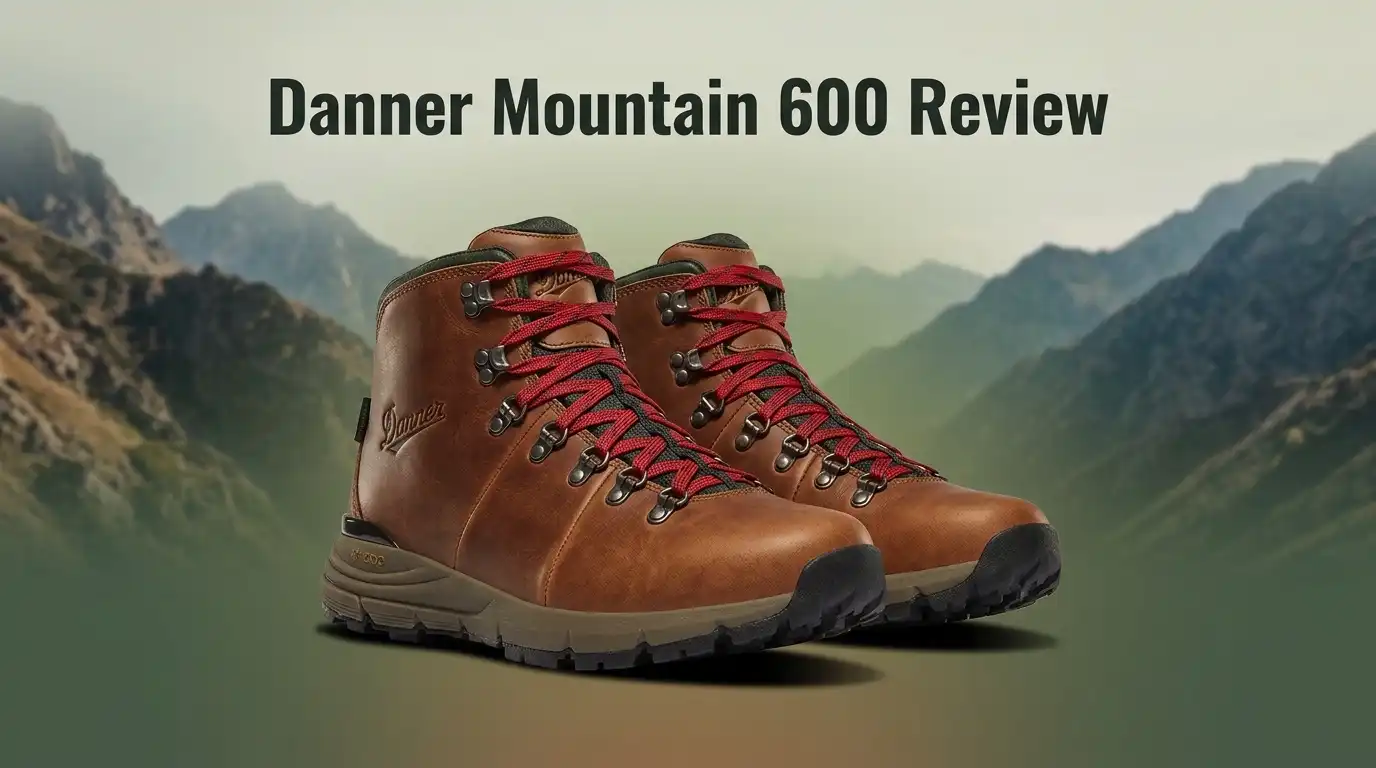
Danner Mountain 600 Review 2026: Still Worth It?
The Danner Mountain 600 sits in a strange sweet spot. It looks like a heritage boot from a 1980s Cascades trailhead, yet it walks like a modern cushioned hiker. That combination has kept it on shelves for a decade while dozens of trail boots came and went.
I have laced these boots for muddy morning walks, rocky day hikes, airport days, and long afternoons standing on concrete. They earned real praise and real frustration. This review covers both sides with actual numbers, honest weak points, and clear buying advice for 2026.
If you want one boot that handles trails on Saturday and errands on Monday, keep reading. If you want a technical mountaineering platform, you will learn quickly why this is not that boot.
In A Nutshell:
- Comfort arrives immediately. The Vibram SPE midsole and soft footbed feel broken in on day one. Most hikers report zero break in period, which is rare for a leather boot at this height.
- Style is a genuine feature, not a bonus. The suede upper and clean stitching look sharp with jeans. Many buyers wear these more in town than on trail, and that is a fair use of the money.
- Waterproofing works well in cool weather. The Danner Dry lining blocks puddles, wet grass, and steady rain. Breathability scores low though, so warm summer hikes get sweaty fast.
- Traction is good, not elite. The Vibram Fuga outsole uses 4 mm lugs. It grips packed dirt, gravel, and moderate rock. It slips on wet slabs, deep mud, and loose scree.
- Weight is average at roughly 18.7 oz per boot. That is heavier than trail runners and lighter than heavy backpacking boots.
- Weak spots are real. Thin heel padding, a shallow toe box ceiling, no reflective details, and mixed reports about long term waterproofing after heavy mileage.
Danner Mountain 600

- WATERPROOF hiking boots featuring 100% waterproof Danner Dry barrier, allowing moisture to escape...
- DURABLE men’s hiking boots with smooth suede uppers built to last on the trail, and coming with...
- ORTHOLITE triple-density polyurethane hiking boot footbed for maximum comfort and support. Open-cell...
Last update on 2026-09-08 / Affiliate links / Images from Amazon Product Advertising API Some of the links on this website are affiliate links, which means that at no additional cost to you, I earn a commission if you click through and make a purchase. I only recommend products and services that I believe will add value to my readers. Thank you for your support!
The Mountain 600 is a 4.5 inch waterproof hiking boot built around a suede or nubuck leather upper. Danner introduced it as a modern take on the classic Mountain Light silhouette. The idea was simple. Keep the heritage look. Drop the weight. Add cushioning.
The recipe includes a Vibram SPE midsole, a rubberized EVA compound that adds cushion without much mass. Under that sits a Vibram Fuga outsole with megagrip rubber and a self cleaning lug pattern. Inside, a triple density Ortholite footbed supports the arch and wicks moisture. A full gusseted tongue seals out grit.
Danner lists the weight at 36 oz per pair. Lab testing puts a single boot at 18.7 oz, or 529 grams. Heel stack measures 36.8 mm, forefoot stack measures 23 mm, and the drop lands near 13.8 mm. Those figures sit almost exactly on the category average, which explains why the boot feels so agreeable to so many feet.
The most interesting spec is not a number. The Mountain 600 is recraftable. Danner can rebuild the boot with a new outsole and midsole when the original wears through. That single detail changes the value math for anyone who hikes often.
Colors range from Rich Brown and Brown/Red to Jet Black and Chocolate Chip. A 200G insulated version exists for cold months, plus the Mountain 600 Leaf GTX for tactical use.
Unboxing Experience: What Arrives In The Box
The box is plain brown cardboard with the Danner stitch logo. No plastic clamshell, no foam inserts, no glossy marketing card. That restraint fits the brand.
Inside, both boots sit in thin tissue paper with cardboard toe stuffers. Laces come pre threaded through every eyelet and hardware loop, which saves five minutes of fiddling. A small hangtag explains the recrafting program. That is the whole package.
First impression: the suede feels softer than expected. Heritage boots usually arrive stiff enough to stand up on their own. The Mountain 600 flexes in the hand right away. The nap on the leather is even, and the stitching around the toe cap looked clean on my pair with no loose threads.
The smell is pure leather and rubber cement, that familiar new boot scent. Weight in hand surprised me. It felt lighter than the tall shaft suggested, though not featherlight.


Last update on 2026-04-11 / Affiliate links / Images from Amazon Product Advertising API Some of the links on this website are affiliate links, which means that at no additional cost to you, I earn a commission if you click through and make a purchase. I only recommend products and services that I believe will add value to my readers. Thank you for your support!
One small letdown. There is no spare set of laces and no shoe bag, which some competitors include at this price. Danner also does not include a leather conditioner sample, and suede genuinely benefits from treatment before the first wet hike.
I slid my foot in without loosening the laces much. The heel dropped into place with a soft thud. No pinching, no pressure points, no stiff collar digging into the ankle. That is the moment most people fall for this boot, and it happens within thirty seconds of opening the box.
Design And Build Quality
The Mountain 600 uses a cemented construction rather than a stitchdown welt. That keeps weight down and lets the sole flex naturally. Traditionalists may prefer the old stitchdown method, yet cemented builds can still be resoled through Danner’s recrafting service.
The upper is a single large panel of suede across each side, which reduces seams and reduces leak points. Fewer seams means fewer failure spots. Lab abrasion testing on the toe box earned a perfect score, so the front of the boot resists rock scuffing well.
Hardware includes metal eyelets low on the boot and two open hooks up top. The hooks speed up lacing and let you lock the ankle in place. They also snag on brush and pant cuffs, which annoyed me on overgrown trails.


Last update on 2026-04-11 / Affiliate links / Images from Amazon Product Advertising API Some of the links on this website are affiliate links, which means that at no additional cost to you, I earn a commission if you click through and make a purchase. I only recommend products and services that I believe will add value to my readers. Thank you for your support!
The tongue is fully gusseted on both sides. Padding there measures only 5.9 mm, well below average, yet I never felt lace bite across the instep. The perforated tongue mesh is the only breathable panel on the whole boot.
Torsional rigidity scored 5 out of 5 in lab twisting tests. The boot barely budges by hand. That stiffness helps on uneven ground because the sole refuses to fold over roots and rocks. The heel counter scored 4 out of 5 for stiffness, holding the foot steady without feeling like a cast.
Overall build quality feels honest for the price. This is not a hand welted heirloom boot. It is a well assembled modern hiker with heritage looks.
Comfort And Fit Straight Out Of The Box
Comfort is the headline. The Mountain 600 requires almost no break in, which separates it from most leather boots at this height.
The midsole durometer reads 24.3 HA, softer than the 28.6 HA average for hiking boots. Softer foam means gentler landings. Shock absorption measures 99 SA, slightly above average, so rocks and roots feel muted underfoot.
Interior volume runs generous through the forefoot. Gel mold testing put the widest interior point at 94.3 mm and the big toe area at 72.3 mm. Both numbers sit right at average, which means the toe box shape suits normal and slightly wide feet without swimming.
Toe box height is the exception. At 22.9 mm, the ceiling is noticeably shallower than the 27.4 mm average. People with high volume feet, bunions, or thick toenails may feel pressure on the top of the toes during long descents. That is a real fit limitation worth checking in person.
The insole is removable, so custom orthotics drop in easily. The stock triple density footbed offers moderate arch support, enough for most feet but not enough for severe overpronation.
Heel hold impressed me on climbs. My heel stayed planted with normal lacing. Debris entry is a minor gripe because the collar flares slightly at the back, and small gravel found its way inside on dusty trails. Gaiters solve that if it bothers you.
Top 3 Alternative for Danner Mountain 600

- Waterproof membrane seals out water and lets moisture escape Pigskin leather and mesh upper...
- Merrell is focused on merging performance, styling, and comfort to empower all people to confidently...
- Merrell Air Cushion in the heel absorbs shock and adds stability
Last update on 2026-06-08 / Affiliate links / Images from Amazon Product Advertising API Some of the links on this website are affiliate links, which means that at no additional cost to you, I earn a commission if you click through and make a purchase. I only recommend products and services that I believe will add value to my readers. Thank you for your support!
Merrell Men’s Moab 3 Mid Waterproof Hiking Boot
No products found.
KEEN Men’s Targhee III Mid Height Waterproof Hiking Boot

- FULL-GRAIN LEATHER UPPER - To ensure its quality, we put our leather through six different tests...
- GORE-TEX - Waterproof combining outdoor performance and environmental responsibility. These liners...
- TWO LACE OPTIONS - Because you can never have too many laces, this pair comes with both round and...
Last update on 2026-09-08 / Affiliate links / Images from Amazon Product Advertising API Some of the links on this website are affiliate links, which means that at no additional cost to you, I earn a commission if you click through and make a purchase. I only recommend products and services that I believe will add value to my readers. Thank you for your support!
Danner Men’s Mountain 600 EVO Hiking Boot
Waterproofing And Wet Weather Performance
Danner uses its own Danner Dry waterproof membrane in the standard Mountain 600. This is a proprietary lining rather than Gore Tex. The Leaf GTX and EVO models use Gore Tex instead.
In practice, Danner Dry works. I walked through soaked morning grass, shallow creek crossings, and two hours of steady rain with dry socks at the end. The fully gusseted tongue and 4.5 inch shaft height keep water out up to roughly ankle depth. Anything deeper spills over the collar, as it would with any mid height boot.
The suede upper is the variable here. Untreated suede absorbs water and darkens, and a soaked upper feels heavier and takes long to dry. Apply a suede protector before your first wet outing. This step matters more than most reviews admit.
Long term reports are mixed. Some owners report the membrane holding strong past two years. Others describe wet toes after a season of heavy use, and a handful mention delamination between the sole and upper. That variability appears in owner forums often enough to mention honestly.
Cold weather performance is solid. Freezer testing showed the midsole firming only 21 percent, close to the category average. The foam does not turn into a brick when temperatures drop, so the boot stays comfortable through fall and winter walking.
Verdict on water: dependable for day hikes, rain, snow, and mud, provided you treat the leather and accept that suede needs drying time.
Traction And Grip On Real Trails
The Vibram Fuga outsole uses a 4 mm lug depth, slightly under the 4.3 mm average. Rubber hardness measures 87 HC, a balanced figure that trades a little grip for a little longevity.
On dry packed dirt, gravel roads, and dry rock, grip is excellent. The lug pattern bites confidently and clears mud better than a flat tread. Downhill braking felt secure on loose dirt, which matters more than uphill grip for most day hikers.
Wet performance is where limits show. On slick granite slabs and wet logs, I felt the sole break loose more than once. Deep sticky mud packs into the shallower lugs and turns the outsole into a skating surface until the mud clears. Snow traction is acceptable on packed trail and poor on ice, which is normal without spikes.
This is a trail boot, not a scrambling boot. If your hikes involve wet slab, talus fields, or steep off trail terrain, a deeper lug boot like the Salomon Quest series serves you better.
Outsole wear testing removed 0.9 mm of rubber under abrasion, slightly worse than the 0.8 mm average. Outsole thickness measured 2.1 mm compared with a 3.0 mm average. Translation: the tread wears faster than the Vibram name suggests. Heavy mileage hikers may see smooth lugs within 400 to 600 miles, which is where the recrafting option becomes valuable.
Around town, the grip is genuinely good on wet pavement and tile.
Weight And Trail Feel
At 18.7 oz per boot, the Mountain 600 lands essentially on the hiking boot average of 18.8 oz. The category ranges from 11.7 oz to 28.3 oz, so this boot sits comfortably in the middle.
How that translates on trail depends on your background. Coming from trail runners, the Mountain 600 feels noticeably heavy and slow. Coming from full leather backpacking boots, it feels almost sporty. Coming from work boots, it feels like a sneaker.
Flex testing needed 34.8 N of force to bend the boot 30 degrees, above the 31.8 N average. That extra stiffness fights foot fatigue on rocky trails because your foot stops wrapping around every stone. The tradeoff is a less natural stride on flat smooth ground.
Energy return measured 46 percent against a 50.5 percent average. The ride is planted rather than springy. You will not feel propelled forward, and that is fine for a hiking boot where stability beats bounce.
Midsole width measured 113.7 mm at the forefoot and 91.2 mm at the heel, both slightly wider than average. A wider platform means a more stable base on side hills and awkward footing.
For day hikes with a light pack, the weight disappears within twenty minutes. For fast moving 20 mile days, you will feel every ounce. Ten to twelve miles with a light load is this boot’s happy zone.
Breathability And Warm Weather Use
Breathability is the Mountain 600’s clearest weakness. Smoke testing gave the boot a 2 out of 5 score. That beats the 1.3 average for waterproof boots, yet it remains poor in absolute terms.
Microscope inspection explained why. The upper is solid slabs of suede with no mesh panels anywhere. Only the perforated tongue lets air move. Air enters and exits through one small window while the rest of the boot stays sealed.
In cool conditions this feels great. Your feet stay warm on 40 degree mornings, and the boot handles fall and winter walking well. Above roughly 75 degrees, the story changes fast.
My feet ran hot and damp on a summer afternoon hike, and sweat has consequences. Damp socks plus friction equals blisters, and long term dampness invites fungal problems. Multiple owners describe exactly this pattern in warm climates.
Two practical fixes help. Wear thin merino socks rather than thick cushioned ones, and remove the boots at breaks to air them out. Neither fix turns a sealed leather boot into a ventilated one.
If you hike mostly in Arizona, Texas, or Florida summers, look at a ventilated non waterproof shoe instead. If you hike the Pacific Northwest, New England, or the Rockies in shoulder seasons, the low breathability becomes an advantage rather than a flaw.
Match the boot to your climate and this issue mostly disappears.
Durability And The Recrafting Program
Durability breaks into three parts, and the Mountain 600 scores differently on each.
The suede upper is tough. Abrasion testing on the toe box earned a perfect 5 out of 5, with the Dremel only smoothing the nap. Rock scuffs and brush will not open up the front of this boot.
The outsole is average. Wear testing showed slightly faster than average rubber loss, and the tread layer is thinner than most competitors. Expect the lugs to round off before the upper shows serious age.
The interior heel is the weak link. Heel padding durability scored just 2 out of 5 against a 3.6 average. The lining tore quickly and the thin padding pulled out under abrasion. In real terms, that means heel lining blowout is the most likely failure point after heavy mileage. Owner reports back this up.
Here is where the recrafting program matters. Danner rebuilds the boot at its Portland factory with a new midsole and outsole. Cost runs well below a new pair. A recraftable boot that lasts three cycles beats three disposable boots on both money and waste.
Owners also mention occasional delamination and stitching issues. Danner’s warranty response gets generally positive marks, though experiences vary. Treat the leather, dry the boots slowly away from direct heat, and you will likely land on the better end of the durability spread.
Sizing Guide And Width Options
Sizing runs true to size for most people, confirmed by both lab fit testing and large owner samples. Order your normal athletic shoe size and you will usually be right.
Two exceptions matter. If you sit between sizes, Danner recommends sizing down a half size. If you plan to wear thick winter socks or hike long descents, staying at your true size gives you needed toe room.
Width options are a genuine strength. The standard fit is D medium for men and B medium for women. Danner also offers EE wide in many colorways, and select models come in extra wide. That range beats many competitors who offer one width and nothing more.
The last shape suits average to slightly wide feet best. Narrow feet may find heel slip and need a thicker sock or an aftermarket insole to take up volume. High volume feet should test the toe box ceiling carefully, since the 22.9 mm toe height is the shallowest measurement on the boot.
Lacing technique fixes several complaints. Use the metal eyelets to set forefoot volume, then lock the top hooks tight to hold the heel. A surgeon’s knot at the ankle transition stops heel lift on climbs.
Try them on in the afternoon when your feet have swelled. That single habit prevents most sizing regret with any hiking boot.
What The Danner Mountain 600 Does Not Do Well
Honest reviews name the failures, so here they are without softening.
It does not carry heavy loads. The midsole is soft and the shank support is modest. Load a 40 pound pack and your feet will fatigue long before the boot does. Multi day backpacking calls for a firmer platform.
It does not breathe in heat. Summer hikes above 75 degrees produce damp socks and blister risk. This is the single most common complaint from real owners.
It does not grip wet rock reliably. Shallow lugs and moderate compound hardness give up traction on slabs, wet logs, and steep mud.
It does not protect the interior heel. Thin padding and weak lining abrasion resistance make heel blowout the likeliest long term failure.
It does not suit narrow or very high volume feet. The generous forefoot combined with a low toe ceiling creates an odd fit profile that not everyone matches.
It does not include reflective details. Zero reflectivity means road walking at dusk requires extra visibility gear.
It does not survive neglect. Untreated suede soaks water, and heat drying cracks leather and weakens adhesives.
One more point that gets glossed over. Waterproofing longevity varies between pairs. Some owners get years of dry feet while others report leaks within a season. That inconsistency is a fair reason to buy from a retailer with easy returns and to register any warranty claim early.
Pros And Cons
Pros
- Immediate comfort with no break in period, thanks to a soft Vibram SPE midsole and a cushioned triple density footbed
- Heritage styling that works off trail, so one pair covers hiking, travel, and casual wear
- Recraftable construction that lets Danner rebuild the sole instead of forcing a full replacement
- Excellent torsional rigidity at 5 out of 5, giving a stable platform on uneven ground
- Outstanding toe box abrasion resistance, scoring a perfect 5 out of 5 in lab testing
- Wide range of width options including EE wide, plus insulated and Gore Tex variants
- Consistent cold weather performance with only 21 percent midsole firming in freezing conditions
- Removable insole that accepts custom orthotics without crowding
Cons
- Poor breathability at 2 out of 5, causing sweat and blister risk in warm weather
- Shallow toe box height at 22.9 mm, which pressures high volume feet and thick toenails
- Thin heel lining and padding scoring only 2 out of 5 for durability
- Modest wet rock and mud traction from 4 mm lugs on a thin 2.1 mm outsole layer
- Mixed long term waterproofing reports, with some owners describing leaks after a season
- No reflective elements anywhere on the boot
- Not built for heavy backpacking loads because of the soft midsole and light shank support
- Suede needs regular treatment, adding a maintenance step that nubuck haters will dislike
Price And Value In 2026

- WATERPROOF hiking boots featuring 100% waterproof Danner Dry barrier, allowing moisture to escape...
- DURABLE men’s hiking boots with smooth suede uppers built to last on the trail, and coming with...
- ORTHOLITE triple-density polyurethane hiking boot footbed for maximum comfort and support. Open-cell...
Last update on 2026-09-08 / Affiliate links / Images from Amazon Product Advertising API Some of the links on this website are affiliate links, which means that at no additional cost to you, I earn a commission if you click through and make a purchase. I only recommend products and services that I believe will add value to my readers. Thank you for your support!
The Mountain 600 typically retails between 200 and 230 dollars depending on color and version. Insulated and Gore Tex variants run higher. Sales appear regularly, and discontinued colorways drop meaningfully below list price.
At full price, the value depends entirely on how you use the boot. As a pure trail tool, competitors offer more grip and better ventilation for less money. The Merrell Moab 3 costs less and breathes far better. The KEEN Targhee III offers a roomier toe box at a similar price.
As a dual purpose boot, the math shifts. You are buying a hiker that genuinely looks good in a coffee shop, and very few trail boots manage that. If these replace both a hiking boot and a casual boot, the cost per wear drops fast.
The recrafting program adds real value. A rebuild costs a fraction of a new pair and extends the life of an upper that resists abrasion well. Two rebuild cycles turn a 220 dollar boot into a five year or longer investment.
Made in Portland status applies to some Danner lines, though the Mountain 600 is imported. Buyers hoping for American assembly should check the specific model before ordering.
Buy at full price if the style matters to you. Wait for a sale if you only care about trail performance. Both positions are reasonable.
Who Should Buy The Danner Mountain 600
Buy it if you are a day hiker who wants comfort from the first mile without a painful break in stretch. This boot delivers that better than almost anything at its height.
Buy it if you hike in cool or wet climates. Fall in New England, spring in Oregon, winter walking in the Midwest. The sealed leather upper and Danner Dry lining shine when temperatures stay moderate.
Buy it if you want one boot for multiple jobs. Trail on Saturday, brewery on Saturday night, dog walk on Sunday, office on Monday if your office allows boots.
Buy it if you value repairability. The recrafting program is a genuine differentiator in a category full of disposable footwear.
Skip it if you hike in summer heat. The breathability score is not a nitpick. It is a daily comfort problem in warm weather.
Skip it if you carry heavy packs. Multi day loads need firmer support than this soft midsole provides.
Skip it if your terrain is technical. Wet slab, scree, and steep off trail travel demand deeper lugs and a stiffer shank.
Skip it if you have very high volume feet. The low toe box ceiling is the fit dealbreaker most people discover too late.
Skip it if you want the lightest option. Trail runners weigh half as much, and modern light hikers offer similar cushioning at lower mass.
Care And Maintenance Tips
Suede care determines how long this boot lasts. Treat the leather before the first wet outing, not after.
Step one: brush off dry dirt with a stiff suede brush after every hike. Dried mud pulls moisture from leather and wears down the nap.
Step two: apply a suede and nubuck protector every eight to ten wet outings. Products with a spray application coat evenly without matting the nap. Avoid heavy waxes, which flatten suede permanently.
Step three: dry slowly. Remove the insoles, loosen the laces, and let the boots air dry at room temperature. Newspaper stuffed inside speeds the process. Never place these boots near a fireplace, heater vent, or in direct sun. Heat shrinks leather, cracks the surface, and weakens the adhesives that hold the sole on.
Step four: rotate your footwear. Boots need 24 hours to fully dry inside. Wearing the same pair daily keeps the lining damp and shortens its life.
Step five: watch the heel lining. This is the known weak point. Check it monthly and address fraying early with a heel patch before the padding escapes.
Step six: replace the insole yearly if you hike often. A 20 dollar insole restores most of the original underfoot feel.
Send the boots for recrafting once the lugs round off rather than waiting for total failure. A worn but intact upper rebuilds beautifully. A cracked upper does not.
Final Verdict
The Danner Mountain 600 is a very good boot with clearly defined limits. It nails comfort, looks, and versatility. It falls short on breathability, wet rock traction, and interior heel durability.
Buy it for day hiking in cool weather and casual wear the rest of the week. In that role, few boots feel this good this quickly while looking this sharp.
Do not buy it as a backpacking boot, a summer desert boot, or a technical scrambling boot. Other models handle those jobs better, and the Mountain 600 will frustrate you if you force it.
My honest summary after real use: this is the boot I reach for when I want to enjoy a hike rather than conquer one. That is a compliment, and it is also a boundary.
FAQs
Does the Danner Mountain 600 run true to size?
Yes. Both lab fit testing and large owner samples confirm true to size fit. Order your normal athletic shoe size. If you fall between sizes, Danner recommends sizing down a half size. Wide EE options exist for broader feet.
Is the Danner Mountain 600 waterproof?
Yes. The standard model uses the Danner Dry proprietary waterproof membrane along with a fully gusseted tongue. It handles rain, wet grass, mud, and shallow crossings well. Water enters over the 4.5 inch collar in deeper water, and some owners report reduced waterproofing after heavy long term use.
How long do Danner Mountain 600 boots last?
Most owners get 500 to 1,000 miles before the outsole lugs wear smooth. The suede upper typically outlasts the sole. The interior heel lining is the most common early failure point. Recrafting extends total lifespan considerably by replacing the midsole and outsole.
Can you resole the Danner Mountain 600?
Yes. The boot is recraftable through Danner’s factory service. Danner installs a new midsole and outsole for a fee well below the cost of a new pair. The upper must still be in serviceable condition for recrafting to work.
Is the Mountain 600 good for backpacking?
For light overnight trips with a small pack, yes. For multi day trips with loads above roughly 30 pounds, no. The soft midsole and modest shank support lead to foot fatigue under heavy weight. A firmer backpacking boot serves better there.
What is the difference between the Mountain 600 and the Mountain 600 EVO?
The EVO adds a Gore Tex waterproof liner, a TPU shank for extra stability, and a more aggressive outsole pattern. It targets rougher terrain. The standard 600 stays lighter, softer, and more casual in appearance.
Does the Danner Mountain 600 need breaking in?
Almost none. The soft Vibram SPE midsole and cushioned footbed feel comfortable on day one. Most owners report wearing them straight out of the box for full hikes without blisters.
Are these boots good for wide feet?
Yes for wide feet, with one caveat. The forefoot width is generous and EE wide options are available. Toe box height is shallow at 22.9 mm, so high volume feet and thick toenails may feel pressure on top.
Can you wear the Mountain 600 for everyday casual use?
Absolutely, and many owners do. The suede upper and heritage silhouette look good with jeans and chinos. Grip on wet pavement is solid, and the cushioning handles long standing days on concrete well.
How should you clean suede Danner boots?
Brush off dry dirt with a suede brush, spot clean with a suede eraser, then reapply a suede protector spray. Air dry at room temperature away from heat sources. Avoid soaking, waxes, and machine washing.

Mia Smith is the founder of Shoe Storyteller, a blog that celebrates the art and stories behind shoes. With a passion for fashion and a flair for storytelling, Mia brings a unique perspective to the world of footwear.