Hoka Mach 7 Review 2026: Still Fast?
The Hoka Mach 7 arrived with a quiet confidence. It did not shout about new foam or a carbon plate. It simply kept the recipe that made the Mach line a runner favorite and sharpened a few edges.
I put serious road miles on this shoe across easy jogs, tempo sessions, and a few rainy commutes. This review shares what the Mach 7 does brilliantly, what it fumbles, and who should skip it.
If you want a light daily trainer that can still stretch its legs, keep reading. The details below will save you money and regret.
In a Nutshell:
- The weight is the headline. My men’s size 9 pair landed near 7.9 oz (224 g). That is far under the daily trainer average. The shoe disappears on foot during easy miles and never feels like a chore at the end of a long run.
- The supercritical EVA foam leans firm. Durometer testing puts it around 41.7 AC, which is firmer than most modern trainers. Runners who crave pillow softness will not love it. Runners who want control and ground feedback will.
- The new creel jacquard upper is excellent. Breathability scored 96 BR in lab testing, well above the 72 BR average. Hot summer runs stay dry and blister free.
- Grip improved in a big way. Traction jumped from 0.49 on the Mach 6 to 0.73 on the Mach 7. Wet pavement and painted crosswalks feel secure now.
- Fit runs narrow and slightly short. Wide footed runners should size carefully or shop elsewhere. The toebox has good height but limited width.
- Price sits at $145. That is below the $157 average for premium trainers, which makes the value story strong for 2026 buyers.
Hoka Mach 7 Overview
No products found.
The Mach 7 is Hoka’s lightweight neutral daily trainer. It sits between the plush Clifton and the race focused Cielo in the brand lineup. Hoka lists the stack at 37 mm heel and 32 mm forefoot for men, with 35 mm and 30 mm for women. The stated drop is 5 mm, though independent lab measurements land closer to 9 mm.
The midsole uses supercritical EVA, the same foam that carried the Mach 6. Hoka did not chase a foam revolution here. Instead the brand refined the upper, reshaped the outsole rubber, and trimmed a bit of weight.
The result feels familiar in the best way. You get a firm, springy, rockered ride that suits runners who log five to forty miles a week. The Mach 7 is a one shoe solution for many people, especially newer runners who do not want a rotation. It handles recovery jogs, steady runs, and Tuesday intervals without complaint.
Unboxing the Hoka Mach 7
The box arrived in Hoka’s standard white and black packaging. Nothing fancy. Lift the lid and you find two shoes wrapped in thin tissue paper, plus a small card with care instructions. No extra laces. No shoe bag. Hoka keeps it simple.
My first reaction was surprise at how light the pair felt in hand. Picking up a Mach 7 feels closer to holding a racing flat than a daily trainer. The foam looks dense and tight, not airy.
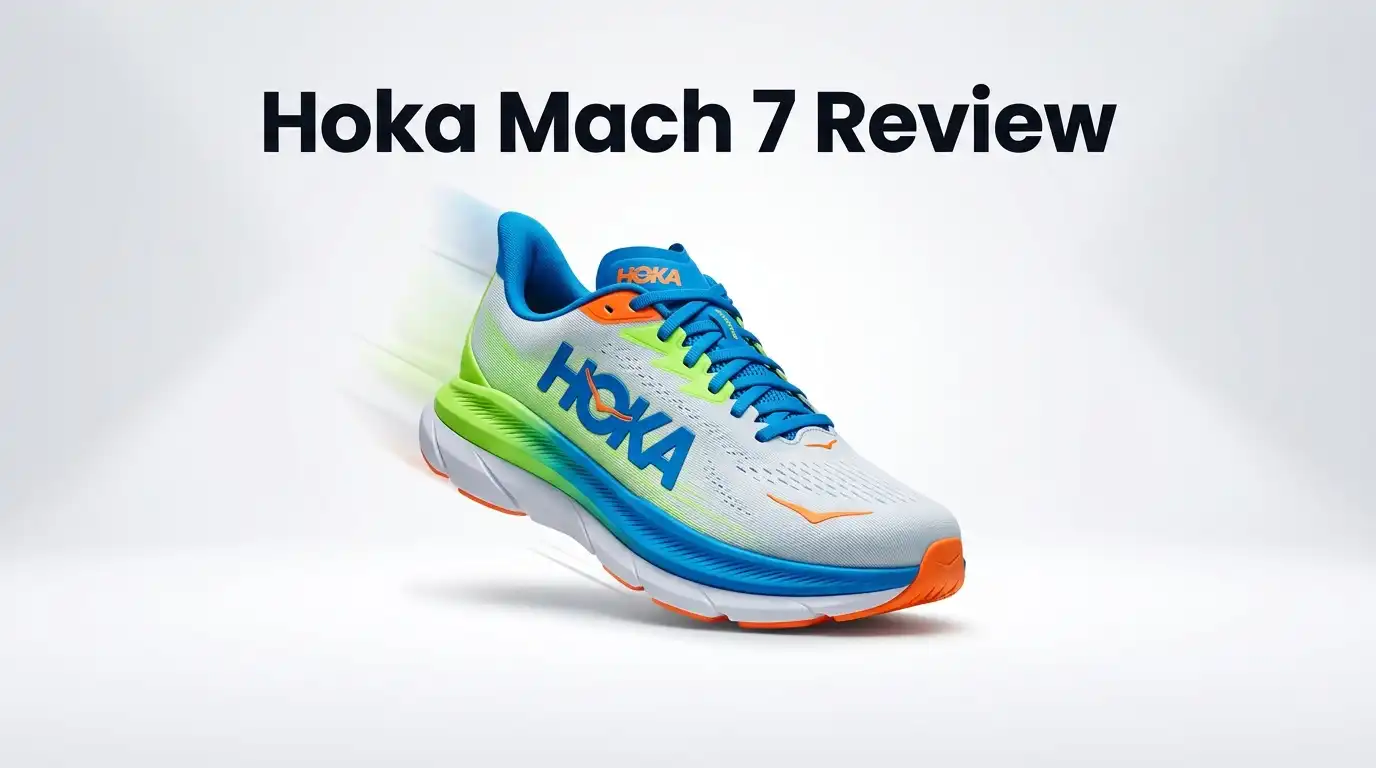
The colorway I received popped more than expected. Recent Mach models looked plain, but this one has real personality with contrast stitching and a clean heel logo. Step in comfort is average rather than luxurious. The tongue measures barely 3.1 mm thick, so there is no plush sneaker feel. The heel collar padding is thin too. This shoe announces itself as a running tool, not a lifestyle sneaker. That honesty set my expectations correctly before the first run.
Design and Build Quality
Hoka built the Mach 7 around restraint. The midsole sidewalls rise slightly under the arch to cradle the foot. The forefoot rocker curves early, which pushes you forward through toe off. Hoka is known for aggressive rockers, and this one feels smooth rather than pushy.
Torsional rigidity measures about 13.6 Nm, close to the category average. Longitudinal stiffness sits near 14.2N. Both numbers tell the same story. Hoka avoided extremes on purpose.
The heel counter is the one exception. It scored a maximum 5 out of 5 for stiffness in testing. That rigid cup locks the rearfoot in place and makes the Mach 7 the most heel striker friendly shoe in the series so far. Runners with sensitive Achilles tendons should take note, because that stiffness can create pressure on the first few runs.


Last update on 2026-04-11 / Affiliate links / Images from Amazon Product Advertising API Some of the links on this website are affiliate links, which means that at no additional cost to you, I earn a commission if you click through and make a purchase. I only recommend products and services that I believe will add value to my readers. Thank you for your support!
Reflective elements sit on the heel, which helps during early morning or evening runs. Small detail, real value.
Top 3 Alternative for Hoka Mach 7

- Smooth MetaRocker, Engineered Mesh Upper
- Inherently Durable Abrasion Rubber Outsole
- Rearfoot-Focused Active Foot Frame
Last update on 2026-09-24 / Affiliate links / Images from Amazon Product Advertising API Some of the links on this website are affiliate links, which means that at no additional cost to you, I earn a commission if you click through and make a purchase. I only recommend products and services that I believe will add value to my readers. Thank you for your support!
Hoka Clifton 11

- Engineered jacquard upper that offers stretch, ventilation, and durability
- Reflective details or visibility in low-light settings
- Tongue wing construction
Last update on 2026-06-07 / Affiliate links / Images from Amazon Product Advertising API Some of the links on this website are affiliate links, which means that at no additional cost to you, I earn a commission if you click through and make a purchase. I only recommend products and services that I believe will add value to my readers. Thank you for your support!
ASICS Novablast 5


Last update on 2026-04-11 / Affiliate links / Images from Amazon Product Advertising API Some of the links on this website are affiliate links, which means that at no additional cost to you, I earn a commission if you click through and make a purchase. I only recommend products and services that I believe will add value to my readers. Thank you for your support!
No products found.
Hoka Mach 6
Midsole Foam and Cushioning
The supercritical EVA returns unchanged, and that decision defines the shoe. Shock absorption measured 137 SA in the heel and 110 SA in the forefoot. Both sit above the category average, so protection is solid despite the moderate stack.
Energy return came in at 60.6 percent in the heel and 66.6 percent in the forefoot. Those numbers beat the average without touching what PEBA superfoams deliver. You feel bounce, but it is controlled bounce.
Softness measured 41.7 AC, which places the Mach 7 on the firm side of the market. My legs noticed this on runs past 90 minutes. The foam does not swallow impact the way a Clifton or a Bondi does.
Cold weather performance impressed me. After freezer testing the foam stiffened only 11 percent, compared to a 22 percent average. Winter runners get a consistent ride when temperatures drop, which many EVA shoes cannot promise.
Fit and Sizing Guide
The Mach 7 fits snug. Internal length measured 265.5 mm, shorter than the 269.2 mm average. Most testers voted that the shoe runs slightly small. I recommend going up half a size if you sit between sizes or wear thick socks.
Width tells a similar story. The gel measurement returned 92.5 mm against a 95.2 mm average. Narrow and regular feet will feel locked in and secure. Wide feet will feel squeezed through the midfoot.
Toebox width measured 72.9 mm, which is normal. Toebox height measured 29.1 mm, which is generous. Your toes get vertical room even when horizontal room runs tight.
The gusseted tongue deserves praise. It stays centered run after run and adds almost no weight. Lockdown through the midfoot is the best the Mach line has offered. Just remember that a snug performance fit is a deliberate choice here, not an accident.
Upper Materials and Breathability
Hoka redesigned the upper with creel jacquard engineered mesh. This material shows up in several Hoka models, and it works beautifully here. Breathability scored 96 BR in lab testing against a 72 BR average. That is one of the best results I have seen in a daily trainer.
Air moves through the forefoot on hot days. My socks stayed noticeably drier than they do in the Clifton. Drying potential measured 54 percent, slightly above average, so wet runs do not leave you with a soggy shoe the next morning.
The tradeoff is thinness. You can nearly see through the forefoot mesh. Toebox durability scored only 2 out of 5 in abrasion testing. Runners who wear holes near the big toe should watch this area.
The upper still wraps the foot better than the Mach 6 did. Cornering feels secure. Heel slip never appeared for me, even on hills.
Outsole Grip and Traction
This is the biggest upgrade of the update. Hoka refined its rubber compound, and traction testing jumped from 0.49 on the Mach 6 to 0.73 on the Mach 7. The category average sits at 0.51, so this shoe now ranks near the top for grip.
I ran through steady rain on city pavement and never felt a slip. Painted lines and manhole covers, usually the enemy, stayed manageable.
Hoka now uses two rubber compounds. The lateral heel gets a firmer red rubber focused on durability. The rest uses the sticky compound. Coverage extends a bit further into the heel than before.
The thin rubber is the compromise. Outsole thickness measured 2.3 mm against a 3.2 mm average. Expect roughly 300 to 400 miles before wear becomes obvious. The upside is ground feel. You sense the road rather than floating above it.
Ride Feel on Daily Runs
Easy runs are where the Mach 7 earns its keep. The low weight means your legs barely register the shoe. The rocker rolls you forward with almost no effort at 9 or 10 minute pace.
The firm foam keeps things stable. Midsole width measures 115.5 mm in the forefoot and 93.3 mm in the heel, both near average. Combined with the rigid heel counter, landings feel planted. This is not a stability shoe, but it never wobbles.
Long runs expose the limits. Past 12 miles the firmness starts to talk back. My calves felt more worked than they do in softer trainers. Runners with heavy builds may notice this sooner.
The lab measured drop sits near 9.4 mm rather than the advertised 5 mm. Heel strikers will love that. Forefoot strikers expecting a low offset shoe should adjust expectations before ordering.
Speed Work and Tempo Sessions
The Mach line built its reputation on uptempo running, and the Mach 7 keeps most of that DNA. Drop into 6:30 pace and the foam firms up underfoot in a helpful way. There is no mushy collapse. The forefoot rocker does real work during turnover.
Interval sessions felt natural. Short 400 and 800 meter repeats suited the shoe best. The light weight helps here more than the foam does.
Longer tempo efforts are less convincing. Without a plate and without PEBA foam, the Mach 7 does not return energy the way a modern super trainer does. Compared to shoes with A TPU midsoles, it asks more from your legs during sustained fast work.
Treat it as a versatile trainer that tolerates speed, not a dedicated speed shoe. For runners without a race day pair, it doubles as a 10K or half marathon option at a fair effort cost.
Hoka Mach 7 vs Hoka Mach 6
The changes between these two versions are modest. Shock absorption is nearly identical. Forefoot stack differs by 0.2 mm. The foam is the same supercritical EVA. If you loved the Mach 6, you will recognize this shoe instantly.
Three things genuinely improved. Traction climbed from 0.49 to 0.73, which is a large real world gain. The creel jacquard upper breathes far better and locks the midfoot more securely. Weight dropped further, landing near 7.9 oz.
The Mach 7 also feels slightly softer to some testers, though lab numbers show the foam is unchanged. Perception may come from the upper and fit.
If your Mach 6 still has life, there is no urgent reason to upgrade. If your pair is worn out, or if grip and heat bothered you, the Mach 7 fixes those specific complaints. The price rose only $5, so value stayed intact.
Hoka Mach 7 Womens Version Explained
No products found.
The women’s Mach 7 uses a slightly lower stack at 35 mm heel and 30 mm forefoot. Weight drops to roughly 7.15 oz. Everything else matches the men’s build, including the supercritical EVA foam, the creel jacquard upper, and the improved outsole rubber.
The narrow last matters more here. Many women with wide forefeet report pressure across the metatarsals during the first week. A wide option exists in some colorways, so check availability before settling on standard width.
Feedback from women runners has been consistently positive on breathability and weight. Several testers use the shoe for walking and gym work as well as running, though the thin tongue and minimal collar padding reduce casual comfort.
Sizing advice stays the same. Order half a size up if you prefer toe room or run in thicker socks. The secure lockdown is a strength for runners who fight heel slip in other Hoka models.
What the Hoka Mach 7 Does Not Do Well
Honest reviews name the flaws, so here they are. The firmness is real. Runners chasing plush, cloudlike cushioning will feel let down. This foam protects but does not coddle.
The fit excludes people. Narrow volume and a snug midfoot make this a poor pick for wide feet. No amount of lace adjustment fixes a last that is simply narrow.
Durability raises questions. The toebox mesh scored 2 out of 5 in abrasion testing, and outsole rubber is thin at 2.3 mm. Heavy mileage runners will replace this shoe sooner than they would a thicker trainer.
The heel counter is aggressively stiff. Sensitive Achilles tendons may protest during the first 20 miles.
Finally, the shoe lacks the pop of plated super trainers. For marathon pace work over long distances, it feels ordinary. There is also no heel pull tab, which makes entry mildly awkward.
Pros and Cons of the Hoka Mach 7
Pros
- Very light for a daily trainer at roughly 7.9 oz, which reduces leg fatigue over time
- Outstanding breathability at 96 BR, keeping feet dry in heat and humidity
- Traction improved dramatically to 0.73, giving real confidence on wet roads
- Excellent midfoot lockdown from the gusseted tongue and reshaped upper
- Foam stiffens only 11 percent in cold conditions, so winter runs feel consistent
- Priced at $145, below the premium trainer average, with reflective safety details
Cons
- Firm ride at 41.7 AC will disappoint runners who want plush cushioning
- Narrow fit at 92.5 mm makes it a poor match for wide feet
- Thin toebox mesh scored only 2 out of 5 for durability in abrasion testing
- Outsole rubber measures just 2.3 mm, which shortens expected lifespan
- Extremely stiff heel counter can irritate sensitive Achilles tendons
- Actual drop near 9.4 mm does not match the advertised 5 mm claim
- Minimal tongue padding limits comfort for casual all day wear
Price and Value in 2026
Hoka sells the Mach 7 at $145. Competing premium trainers average around $157, and several flagship models now cross $180. That places the Mach 7 in strong value territory.
You get supercritical foam, a top tier upper, and legitimate versatility for a price below most rivals. Few shoes at this price run this light.
The value math shifts if durability matters most to you. Thin outsole rubber and a fragile toebox mean you may get 300 to 400 miles rather than 500. Cost per mile then looks less friendly than a chunkier trainer.
Discounts appear regularly as retailers clear colorways. Patient shoppers find pairs near $110 to $120, which turns a good deal into an excellent one.
For runners who want one capable shoe instead of a rotation, the Mach 7 justifies every dollar. For high mileage athletes, pair it with a more durable trainer and rotate.
Final Verdict on the Hoka Mach 7
The Mach 7 is a smart, focused update rather than a reinvention. Hoka fixed the two real complaints about the Mach 6, grip and heat, and kept everything else intact. The shoe is light, quick, stable, and honest about what it is.
It suits neutral runners with narrow or regular feet who want a nimble daily trainer. It suits newer runners who need one shoe for every run. It suits heel strikers especially well thanks to the high effective drop and rigid heel cup.
It does not suit wide feet, plush cushioning fans, or runners who demand 500 mile durability from every pair.
My rating sits at 8.5 out of 10. The Mach 7 does the important things right and asks a fair price. If the fit works for your foot, this is one of the most enjoyable trainers you can buy in 2026.
Frequently Asked Questions
Does the Hoka Mach 7 run true to size?
The Mach 7 fits slightly small. Internal length measured 265.5 mm against a 269.2 mm average. Most testers recommend going up half a size, especially if you wear thick socks or prefer toe room. The width is narrow at 92.5 mm, so wide footed runners should look for the wide version or consider another model.
How many miles will the Hoka Mach 7 last?
Expect roughly 300 to 400 miles from a pair. The outsole rubber measures only 2.3 mm, thinner than the 3.2 mm average, and the toebox mesh scored 2 out of 5 in abrasion testing. Lighter runners with neutral gaits may push past 400 miles. Heavier runners should plan for the lower end of that range.
Is the Hoka Mach 7 good for long runs?
It works for long runs up to roughly 12 to 14 miles for most runners. Past that point the firm foam at 41.7 AC starts to feel harsh on tired legs. If your weekly long run regularly exceeds 15 miles, a softer trainer with more stack will treat your legs better.
Can I use the Hoka Mach 7 for walking or daily wear?
You can, but it is not built for that job. The tongue has only 3.1 mm of padding and the heel collar is thin. Step in comfort is average. The shoe performs best when you are actually running. For all day standing or walking, a Clifton or Bondi offers far more comfort.
Is the Hoka Mach 7 worth upgrading from the Mach 6?
Only if your Mach 6 is worn out or if grip and heat bothered you. The foam, stack, and cushioning are nearly identical. The Mach 7 improves traction from 0.49 to 0.73, breathes better, and weighs slightly less. Those are real gains, but they do not justify replacing a Mach 6 that still has miles left.
Does the Hoka Mach 7 have a 5 mm drop?
Hoka lists 5 mm, but independent lab testing measured 9.4 mm. Hoka measures stack differently from World Athletics guidelines, which explains the gap. On the road the shoe feels closer to an 8 mm drop. Heel strikers benefit from this. Runners who specifically want a low offset shoe should know this before buying.

Mia Smith is the founder of Shoe Storyteller, a blog that celebrates the art and stories behind shoes. With a passion for fashion and a flair for storytelling, Mia brings a unique perspective to the world of footwear.