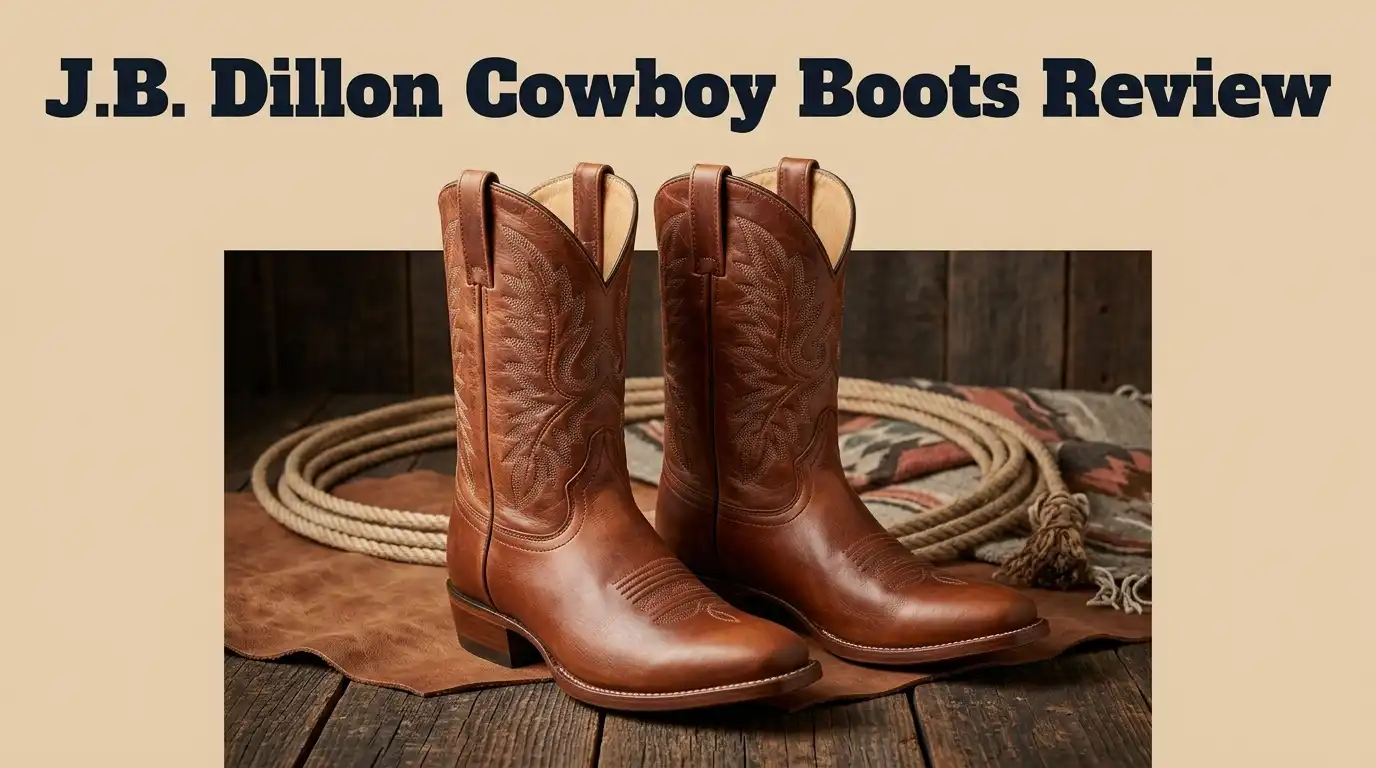
J.B. Dillon Cowboy Boots Review 2026: Worth It?
Cowboy boots carry a strange kind of pressure. You want real leather, a shape that flatters your jeans, and a price that does not make your stomach drop. J.B. Dillon sits right in that sweet spot for a lot of buyers, and the brand has quietly built a loyal following since 1978.
I spent months wearing these boots, reading owner feedback, and comparing them against the usual suspects.
This review covers the good, the frustrating, and the parts nobody mentions in the product photos. If you are deciding between J.B. Dillon and a bigger name, keep reading. The answer is more interesting than a simple yes.
In A Nutshell:
- J.B. Dillon boots are handmade in León, Mexico, a city with generations of leather craft history. The brand skips retail markup and sells direct, which is the main reason prices stay lower than the finish quality suggests.
- Comfort is the strongest selling point. Multiple long term owners report all day wearability with almost no painful break in period. The padded leather insole earns real praise from people who stand for hours.
- The finishing is where corners get cut. Edge dressing can crack, a few stitch ends run loose, and the leather outsoles wear faster than premium brands. None of these ruin the boot, but you should know before you buy.
- Exotic leathers punch far above their price. Full quill ostrich, caiman, python, and lizard models land between $279 and $599, often on sale. Owners consistently call these the best value in the lineup.
- Free shipping, free returns, and free exchanges within 60 days remove most of the risk of buying boots you cannot try on first.
- Women’s models get mixed reviews compared to the men’s line, which is a pattern across the whole western boot industry.
What Are J.B. Dillon Cowboy Boots?

Last update on 2026-08-27 / Affiliate links / Images from Amazon Product Advertising API Some of the links on this website are affiliate links, which means that at no additional cost to you, I earn a commission if you click through and make a purchase. I only recommend products and services that I believe will add value to my readers. Thank you for your support!
J.B. Dillon started in 1978 when Rick Blase opened a storefront in Youngstown, Ohio with 72 pairs of boots. The shop was called Rick’s Ranchwear. It did well. By 1992 Rick noticed the handmade boot market shrinking as mass produced options flooded shelves.
Instead of following that trend, he went the other direction. He traveled to León, Mexico, a city known worldwide for leather work, and started building his own line with local master craftsmen. That decision created the J.B. Dillon brand.
The company has since sold over one million pairs through retail stores. The online store carries the J.B. Dillon Reserve line, which is the premium tier. These are the boots you see on the website with full quill ostrich, caiman, python, and lizard uppers.
The pitch is simple. You get handmade construction and genuine exotic leather without paying for showroom rent, sales staff, or department store margin. Prices start around $209 for basic models and climb to roughly $599 for the fanciest exotics, though sale pricing is common and aggressive.
You will also spot J.B. Dillon boots in buy one get two free stores in tourist towns like Nashville. Those locations move enormous volume, which is another piece of the low price puzzle.
The Unboxing Experience
The box arrives heavier than you expect. J.B. Dillon ships in a sturdy printed boot box, and the presentation feels closer to a $500 purchase than a $250 one.
Inside, each boot sits wrapped in tissue paper with a cardboard shaft insert holding the leg upright. That detail matters more than it sounds. Shafts that arrive folded or creased are a common annoyance with cheaper brands, and these hold their shape.
The first thing you notice is smell. Real leather has a distinct, slightly sweet scent that synthetic uppers never replicate. Pull the tissue away and it hits immediately. That alone tells you the material claims are honest.
Pick one up and the weight feels balanced. The leather sole flexes a little under thumb pressure. The pull straps are stitched, not glued. Run a finger along the shaft stitching and you will find tight, even rows on most pairs.


Last update on 2026-04-11 / Affiliate links / Images from Amazon Product Advertising API Some of the links on this website are affiliate links, which means that at no additional cost to you, I earn a commission if you click through and make a purchase. I only recommend products and services that I believe will add value to my readers. Thank you for your support!
Here is the part reviewers skip. Inspect the edges of the sole carefully during unboxing. Some pairs arrive with edge paint that already looks thin in spots. A few owners find loose thread ends near the welt. Neither is a defect that affects wear, but if you are the type who wants perfection out of the box, check before the 60 day window closes.
Overall the unboxing feels genuinely good. It is not luxury theater, but nothing about it feels cheap.
Leather Quality And Materials
This is where J.B. Dillon earns its reputation. The company states it rejects hides with scratches, scuffs, or visible imperfections before production begins.
Long term owners back this up. One collector who owns five pairs of the exotics confirmed all of them use genuine full grain exotic leather, not printed or embossed cowhide pretending to be something else. That distinction is worth real money in the boot world.
The exotic lineup covers full quill ostrich, ostrich leg, caiman, python, and lizard. Each starts stiff. Python and lizard in particular feel like cardboard for the first week. Then they soften considerably and become supple in a way that surprises people who expected a bargain boot to stay rigid forever.


Last update on 2026-04-11 / Affiliate links / Images from Amazon Product Advertising API Some of the links on this website are affiliate links, which means that at no additional cost to you, I earn a commission if you click through and make a purchase. I only recommend products and services that I believe will add value to my readers. Thank you for your support!
Cowhide models sit at the lower price tier. The leather here is good but not remarkable. Some pairs use corrected grain rather than full grain, and the brand does not always spell this out clearly on product pages.
One warning about lighter colors. A verified owner reported that a tan and natural pair stained easily because the factory sealant was weak. He fixed it himself with a satin finish sealer and had no further trouble. If you buy a light shade, treat it before the first wear.
Inside, you get a leather lining and a glued foam layer under a thin leather sock liner. It is comfortable but permanent, so orthotic users should size up.
Fit, Sizing, And Comfort
Comfort is the reason people come back for a second and third pair.
A Texas reviewer who owns Lucchese, Ariat, Wolverine, and Red Wing boots compared his J.B. Dillon Chambers against a pair of Tecovas. His conclusion was direct. The Chambers felt more comfortable after eight hours on his feet. Tecovas leather feels softer in the hand, but hand feel and all day wear are two different tests.
Another owner described the round toe models as unusually accommodating for wide feet without sitting too tall at the instep. That combination is rare and hard to engineer.
Sizing runs close to true for most people, but consistency across models varies. Several buyers report needing different sizes between styles within the same brand. One woman who wears an 8.5 found men’s size 6 fit her perfectly, which suggests the sizing charts are approximate rather than precise.
My advice is straightforward. Order your normal boot size, walk around indoors on carpet, and use the free exchange if anything pinches.
Ignore any salesperson who tells you a boot will loosen into comfort. A leather sole stiffens your first few walks, yes, but a boot that hurts your toes in the store will hurt your toes six months later. Fit problems do not resolve themselves.
Top 3 Alternative For J.B. Dillon Cowboy Boots
If J.B. Dillon does not fit your foot or your budget, these three are the models buyers cross shop most often.

- COUNTRY FASHION: Get your cowboy work look on-point wearing these men’s calf boots from Ariat’s...
- PREMIUM QUALITY LEATHERS: These classic western boots by Ariat carefully uses the right kind of...
- ATS TECHNOLOGY: For superior stability and all-day comfort, these cowboy boots for men have the...
Last update on 2026-06-07 / Affiliate links / Images from Amazon Product Advertising API Some of the links on this website are affiliate links, which means that at no additional cost to you, I earn a commission if you click through and make a purchase. I only recommend products and services that I believe will add value to my readers. Thank you for your support!
ARIAT Men’s Heritage R Toe Western Boot

- Rugged 11-inch pull-on western boot for men with cowhide upper
- Broad round toe and long base heel give a relaxed fit and classic cowboy style
- J-Flex cushioned footbed and orthotic insert deliver comfort for long hours on feet
Last update on 2026-08-27 / Affiliate links / Images from Amazon Product Advertising API Some of the links on this website are affiliate links, which means that at no additional cost to you, I earn a commission if you click through and make a purchase. I only recommend products and services that I believe will add value to my readers. Thank you for your support!
Justin Buster III 11″ Western Boots for Men Stampede Collection

- Genuine tumbled leather upper
- Pull on entry
- Thick cushioned insole
Last update on 2026-08-27 / Affiliate links / Images from Amazon Product Advertising API Some of the links on this website are affiliate links, which means that at no additional cost to you, I earn a commission if you click through and make a purchase. I only recommend products and services that I believe will add value to my readers. Thank you for your support!
Laredo Men’s Birchwood Round Toe Cowboy Boots
Break In Period And First Month
Most J.B. Dillon buyers describe a gentle break in. That is unusual for handmade western boots.
The Texas reviewer wearing full quill ostrich Chambers said they were easy to pull on and comfortable from day one. No blisters, no hobbling around the house, no thick sock tricks.
Exotic leathers behave differently. Python, lizard, and ostrich leg all start noticeably stiff. Expect roughly seven to fourteen days of regular wear before the shaft relaxes and the vamp molds to the top of your foot. After that point owners describe the leather as supple.
Cowhide models break in faster, usually within a few days.
Here is a practical tip. Wear them for two hours at a time indoors during the first week. Leather stretches with body heat and moisture, so short repeated sessions work better than one long painful day.
Do not soak them or use heat guns. Both tricks circulate online and both damage the fibers permanently.
Leather soles need their own break in. They start slick, especially on tile and polished concrete. Scuff them on rough pavement or add a rubber half sole if you work on smooth floors. Rubber sole models skip this problem entirely and are the better choice for anyone doing ranch or barn work.
By week three, most people stop thinking about the boots at all. That is exactly the goal.
Construction And Sole Details
Here is where the price makes sense.
The uppers are genuinely good. Stitching on the shaft is tight and even on most pairs, and the leather is well chosen. The trade offs happen below the ankle.
The outsoles use a fairly soft leather that wears faster than premium alternatives. Daily wearers notice thinning within a year or two. This is not a defect, it is a material choice that keeps the price down. A resole from a competent cobbler costs $80 to $150 and gives you many more years.
Edge dressing is another shortcut. Instead of proper burnished edge finish, some pairs use leather paint that eventually cracks and flakes. The fix takes ten minutes with shoe cream or matching leather dye.
One knowledgeable commenter suggested the heel counters may use fiberboard rather than leather, and the midsole may be synthetic rather than cork or leather. That would limit how many times you can resole a pair. If you plan on three resoles over twenty years, these are not that boot. If you plan on one, they are fine.
Rubber sole models are available and hold up better for work use. Owners report they handle stirrups acceptably if you ride with the ball of your foot.
Judge these as excellent value boots, not as heirloom boots. That framing keeps expectations honest.
What J.B. Dillon Boots Do Not Do Well
Every honest review needs this section, so here it is without softening.
Finishing quality is inconsistent. Some pairs arrive flawless. Others have loose stitch ends, thin edge paint, or slightly crooked shaft stitching. You are rolling dice on the details.
Sole longevity disappoints heavy daily wearers. Soft leather outsoles wear through faster than what you get from Nicks, Whites, or high end Lucchese. Budget for a resole sooner than you would with a $600 American made boot.
Women’s models get weaker reviews than men’s. Several owners suspect the women’s line is built to a lower standard, which mirrors an industry wide pattern. Some women love theirs and compare them favorably to Ariat. Others find them ordinary. Read style specific feedback before ordering.
Light colored leathers stain easily because the factory sealant is underwhelming. Treat them yourself before first wear.
The insoles are glued in permanently. Custom orthotic users need to size up, and even then the fit gets tight.
Resale value is low. Exotic pairs that cost $130 each in a buy one get two deal rarely resell above $150. These are boots to wear, not boots to flip.
None of this makes them bad boots. It makes them honest boots at an honest price, and knowing the limits helps you buy the right pair.
Pros And Cons Of J.B. Dillon Cowboy Boots
Here is the balanced scorecard after everything above.
Pros
- Genuine full grain exotic leathers including ostrich, caiman, python, and lizard at prices well under comparable brands.
- Handmade in León, Mexico by experienced craftsmen rather than mass produced overseas.
- Exceptional comfort with a padded leather insole that owners praise for long standing days.
- Minimal break in period on most models, especially cowhide and full quill ostrich.
- Round toe shapes accommodate wide feet without excessive instep height.
- Free shipping, free returns, and free exchanges within 60 days removes purchase risk.
- Strong repeat buyer loyalty, with many owners reporting four to nine pairs over several years.
- Leather softens beautifully instead of staying rigid like cheaper boots.
Cons
- Edge dressing uses leather paint that cracks and needs occasional touch up.
- Soft leather outsoles wear faster than premium boots and need earlier resoling.
- Loose stitch ends and minor shaft stitching flaws appear on some pairs.
- Light colored leathers stain easily due to weak factory sealant.
- Women’s line quality feels less consistent than the men’s line.
- Sizing varies between models within the brand.
- Glued insoles cannot be removed for orthotics.
- Internal components may limit how many resoles the boot can accept.
Price And Value In 2026
The lineup starts around $209 and reaches roughly $599 for premium exotics. Sale pricing is frequent and steep.
Recent listings show the Chambers full quill ostrich dropping from $599 to about $395. Cowhide and lizard models regularly fall from $399 to $279. Women’s styles often sit between $199 and $279 on sale.
Compare that to the alternative. Full quill ostrich from a heritage brand starts around $700 and climbs past $1,200. Caiman runs similar. At $395, J.B. Dillon undercuts by half or more while using real exotic hides.
The buy one get two free stores are a different calculation. Buyers report walking out with three pairs for roughly $400, which works out to $133 each. One owner correctly noted this is smart business. The store sells more volume, and buyers feel like they won.
Is the value real? Yes, with a caveat. You are getting excellent leather and comfortable construction with average finishing. If you value the hide and the fit more than perfect edge burnishing, the math works strongly in your favor.
If you want a boot that survives three resoles and outlives you, spend more elsewhere. For everyone else, this is one of the better deals in western footwear right now.
J.B. Dillon Versus Tecovas And Ariat
These three come up constantly in the same conversations.
Against Tecovas, the comparison is close. Tecovas leather feels softer in your hands and the brand markets harder. The Texas reviewer who owns both found his J.B. Dillon Chambers more comfortable after a full workday than his Tecovas Earl. Prices are similar, both ship direct, and both are made in León. Tecovas has better customer service infrastructure and a wider retail footprint. J.B. Dillon has better exotic pricing.
Against Ariat, the split is clearer. Ariat wins on athletic style comfort technology, rubber outsoles, and work boot durability. Many Ariat models are produced in Asia now. One woman who owns both said her J.B. Dillon boots feel as good as her Ariats and more comfortable than her other western boots. For pure leather quality at similar money, J.B. Dillon has the edge. For work boots with safety features, Ariat wins.
Against Justin and Laredo, J.B. Dillon offers better leather and worse finishing, roughly speaking. Justin has broader dealer support and easier warranty claims.
The honest summary is this. J.B. Dillon competes well in leather and comfort, loses on brand recognition and finishing polish, and wins decisively on exotic value.
Care And Maintenance Tips
Good care doubles the life of these boots, and they need it more than premium alternatives.
Condition every four to six weeks. Use a quality leather conditioner on cowhide. For exotics, use a product made for that specific skin. Ostrich and caiman need lighter treatment than cowhide.
Seal light colors before first wear. One owner solved his staining problem with a satin finish sealer that matched the original sheen. Do this before the boots meet rain or spilled coffee.
Fix the edge paint yourself. When the edge dressing cracks, clean the edge, apply matching leather dye or shoe cream, and let it dry fully. Ten minutes of work restores the look completely.
Snip and burn loose threads. A loose stitch end is not a failure. Trim it close and touch the tip with a lighter to seal it.
Rotate pairs. Leather needs at least a day to dry between wears. Owners who rotate three pairs report much longer life than those wearing one pair daily.
Use boot trees or shaft inserts. They prevent the deep vamp creases that eventually crack.
Resole before the sole wears through. Once water reaches the insole, the damage spreads fast. Watch the heel and ball of the foot and take them to a cobbler at the first sign of thinning.
Who Should Buy These Boots
These boots suit specific people very well and disappoint others.
Buy them if you want genuine exotic leather without paying heritage brand prices. The ostrich, caiman, and python models are the strongest arguments in the entire lineup.
Buy them if comfort matters more to you than perfect finishing. Owners who stand all day consistently rank these above more expensive boots.
Buy them if you have wide feet. The round toe models get repeated praise for accommodating width without a tall instep.
Buy them if you want a dress or going out boot rather than a hard working ranch boot. They clean up beautifully for weddings, offices, and nights out.
Skip them if you need a boot for daily heavy labor on concrete. The soft outsoles will not keep up, and a purpose built work boot serves you better.
Skip them if you want a lifetime boot with multiple resoles. The internal construction likely will not support that.
Skip them if you cannot inspect and return easily. The finishing variability means you should always keep the 60 day window in mind.
One teenage owner wears hers for archery, fishing, four wheeling, and animal care, then wipes them down for church. That range describes the ideal use case perfectly.
Final Verdict
J.B. Dillon makes a genuinely good boot at a genuinely fair price, and that combination is rarer than it should be.
The leather is real, the comfort is excellent, and the exotic pricing is the best I have found from a direct to consumer brand. Owners who buy one pair usually buy more, which is the clearest quality signal available.
The flaws are real too. Edge paint cracks. Soles wear faster than premium alternatives. Some pairs need a few minutes of DIY cleanup. Women’s models are less consistent than men’s.
Score: 4.2 out of 5. These are excellent value boots with average finishing, and that is exactly how you should judge them.
If you have been eyeing a pair of ostrich or caiman boots but flinched at $900 price tags, this is your entry point. Order your normal size, use the free exchange if needed, and treat light colors before wearing them.
Frequently Asked Questions
Are J.B. Dillon boots real leather?
Yes. The exotic models use genuine full grain ostrich, caiman, python, and lizard. Cowhide models use real leather as well, though some may be corrected grain rather than full grain. The word “genuine leather” stamped inside a boot does not indicate low quality, despite common internet claims.
Where are J.B. Dillon boots made?
They are handmade in León, Mexico. The city has a long history of leather production, and the company works with experienced craftsmen there. Many competing brands now produce in Asia.
Do J.B. Dillon boots run true to size?
Mostly yes, but sizing varies between models. Order your normal boot size first and use the free 60 day exchange if the fit is off. Size up if you plan to add an insole, since the factory insole is glued in.
How long do J.B. Dillon boots last?
With rotation and regular conditioning, expect several years of frequent wear. Daily wearers may need a resole within one to two years because the leather outsoles are soft. The uppers typically outlast the soles by a wide margin.
Are J.B. Dillon boots better than Tecovas?
They are comparable. Both are made in León and priced similarly. Several owners find J.B. Dillon more comfortable after a full day, while Tecovas offers softer initial hand feel and stronger customer support. J.B. Dillon usually wins on exotic leather pricing.
Can you wear J.B. Dillon boots for ranch work?
The rubber sole cowhide models handle light ranch work reasonably well. For heavy daily labor on concrete, a purpose built work boot serves you better. The exotic models are best kept for dress and casual wear.
What is the return policy?
You get 60 days from purchase to return or exchange. Shipping, returns, and exchanges are all free with no restocking fees, excluding Alaska and Hawaii.

Mia Smith is the founder of Shoe Storyteller, a blog that celebrates the art and stories behind shoes. With a passion for fashion and a flair for storytelling, Mia brings a unique perspective to the world of footwear.