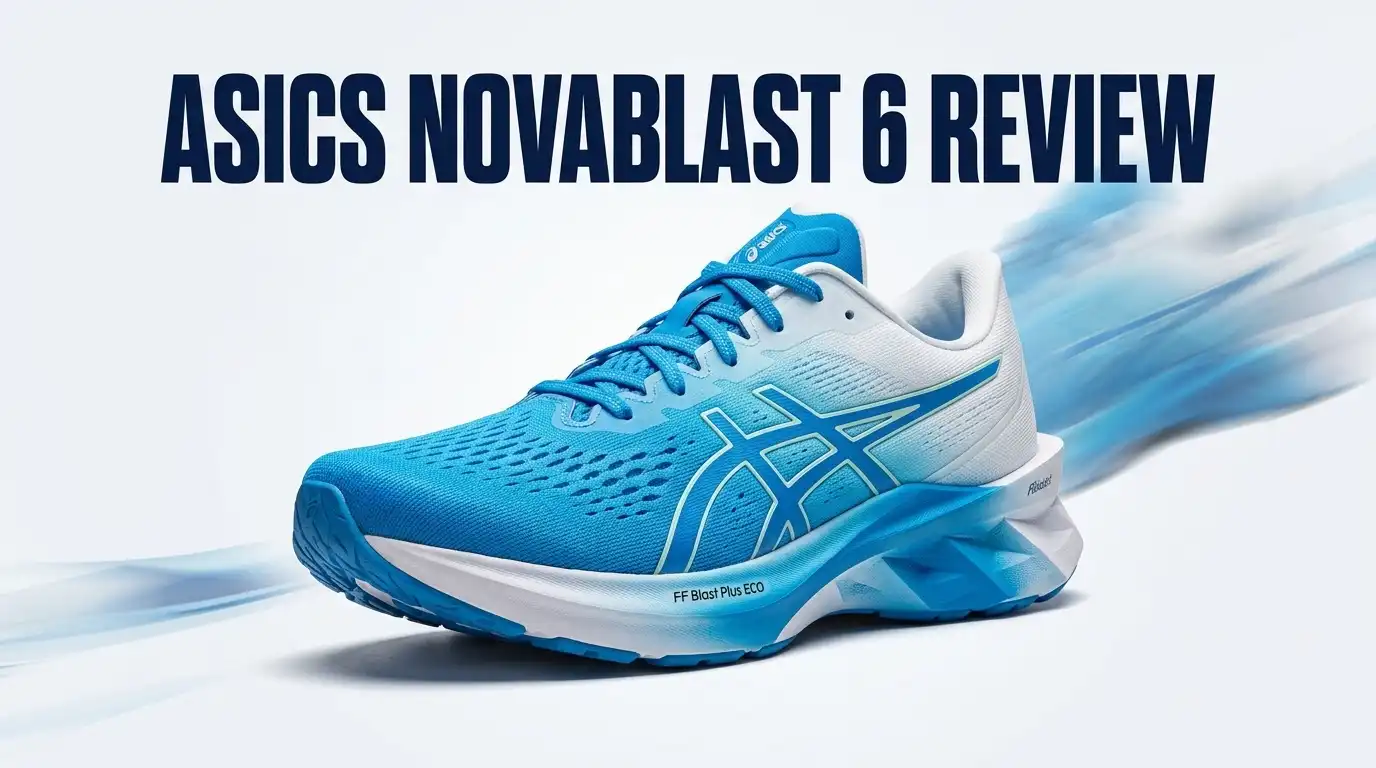
Asics Novablast 6 Review 2026: Worth Upgrading?
The Asics Novablast has been the shoe everyone talks about at the start line. Version 5 became the brand’s best selling trainer in 2025, and it dethroned some big names on Strava.
So the Novablast 6 arrives with real pressure on it. Asics did not play safe either. The brand added a new forefoot foam, trimmed the platform, changed the outsole rubber, and raised the price by fifteen dollars.
I put the Novablast 6 through easy runs, one long run, a treadmill session, and a wet morning loop. I also compared it side by side with the Novablast 5 that still sits in my rotation.
In A Nutshell:
- The Novablast 6 is a lighter, bouncier, and faster feeling daily trainer. It weighs 8.8 oz (249 g) in a men’s size 9 and 7.7 oz (218 g) in a women’s size 8, with a 41.5 mm heel and 33.5 mm forefoot stack.
- The big change sits under your toes. Asics added a puck of FF Turbo Squared foam in the forefoot, the same premium foam used in the Megablast. Lab testing shows 69.1% energy return in the forefoot versus only 55.4% in the heel.
- Midfoot and forefoot strikers get the most benefit. Heel strikers report a slappy, clunky landing because the FF Blast Max heel feels flat compared to the springy front section.
- The outsole finally uses ASICSGRIP rubber. Traction jumped to a 0.76 coefficient of friction against a 0.52 average, and wear testing showed only 0.5 mm of rubber loss. This shoe should last 400 to 500 miles.
- The platform got narrower. The forefoot dropped from 122.3 mm to 115.2 mm and the heel from 97.6 mm to 93.8 mm. That means more agility but less inherent support for mild overpronators.
- Price is now $155. It still undercuts most premium trainers, though the Novablast no longer feels like the budget hero it once was.
Asics Novablast 6 Overview And Quick Verdict

- Engineered woven upper
Last update on 2026-08-30 / Affiliate links / Images from Amazon Product Advertising API Some of the links on this website are affiliate links, which means that at no additional cost to you, I earn a commission if you click through and make a purchase. I only recommend products and services that I believe will add value to my readers. Thank you for your support!
The Asics Novablast 6 is a neutral daily trainer built for high mileage runners who want cushion without weight. It sits in the max stack category with a 41.5 mm heel, yet it still weighs under nine ounces. That combination is the reason this series keeps selling.
My short verdict: the Novablast 6 is a better shoe than version 5 for anyone who lands forward on the foot, and a slightly worse shoe for classic heel strikers. The forefoot pop is genuinely fun. You feel it on the third or fourth mile, when your legs settle into rhythm and the toe off starts giving something back.
The heel is the weak link. FF Blast Max absorbs shock well, scoring 143 SA against a 131 average, but it does not return much energy. So the shoe has two personalities. The back half cushions. The front half bounces. Some runners find that contrast exciting. Others find it disjointed.
Asics kept the trampoline outsole pod, the wide sidewalls, and the general Novablast shape. The upper is new woven mesh, the tongue padding extends further down, and the heel collar is stuffed with foam. Step in comfort is excellent.
At $155 it competes with the Hoka Clifton, the Saucony Ride, and the Adidas Adizero SL family. It beats most of them on grip and outsole durability. It loses to some of them on transition smoothness.
The Unboxing Experience And First Step In Feel
The box arrived in the familiar Asics orange and grey design, nothing fancy, no extra packaging waste. Inside, the shoes sat wrapped in thin tissue with a small cardboard insert in each toe box. No spare laces. No shoe bag. Asics keeps this simple, and that is fine at this price.
The first thing I noticed was the weight in hand. The Novablast 6 feels light for how tall it looks. Pick one up and the sidewalls give an impression of bulk that the scale simply does not confirm.
The colorway I received had a clean woven upper with a subtle sheen. The hidden lace loops are a nice visual upgrade. Version 5 looked slightly cheap around the midfoot. Version 6 looks like a $180 shoe.
Step in feel is the highlight. The heel collar is packed with soft foam, and your foot sinks into it. The tongue has a padded top section that stops lace pressure completely. I did not need to tighten the laces hard to lock the foot down.


Last update on 2026-04-11 / Affiliate links / Images from Amazon Product Advertising API Some of the links on this website are affiliate links, which means that at no additional cost to you, I earn a commission if you click through and make a purchase. I only recommend products and services that I believe will add value to my readers. Thank you for your support!
One small warning from that first fitting. The heel padding is so generous that the shoe fits slightly short. I wear a men’s size 10 and my toes sat closer to the front than expected. Runners between sizes should go up half a size.
Specs, Materials And Build Details
Here is what Asics actually built into this shoe. The midsole uses FF Blast Max as the primary foam, with a visible white insert of FF Turbo Squared under the forefoot. That insert is fully walled in by the surrounding foam, so it compresses vertically and does not roll sideways. It is a smart piece of engineering.
Stack height measures 41.5 mm at the heel and 33.5 mm at the forefoot for men, giving a listed 8 mm drop. Independent lab measurement came in closer to 7.1 mm, which slightly favors forward landings.
Midsole softness measured 35.1 AC for the main foam and 28.8 AC for the Turbo Squared puck. That gap is what creates the bouncy front and muted rear sensation.
The upper is an engineered woven mesh with a semi gusseted tongue on both sides. Breathability scored 80 BR against a 74 average, and the shoe released 59% of absorbed moisture in drying tests. Summer runs will feel manageable.


Last update on 2026-04-11 / Affiliate links / Images from Amazon Product Advertising API Some of the links on this website are affiliate links, which means that at no additional cost to you, I earn a commission if you click through and make a purchase. I only recommend products and services that I believe will add value to my readers. Thank you for your support!
Torsional rigidity sits high at 16.7 Nm, so the shoe resists twisting. Flex resistance measured 15.5N, right on the daily trainer average. The insole is 4.5 mm thick and fully removable, so orthotic users have options.
One clear miss: there are no reflective elements anywhere on this shoe. Early morning and evening runners will want a vest or a light.
Top 3 Alternative for Asics Novablast 6

- BETTER FOAM: Experience the reformulated PWRRUN+ foam, now lighter, softer, and more responsive...
- UPGRADED DURABILITY & TRACTION: Improved durability and grip with more rubber in the forefoot and...
- ADAPTABLE UPPER: The new engineered mesh upper offers enhanced breathability and stretch for a more...
Last update on 2026-08-30 / Affiliate links / Images from Amazon Product Advertising API Some of the links on this website are affiliate links, which means that at no additional cost to you, I earn a commission if you click through and make a purchase. I only recommend products and services that I believe will add value to my readers. Thank you for your support!
Saucony Ride 19

Last update on 2026-08-30 / Affiliate links / Images from Amazon Product Advertising API Some of the links on this website are affiliate links, which means that at no additional cost to you, I earn a commission if you click through and make a purchase. I only recommend products and services that I believe will add value to my readers. Thank you for your support!
HOKA Clifton 10

- adizero Evo SL M FTWWHT/CPURPL/LIMBUR
Last update on 2026-08-30 / Affiliate links / Images from Amazon Product Advertising API Some of the links on this website are affiliate links, which means that at no additional cost to you, I earn a commission if you click through and make a purchase. I only recommend products and services that I believe will add value to my readers. Thank you for your support!
adidas Adizero EVO SL
Midsole Foam Explained: FF Blast Max Meets FF Turbo Squared
This is the heart of the update, so it deserves a proper explanation. FF Blast Max is the nitrogen infused foam Asics introduced in the Novablast 5. It is light and it absorbs impact. What it does not do is spring back. Lab energy return in the heel measured 55.4%, below the 58.7% average across hundreds of tested shoes.
FF Turbo Squared is a different animal. It is the same compound found in the Megablast and it returned 69.1% of energy in testing. That number sits near carbon plated racing shoe territory.
Asics placed that premium foam only under the forefoot, directly above the trampoline outsole pod. So you get racing shoe feedback exactly where toe off happens, and daily trainer softness everywhere else.
The result on the run is a shoe with two distinct zones. Land on the midfoot and the Turbo Squared fires you forward. Land hard on the heel and you sink into flat foam, then get thrown into the forefoot rather than rolled into it.
One honest criticism deserves attention here. Asics designed the midsole so the white premium foam is visible along the sidewall, which makes the shoe look like it uses far more Turbo Squared than it actually does. The visible white section is mostly cosmetic wall. The functional puck is smaller. That marketing choice bothers me more than the ride does.
Ride Quality On Daily Miles And Long Runs
On easy runs the Novablast 6 does its job well. The cushion protects the legs, the shoe stays light, and the forefoot gives a small nudge every stride. I finished a fourteen mile long run with no soreness in the calves or quads.
The magic pace for this shoe is between 8:00 and 9:30 per mile. At that effort the transition smooths out and the forefoot foam has time to compress and rebound properly.
Below 7:00 per mile the shoe starts fighting you. The FF Blast Max heel does not keep up, and the shoe feels heavier than the spec sheet says. This is a daily trainer with occasional uptempo ability, not a workout shoe.
The heel transition is the most divisive part of the ride. Asics used a sharp posterolateral bevel with a steep angle. If you land heel first with a high ankle angle, the shoe slaps you down into foot flat quickly. Some testers describe it as a clunky drop rather than a roll.
I adapted by landing slightly further forward, and the shoe transformed. The bounce showed up, the slap disappeared, and the ride became genuinely enjoyable. That adaptation should not be required from a mainstream daily trainer, though.
Treadmill running felt smooth and quiet. Wet pavement felt secure. Concrete sidewalks felt well protected.
Fit, Sizing And Upper Comfort
The Novablast 6 fits true to size for most runners according to voting data, but that hides some nuance. Internal length measured 274.4 mm against a 269.3 mm average, so the shoe is technically long inside. The heavy heel padding pushes your foot forward and eats that extra room.
My honest advice: if you are between sizes, go up. If you have a wide forefoot, try before you buy.
Toe box width measured 71.0 mm against a 73.2 mm average. That is narrow. The shape tapers toward the big toe in the classic Asics style. Toe box height measured a generous 27.9 mm, so there is vertical space even when horizontal space runs short.
Runners with narrow or medium feet will love the lockdown. Runners with wide feet will feel squeezed after mile eight, especially in summer heat when feet swell.
The midfoot fit is secure thanks to the semi gusseted tongue. I never needed to overtighten. Those with a high instep may need to loosen the top eyelet slightly, since midfoot volume is on the lower side.
The heel counter is moderately stiff, rated 3 out of 5, and the padding hides it completely. No heel slip appeared over any run. Runners with Haglund’s deformity should find this comfortable, at least until the padding compresses with mileage.
Upper durability tested at 4 out of 5 in the toe box and 4 out of 5 in the heel lining. That is well above average.
Outsole Grip And Long Term Durability
This section holds the biggest good news of the review. Asics finally fitted ASICSGRIP rubber to the Novablast, the same compound used on the brand’s racing shoes.
Traction testing produced a 0.76 coefficient of friction. The average across nearly 400 tested shoes is 0.52. That is a huge margin, and you feel it on wet roads and painted crosswalk lines. I ran through steady rain and never felt the foot skate.
Wear testing was equally strong. A controlled abrasion test removed only 0.5 mm of rubber against a 1.1 mm average. Outsole thickness sits at 2.7 mm, slightly below average, but the compound quality more than compensates.
Real world experience matched the lab. After roughly fifty miles the rubber showed no visible wear pattern at all. Only the exposed midsole foam in the center showed minor scuffing.
The outsole layout keeps the familiar Novablast design. Rubber wraps the perimeter, the exposed foam sits recessed so it does not touch the ground first, and the trampoline pod sits under the forefoot.
One caution applies. Runners who scuff heavily or drag the foot may chew through the exposed foam sections faster than the rubber. For most runners a realistic lifespan is 400 to 500 miles, which is genuinely good for a $155 shoe.
Stability And Support Assessment
The Novablast 6 is a neutral shoe, and it is less stable than the Novablast 5. That is the plain truth.
The platform shrank in both directions. Forefoot width dropped from 122.3 mm to 115.2 mm. Heel width dropped from 97.6 mm to 93.8 mm. Asics traded stability for agility, and the shoe does feel quicker because of it.
Some guidance features remain. Large sidewalls cradle the heel on both sides. The midfoot is filled in rather than cut out. Torsional rigidity is high at 16.7 Nm, so the shoe does not twist under load.
The problem is that these stable elements fight against softer components. The FF Blast Max heel compresses fast under load. The sharp bevel accelerates the landing. Together they exaggerate whatever motion your foot already wants to make.
There is also a lateral flare in the forefoot that creates a mild inward push. I noticed my foot drifting slightly medial at toe off, which made me feel like I was missing the center of the Turbo Squared pod.
Neutral runners with a stable gait will not care about any of this. Runners with mild to moderate overpronation should look at a shoe with a wider base or a genuine support frame. The Novablast 6 is not the answer for that group.
Asics Novablast 6 vs Novablast 5: What Changed
If you own the Novablast 5, this is the question you actually came here for. Here is the direct comparison.
Weight: Version 6 is slightly lighter at 8.8 oz versus 8.9 oz. Marginal, but the shoe feels noticeably less bulky because of the narrower platform.
Foam: Version 5 used FF Blast Max throughout and delivered a consistent, uniform bounce. Version 6 uses a reformulated FF Blast Max with less bounce plus a Turbo Squared forefoot puck. The result is more exciting up front and duller at the back.
Stability: Version 5 was the more stable shoe by a clear margin thanks to that huge 122 mm forefoot platform. Version 6 is more agile and less planted.
Outsole: Version 6 wins easily. ASICSGRIP transformed wet weather confidence and durability.
Upper: Version 6 wins again. Better tongue padding, cleaner lace loops, more durable material, better breathability.
Price: Version 5 launched at $150. Version 6 costs $155.
My recommendation is honest. If you are a heel striker who loved the smooth consistent ride of version 5, buy discounted pairs of the 5 while stock lasts. If you land midfoot or forefoot and wanted the Novablast to feel snappier, version 6 is a clear upgrade worth the extra money.
What The Asics Novablast 6 Does Not Do Well
Every review should name the failures plainly, so here they are.
The heel transition is clunky. The sharp bevel combined with the flat feeling FF Blast Max creates a slapping sensation for heel strikers. Some runners describe walking in the shoe as uncomfortable for this reason.
The fit runs short. Excessive heel collar padding pushes the foot forward. A shoe with above average internal length should not feel cramped, yet this one can.
The toe box is narrow. At 71.0 mm it sits well under average. Wide footed runners should look elsewhere, since Asics does not offer this model in generous width options everywhere.
The heel foam feels dead. Energy return of 55.4% is below average, which is disappointing in a shoe marketed around bounce.
There are zero reflective elements. For a mainstream trainer sold to recreational runners who train before work and after dark, this is a genuine safety oversight.
The midsole marketing is misleading. The visible white foam along the sidewall suggests far more Turbo Squared than the shoe actually contains.
Stability dropped compared to version 5. Runners who need mild guidance lost a good option.
The price climbed. At $155 the Novablast no longer functions as the affordable alternative to premium super trainers, which was a big part of its earlier appeal.
Pros And Cons Of The Asics Novablast 6
Pros
- Excellent forefoot energy return at 69.1%, delivering real bounce at toe off for midfoot and forefoot strikers.
- Outstanding outsole grip with ASICSGRIP rubber scoring 0.76 in traction testing, well above the 0.52 average.
- Exceptional durability with only 0.5 mm of rubber wear in abrasion testing, plus 4 out of 5 scores for upper and heel lining toughness.
- Light for the stack height at 8.8 oz with 41.5 mm of heel cushioning underfoot.
- Plush step in comfort from the padded heel collar, extended tongue padding, and clean woven upper.
- Strong breathability scoring 80 BR with 59% moisture release, so summer runs stay comfortable.
- More agile and quicker feeling than the Novablast 5 thanks to the narrower platform.
Cons
- Clunky heel transition that slaps heel strikers into foot flat rather than rolling them forward.
- Flat feeling heel foam with below average 55.4% energy return.
- Fits short because of heavy heel padding, so runners between sizes should size up.
- Narrow toe box at 71.0 mm that restricts wide feet on long runs.
- Less stable than version 5 after the platform shrank in both heel and forefoot.
- No reflective details anywhere on the shoe.
- Price increased to $155, weakening the value argument.
Price, Value And Buying Advice

- Engineered woven upper
Last update on 2026-08-30 / Affiliate links / Images from Amazon Product Advertising API Some of the links on this website are affiliate links, which means that at no additional cost to you, I earn a commission if you click through and make a purchase. I only recommend products and services that I believe will add value to my readers. Thank you for your support!
The Novablast 6 retails at $155 in the United States and around 160 euros in Europe. That places it just below the $157 average for modern running shoes, so it is not expensive by current standards. It is, however, five dollars more than version 5 and fifteen dollars more than version 4.
Is the increase justified? Mostly yes. You are paying for a genuinely premium foam insert and one of the best outsole compounds available on a road shoe. Both of those upgrades cost real money to produce.
Where the value argument weakens is competition. At this price you can find the Saucony Ride 19, the Hoka Clifton 10, and the Adidas Adizero SL family, all of which offer smoother transitions for heel strikers.
My buying advice is simple. Try the shoe on before committing if you have wide feet or if you are a strong heel striker. Everyone else can order with reasonable confidence, since sizing runs close to true with the half size caution noted earlier.
Watch for sales. The Novablast series historically drops to $110 or $120 within six months of launch. At that price it becomes an easy recommendation for almost any neutral runner.
Both men’s and women’s versions share the same construction, with the women’s model using a 40.5 mm heel and 32.5 mm forefoot.
Who Should Buy The Novablast 6 And Who Should Skip It
Buy the Novablast 6 if you land on your midfoot or forefoot. This shoe was clearly redesigned around that gait, and the Turbo Squared puck rewards it every stride.
Buy it if you thought the Novablast 5 felt too wide and bulky. Version 6 fixes that complaint directly.
Buy it if you want one shoe that handles easy runs, long runs, and the occasional steady effort without needing a second pair.
Buy it if you run in wet climates. The grip upgrade alone justifies the purchase for anyone who trains through rain regularly.
Buy it if you are new to running and want a dependable, cushioned, durable trainer that will not fall apart in three months.
Skip it if you are a heavy heel striker with a high inclination angle. The transition will feel harsh and you will fight the shoe.
Skip it if you overpronate even mildly. The narrower platform gives less help than version 5 did.
Skip it if you have wide feet. That 71.0 mm toe box will not stretch enough to save you.
Skip it if you loved version 5 and simply want more of the same. This is a different shoe with a different personality, not a refinement.
Final Thoughts On The Asics Novablast 6
The Novablast 6 is a bold update to a shoe that did not strictly need one. Asics could have coasted on version 5’s success and sold plenty of pairs. Instead the brand tore into the midsole and rebuilt the character of the ride.
The gamble half worked. The forefoot is the best it has ever been in this series. The outsole is genuinely excellent. The upper is a clear step up in quality and comfort.
The heel is where the shoe leaves points on the table. A puck of Turbo Squared back there, or a softer bevel angle, would have turned a good trainer into a great one.
My overall grade sits around a B plus. It is a very good daily trainer with one clear flaw that affects a large slice of the running population.
If you land forward, this shoe will make you smile. If you land back, it will make you think about the Saucony Ride 19 or the Clifton 10 instead. That split reaction is exactly why the Novablast 6 has divided runners since launch.
Try it on, run in it if your local store allows, and trust your own legs over any review, including this one.
Frequently Asked Questions
Is the Asics Novablast 6 good for beginners?
Yes, with one condition. The cushioning, durability, and grip all suit new runners well. The clunky heel transition may feel odd if you land hard on your heel, which many beginners do. Try the shoe in store first and pay attention to how the landing feels during a short jog.
Does the Novablast 6 fit true to size?
Mostly, but it fits slightly short because of the thick heel collar padding. Runners between half sizes should size up. Wide footed runners should consider a different model entirely, since the toe box measures narrower than average at 71.0 mm.
How many miles will the Novablast 6 last?
Expect 400 to 500 miles for most runners. Abrasion testing showed only 0.5 mm of rubber loss, which ranks among the best results recorded for road shoes. The exposed midsole foam is the more likely wear point for runners who scuff.
Can you race in the Novablast 6?
You can, but it is not built for it. The shoe handles steady efforts and moderate tempo work fine. At true race pace the FF Blast Max heel feels sluggish. For 5K and 10K racing, a lighter plated shoe will serve you better.
Is the Novablast 6 better than the Novablast 5?
It depends on your footstrike. Version 6 wins on grip, durability, upper quality, and forefoot bounce. Version 5 wins on stability and transition smoothness. Forefoot and midfoot strikers should upgrade. Heel strikers may prefer to stock up on version 5.
Is the Novablast 6 a stability shoe?
No. It is a neutral trainer with mild guidance features like wide sidewalls and high torsional rigidity. The platform narrowed compared to version 5, so runners needing support should look at a dedicated stability model instead.

Mia Smith is the founder of Shoe Storyteller, a blog that celebrates the art and stories behind shoes. With a passion for fashion and a flair for storytelling, Mia brings a unique perspective to the world of footwear.