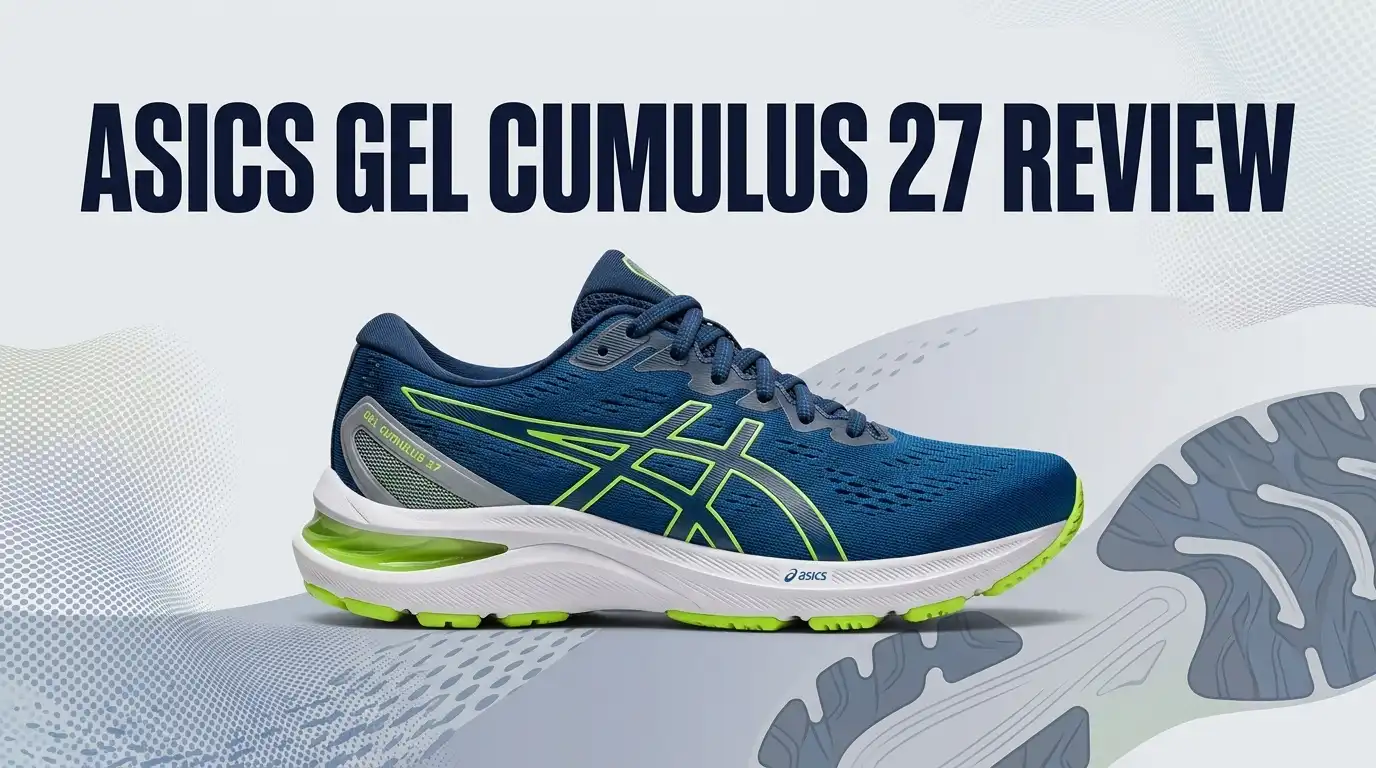
Asics Gel Cumulus 27 Review 2026: Still Worth It?
The Asics Gel Cumulus 27 is the shoe your running club friend keeps quietly wearing while everyone else chases the newest carbon plated hype.
It costs $140, weighs about 9.2 ounces in a men’s size 9, and it does not beg for attention. Yet it keeps selling in huge numbers, year after year, version after version.
So the real question for 2026 is simple. With the Cumulus 28 now on shelves and the 27 sitting at steep discounts, does this daily trainer still earn a spot in your rotation?
Key Takeaways
- The ride is calm and predictable. The Cumulus 27 uses FF Blast Plus foam with a PureGel insert in the heel. It feels smooth and slightly dense rather than soft or bouncy. Runners who dislike wobbly, springy foams will love this.
- Cushioning grew, comfort improved. Lab measurements put the heel stack near 41 mm and the forefoot near 29 mm. That is a real jump over the Cumulus 26, and it makes long runs friendlier on tired legs.
- Stability is the hidden strength. The platform measures roughly 120 mm at the forefoot and 100 mm at the heel. That wide base keeps neutral runners upright without adding a medial post.
- Breathability is the biggest flaw. The thick jacquard mesh upper traps heat. If you run in hot, humid weather, this shoe will feel like a sauna.
- Energy return sits below average. Testing showed roughly 49 percent return against a 58 percent average. This is a mile eater, not a speed tool.
- Value in 2026 is excellent. With the Cumulus 28 out, the 27 regularly drops near $90 to $110. At that price it beats most rivals on cost per mile.
Asics Gel Cumulus 27 At A Glance

- FF BLAST PLUS technology: Cushioning provides lightweight impact absorption and a responsive rebound
- PureGEL technology .: Helps provide lightweight cushioning and softer landings
- Engineered mesh upper: Helps improve breathability and comfort
Last update on 2026-08-30 / Affiliate links / Images from Amazon Product Advertising API Some of the links on this website are affiliate links, which means that at no additional cost to you, I earn a commission if you click through and make a purchase. I only recommend products and services that I believe will add value to my readers. Thank you for your support!
The Gel Cumulus line started in 1999, and version 27 keeps the same job description. Asics builds it as an everyday neutral trainer for runners who want cushioning, durability, and a fair price. It sits below the Gel Nimbus in softness and below the Gel Kayano in support.
The men’s model weighs about 9.2 to 9.5 ounces, or roughly 261 to 270 grams. The women’s version lands near 8.1 ounces, or 230 grams. Asics lists the stack at 38.5 mm heel and 30.5 mm forefoot for men, with an 8 mm drop. Independent lab testing measured slightly taller numbers, closer to 41 mm and 29 mm.
The midsole uses FF Blast Plus Eco foam, a blend of EVA and olefin block copolymers. A PureGel insert sits in the heel. The outsole is FluidRide, which is coated EVA foam rather than traditional rubber. Asics also adds an Ortholite sockliner, a semi gusseted tongue, reflective heel details, and a finger loop heel tab that the 26 did not have.
The retail price stayed at $140, which was a smart move in a market where trainers now push past $160. Sizing runs true to size for most people. A wide version exists, though availability changes by region and by colorway.
Unboxing The Asics Gel Cumulus 27
The box arrives plain. Asics uses a simple cardboard shoebox with the blue and white branding, no ribbon, no tissue paper theater, no QR code inviting you to join a community. You lift the lid and there they are, wrapped in one sheet of thin paper.
My first reaction was about the colorway. The launch men’s option is a brown and pistachio combination that looks like a 1970s station wagon interior. It grew on me by week two, but I would not call it handsome. Better options exist, including a clean white and a deep indigo. Check the swatches carefully before ordering.
Pick the shoe up and the weight surprises you. For something with this much foam under the heel, it feels light in hand. The upper mesh is smooth and slightly stiff to the touch, with a woven texture you can feel with a fingertip.
The tongue is thin. Very thin. It measures under 2 mm at the lace area, with a small foam pad lower down near the toes. That backward padding setup felt odd during my first lacing session.
Step in feel is soft and welcoming. The heel collar padding is plush, the Ortholite insole adds a pleasant squish, and the finger loop at the back makes pulling them on easy. The first ten seconds in this shoe feel like more money than you paid.


Last update on 2026-04-11 / Affiliate links / Images from Amazon Product Advertising API Some of the links on this website are affiliate links, which means that at no additional cost to you, I earn a commission if you click through and make a purchase. I only recommend products and services that I believe will add value to my readers. Thank you for your support!
Midsole Foam And Cushioning Feel
FF Blast Plus Eco is the engine here, and it behaves like a sensible engine rather than a turbocharged one. Durometer testing put the top foam layer around 34 on the Asker C scale, which counts as moderately soft. A firmer EVA layer sits below it and doubles as the outsole.
On the road, this translates to comfort without mush. My foot never sank in the way it does in a Gel Nimbus. Landings feel absorbed, then the shoe moves on. Shock absorption tested at 136 in the heel, above the 131 average, so protection is genuinely better than the Cumulus 26 delivered.
The PureGel insert lives in the heel, sealed inside the foam. Heel strikers notice a small softening on impact. Midfoot and forefoot runners will never know it exists. Do not expect a spring from it, because Asics designed PureGel for comfort, not for bounce.
Energy return is where the shoe shows its price. Testing recorded 49.4 percent against an average near 59 percent. You feel that gap when you try to push pace. The foam absorbs, it does not repay.
For easy runs at conversational effort, this suits me fine. For a 10 mile long run, the extra stack kept my calves fresh past mile eight. The Cumulus 27 cushions your legs rather than propelling them, and that trade works for the runs most of us actually do.


Last update on 2026-04-11 / Affiliate links / Images from Amazon Product Advertising API Some of the links on this website are affiliate links, which means that at no additional cost to you, I earn a commission if you click through and make a purchase. I only recommend products and services that I believe will add value to my readers. Thank you for your support!
Top 3 Alternative for Asics Gel Cumulus 27

- THIS MEN’S SHOE IS FOR: The Ghost 17 is for runners and walkers alike looking for an everyday...
- SOFT & DYNAMIC CUSHIONING: The Ghost 17 offers neutral support with premium nitrogen-infused DNA...
- SMOOTH TRANSITIONS: The newly designed midsole incorporates precise flex grooves that enhance the...
Last update on 2026-06-08 / Affiliate links / Images from Amazon Product Advertising API Some of the links on this website are affiliate links, which means that at no additional cost to you, I earn a commission if you click through and make a purchase. I only recommend products and services that I believe will add value to my readers. Thank you for your support!
Brooks Ghost 17

- Engineered jacquard upper that offers stretch, ventilation, and durability
- Reflective details or visibility in low-light settings
- Tongue wing construction
Last update on 2026-06-07 / Affiliate links / Images from Amazon Product Advertising API Some of the links on this website are affiliate links, which means that at no additional cost to you, I earn a commission if you click through and make a purchase. I only recommend products and services that I believe will add value to my readers. Thank you for your support!
Asics Novablast 5
No products found.
New Balance Fresh Foam X 880v15
Fit Sizing And Upper Comfort
The Cumulus 27 fits true to size for most runners. Voting data from testers backs this up strongly, so order your normal size and expect a match. Half sizes are available across the range.
The shape is medium volume with a slight narrow lean. Lab measurement of the widest point came in at 93.9 mm, just under the 95.2 mm average. The big toe area measured 71.1 mm, again slightly below average. Vertical toebox height is generous at 29.7 mm, so your toes can splay upward even if side space is tight.
Runners with wide feet should look for the wide version or consider the Brooks Ghost 17 instead. Runners with narrow feet may need to cinch the laces hard, and even then the midfoot lockdown can feel loose.
Here is my main upper complaint. Asics replaced the stretch knit tongue from the Cumulus 26 with plain mesh. That old tongue was one of the best in the category. The new one is thin, flat, and forgettable. I felt lace pressure across the top of my foot on runs over an hour.
The engineered jacquard mesh itself is smooth and does not chafe. Heel hold is excellent thanks to a stiff heel counter rated 4 out of 5 for rigidity, softened by thick collar padding. Comfort is high, lockdown is average, and the tongue is a downgrade.
Ride Quality On Daily Runs
The Cumulus 27 rides like a reliable compact car. It starts every morning, it never thrills you, and it never lets you down. That description sounds like faint praise, but plenty of runners want exactly this.
Transitions are smooth. Asics reshaped the heel bevel again, and extreme heel strikers roll forward without a slapping sensation. The forefoot rocker is moderate rather than aggressive, which feels refreshing in a market full of exaggerated rockers.
Flexibility tested at 15.1N, right around average. The shoe bends, but not much, because torsional rigidity scored a maximum 5 out of 5. That is the same rating carbon plated racers get. The result is a stable ride that feels slightly board like through the arch.
At easy pace the shoe disappears under you, which is the highest compliment for a daily trainer. I ran several 6 mile sessions and never thought about my feet once.
Push the pace and the story changes. The wide base and the dense foam create a plodding sensation. It feels like steering a small boat when you try to turn over quickly. Strides at the end of a run worked fine. A full tempo session did not.
Use this shoe for easy miles, recovery days, and long runs, and it performs above its price. Ask it to run fast and it politely declines.
Stability And Support
Asics markets the Cumulus 27 as a neutral shoe, and technically that is correct. There is no medial post and no guide rail system. In practice, the geometry does a lot of stability work quietly.
The forefoot platform measures 120.2 mm and the heel measures 100.7 mm. Both numbers sit well above category averages. That footprint gives you a broad landing zone, so mild wobble at the ankle gets corrected by the shoe shape rather than by your muscles.
Add the maximum torsional rigidity score and the stiff heel counter, and you get a trainer that feels planted. Testers rated lateral stability around 7 or 8 out of 10 for neutral runners. That is strong for a shoe with 41 mm of heel stack.
Runners who feel nervous in tall, tippy shoes should put this on their shortlist. New runners in particular benefit, because the wide base forgives sloppy form late in a run.
Runners who need genuine motion control should still look at the Gel Kayano. Severe overpronation needs dedicated support hardware, and the Cumulus does not have it.
There is a cost to all this stability. The rigid platform limits natural foot flex, and the wide base adds that boat like feel at faster paces. You trade agility for confidence, and most daily miles reward that trade.
Outsole Grip And Durability
Asics uses FluidRide on the outsole, which is EVA foam with a protective coating rather than standard rubber. This choice divides runners. It creates quiet, soft landings and saves weight, but it wears faster than rubber.
Wet grip tested at 0.50, a small improvement over the 0.48 of the Cumulus 26. That is close to the 0.52 average. On damp asphalt I felt secure. On wet painted lines and metal grates I stepped carefully, as you should in any road shoe.
Abrasion testing showed the foam outsole giving up 2.8 mm of material, nearly triple the average. That sounds alarming until you see the thickness figure. Asics laid down 8.4 mm of outsole material against a 3.1 mm average.
More material to burn through balances the faster wear rate. My pair showed visible scuffing on the lateral heel at 60 miles, but no structural loss.
Upper durability is a genuine highlight. Dremel testing gave the toebox a perfect 5 out of 5 and the heel padding another perfect 5. The dense mesh that blocks airflow also resists tearing.
Expect 350 to 450 miles from this shoe on road surfaces. Skip it for gravel, trail, and slick winter conditions, because the foam outsole lacks bite on loose ground.
Asics Gel Cumulus 27 vs Gel Cumulus 26
If you own the Cumulus 26 and love it, the upgrade decision is close. The two shoes share the same midsole compound and the same outsole material. Asics did not rebuild anything.
The measurable change is stack height. The 26 measured around 36.8 mm at the heel. The 27 measured 40.9 mm. That extra foam explains the better shock absorption score and the slightly softer landings.
The 27 also gained about 10 grams. You will not notice that on the run. Midfoot width grew a touch, which increases the base of support and makes the shoe feel more secure.
The upper switched to engineered jacquard mesh borrowed from the Gel Nimbus 27. This is the change I dislike most, because the stretch knit tongue on the 26 was better in every way. The 27 does add a finger loop heel tab, which the 26 lacked.
Asics also added more rubberized foam to the outsole for longer life.
So who should upgrade? Runners who wanted more cushioning for long runs will enjoy the 27. Runners who liked the closer ground feel of the 26 should hunt for remaining pairs at clearance prices.
The 27 is the better long run shoe. The 26 is the better bargain and the better upper.
Asics Gel Cumulus 27 vs Novablast 5 And Gel Nimbus 27
This comparison exposes the awkward spot the Cumulus occupies inside the Asics lineup.
The Novablast 5 costs the same $140. It uses a similar FF Blast Plus foam, sits at a similar stack height, and weighs slightly less. It also feels softer, bouncier, and considerably more fun. For most runners shopping in this price bracket, the Novablast 5 is simply the more exciting shoe.
So why buy the Cumulus? Two reasons. The Cumulus is more stable thanks to that wide, rigid platform. It is also more traditional, with a firmer feel and less rocker, which suits runners who dislike modern bouncy foams.
The Gel Nimbus 27 costs $165 and delivers plush, pillowy cushioning. It is heavier and softer. Choose it if maximum comfort matters more than pace or price.
Think of it this way. The Nimbus is the large sedan, the Novablast is the sporty hatchback, and the Cumulus is the dependable compact car that gets you to work every day.
Buy the Cumulus 27 if stability and tradition matter to you. Buy the Novablast 5 if you want more life underfoot for identical money.
What The Asics Gel Cumulus 27 Does Not Do Well
Honest reviews name the flaws, so here they are without softening.
Breathability is poor. Smoke testing scored the upper 2 out of 5 against a 3.6 average. The jacquard mesh blocks airflow, and moisture lingers inside the shoe. In July heat my socks were soaked by mile four. Runners in warm climates should look elsewhere.
Energy return is below average at 49.4 percent. The foam cushions well but gives little back. Fast running feels like work.
The tongue is too thin at 1.7 mm against a 5.8 mm average. Lace pressure appears on longer runs, particularly if you cinch hard for a narrow foot.
The wide platform creates a plodding, boat like sensation at faster paces. Stability comes at the cost of nimbleness.
The measured heel to toe drop reached 11.6 mm rather than the advertised 8 mm. Forefoot strikers may find that steep, though calf sensitive runners might welcome it.
The foam outsole wears quickly and grips poorly on anything other than pavement.
Finally, the launch colorway is genuinely unattractive.
None of these flaws are dealbreakers on their own. Together, they explain why the Cumulus rarely tops best of year lists despite selling extremely well.
Pros And Cons Of The Asics Gel Cumulus 27
Pros
- Excellent stability for a neutral shoe thanks to a 120 mm forefoot and 100 mm heel platform that keeps landings planted.
- Strong shock absorption at 136 SA, above average, which protects legs during long runs and back to back training days.
- Outstanding upper durability with perfect 5 out of 5 scores for both toebox abrasion and heel padding wear.
- Thick 8.4 mm outsole layer that offsets the faster wear rate of the foam compound.
- Fair price at $140 retail, well below the $157 category average, with frequent 2026 discounts near $90 to $110.
- True to size fit with generous toebox height and a plush, secure heel collar.
- Smooth, predictable ride with a moderate rocker that suits runners who dislike aggressive geometry.
Cons
- Poor breathability rated 2 out of 5, making the shoe a bad choice for hot and humid conditions.
- Below average energy return of 49.4 percent, so the shoe feels flat when you try to run fast.
- Very thin 1.7 mm tongue that creates lace pressure on longer efforts.
- Downgraded upper compared to the stretch knit setup on the Cumulus 26.
- Wide base feels sluggish during pace changes and quick turnover.
- Foam outsole wears faster than traditional rubber and grips poorly off road.
- Slightly narrow forefoot at 93.9 mm, which can pinch wide feet.
Who Should Buy The Asics Gel Cumulus 27
This shoe fits a specific runner very well.
Buy it if you train in cool or cold weather. The dense upper that traps heat in summer becomes an advantage in November. Winter runners get a warm, weather resistant trainer at a reasonable price.
Buy it if you are a heel striker. The tall heel stack, the PureGel insert, and the well shaped bevel all favor rearfoot landings.
Buy it if you want one shoe for running, walking, gym sessions, and standing all day. The durability scores and the stable base make it a genuine all rounder.
Buy it if tall, soft, rockered shoes make you feel unstable. The Cumulus keeps things traditional and grounded.
Buy it if you are a new runner building a base. Easy miles are exactly what this shoe handles best, and the wide platform forgives developing form.
Skip it if you run in heat and humidity. Skip it if you want bounce and speed, because the Novablast 5 costs the same and delivers both. Skip it if you have wide feet and cannot find the wide version. Skip it if you need genuine pronation control, since the Gel Kayano handles that job properly.
The Cumulus 27 rewards runners who value consistency over excitement.
Price Value And Where To Buy In 2026
No products found.
The Cumulus 27 launched at $140, which already undercut the $157 average for cushioned trainers. That number matters more now that the Cumulus 28 has arrived.
Retailers cleared 27 inventory through 2025 and into 2026, and prices dropped sharply. I have seen pairs listed near $90, with common sale prices between $100 and $115. Popular sizes in popular colorways sell out first, so the odd colorways often carry the deepest discounts.
At $90 to $110, this shoe becomes one of the strongest value picks available. You get 350 to 450 miles of reliable training from a shoe that costs less than most brands charge for entry level models.
A quick value calculation helps. At $100 across 400 miles, you pay 25 cents per mile. A $180 trainer over the same distance costs 45 cents per mile. That difference adds up across a training year.
Buy the men’s version or the women’s version depending on your fit, since the women’s model uses a slightly lower stack at 37.5 mm and 29.5 mm. Check the wide option if your foot needs room.
Compare the discounted 27 against the full price 28 before deciding. The updates in the 28 are modest, and the savings on the 27 are not.
Final Verdict On The Asics Gel Cumulus 27
The Asics Gel Cumulus 27 is a good shoe that refuses to be a great one. It cushions well, it lasts, it stays stable, and it never surprises you. Those qualities do not generate excitement, but they do generate repeat buyers.
My scoring lands around 80 out of 100. The ride earns solid marks for daily training. The stability earns high marks. Breathability and energy return pull the total down.
I enjoyed my miles in it more than I expected. There is real value in a shoe that just works, especially after weeks of testing tall, bouncy foams that demand attention.
Would I make it my only shoe? No. I would pair it with something faster for workout days. As an easy day and long run trainer, it holds its place comfortably.
The strongest argument for the Cumulus 27 in 2026 is price. At full retail it faces tough competition from its own sibling, the Novablast 5. At clearance pricing it beats almost everything.
Verdict: a dependable, durable, stable daily trainer that is worth buying on discount, worth considering at full price if you value stability, and worth skipping if you run in the heat or want speed.
Frequently Asked Questions
Does the Asics Gel Cumulus 27 run true to size?
Yes. Tester voting shows a strong true to size result, so order your usual running shoe size. The fit runs slightly narrow at the forefoot, measuring 93.9 mm against a 95.2 mm average. Toebox height is generous at 29.7 mm, so toes have vertical room even when width feels snug. Runners with wide feet should look for the wide version where available.
How many miles will the Asics Gel Cumulus 27 last?
Expect 350 to 450 miles on road surfaces. The foam based FluidRide outsole wears faster than rubber, but Asics compensates with an 8.4 mm thick layer, nearly triple the average. The upper scored perfect durability marks in abrasion testing. Heavier runners and those who log miles on rough pavement should plan for the lower end of that range.
Is the Asics Gel Cumulus 27 good for long distance running?
Yes, for easy paced long runs. The heel stack near 41 mm and shock absorption rating of 136 protect your legs across extended efforts. The wide platform keeps you stable when form fatigues. The limits are breathability in warm weather and thin tongue padding, which can create lace pressure past the hour mark.
Can I use the Asics Gel Cumulus 27 for walking and gym workouts?
Yes. The stable base, cushioned midsole, and durable upper make it a capable all day shoe. Many owners use it for walking, standing shifts, treadmill sessions, and light gym work. Heavy lateral movement sports are a poor match, because the tall stack and foam outsole are built for straight ahead motion on pavement.
What is the difference between the Gel Cumulus and the Gel Nimbus?
The Gel Nimbus is softer, taller, heavier, and more expensive at $165. It targets runners who want maximum plush comfort. The Gel Cumulus is firmer, lighter, lower, and priced at $140. It targets runners who want a traditional daily trainer. Think of the Nimbus as the large sedan and the Cumulus as the dependable compact car.
Is the Asics Gel Cumulus 27 a stability shoe?
No, it is officially a neutral shoe with no medial post or guide rails. That said, the geometry provides real stability through a 120 mm forefoot and 100 mm heel platform, maximum torsional rigidity, and a stiff heel counter. Neutral runners and mild overpronators do well in it. Severe overpronation calls for the Gel Kayano instead.
Should I buy the Cumulus 27 or wait for the Cumulus 28?
Buy the 27 if you find it discounted near $90 to $110. The 28 keeps the same 38.5 mm heel stack, the same 30.5 mm forefoot, and the same 8 mm drop, with only modest refinements. Paying full price for the newer version makes sense mainly if you want the latest upper materials or a colorway you prefer.

Mia Smith is the founder of Shoe Storyteller, a blog that celebrates the art and stories behind shoes. With a passion for fashion and a flair for storytelling, Mia brings a unique perspective to the world of footwear.