Merrell Hiking Boots Review 2026: Still Worth It?
Merrell has been the default answer to “which hiking boots should I buy” for close to two decades. That kind of reputation invites doubt.
Boot technology moved fast over the last few years, Hoka piled foam under everyone’s heels, Salomon tightened its grip on backpacking, and budget brands started copying the Moab silhouette almost lug for lug. So the fair question in 2026 is simple. Does Merrell still deserve the shelf space?
I spent months on real trails in Merrell boots, plus a lot of time comparing lab numbers, retailer feedback, and long term owner reports. This review covers the Moab 3 Mid Waterproof and the Moab Speed 2 Mid Gore Tex, the two models most buyers actually choose between.
In A Nutshell:
- The Moab 3 Mid Waterproof remains the best value hiking boot under $175. It needs almost no break in, the toe box is roomier than the Moab 2, and the Vibram TC5+ outsole holds well on rock. It is not the best boot in any single category, but the total package is hard to beat at this price.
- The Moab Speed 2 Mid Gore Tex weighs 14.1 oz per boot versus 17.5 oz for the Moab 3. That is a real difference over 12 miles. The tradeoff is a softer, flatter ride with very low energy return and a collar that wears out early.
- Waterproofing works. Breathability does not. Lab testing scored the Speed 2 at 34 BR, one of the lowest breathability numbers recorded for a hiking boot. Your feet will sweat on warm days in either model.
- Traction is good, not great. The rounded center lugs grip rock and hardpack well, then clog fast in soft mud and lose bite on loose forest duff. Steep and technical terrain calls for a different boot.
- Sizing runs true in the Moab 3 and slightly small in the Speed 2. Wide versions exist for both, which is a genuine advantage over most competitors.
- Durability is the honest weak spot. Nylon lace loops, single row stitching in places, and fragile collar mesh mean most owners get one to two heavy seasons rather than five.

- Waterproof membrane seals out water and lets moisture escape Pigskin leather and mesh upper...
- Merrell is focused on merging performance, styling, and comfort to empower all people to confidently...
- Merrell Air Cushion in the heel absorbs shock and adds stability
Last update on 2026-06-08 / Affiliate links / Images from Amazon Product Advertising API Some of the links on this website are affiliate links, which means that at no additional cost to you, I earn a commission if you click through and make a purchase. I only recommend products and services that I believe will add value to my readers. Thank you for your support!
Why Merrell Still Owns The Trail In 2026
Merrell sells more hiking footwear than any other brand in North America, and the Moab line carries most of that weight. The reason is not marketing. It is fit.
Merrell builds a medium volume last with a generous forefoot, which happens to match a huge slice of the population. Most people can pull a Moab out of the box, lace it, and walk comfortably the same afternoon.
That matters more than spec sheets suggest. Stiff leather boots from European brands often demand 30 or 40 miles before they stop fighting your heel. Merrell skips that argument entirely. Testers at multiple independent labs report zero break in discomfort with the Moab 3.
The second reason is price discipline. While flagship boots from Salomon, Lowa, and Hoka drifted past $230 in 2026, the Moab 3 Mid Waterproof still lands near $150 to $175, and it drops lower during seasonal sales. Merrell also keeps wide widths in stock, which many premium brands treat as an afterthought.
The third reason is availability. You can try these boots on at REI, at Dick’s, at outlet stores, and at hundreds of small shops. Fit confidence beats spec superiority for most weekend hikers.
None of this makes Merrell the technical leader. It makes Merrell the safest first pair, and often the sensible second pair too.
Merrell Moab 3 Mid Waterproof Review
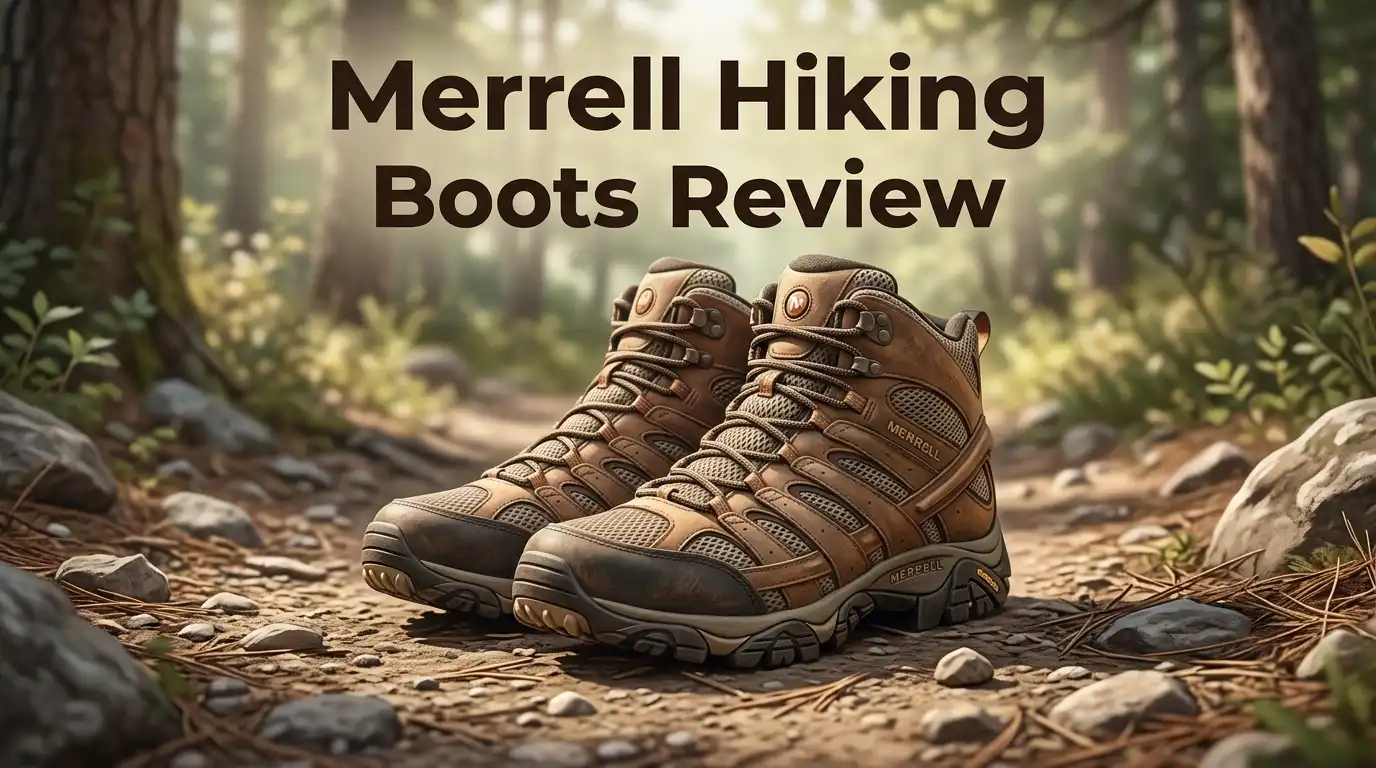
The Moab 3 Mid Waterproof is the boot most people mean when they say “Merrell hiking boots.” It uses a pig suede leather and mesh upper, a proprietary waterproof membrane, a Super Rebound Compound midsole, a molded nylon arch shank, and a Vibram TC5+ outsole with 5mm lugs. Drop sits at 11.5mm. A single boot weighs about 17.5 oz in a men’s 9, so a pair lands near 2 lbs 7 oz in size 11.
On trail, the boot feels planted rather than lively. The wide sole platform gives you a stable base on rocks and logs. The Merrell Air Cushion pod under the heel absorbs impact on hardpack better than the price suggests. It never feels plush like a Hoka, and it should not. This is a midweight hiker built for control.
The upper is the quiet highlight. Merrell splits it into flexing panels, so it moves with your foot instead of creasing into it. Padding in the tongue and collar is genuinely thick, which lets you crank the laces tight for side hill work without ankle irritation.


Last update on 2026-04-11 / Affiliate links / Images from Amazon Product Advertising API Some of the links on this website are affiliate links, which means that at no additional cost to you, I earn a commission if you click through and make a purchase. I only recommend products and services that I believe will add value to my readers. Thank you for your support!
Support sits in the middle of the pack. A mid collar helps, but this is not an ankle brace. You can carry a 30 pound pack in these comfortably, and most testers report all day wear without the foot fatigue cheap boots cause.
The main complaint is character. The Moab 3 feels slightly clunky and heavy for its size. It gets you there. It does not make the walk exciting.
Unboxing And First Impressions
The box is plain brown with the Merrell logo and a sustainability note. Nothing fancy. Inside you get the boots stuffed with paper, wrapped in thin tissue, and that is the whole presentation. No dust bag, no spare laces, no shoe horn. Merrell spends money on the boot, not the packaging, which I appreciate more than a fancy sleeve.
First lift out of the box, the weight registers. These feel like real boots. The suede has a matte, slightly fuzzy texture with visible grain, and the stitching lines are neat with double rows at the high stress panels. The Vibram badge sits on the heel, and the lug pattern looks deeper in person than in product photos.
The smell is pure suede and rubber, strong for the first day, then it fades.


Last update on 2026-04-11 / Affiliate links / Images from Amazon Product Advertising API Some of the links on this website are affiliate links, which means that at no additional cost to you, I earn a commission if you click through and make a purchase. I only recommend products and services that I believe will add value to my readers. Thank you for your support!
Pull the insole out immediately. The Kinetic Fit footbed has a firm heel cup and a modest arch ridge, and it slides back in cleanly if you want to swap in orthotics. The tongue is bellows style and fully attached, so it will not slide sideways.
Lacing takes a moment to learn. The lower eyelets are nylon loops, the top two are metal hooks. Tension pulls evenly, and one pull usually gets it right. Slip them on, stand up, and the roomy toe box is the first thing you notice. There is real space for your toes to spread, without the boot feeling sloppy at the heel.
Merrell Moab Speed 2 Mid Gore Tex Review

- The Moab Speed 2 Gore-Tex is the latest innovation in the hiking area of Merrell.
- Recycled mesh lining provides breathability.
- GORE-TEX breathable, waterproof membrane protects feet from external elements.
Last update on 2026-08-27 / Affiliate links / Images from Amazon Product Advertising API Some of the links on this website are affiliate links, which means that at no additional cost to you, I earn a commission if you click through and make a purchase. I only recommend products and services that I believe will add value to my readers. Thank you for your support!
The Moab Speed 2 Mid Gore Tex is the trail runner adjacent version of the family. It swaps suede for nylon ripstop with TPU overlays, adds a Gore Tex membrane, and rides on FloatPro Foam with a fiberglass reinforced FlexPlate in the midfoot. Retail sits near $185.
Lab measurements tell a clear story. Weight drops to 14.1 oz per boot, well under the 18.4 oz category average. Heel stack measures 40.8mm, forefoot 26.9mm, and midsole softness reads 33.5 AC, roughly 30 percent softer than the average hiking boot. Shock absorption of 108 SA beats the Moab 3 at 88 SA. So yes, it is lighter and cushier at the same time.
Then comes the catch. Energy return sits at 39.9 percent, near the bottom of the category. The name says Speed. The ride does not deliver rebound. It feels muted, grounded, and a little flat, which some hikers love and others find lifeless.
Torsional rigidity measures 20.7 Nm and forefoot flex needs only 26.0N, so this boot bends more than the Moab 3. That is fine for day hikes and light packs. It is not enough for scree, off trail travel, or heavy multi day loads.
Toe box durability scored a perfect 5 out of 5 in abrasion testing. The collar mesh scored a 1. That contrast defines this boot.
Top 3 Alternative For Merrell Moab 3 Mid Waterproof

- The stable & supportive backpacking shoe that delivers a smooth ride
- Smooth ride
- Enhanced support
Last update on 2026-08-27 / Affiliate links / Images from Amazon Product Advertising API Some of the links on this website are affiliate links, which means that at no additional cost to you, I earn a commission if you click through and make a purchase. I only recommend products and services that I believe will add value to my readers. Thank you for your support!
Salomon Quest 4 Gore Tex Hiking Boots
No products found.
KEEN Targhee 4 Mid Height Waterproof Hiking Boots

- ADVANCED TECHNOLOGY: Columbia Men's Newton Ridge Plus II Waterproof Hiking Boot features our...
- HANDY FEATURES: Treacherous days out on the trail are comfortable and worry-free with this boot's...
- ADJUSTABLE FEATURES: The Newton Ridge Plus II Waterproof Hiking Boot features a lace-up closure for...
Last update on 2026-08-27 / Affiliate links / Images from Amazon Product Advertising API Some of the links on this website are affiliate links, which means that at no additional cost to you, I earn a commission if you click through and make a purchase. I only recommend products and services that I believe will add value to my readers. Thank you for your support!
Columbia Newton Ridge Plus II Waterproof Hiking Boot
Comfort And Break In Period
This is where Merrell wins most comparisons. The Moab 3 requires no break in period. Multiple independent testers, including reviewers carrying loaded packs, report walking straight out of the box onto trail with no hot spots. That is unusual for a leather boot at any price.
Three design choices create that comfort. The segmented upper flexes at natural bend points. The collar and tongue carry extra foam. The lacing tension spreads evenly, so you rarely need to fine tune eyelet by eyelet.
The insole deserves credit too. Merrell includes a heel cup deeper than what several $220 boots offer. It cradles the heel and keeps it from sliding on descents.
Arch support is mild. If you have flat feet or plantar fasciitis, the stock footbed will feel undersupportive within a few hours. Swap in a Superfeet or Currex insole and the boot transforms. The Moab 3 has enough internal volume to accept aftermarket insoles without cramping the toes.
The Speed 2 comforts differently. Its FloatPro foam feels softer underfoot right away, and the sock like upper wraps closely. Some testers find that wrap too snug through the midfoot, especially with thick socks.
One honest caution. Comfort at hour one is not comfort at hour eight. On long descents in the Moab 3, the modest cushioning lets your toes press forward. Size accordingly and lace the top hooks tight.
Traction Testing On Real Terrain
The Vibram TC5+ compound appears on both boots, and it behaves consistently. On dry rock, wet rock, gravel, and packed dirt, grip is dependable. Lab friction testing put the Speed 2 at a 0.51 coefficient, which is functional though below the 0.60 average across tested boots.
Here is the honest limitation. The center lugs are rounded and shallow relative to aggressive backpacking soles. They shine on slab and hardpack because more rubber contacts the surface. They struggle in soft conditions.
Mud clogs these outsoles quickly. Once packed, the tread becomes a slick plate until you scrape it out. Loose forest duff, dry pine needles, and steep loose dirt all reduce confidence. Perimeter lugs are sharper and help on climbs and descents, and the heel brake bites reasonably on steep downhill sections.
Snow and ice are outside the range unless you buy the Thermo versions with Arctic Grip. Standard TC5+ hardens modestly in cold, but it is not an ice compound.
Durability of the rubber is solid. Drilling tests on the Speed 2 outsole left only a 0.6mm dent, better than average. The Moab 3 rubber is slightly softer and wears faster, though Merrell offsets this by grouping lugs densely around the perimeter.
Verdict: excellent on maintained trails, average off them. If your hikes involve wet roots, steep scree, or deep mud, look at boots with 5mm plus chevron lugs.
Waterproofing And Breathability Reality Check
Both boots keep water out. That part works. The Moab 3 uses an unnamed proprietary membrane, and testers walked through creeks, muddy meadows, and slushy snow with dry socks. The Speed 2 pairs Gore Tex with a fully gusseted tongue, which raises the effective flood height to just below the collar.
Now the part product pages avoid. Breathability is poor. Independent testing scored the Speed 2 at 34 BR, one of the lowest results across a 13 boot comparison group where the average is 46 BR. Drying potential measured 19 percent moisture evaporation over three hours against a 25 percent average.
In plain terms, your feet will sweat, and the sweat will stay inside. On a warm afternoon with sustained climbing, expect damp socks even if you never touch water. Damp socks plus friction equals blisters, so merino liners and a mid hike sock change matter here.
The Moab 3 breathes slightly better thanks to mesh side panels, but it is still a waterproof boot with the usual penalty. Merrell sells a ventilated version of the Moab 3 without the membrane, and for desert, summer, or dry climate hiking, that model is the smarter buy.
Also worth knowing. Once a waterproof boot floods over the collar, it holds water and drains slowly. Waterproof does not mean quick drying. Plan around that on stream heavy routes.
Weight, Speed, And Long Day Performance
Weight numbers matter more than most buyers expect. A pair of Moab 3 Mid Waterproof boots weighs roughly 2 lbs 7 oz in size 11. A pair of Speed 2 Mid Gore Tex lands near 1 lb 12 oz. That gap of about 11 oz per pair translates into thousands of ounces lifted over a 15 mile day.
The Speed 2 feels noticeably quicker on foot. Testers describe it as nimble and easy to move fast in, especially on rolling terrain. The lower cuff volume and thinner padding help too.
The Moab 3 feels sturdier but clunkier. The wide sole footprint that gives it stability also makes it slower to place precisely between rocks. It never feels agile.
Cushioning affects fatigue as much as weight. The Speed 2 absorbs more shock at 108 SA, so joint fatigue arrives later on hard surfaces. But with near zero energy return, neither boot gives anything back. You supply all the propulsion.
For a 5 to 8 mile day hike, the difference barely registers. For a 15 mile day, or a fast overnight with a light pack, the Speed 2 wins clearly. For 35 pound loads over three days, the Moab 3 stiffer shank wins instead.
Match the boot to the distance and the load, not to the brand story.
Durability After Hundreds Of Miles
This is the section that keeps Merrell out of the top tier. Neither boot is built for five seasons of hard use.
The Moab 3 upper carries many sewn seams. Seams give sticks and rock edges something to catch. Merrell uses double row stitching in the high stress panels, but single row appears elsewhere, and fraying starts there first. Boots with smooth full grain leather sidewalls simply last longer.
The nylon lace loops are the biggest concern. Metal hooks sit at the ankle, but the lower loops are fabric, and fabric loops fray after repeated abrasion. Replacing them is possible but tedious.
The Speed 2 splits the difference in an odd way. Its ripstop toe box survived aggressive abrasion testing with zero visible damage, earning a perfect score. Its collar mesh tore apart in seconds under the same test, earning the lowest possible score. Expect the heel collar to shred before anything else fails.
Outsole life is decent. Most owners report 400 to 600 miles before lugs round off enough to matter, less on abrasive granite and pavement.
Realistic expectation: one heavy season or two moderate seasons of use, then replacement. At $150 to $185 that is acceptable value, though it is not the buy once philosophy some brands sell.
Sizing And Fit Guide
The Moab 3 fits true to size for most people. Order your normal running shoe size, or a half size up if you wear thick winter socks or hike long descents. Merrell offers regular and wide widths, and the wide version is genuinely wide, not just longer.
Toe box space improved noticeably over the Moab 2. There is room for toe splay without a sloppy feel, and narrow footed hikers can still cinch the laces down to a secure fit. That dual capability is rare.
The Speed 2 fits slightly small. Owner votes lean that direction, and internal length measured 267.0mm against a 270.8mm average. Widest interior width came in at 91.4mm versus a 94.0mm average, so the medium width is snug. If you have 2E feet or bunions, buy the wide version or skip this model. Toe box height is fine at 27.3mm, so vertical pressure is not an issue.
A few practical fit notes. Wear the socks you actually hike in when trying boots on. Test on a store incline board, not just flat carpet. Check heel lift by walking uphill, and if your heel slips more than a few millimeters, use a runner’s loop lacing at the top eyelets.
Merrell heel cups are moderately narrow, which helps most people and frustrates a few.
What These Boots Do Not Do Well
Every review should include this section, so here it is plainly.
They do not handle technical terrain. The mid collar offers modest ankle support, the shank is only moderately stiff in the Moab 3 and quite flexible in the Speed 2, and neither boot is crampon compatible. Off trail scree, alpine approaches, and boulder fields call for a stiffer boot.
They do not breathe. Both waterproof versions trap heat and moisture. Summer hikers in humid climates will finish with soaked socks regardless of terrain.
They do not grip in mud. The lug design clogs, and cleaning it mid hike is annoying.
They do not feel exciting. Energy return is near the bottom of the category. These boots are transportation, not performance equipment.
They do not last as long as premium boots. Nylon eyelets, numerous seams, and fragile collar mesh set a ceiling on lifespan.
They do not fit narrow heels perfectly. Some users report heel slip, especially in the Moab 3, which lacing tricks reduce but do not eliminate.
Finally, quality control varies. Owner reports mention occasional glue lines, uneven suede coloring, and one boot fitting slightly tighter than the other. This is high volume manufacturing, and inspection standards match the price point.
Pros And Cons
Merrell Moab 3 Mid Waterproof Pros
- Zero break in period, comfortable from the first mile, which is rare for a leather boot at any price.
- Roomy toe box with a secure midfoot, and a genuine wide width option that fits properly rather than just running longer.
- Strong price to performance ratio near $150 to $175, well below the $210 category average.
- Stable, wide sole platform that handles a 30 pound pack without complaint.
- Vibram TC5+ outsole grips rock, slab, and hardpack reliably.
- Deep heel cup and removable insole that accepts orthotics easily.
Merrell Moab 3 Mid Waterproof Cons
- Feels heavy and clunky compared to modern lightweight hikers.
- Lugs clog in mud and lose bite on loose dirt and forest duff.
- Breathability is limited, so feet get damp on warm climbs.
- Nylon lace loops and multiple single row seams shorten lifespan.
- Cushioning is firm, which some hikers find harsh on long road sections.
Merrell Moab Speed 2 Mid Gore Tex Pros
- Light at 14.1 oz per boot, well under the category average.
- Softer, better cushioned ride with 108 SA shock absorption.
- Gore Tex plus a fully gusseted tongue delivers reliable water protection.
- Outstanding toe box abrasion resistance and durable outsole rubber.
- Reflective heel details and two carabiner ready pull loops.
Merrell Moab Speed 2 Mid Gore Tex Cons
- Almost no energy return at 39.9 percent, so the ride feels flat.
- Collar mesh failed abrasion testing badly and will wear early.
- Very low breathability at 34 BR with slow drying.
- Runs slightly small and narrow in standard width.
- Too flexible for heavy loads or serious off trail travel.
Price And Value In 2026
Pricing has shifted. The average hiking boot in the tested category now sits near $210, and flagship models from Salomon, Lowa, and Hoka regularly cross $230. Against that backdrop, Merrell looks like the value play.
The Moab 3 Mid Waterproof lists near $175 and frequently sells between $110 and $150 during seasonal promotions. At that price it delivers roughly 85 percent of the performance of boots costing $80 more. The gap shows up in durability and technical terrain, not in comfort.
The Moab Speed 2 Mid Gore Tex lists near $185, which is fair for a Gore Tex boot with real lab credentials, though the collar durability issue makes it a harder recommendation at full price.
Cost per mile is the number that matters. If a $150 Moab 3 gives you 500 trail miles, that is 30 cents per mile. If a $230 premium boot gives you 900 miles, that is 26 cents per mile. The premium boot wins slightly on math, but only if you actually hike enough to reach those miles.
For someone hiking 15 to 30 days per year, the Moab 3 is the smarter purchase. For someone hiking 80 days per year with a heavy pack, the extra money buys real longevity.
Watch for sales in late summer and January when new colorways arrive.
Who Should Buy And Who Should Skip
Buy the Moab 3 Mid Waterproof if you hike maintained trails, want comfort without a break in period, carry loads under 35 pounds, have medium or wide feet, or want your first serious hiking boot without spending $230. It also works well for travel, dog walking in bad weather, light yard work, and job sites that allow soft toe footwear.
Buy the Moab Speed 2 Mid Gore Tex if you prioritize low weight, hike day distances rather than multi day routes, prefer a softer underfoot feel, and accept that the collar will wear early. Choose the wide version unless you know your feet are narrow.
Skip both if you need serious ankle support, hike technical alpine terrain, carry 45 pound expedition loads, hike in hot humid climates where breathability matters most, or want boots that survive five seasons of hard use.
Also skip if you have severe pronation or need aggressive arch support, unless you plan to buy aftermarket insoles immediately.
Consider the Salomon Quest 4 Gore Tex for support and off trail stability, the KEEN Targhee 4 for a wider forefoot with a firmer sole, and the Columbia Newton Ridge Plus II if budget is the deciding factor.
My overall verdict: the Moab 3 earns a solid recommendation in 2026, not because it excels anywhere, but because it fails almost nowhere at a price most people can justify.
Frequently Asked Questions
Are Merrell hiking boots good for wide feet?
Yes. Merrell is one of the few major brands that stocks true wide widths across the Moab line in both men’s and women’s sizing. The standard Moab 3 already runs roomier in the forefoot than most competitors, and the wide version adds real volume rather than just extra length. The Speed 2 runs narrower, so wide footed hikers should go straight to the wide model.
How long do Merrell Moab 3 boots last?
Most owners report 400 to 600 trail miles before the outsole rounds off or the upper seams begin fraying. Heavy hikers on abrasive terrain see closer to 300 miles. The nylon lace loops and stitched seams typically fail before the rubber does. With moderate weekend use, expect two seasons.
Is the Moab 3 better than the Moab 2?
Yes, in most ways. The Moab 3 has a more supportive insole, a softer midsole, a roomier toe box, and a Vibram TC5+ outsole. Some longtime Moab 2 owners prefer the older fit, which felt slightly narrower and lower volume, so it is not universal. For new buyers, the Moab 3 is the better boot.
Do I need the Gore Tex version or the standard waterproof version?
The standard Merrell membrane keeps water out effectively and costs less. Gore Tex generally breathes better and carries a stronger warranty position. If you hike in cool wet conditions, Gore Tex is worth the upgrade. If you hike in dry or hot climates, consider the ventilated non waterproof version instead, since breathability will matter more than water protection.
Can I use Merrell Moab boots for backpacking?
For loads up to about 35 pounds on established trails, yes. The Moab 3 nylon shank provides enough torsional support for that range, and testers have carried full packs comfortably. Above 40 pounds or off trail, a stiffer boot such as the Salomon Quest 4 handles the load better and protects your feet from sharp rock underfoot.
Should I size up in Merrell hiking boots?
The Moab 3 fits true to size for most people. Size up half a size if you wear thick socks, expect foot swelling on long days, or plan sustained descents. The Speed 2 runs slightly small, so half a size up is the safer choice there. Always test with your actual hiking socks.

Mia Smith is the founder of Shoe Storyteller, a blog that celebrates the art and stories behind shoes. With a passion for fashion and a flair for storytelling, Mia brings a unique perspective to the world of footwear.