Hoka Hopara 2 Review 2026: Still Worth It?
Water shoes usually force a choice. You either get grip or you get cushion. The Hoka Hopara 2 tries to give you both in one closed toe package. It looks like a hiking shoe that fell into a river and decided to stay there.
I have worn this sandal on wet granite, gravel fire roads, boat decks, and grocery store runs. It surprised me in good ways. It also annoyed me in a few very specific ways that most reviews skip over.
This review covers the real numbers, the unboxing, the comfort, the grip failures, and the sizing traps. By the end you will know if the Hopara 2 belongs in your closet or if your money belongs somewhere else.
In a Nutshell:
- Cushioning is the headline feature. Lab testing measured shock absorption at 123 SA, which beats the average hiking sandal and even rivals some hiking shoes. Your feet stay fresh after six hours of standing.
- It is lighter than the original. The Hopara 2 weighs roughly 11.6 oz per shoe in a men’s US 9. That is a full ounce lighter than the first Hopara, thanks to Cordura mesh replacing thick synthetic overlays.
- Grip is strong on wet rock but weak on loose silt. Testers slid down scree slopes and had to use their hands. The 3.0 mm lugs handle mossy stream beds beautifully and fail on sandy scrambles.
- Sand is the enemy. This is the biggest flaw. Sand and pebbles get inside and refuse to leave. You must remove the shoe and rinse it out.
- The fit runs roomy. Wide feet will love it. Narrow feet will swim in it, even with the new Velcro heel strap cinched down.
- Price sits around $135 to $140 retail. That feels fair because one pair replaces both your camp sandals and your water shoes.
What Is the Hoka Hopara 2?

- Topically applied PFC-Free water repellency treatment
- Textile
Last update on 2026-09-22 / Affiliate links / Images from Amazon Product Advertising API Some of the links on this website are affiliate links, which means that at no additional cost to you, I earn a commission if you click through and make a purchase. I only recommend products and services that I believe will add value to my readers. Thank you for your support!
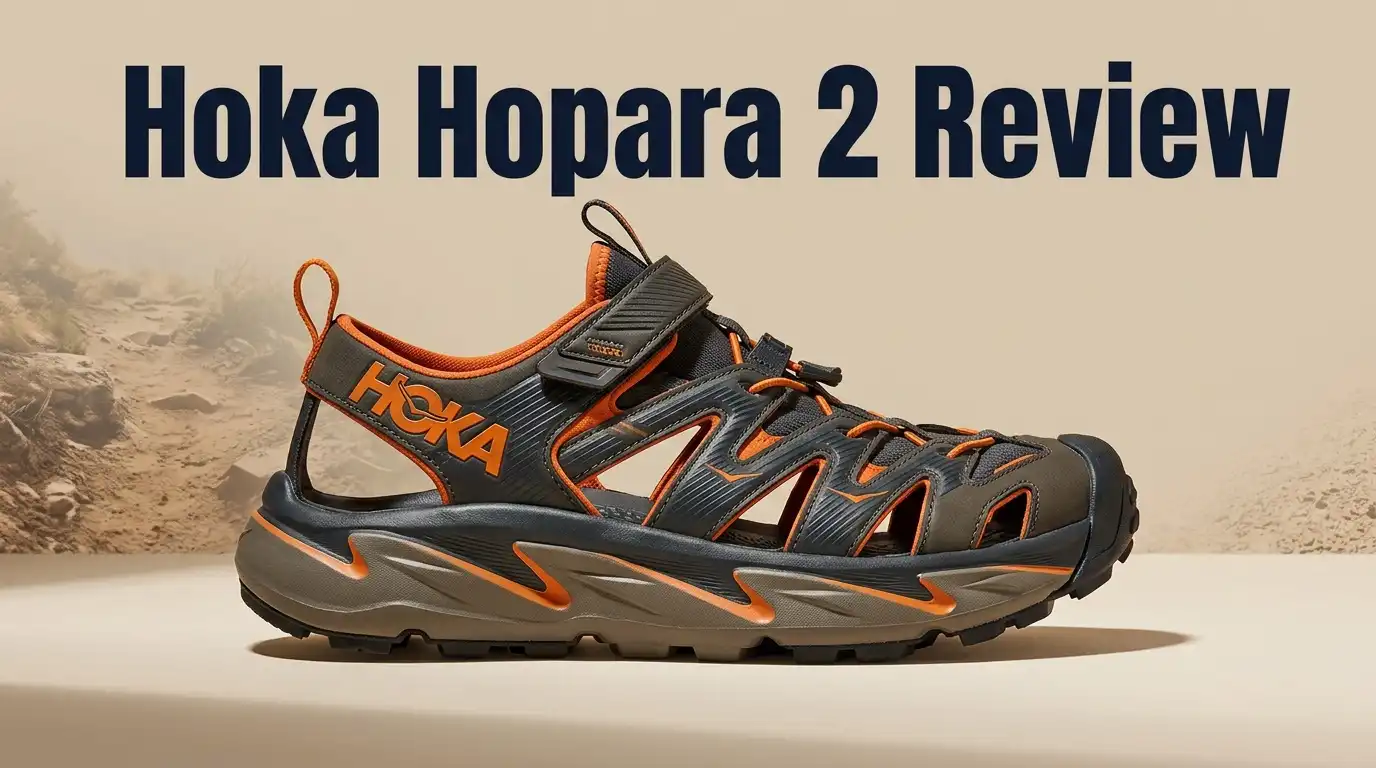
The Hopara 2 is a closed toe water sandal built on a Hoka midsole. Think of it as a hybrid. The chunky rockered sole comes straight from Hoka’s hiking line. The open sides, drainage ports, and bungee lacing come from the water shoe world.
Hoka released the second version with three meaningful updates. The upper switched to recycled Cordura mesh. The ankle collar became a soft knit sock style cuff instead of neoprene. A Velcro strap arrived at the heel for fit control.
The target user is clear. This shoe exists for people who hike near water. Creek crossings, waterfall trails, kayak launches, rocky shorelines, and cruise ship excursions all fit the brief.
It is not a flip flop replacement. You cannot slip it on in two seconds. You also cannot pack it flat in a carry on bag. It behaves like a shoe because it basically is one.
Unboxing Experience and First Impressions
The box arrives in Hoka’s usual matte cardboard with the brand wordmark on the lid. Inside you get tissue paper, a small care card, and the pair sitting sole to sole. No extra laces. No dust bag. Nothing fancy.
The first thing you notice is the weight distribution. Pick one up and the sole feels dense while the upper feels like nothing. The mesh is thin enough to see light through. The toe bumper, by contrast, feels like a car bumper.
Slipping the first one on takes a moment of learning. The knit collar needs a firm stretch. The fabric loop at the heel exists for this exact reason, and you will use it every single time.
My honest first reaction was mild disbelief. The sole looked enormous, almost comical, like platform footwear for hikers. Then I stood up and the boat shaped midsole cradled my foot lower than expected. The height illusion faded immediately.
Design and Build Quality
The construction quality is genuinely impressive. The Cordura mesh panels come from the same fabric family used in military gear and heavy duty backpacks. Abrasion testing showed the toe cap resisting a Dremel better than several full hiking shoes.


Last update on 2026-04-11 / Affiliate links / Images from Amazon Product Advertising API Some of the links on this website are affiliate links, which means that at no additional cost to you, I earn a commission if you click through and make a purchase. I only recommend products and services that I believe will add value to my readers. Thank you for your support!
The midsole uses two foam layers. A softer top layer at roughly 45 AC sits above a firmer bottom layer at roughly 55 AC. The soft layer gives step in comfort. The firm layer protects your foot and extends the lifespan.
The sole measures 121.9 mm wide at the forefoot. That makes it the widest platform among tested hiking sandals, edging out the Keen Newport H2. The heel measures 98.4 mm, roughly 8 mm wider than average.
Sustainability gets real attention here. The upper knit is 100 percent recycled. The Cordura mesh is 100 percent recycled. The midsole and topsole contain 30 percent sugarcane derived material.
Nothing on my pair has frayed, peeled, or separated. The stitching looks clean under a bright light.
Top 3 Alternative for Hoka Hopara 2

- MATERIAL: Adjustable bungee cords and pull-on design make it easier to put on and take of; Quick dry...
- FIT: KEEN Original Fit gives generous space for toes to spread out making these hybrid sandals...
- CLOSURE: Lace lock bungee capture system provides a secure fit while offering a quick and easy way...
Last update on 2026-09-22 / Affiliate links / Images from Amazon Product Advertising API Some of the links on this website are affiliate links, which means that at no additional cost to you, I earn a commission if you click through and make a purchase. I only recommend products and services that I believe will add value to my readers. Thank you for your support!


Last update on 2026-04-11 / Affiliate links / Images from Amazon Product Advertising API Some of the links on this website are affiliate links, which means that at no additional cost to you, I earn a commission if you click through and make a purchase. I only recommend products and services that I believe will add value to my readers. Thank you for your support!
KEEN Men’s Hyperport H2

- WATER-RESISTANT: Quick dry washable synthetic straps and lining for active use in and out of the...
- SUPPORT & COMFORT: Lace lock bungee capture system provides a secure fit while offering quick and...
- TRACTION & PROTECTION: Multi directional lugs with siping channels provide superior grip on slippery...

Last update on 2026-09-22 / Affiliate links / Images from Amazon Product Advertising API Some of the links on this website are affiliate links, which means that at no additional cost to you, I earn a commission if you click through and make a purchase. I only recommend products and services that I believe will add value to my readers. Thank you for your support!
KEEN Men’s Newport H2

- Quick-dry webbing made from recycled plastic using traceable, verifiable REPREVE polyester yarn by...
- Injection-molded strap ends for quick and easy grip and adjustability, Easy hook-and-loop closure...
- Robust EVA footbed for enhanced comfort built for all-day wear
Last update on 2026-06-08 / Affiliate links / Images from Amazon Product Advertising API Some of the links on this website are affiliate links, which means that at no additional cost to you, I earn a commission if you click through and make a purchase. I only recommend products and services that I believe will add value to my readers. Thank you for your support!
Teva Women’s Hurricane XLT2
Comfort and Cushioning on Long Days
This is where the Hopara 2 earns its price tag. Shock absorption measured 123 SA in the heel against a category average of 116 SA. You feel that difference immediately on hard packed trail.
Forefoot stack sits at 23.0 mm, about 5 mm thicker than average. That extra foam under the ball of your foot matters more than heel stack for most walkers. Sharp gravel simply disappears underfoot.
The heel stack measures only 26.2 mm, which surprised testers. The sandal looks taller than it is because the midsole walls rise around your foot instead of stacking under it.
Measured drop came in at 3.2 mm rather than the advertised 6 mm. A lower drop keeps your heel closer to level with your toes, which improves balance on uneven rock.
One honest note on break in. Some testers felt a hot spot developing around mile two while wearing socks. It faded and never became a blister, but the first few miles need attention.
Fit and Sizing Guide

- 100% RECYCLED KNIT UPPER
- TEXTILE, SYNTHETIC
Last update on 2026-09-22 / Affiliate links / Images from Amazon Product Advertising API Some of the links on this website are affiliate links, which means that at no additional cost to you, I earn a commission if you click through and make a purchase. I only recommend products and services that I believe will add value to my readers. Thank you for your support!
The Hopara 2 fits true to size for most people based on user voting. Internal length in a US 9 measured 259.1 mm, slightly shorter than average, so do not size down out of habit.
Width is the real conversation. The toebox measured 104.1 mm at its widest point. Wide footed hikers finally get room without buying a specialty width. Toes spread naturally on steep descents.
Narrow feet face a problem. Testers described the fit as loose and sloppy without socks. The bungee toggle tightens the instep but does nothing for forefoot volume. There is no adjustable forefoot strap.
The Velcro heel strap helps but does not solve everything. It locks your ankle down and stops heel lift. It cannot shrink the toebox.
My advice is simple. Wear a midweight sock if you sit between sizes or have slim feet. Socks transform the fit and also solve the pebble problem discussed below.
Traction and Grip on Real Terrain
Lug depth measures 3.0 mm, exactly average for the category. Depth alone does not tell the story though. The outsole mixes sticky rubber zones, exposed foam, and varied lug shapes.
Wet rock performance is excellent. Mossy creek stones, slick boat ramps, and rain soaked granite all felt secure. This is the terrain the shoe was built for and it delivers.
Dry dirt, grass, gravel, and bare rock at moderate angles all pose no issue. The rockered shape rolls you forward smoothly.
Then comes the failure. One tester descending a steep scree face had to sit down and use her hands for balance. Loose silty surfaces overwhelm the outsole completely. The rubber feels slightly plasticky rather than tacky on dust.
Deep mud is another weak spot. Three millimeter lugs clog fast. If mud is your normal terrain, buy a hiking shoe with 4 mm lugs or deeper.
Water Drainage and Drying Speed
The Cordura mesh upgrade improved drainage substantially over the first Hopara. Water exits through the mesh panels and the open sole channels within seconds of stepping out of a stream.
The upper is treated with a water repellent finish. That sounds contradictory for a water shoe, but it means the fabric does not soak up and hold moisture like a sponge. Less retained water means less weight on the second half of your hike.
Drying time at room temperature runs a few hours for the mesh and longer for the foam collar. Direct sun cuts that down considerably.
The knit collar is the slowest part to dry. It holds moisture the way a thick sock does. Overnight drying is realistic rather than a quick lunch break turnaround.
Rinsing is easy. Cold water, mild soap, air dry away from heat. Never put these in a dryer because heat damages the adhesives and foam.
Weight and Packability
A pair weighs roughly 20.8 oz, or 1 lb 4.8 oz. Hoka lists the men’s shoe at 12.90 oz individually. Lab testing of a men’s US 9 returned 11.6 oz.
Those numbers make it heavy for a sandal and light for a shoe. Compared against traditional strap sandals, the Hopara 2 is among the heaviest options available. Compared against closed toe water sandals specifically, it is the lightest tested.
Packability is poor. The sole does not compress or fold. These occupy real estate in a backpack the same way sneakers do.
Here is the counterargument worth considering. If the Hopara 2 replaces both your trail shoes and your camp sandals, your total packed weight drops. One pair doing two jobs beats two pairs doing one job each.
Backpackers who count grams will still reach for minimal strap sandals as a second pair. That is a fair call.
Durability After Real Miles
Outsole durability testing produced one of the better results in the category. After 22 seconds of high speed drilling, wear measured just 0.7 mm deep against a 1.2 mm average. The rubber hardness registered 82.9 HC.
Long term owner reports back this up. Multiple users report wearing the Hopara line for a year or more with the fit still snug and the tread still present. That is unusual for water footwear.
The toe cap is the durability star. It shrugs off rock strikes that would shred a mesh trail runner.
One area concerns me over time. The soft stretchy knit at the ankle collar takes repeated stress every time you pull the shoe on. That material could lose elasticity or fray after a couple of seasons. Use the heel loop rather than yanking the collar.
Outsole thickness sits at 2.7 mm, slightly above the category average of 2.4 mm.
What the Hopara 2 Does Not Do Well
Honest reviews list failures, so here they are without sugarcoating.
Sand is the deal breaker for beach users. Grains work their way in through the mesh and then refuse to exit. You cannot shake them out the way you can with open strap sandals. You must stop, remove the shoe, and rinse. On a sandy beach day this becomes genuinely irritating.
Silty scrambles produce the same problem with small pebbles. Wearing socks fixes it. Going sockless invites it.
Traction on loose dust is unreliable. Do not trust these on scree descents.
The quick toggle lace jams. Testers reported needing to press the toggle sides in a very particular way to release it. It is a small daily friction point.
Color photos online do not match reality. The Barley and Oat Milk colorway in particular looks different in person than in studio shots.
Finally, the midsole feels firm rather than plush despite the thickness.
Pros and Cons
Here is the balance sheet in plain terms.
Pros
- Outstanding cushioning with 123 SA shock absorption, beating most hiking sandals and some hiking shoes.
- Lightest closed toe water sandal tested at roughly 11.6 oz per shoe in men’s US 9.
- Extremely durable toe cap and Cordura mesh upper that resist abrasion better than many hiking shoes.
- Excellent grip on wet rock, boat decks, and stream beds.
- Widest tested platform at 121.9 mm forefoot, which delivers real stability on uneven ground.
- Adjustable Velcro heel strap and improved knit collar give better lockdown than version one.
- Recycled and sugarcane based materials throughout.
Cons
- Sand and small pebbles get trapped inside and require removing the shoe to clear.
- Traction fails on loose silt and scree.
- Too heavy and bulky to pack as a second pair of shoes.
- Roomy toebox leaves narrow feet with a sloppy fit and no forefoot adjustment.
- Toggle lace mechanism sticks and takes practice.
- Firmer ride than the thick midsole suggests.
Hopara 2 vs the Original Hopara
The differences are meaningful enough to justify the upgrade if you own version one.
Weight dropped by a full ounce. The original measured 12.6 oz per shoe. The second version measures 11.6 oz. Replacing thick synthetic leather overlays with Cordura mesh did most of that work.
The heel strap is new. Version one had no ankle adjustment, and many owners complained the heel felt insecure. The Velcro strap directly answers that complaint.
The collar changed from neoprene to knit. Knit sits closer to your skin, feels more sock like, and blocks debris more effectively than the old bootie.
Drainage improved because mesh moves water faster than layered synthetic panels. Ventilation improved for the same reason.
The toggle lace lost the annoying knob that used to press against the instep.
Some owners still prefer the original’s looks. Version one has a cleaner, less technical appearance. Performance clearly favors version two.
Price and Value in 2026
Retail sits at $135 on Hoka’s own site, with some retailers listing $140. Amazon pricing swings between roughly $120 and $152 depending on colorway, size, and seller.
Discounted colorways are the smart play. Unpopular colors regularly drop below $125. The shoe performs identically regardless of color, so let your budget choose the shade.
Value depends on how you use it. As a single purpose beach shoe, $135 is poor value because cheaper sandals handle sand better. As a combined hiking shoe and water shoe, the math works.
Compare against buying two products. A pair of trail shoes plus a pair of camp sandals easily exceeds $200. The Hopara 2 covers both roles for one price and one slot in your closet.
Durability strengthens the case. Owners reporting more than a year of regular wear means the cost per use stays low over time.
Who Should Buy the Hoka Hopara 2?
Buy this sandal if you hike near water. Creek crossings, waterfall trails, rocky shorelines, and river canyons all play to its strengths. The toe cap and grip combination handles that terrain better than anything strap based.
Travelers get strong value here. Cruise excursions, rainy city walking, and mixed terrain day trips all suit a shoe that dries fast and looks acceptable at dinner.
People who stand all day should consider it too. Gardeners, boat crew, and anyone on their feet for hours will appreciate the cushioning and the wide stable base.
Skip it if you have narrow feet. The Keen Newport H2 offers a slimmer footbed and tapered toebox that fits better.
Skip it if you want a beach sandal. The sand issue is not a minor complaint, it is a genuine daily frustration.
Skip it if you need a packable second pair. Traditional strap sandals fold flat and weigh half as much.
Frequently Asked Questions
Does the Hoka Hopara 2 run true to size?
Yes, most users report true to size fit. The toebox runs wide though, so narrow feet may want socks or a different model entirely.
Can you wear the Hopara 2 in salt water?
Yes. Rinse with fresh water afterward to prevent salt buildup on the foam and mesh. Air dry away from direct heat.
Is the Hopara 2 good for actual hiking?
Yes for light to moderate trails, wet terrain, and rocky paths. No for deep mud, scree slopes, or technical alpine routes.
How long does the Hopara 2 take to dry?
The mesh dries within a few hours. The knit ankle collar takes longer, often overnight indoors or a couple of hours in direct sun.
Can you wear socks with the Hopara 2?
Absolutely, and many owners do. Socks improve the fit for narrow feet and prevent pebbles from irritating your skin.
Is the Hopara 2 worth upgrading from version one?
Yes if fit and drainage bothered you. The heel strap, lighter weight, and better mesh solve the main complaints about the original.
What is the heel to toe drop?
Hoka lists 6 mm for men and 5 mm for women. Independent lab measurement found the actual drop closer to 3.2 mm.

Mia Smith is the founder of Shoe Storyteller, a blog that celebrates the art and stories behind shoes. With a passion for fashion and a flair for storytelling, Mia brings a unique perspective to the world of footwear.