
Hoka Hiking Shoes Men’s Review 2026: Still Worth It?
Hoka started as a running brand. Today it sits on the gear list of serious hikers, thru hikers, and weekend trail walkers. The thick foam midsoles, the wide platforms, and the Vibram outsoles changed how men think about hiking footwear. Heavy leather boots no longer feel like the only safe choice.
But big foam creates big questions. Do these shoes last? Do they grip wet granite? Do they hold up under a 40 pound pack?
I have logged miles in several Hoka models across rocky ridgelines, muddy forest paths, and long gravel approaches. This review covers the real performance, the honest flaws, and the models that deserve your money in 2026.
In A Nutshell:
- Comfort is the main reason to buy. Hoka hiking shoes deliver more foam than almost any competitor. The Anacapa 2 Low GTX measures roughly 36 mm of stack under the heel. Your joints notice the difference after mile 10.
- Traction is genuinely good. Most Hoka hiking models use Vibram Megagrip rubber with 5 mm lugs. Grip on loose dirt, wet roots, and steep descents is confident. Smooth wet rock still demands care.
- Durability is the weak spot. Exposed foam sections on the midfoot wear faster than rubber. Mesh uppers on the running style models scuff early. Expect 400 to 600 miles, not 1,000.
- Sizing runs narrow for some feet. The toebox measures slightly below average in width. Wide sizes exist and most men with broad feet should order them.
- The lineup splits into clear jobs. The Anacapa 2 Low GTX handles day hikes. The Kaha 3 GTX carries heavy packs. The Speedgoat 6 moves fast and light.
- Price sits high. You will pay $155 to $240. The comfort justifies it for many hikers, though budget boots from Merrell cost far less.
Why Hoka Hiking Shoes Keep Winning Fans

- PFC-Free water repellency treatment
- Textile
Last update on 2026-10-03 / Affiliate links / Images from Amazon Product Advertising API Some of the links on this website are affiliate links, which means that at no additional cost to you, I earn a commission if you click through and make a purchase. I only recommend products and services that I believe will add value to my readers. Thank you for your support!
The appeal starts the second you step in. Hoka builds a wide, rockered platform with soft compression molded EVA foam. That shape rolls your stride forward instead of forcing your foot to bend.
For hikers with plantar fasciitis, sore knees, or old ankle injuries, this matters more than any marketing claim. The foam absorbs shock that a stiff leather boot transfers straight into your legs.
The second reason is weight. Traditional backpacking boots often pass 2 pounds 8 ounces per pair. Hoka delivers similar protection at lower weight in several models. Less weight on your feet means less energy burned over a full day.
The third reason is simple fatigue reduction. After six hours on rocky trail, cushioned shoes leave your feet feeling fresher. That single benefit converts most skeptics.
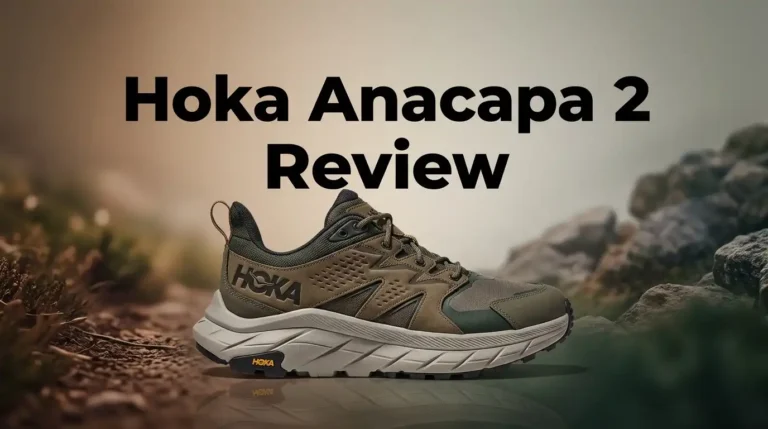
Hoka Anacapa 2 Low GTX: The Best All Day Day Hiker
This is the model most men should start with. The Anacapa 2 Low GTX uses gold rated waterproof nubuck leather panels, GORE TEX Invisible Fit waterproofing, and a Vibram Megagrip outsole with 5 mm chevron lugs.
Weight lands near 14.1 ounces per shoe in a men’s size 9. Stack height measures about 36 mm at the heel and 24 mm at the forefoot. The claimed drop is 8 mm.
On trail it feels like a cushioned cruiser. Rocks disappear underfoot. The wide 117 mm forefoot platform creates strong side to side stability, which surprises people who assume tall foam means wobble.
The trade off is agility. That wide base feels clumsy on narrow technical scrambles where you need precise foot placement.
Pros
- Excellent shock absorption for long mileage days
- Fully waterproof GORE TEX that stays dry in stream crossings
- Wide stable platform resists rolling
- Thick 7 mm insole adds real underfoot padding
- Stiff torsional structure supports a moderate pack
Cons
- Nearly zero breathability, so feet run hot in summer
- Toebox measures narrower than average
- Exposed midfoot foam wears early
- Laces loosen without a double knot
- No reflective details for dawn or dusk walking
Unboxing The Anacapa 2 Low GTX
The box arrives plain and recycled, nothing fancy. Inside, the shoes sit wrapped in thin tissue with a small cardboard insert in each toe. No dust bag, no spare laces, no shoe horn.


Last update on 2026-04-11 / Affiliate links / Images from Amazon Product Advertising API Some of the links on this website are affiliate links, which means that at no additional cost to you, I earn a commission if you click through and make a purchase. I only recommend products and services that I believe will add value to my readers. Thank you for your support!
Lift them out and the first impression is leather smell and surprising lightness. The nubuck feels soft, almost suede like, not stiff like old school hiking leather. The tongue is plush at around 10 mm of foam.
Slide your foot in. The heel collar on version two has a cleaner, lower cut than the original, so your Achilles does not catch on anything.
First steps on carpet feel bouncy and slightly unstable until your brain adjusts. That adjustment takes about two walks. Break in time is nearly zero, which is the real luxury here.
Hoka Kaha 3 GTX: The Pack Carrying Boot

- Pinnacle Plushness with Weather-Ready Capabilities
Last update on 2026-10-03 / Affiliate links / Images from Amazon Product Advertising API Some of the links on this website are affiliate links, which means that at no additional cost to you, I earn a commission if you click through and make a purchase. I only recommend products and services that I believe will add value to my readers. Thank you for your support!
The Kaha 3 GTX is the mid cut option for loaded hikes. It weighs roughly 19 to 20 ounces per boot in a men’s size 9 and carries a 7 mm drop. Ankle coverage reaches about 7.5 inches.


Last update on 2026-04-11 / Affiliate links / Images from Amazon Product Advertising API Some of the links on this website are affiliate links, which means that at no additional cost to you, I earn a commission if you click through and make a purchase. I only recommend products and services that I believe will add value to my readers. Thank you for your support!
Hoka added GORE TEX Invisible Fit, a rubber toe cap, and an Achilles friendly collar that removes pressure from the back of your heel. The Vibram Megagrip outsole runs deep lugs for loose scree.
Testers have taken this boot up Kilimanjaro and reported dry feet and zero blisters. Lockdown is the standout quality. The heel stays planted even on steep sidehill traverses.
It is not light and it is not cheap at around $240. Hot weather hikers will sweat in it. But for 30 to 45 pound loads, it offers comfort that leather boots cannot match.
Pros
- Outstanding cushioning under heavy pack weight
- Genuine ankle support without feeling rigid
- Reliable waterproof performance in snow and mud
- Secure heel hold with no slippage
- Works for wide feet better than most Hoka models
Cons
- Heavy compared to low cut hiking shoes
- Runs warm in summer temperatures
- High price for a non leather welted boot
- Tall stack reduces ground feel on technical rock
Top 3 Alternative for Hoka Anacapa 2 Low GTX

- Pinnacle Plushness with Weather-Ready Capabilities
Last update on 2026-09-08 / Affiliate links / Images from Amazon Product Advertising API Some of the links on this website are affiliate links, which means that at no additional cost to you, I earn a commission if you click through and make a purchase. I only recommend products and services that I believe will add value to my readers. Thank you for your support!
Hoka Men’s Kaha 3 Low GTX

- Textile, Synthetic
- Polyurethane
Last update on 2026-10-03 / Affiliate links / Images from Amazon Product Advertising API Some of the links on this website are affiliate links, which means that at no additional cost to you, I earn a commission if you click through and make a purchase. I only recommend products and services that I believe will add value to my readers. Thank you for your support!
Hoka Men’s Challenger 7 GORE TEX

- Boot construction with GORE-TEX waterproof membrane
- CMEVA midsole with HUBBLE and SwallowTail design
- 5mm Flights
Last update on 2026-10-03 / Affiliate links / Images from Amazon Product Advertising API Some of the links on this website are affiliate links, which means that at no additional cost to you, I earn a commission if you click through and make a purchase. I only recommend products and services that I believe will add value to my readers. Thank you for your support!
Hoka Men’s Trail Code GTX
Hoka Speedgoat 6: Fast And Light On Trail
Plenty of hikers skip hiking shoes entirely and hike in trail runners. The Speedgoat 6 is the most popular choice in that category. It costs around $155 and delivers roughly 124 SA of heel shock absorption in lab testing.
The Vibram Megagrip outsole with Traction Lug rubber bites hard into dirt, mud, and wet wood. The upper is breathable woven mesh, so your feet stay cooler than any GORE TEX model.
This is the shoe for summer day hikes, fastpacking, and long gravel approaches.
Durability is the honest problem. Users report midsole compression and upper wear sooner than expected. Several report outsole separation issues. Treat it as a 400 mile shoe and plan replacements.
A GTX version exists if you want waterproofing with the same low profile ride.
Hoka Trail Code GTX: Mid Cut Comfort
The Trail Code GTX sits between the Anacapa and the Kaha. It is one of the lightest waterproof hiking boots available at roughly 2 pounds 2 ounces per pair.
The build uses nubuck leather, GORE TEX, and a Vibram Megagrip outsole. The silhouette looks sleek enough for city wear, which many buyers appreciate.
On trail it feels agile for a boot. You get ankle coverage without the bulk penalty. Testers praise grip on slippery mud and wet stone.
The low drop takes adjustment if you come from traditional boots with steep heel ramps. Some hikers also find the ankle cuff softer than true support boots.
Choose this one if you want boot coverage with shoe like weight. Choose the Kaha if you carry real load.
Cushioning And Comfort Tested
Cushioning is why you buy Hoka. Lab tests put the Anacapa 2 Low GTX at 118 SA shock absorption against a hiking shoe average near 106 SA.
In plain terms, hard packed gravel stops punishing your heels. Sharp roots stop bruising your arches.
The midsole measures 43 AC on a durometer, which reads as balanced rather than mushy. You get squish without sinking.
There is a catch worth knowing. Cold weather stiffens the foam by about 28 percent, well above the 18 percent average. On freezing mornings the first mile feels firm until body heat softens things.
Energy return sits at a moderate 47 percent. These shoes feel smooth and stable rather than springy and playful.
Traction And Grip On Wet Rock
Vibram Megagrip is the right rubber for hiking, and Hoka uses it across the lineup. Lug depth on the Anacapa 2 reaches the full 4.9 mm, which ranks at the top of the hiking shoe category.
The chevron shaped lugs are spaced widely enough to shed mud instead of packing it. Descents feel controlled. Loose dirt and pine duff pose no trouble.
Outsole rubber reads 85 HC on a durometer, right at average hardness, which balances grip against wear.
Two honest limits exist. Smooth wet slabs still get slick, because tall foam reduces the feedback your foot needs. And the Anacapa has no dedicated heel brake, so very steep muddy drops require short careful steps.
Waterproofing And Breathability
GORE TEX Invisible Fit is the version Hoka uses now. It bonds the membrane directly to the upper instead of hanging as a separate bootie. The result is a thinner, lighter feel.
Waterproofing works. Stream crossings, wet grass, and steady rain all failed to soak testers’ socks.
Breathability is the price. Smoke testing showed essentially no airflow through the upper. The score lands at 1 out of 5.
Summer hikers in hot climates should strongly consider the non waterproof versions, such as the Anacapa Breeze Low or the standard Speedgoat 6.
A waterproof shoe that floods also drains slowly. Water above the collar takes hours to dry out.
Fit And Sizing Guide For Men
Most buyers find Hoka hiking shoes true to size in length. Internal length on the Anacapa 2 Low GTX measured 270 mm in a size 9, right around average.
Width is the issue. The widest point of the interior measured about 90 mm, noticeably under the 94 mm category average. The big toe area read 69.5 mm.
If you have wide feet or bunions, order the 2E wide option. That adds roughly 8 mm of room in men’s sizing.
Toebox height is generous at 28 mm, so toes have vertical space even when width feels snug.
Heel hold is secure thanks to a medium stiffness heel counter. Use the extra lace eyelet for a tighter lockdown on descents.
Durability: The Honest Truth
This section matters most, because it is where Hoka loses arguments.
The rubber sections hold up well. Drilling tests removed only 1.0 mm of tread, which is normal. The Vibram compound will handle hundreds of miles.
The exposed foam in the midfoot is different. It measured just 52 HC, far softer than rubber. That area wears down early and permanently.
Toebox abrasion resistance scored 3 out of 5, below average. Heel lining scuffed after only 4 seconds of sandpaper contact.
Realistic expectations: 400 to 600 miles for a Hoka hiking shoe. Leather boots from Lowa or Zamberlan can double that. You are trading lifespan for comfort.
What Hoka Hiking Shoes Do Not Do Well
Let me be direct about the limits.
They do not perform on technical terrain. Tall soft foam plus a wide base removes precision. Scrambling on boulders, edging on small holds, and crossing narrow ledges all feel sketchy.
They do not breathe in GORE TEX form. Your feet will sweat in July.
They do not offer long term value if you hike 1,000 miles per year. The replacement cycle gets expensive fast.
They do not suit people who want ground feel. You are walking on a cushion, not the trail.
They do not handle crampons. None of these models accept technical mountaineering hardware.
Finally, resoling is not an option. When the midsole dies, the shoe dies.
Who Should Buy Hoka Hiking Shoes
Buy them if comfort ranks above everything else. Hikers with knee pain, heel pain, or heavy body weight gain the most.
Buy them if you walk long distances on moderate trail. Gravel paths, forest roads, rolling single track, and standard national park routes suit these shoes perfectly.
Buy them if you want short break in time. You can hike 12 miles on day one.
Skip them if you scramble on rock, climb technical peaks, or need footwear that lasts five seasons. Skip them if your budget caps at $100.
Hoka serves the distance hiker, not the alpinist.
Price And Value In 2026
Current pricing looks like this. The Speedgoat 6 sits near $155. The Anacapa 2 Low GTX runs around $180 to $185. The Trail Code GTX lands near $200. The Kaha 3 GTX reaches $240.
Those numbers place Hoka in the premium bracket alongside Salomon and Oboz, below Italian leather boots.
Value depends on your mileage. A hiker doing 300 miles per year gets several seasons from one pair. That is reasonable value.
A hiker doing 1,200 miles per year will buy three pairs annually. That math stops working.
Watch for previous generation models. Last season colors often drop 30 percent, and the performance difference between versions is small.
Care Tips To Extend Shoe Life
Simple habits add months of life.
Rinse mud off after every wet hike. Dried grit grinds away at the mesh and the membrane.
Never machine wash GORE TEX shoes. Use lukewarm water, a soft brush, and mild soap.
Dry them at room temperature with the insoles removed. Heat from radiators and campfires destroys adhesives and shrinks membranes.
Condition nubuck leather panels two or three times per season with a spray treatment made for waterproof footwear.
Loosen the laces fully before taking shoes off. Yanking them off stretches the heel collar and tears lining.
Rotate two pairs if you hike often. Foam recovers between outings, and recovered foam cushions better.
Final Verdict
Hoka hiking shoes earn their reputation on comfort and traction. The Anacapa 2 Low GTX remains the smartest first purchase for most men. The Kaha 3 GTX is the pick for loaded trips. The Speedgoat 6 wins for fast summer miles.
The flaws are real. Breathability is poor in waterproof models. Durability trails leather boots. Technical terrain exposes the soft wide platform.
If your hiking looks like long days on reasonable trail, these shoes will make those days better. That is a genuine win.
If your hiking involves rock scrambles and five year gear cycles, look at Salomon, Oboz, or traditional leather instead.
FAQs
Are Hoka shoes good for hiking?
Yes, for most hikers. Models like the Anacapa 2 Low GTX and Kaha 3 GTX use Vibram Megagrip outsoles, GORE TEX waterproofing, and heavy cushioning. They excel on day hikes and moderate backpacking. They are weaker on technical rock.
How long do Hoka hiking shoes last?
Plan on 400 to 600 miles. The Vibram rubber holds up well, but exposed foam sections and mesh uppers wear faster. Heavier hikers and rocky terrain shorten that range.
Should I size up in Hoka hiking shoes?
Length runs true to size for most men. Width runs narrow. Order the 2E wide version rather than sizing up if your feet are broad.
Is the Anacapa 2 better than the Kaha 3?
They serve different jobs. The Anacapa 2 Low GTX is lighter and better for day hikes. The Kaha 3 GTX offers ankle coverage and more support for heavy packs.
Can I hike in Hoka Speedgoat 6?
Yes. Many hikers prefer it for summer. It breathes well, grips hard, and weighs little. Durability is the main compromise.
Are Hoka hiking shoes waterproof?
The GTX versions are. GORE TEX Invisible Fit kept testers dry in rain and stream crossings. Breeze and standard mesh versions are not waterproof.

Mia Smith is the founder of Shoe Storyteller, a blog that celebrates the art and stories behind shoes. With a passion for fashion and a flair for storytelling, Mia brings a unique perspective to the world of footwear.