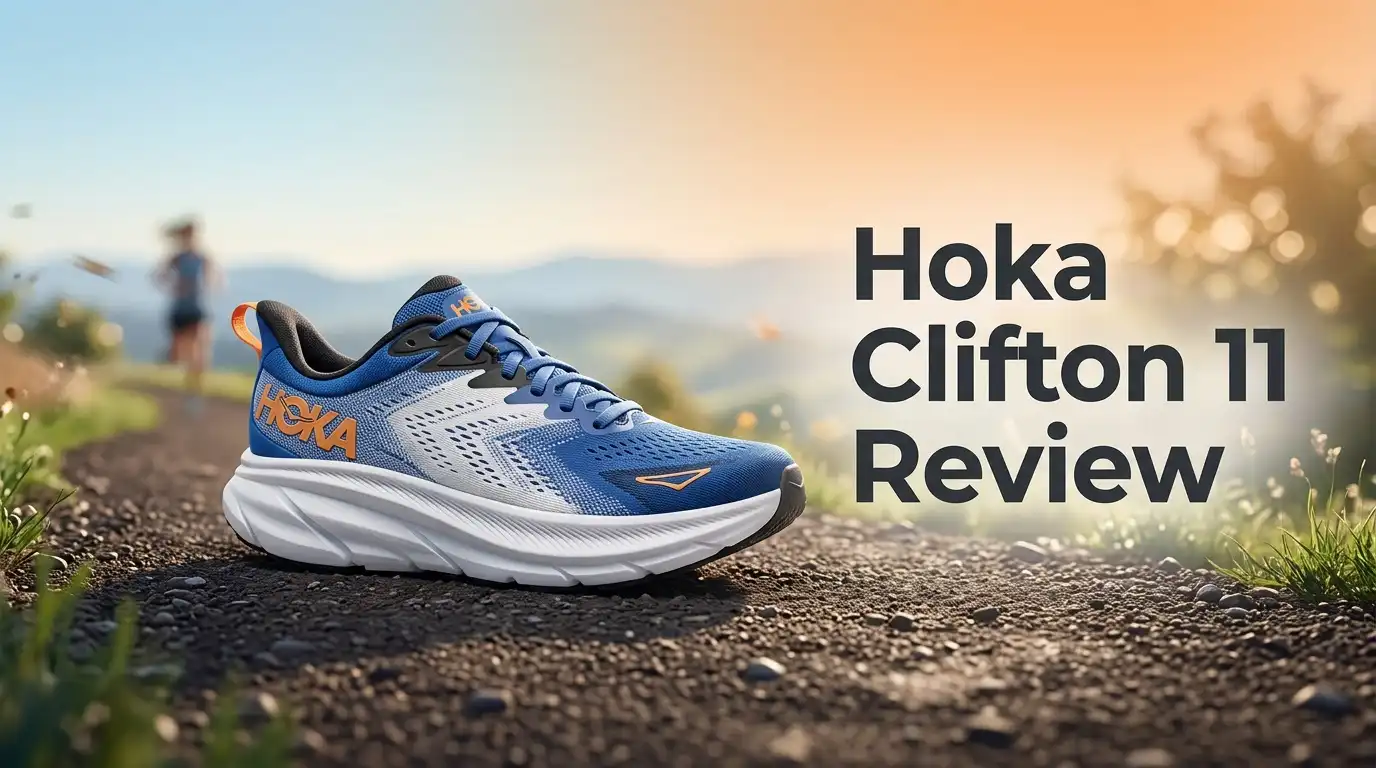
Hoka Clifton 11 Review 2026: Still Worth It?
The Hoka Clifton has a reputation. It is the shoe your running club friend swears by, the one nurses wear for twelve hour shifts, and the pair most people picture when someone says “cushioned running shoe.” Version 11 arrives with a new upper, a softer insole, and a lighter build. It also arrives with real competition from every direction.
I put these on for easy miles, long runs, walking, and standing around all day. I wanted to know one thing. Does the Clifton 11 still deserve your $155 in 2026, or has Hoka coasted on a famous name for too long?
This review covers the good parts and the parts Hoka does not advertise. You will get the actual lab numbers, the fit details, the durability problems, and honest alternatives. No fluff. Let us get into it.
In a Nutshell:
- The upper is the best Clifton upper ever made. The engineered mesh is soft, light, and slightly stretchy. Breathability tested at 93 BR against a category average of 75 BR. Your feet stay dry in summer heat.
- Cushioning is plush but flat. The stack measures 41.4mm heel and 29.7mm forefoot. Shock absorption is excellent at 146 SA. Energy return, however, sits at just 50.1% versus a 61.4% average. This shoe absorbs impact. It does not give much back.
- Durability is the weak spot. Testers reported chewed outsole rubber and a flattening midsole at only 80 miles. Toebox durability scored 2 out of 5. Heavier runners should expect a short lifespan.
- It is lighter than version 10 at roughly 9.4 oz for a men’s US 9, and torsional rigidity dropped to 12.1 Nm, so the clunky feeling of the Clifton 10 is mostly gone.
- Fit runs true to size but narrow. The toebox measures 70.9mm with an aggressive taper. Wide and extra wide options exist, though only in some colorways.
- Best use case is easy running, long slow miles, walking, and standing. It is not a tempo shoe and never pretends to be one.
Hoka Clifton 11 Overview

- Smooth MetaRocker, Engineered Mesh Upper
- Inherently Durable Abrasion Rubber Outsole
- Rearfoot-Focused Active Foot Frame
Last update on 2026-09-20 / Affiliate links / Images from Amazon Product Advertising API Some of the links on this website are affiliate links, which means that at no additional cost to you, I earn a commission if you click through and make a purchase. I only recommend products and services that I believe will add value to my readers. Thank you for your support!
The Clifton 11 is Hoka’s flagship neutral daily trainer. It sells for $155 and sits in the max cushion category after the big redesign that started with version 10. The midsole uses compression molded EVA, often shortened to CMEVA. The geometry includes Hoka’s early stage MetaRocker and the Active Foot Frame, which sinks your foot between raised midsole sidewalls.
Hoka markets version 11 mainly as an upper update. In practice, the whole shoe feels different. A new softer sockliner changes the underfoot feel, and the forefoot flexes more than the stiff version 10 did.
The claimed drop is 8mm, though independent lab measurement using the World Athletics method came out closer to 11.7mm. Hoka measures nearer the midfoot, which explains the gap. Either way, this shoe rewards heel strikers with a pronounced roll forward.
Three widths exist: regular, wide, and extra wide. A GTX waterproof version is also available for wet climates.
The Unboxing Experience and First Impressions
The box is standard Hoka: recycled cardboard, minimal printing, no plastic tray. Lift the lid and the shoes sit under a single sheet of tissue paper. No shoe bag, no extra laces, no insole swaps. Hoka keeps packaging plain and that feels right for the price.
The first thing you notice is weight. Pick one up and it feels lighter than it looks. The midsole is tall and visually chunky, so your brain expects something heavy. It is not.
The second thing you notice is the tongue. It is thick, plush, and 8.1mm deep across its whole length. It feels like a small pillow on your instep.
Slip your foot in and the heel collar wraps close with generous padding. There is no lace lock needed for most people. Reflective details catch the light on all sides, which is a genuinely useful touch for early morning runs.
First step feeling is soft and secure, with almost no break in required.


Last update on 2026-04-11 / Affiliate links / Images from Amazon Product Advertising API Some of the links on this website are affiliate links, which means that at no additional cost to you, I earn a commission if you click through and make a purchase. I only recommend products and services that I believe will add value to my readers. Thank you for your support!
Hoka Clifton 11 Specs and Numbers
Here is the technical summary, stripped of marketing language.
Weight lands at roughly 9.4 oz or 266g for a men’s US 9, and around 8.0 oz or 227g for a women’s US 8. That is a real improvement over the Clifton 10, especially given the outdated foam Hoka still uses.
Stack height measures 41.4mm at the heel and 29.7mm at the forefoot in independent testing. Hoka lists 42mm and 34mm for men. The insole is 4.4mm thick and fully removable, so orthotic users are covered.
Midsole softness measured 31.1 on the Asker C scale, softer than the 35.4 average. This is the softest Clifton midsole to date.
Outsole rubber sits at 3.2mm thick. Flexibility measured 13.5N, which is more flexible than most tall stack trainers. Price stays at $155, unchanged from the previous version.


Last update on 2026-04-11 / Affiliate links / Images from Amazon Product Advertising API Some of the links on this website are affiliate links, which means that at no additional cost to you, I earn a commission if you click through and make a purchase. I only recommend products and services that I believe will add value to my readers. Thank you for your support!
Top 3 Alternative for Hoka Clifton 11

- Engineered jacquard upper that offers stretch, ventilation, and durability
- Reflective details or visibility in low-light settings
- Tongue wing construction
Last update on 2026-06-07 / Affiliate links / Images from Amazon Product Advertising API Some of the links on this website are affiliate links, which means that at no additional cost to you, I earn a commission if you click through and make a purchase. I only recommend products and services that I believe will add value to my readers. Thank you for your support!
ASICS Novablast 5

- THIS MEN’S SHOE IS FOR: The Ghost 17 is for runners and walkers alike looking for an everyday...
- SOFT & DYNAMIC CUSHIONING: The Ghost 17 offers neutral support with premium nitrogen-infused DNA...
- SMOOTH TRANSITIONS: The newly designed midsole incorporates precise flex grooves that enhance the...
Last update on 2026-06-08 / Affiliate links / Images from Amazon Product Advertising API Some of the links on this website are affiliate links, which means that at no additional cost to you, I earn a commission if you click through and make a purchase. I only recommend products and services that I believe will add value to my readers. Thank you for your support!
Brooks Ghost 17

- JACQUARD KNIT UPPER
- Lining Textile
Last update on 2026-09-20 / Affiliate links / Images from Amazon Product Advertising API Some of the links on this website are affiliate links, which means that at no additional cost to you, I earn a commission if you click through and make a purchase. I only recommend products and services that I believe will add value to my readers. Thank you for your support!
Hoka Mach 6
Cushioning and Midsole Feel
The Clifton 11 protects your legs. Shock absorption measured 146 SA at the heel against a 131 SA average across 405 shoes. Landings feel padded and quiet. If your knees complain after runs, this softness helps.
The problem is what happens next. Energy return came in at 46.8% in the heel and 50.1% in the forefoot. The category average is 61.4%. You press down into the foam and very little pushes back.
Compression molded EVA was the standard years ago. In 2026, most $150 trainers use supercritical foams, TPU blends, or PEBA. Hoka owns better foams. It simply did not put one here.
The practical result is a ride that feels pleasant at nine or ten minute pace and lifeless when you try to speed up. Think comfort, not propulsion. For walking, standing, and slow miles, that trade is completely fine.
Fit, Sizing, and Upper Comfort
The Clifton 11 fits true to size for most runners. Internal length measured 269.9mm, almost exactly average.
Width is another story. The forefoot interior measured 94.7mm and the toebox only 70.9mm with a sharp taper toward the big toe. If you have wide feet or splayed toes, the standard width will pinch. Buy the wide or extra wide version, but check colorway availability first because the selection shrinks fast.
Toebox height is fine at 27.4mm, so there is vertical room even when horizontal room runs short.
The engineered mesh has light stretch and feels soft against bare skin. Sockless wear is realistic here. The midfoot is slightly low volume thanks to that thick tongue, so high instep runners may need to loosen the laces.
One miss: the tongue is not gusseted. It stayed centered during testing thanks to double lace loops, but a gusset would be better.
Ride Quality on Easy and Long Runs
This is where the Clifton 11 earns its fans. The rocker geometry rolls you forward without demanding effort. Once the lateral heel foam compresses a bit, transitions smooth out nicely.
The first few miles can feel slightly clunky. The heel bevel is angled toward the medial side, so very rear heel strikers may notice a small inward tilt at first. This settles after roughly ten to fifteen miles of wear.
Long runs are the sweet spot. The soft foam and tall stack keep your legs fresher in the final miles. Recovery days feel easy and forgiving.
Pick up the pace and the shoe does not resist you, but it does not help either. Strides feel mushy. Tempo work feels like running through soft sand.
Walking is genuinely excellent in these. The forefoot flexes enough for a natural stride, which many max stack shoes cannot manage.
Stability for Neutral Runners
Hoka calls this a neutral shoe. It behaves like a stable neutral shoe.
The Active Foot Frame sinks your heel between raised sidewalls. The heel platform measures 96.2mm wide, well above the 91.1mm average, and it barely tapers into the midfoot. That boxy base resists wobble.
The midfoot is filled in rather than hollowed out, and the medial sidewall extends further forward than the lateral one. This creates quiet support without any plastic post or firm density wedge.
Runners with mild overpronation often do well here. Runners with significant pronation control needs should look at the Hoka Arahi or a dedicated stability model instead.
The forefoot is the most neutral zone of the shoe. Midsole width there measured 113.8mm, slightly under average, but the shoe never felt tippy during testing.
Stability grade: strong for the heel and midfoot, average up front.
Outsole Grip and Durability Concerns
Here is where honesty matters most. Traction measured a coefficient of friction of 0.52. That is barely average. For comparison, a cheaper trainer like the Adidas Supernova Rise 3 scored 0.94.
On dry roads, grip is fine. On wet painted lines, metal covers, or smooth tile, be careful. The exposed foam across the midfoot has no traction at all.
Lab abrasion testing was actually positive, removing only 0.9mm of rubber. Real world testing told a harsher story. Experienced reviewers reported visible outsole wear and midsole flattening at just 80 miles.
The gap makes sense. The rubber pods hold up. The large exposed foam sections do not.
Toebox durability scored 2 out of 5 due to the soft mesh and ventilation holes.
Expect 250 to 350 miles if you are heavier or hard on shoes. Lighter runners may reach 400.
Hoka Clifton 11 for Women

- Smooth MetaRocker, Engineered Mesh Upper
- Inherently Durable Abrasion Rubber Outsole
- Rearfoot-Focused Active Foot Frame
Last update on 2026-09-20 / Affiliate links / Images from Amazon Product Advertising API Some of the links on this website are affiliate links, which means that at no additional cost to you, I earn a commission if you click through and make a purchase. I only recommend products and services that I believe will add value to my readers. Thank you for your support!
The women’s Clifton 11 uses the same midsole formula and geometry with women’s specific stack numbers, typically listed around 38mm heel and 30mm forefoot. Weight drops to roughly 8.0 oz for a US 8.
The narrower toebox affects women’s sizing more often in feedback I found. Wide options exist and are worth considering if your current running shoes feel snug across the ball of the foot.
Colorway selection is broader on the women’s side, including several bright seasonal releases alongside the standard black and white.
Many buyers use this pair for work rather than running. Nurses, teachers, retail staff, and travelers all report the same thing: all day comfort with very little break in time. The flexible forefoot helps here more than most people realize.
If you want one shoe for walking, standing, and easy jogging, the women’s Clifton 11 covers all three well. Just accept that the outsole will wear faster than a dedicated walking shoe.
What the Clifton 11 Does Not Do Well
Every review should say this part plainly. Here is where the Clifton 11 falls short.
It is not fast. The foam returns barely half the energy you put in. Workouts, races, and fast finish long runs all feel better in other shoes.
It is not durable. Midsole flattening at 80 miles is disappointing for a $155 trainer. Budget for replacement sooner than you would like.
It is not wide. The standard toebox taper is aggressive and unforgiving.
Grip is mediocre in wet conditions. The exposed foam sections are slick.
The tongue is not gusseted, which is a small but noticeable omission at this price.
The heel bevel needs a break in period, and very rear heel strikers may feel an inward tilt early on.
Value is the real sticking point. Competitors at the same price now use far better foam technology, and Hoka has not answered that.
Clifton 11 vs Clifton 10: What Actually Changed
Hoka positioned this as an upper refresh. Runners disagree about how much really changed.
The upper is clearly new. It is lighter, softer, more flexible, and offers slightly more room for normal width feet. Breathability improved noticeably.
The insole is new and softer. Combined with the same CMEVA midsole, the underfoot feel is plusher than version 10.
Torsional rigidity dropped from stiff to 12.1 Nm. This is the biggest practical improvement. The Clifton 10 felt rigid and awkward at slow paces. Version 11 does not.
Weight came down slightly. Traction improved marginally from 0.49 to 0.52.
What did not change: the foam, the geometry, the stack height, and the price.
Should Clifton 10 owners upgrade? Only if your current pair is worn out or the stiffness bothered you. The cushioning experience is close to identical.
Pros and Cons of the Hoka Clifton 11
Pros
- Excellent shock absorption at 146 SA protects tired legs on long runs
- Lightest recent Clifton at roughly 9.4 oz for a men’s US 9
- Outstanding breathability of 93 BR and 62% moisture release in testing
- Wide 96.2mm heel base delivers real stability for a neutral shoe
- Flexible forefoot makes it great for walking and all day standing
- Plush 8.1mm tongue and padded heel collar prevent hot spots
- Available in regular, wide, and extra wide, plus a GTX waterproof model
- 360 degree reflective details improve visibility in low light
- Removable insole works well with custom orthotics
Cons
- Energy return of just 50.1% feels flat and slow
- Outdated CMEVA foam trails competitors at the same price
- Midsole softness fades noticeably by 80 to 100 miles
- Exposed midsole wears through quickly on rough pavement
- Toebox width of 70.9mm is narrow with an aggressive taper
- Wet traction is only average at 0.52 coefficient of friction
- Tongue is not gusseted
- Not suitable for tempo runs, intervals, or racing
- $155 price is hard to justify against newer foam technology
Who Should Buy and Who Should Skip
Buy the Clifton 11 if you run easy miles and long runs at a steady effort, you want a soft landing under a high stack, or you liked the Clifton 10 and want the same feel with a better upper. Heel strikers benefit from the pronounced roll. Walkers, nurses, travelers, and people on their feet all day get excellent value here.
Orthotic users should also take a close look, since the insole comes out easily and the platform is wide and supportive.
Skip the Clifton 11 if energy return matters to you. The Saucony Endorphin Azura or Adidas Supernova Prima 3 offer a livelier ride. If you dislike tall stacks, the Hoka Mach 6 gives you more bounce in a lower profile.
Skip it also if you have wide feet and cannot find the wide version in a color you like, or if you are heavy on your feet and need 500 mile durability from a $155 shoe.
Final Verdict: Is the Hoka Clifton 11 Worth It in 2026?
The Clifton 11 is the most comfortable Clifton Hoka has built. The upper is genuinely excellent, the fit is secure, the stability is quietly impressive, and the walking performance is hard to beat in this category.
It is also the least modern shoe in its price bracket. Compression molded EVA in 2026 is a choice, and not a good one for the money. You get protection without propulsion and comfort without longevity.
My honest score is 8 out of 10 for comfort and 6 out of 10 for value.
Buy it if soft, stable, easy paced cushioning is your priority and you can find it discounted. At full price, shoppers who want performance per dollar should compare the ASICS Novablast 5 and Brooks Ghost 17 before committing.
For everyone who just wants a reliable, plush, breathable shoe for daily miles and long days on your feet, the Clifton 11 still delivers.
Frequently Asked Questions
Is the Hoka Clifton 11 true to size?
Yes. Internal length measured 269.9mm, almost exactly the category average. Order your normal size. The width is the issue, not the length, so consider the wide version if your feet are broad.
How many miles will the Clifton 11 last?
Expect 250 to 350 miles if you are heavier or run on rough pavement. Lighter runners may reach 400 miles. Testers saw midsole flattening and outsole wear starting around 80 miles, which is earlier than ideal.
Can you run fast in the Hoka Clifton 11?
Not comfortably. Energy return measured 50.1%, well below the 61.4% average. The shoe handles strides and light pickups, but tempo work and intervals feel sluggish. Use a different shoe for speed sessions.
Is the Clifton 11 good for walking and standing all day?
Yes, and this is one of its best uses. The forefoot flexes more than most max stack shoes, torsional rigidity is low, and the cushioning is soft. Many buyers wear it for twelve hour work shifts.
What is the difference between the Clifton 11 and the Clifton Pro?
The Clifton Pro is taller at around 46mm and 38mm, slightly heavier, and wider fitting. It uses a snappier foam and a longer forefoot rocker, which makes it better for picking up the pace. The Clifton 11 is softer and better for easy miles.
Does the Clifton 11 work for flat feet or overpronation?
It handles mild overpronation well thanks to the Active Foot Frame sidewalls and the wide 96.2mm heel base. Runners with moderate to severe pronation should look at a dedicated stability shoe like the Hoka Arahi instead.
Is the Clifton 11 waterproof?
The standard model is not. Hoka offers a Clifton 11 GTX version with a Gore Tex membrane for wet conditions. The tradeoff is reduced breathability compared to the 93 BR score of the standard mesh upper.

Mia Smith is the founder of Shoe Storyteller, a blog that celebrates the art and stories behind shoes. With a passion for fashion and a flair for storytelling, Mia brings a unique perspective to the world of footwear.