
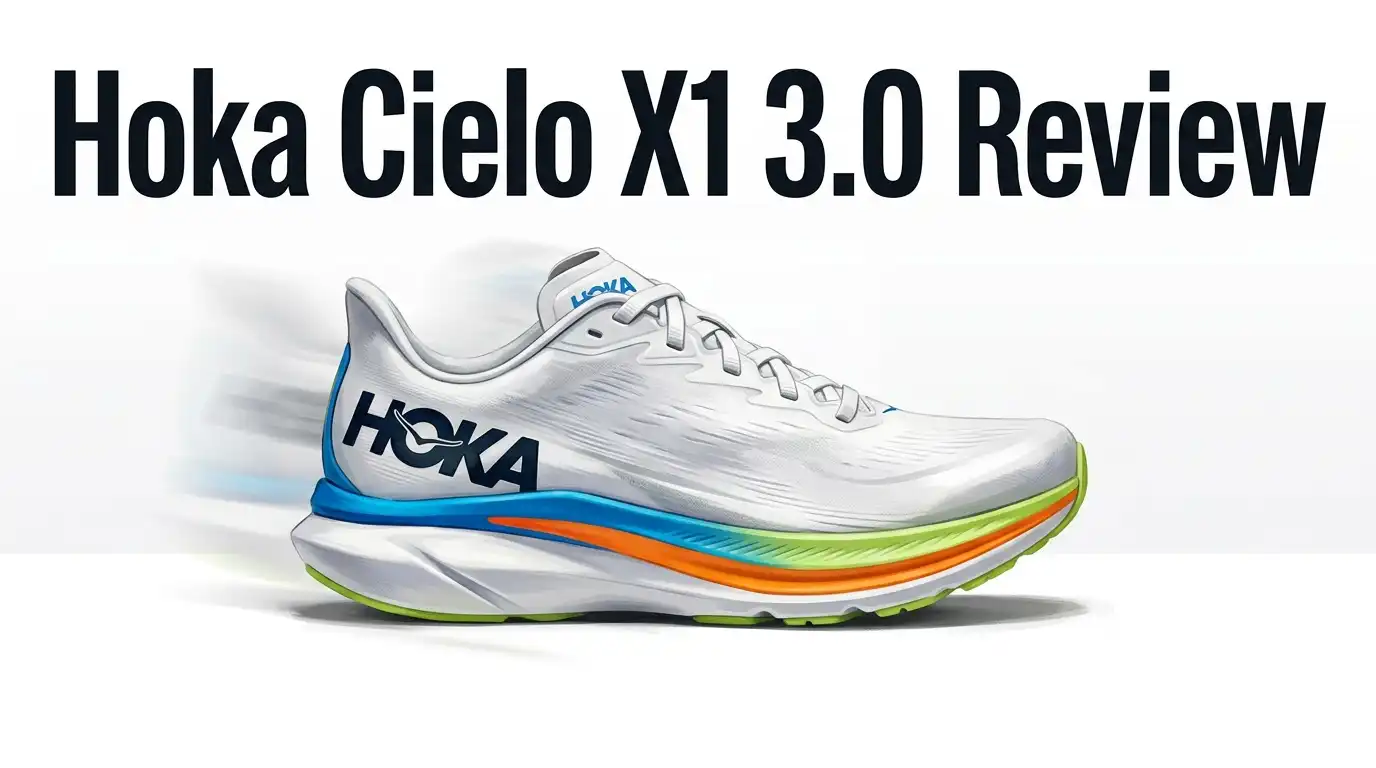
Hoka Cielo X1 3.0 Review 2026: Worth It?
The super shoe race keeps getting faster, and Hoka refuses to sit still. The Cielo X1 3.0 arrives as the lightest, bounciest, and most refined racer the brand has built so far.
It carries a carbon fiber plate, a towering PEBA midsole, and a rocker so aggressive that it almost picks your stride for you. Runners who loved the 2.0 will notice real changes here, and runners who skipped the earlier versions may finally see a reason to look.
This review covers the unboxing, the lab numbers, the road feel, the fit quirks, and the honest weak points. I also cover who should walk away from this shoe. Race day gear costs real money in 2026, and $275 deserves scrutiny. Read on before you add it to your cart.
In a Nutshell:
- Massive cushioning with elite shock absorption. Lab testing recorded 170 SA in the heel, one of the highest scores ever measured in a racing shoe. Your legs will thank you at mile 22.
- Hoka’s lightest super shoe yet. It weighs roughly 6.8 oz (193 g) in a men’s US 9, about 15 g lighter than the Cielo X1 2.0. That is progress, though rivals still weigh less.
- The full length PEBA midsole is the headline upgrade. Hoka dropped the dual density setup and moved to one softer foam. The result feels livelier, bouncier, and noticeably plusher underfoot.
- Grip finally got fixed. A compression molded polyurethane outsole nearly doubled the traction score versus the previous model. Wet roads no longer feel risky.
- The fit runs narrow and the durability is poor. Toebox width measured 70.4 mm, well under average, and the thin upper and minimal outsole rubber wear quickly. Treat this as a race day only shoe.
- The rocker is extreme. It pushes you forward constantly. Runners who want a calm, neutral ride should look elsewhere.
Hoka Cielo X1 3.0

- Get ready for life in the fast lane. A tip-of-the-spear product tuned for race day, the Cielo X...
- Highly engineered Leno weave textile
- Stretchy, patent-pending dynamic vamp
Last update on 2026-09-20 / Affiliate links / Images from Amazon Product Advertising API Some of the links on this website are affiliate links, which means that at no additional cost to you, I earn a commission if you click through and make a purchase. I only recommend products and services that I believe will add value to my readers. Thank you for your support!
The Cielo X1 3.0 is Hoka’s top tier marathon racer. It sits above the Rocket X 3 in the lineup and targets runners chasing a personal best. Hoka lists the stack at 38 mm in the heel and 31 mm in the forefoot with a 7 mm drop. The shoe is World Athletics approved for competition.
Three things define it. First, a full length PEBA midsole that replaces the two foam densities used in version 2.0. Second, a redesigned carbon fiber plate with cutouts that trim weight and add a touch of flex. Third, a leno weave textile upper paired with asymmetrical lacing.
The price stays at $275, matching the 2.0. Hoka sells it as a unisex shoe. In practice, it feels like a genuine rival to the Nike Vaporfly 4 and the Adidas Adizero Adios Pro 4, which is something earlier Cielo models could not honestly claim.
Unboxing the Cielo X1 3.0
The box arrives in Hoka’s usual clean design with a simple lid and minimal packing. Lift the tissue and the first thing you notice is how little the shoes weigh in your hand. They feel almost empty. The pair I received came in Neon Yuzu, a bright citrus green that photographs better than it looks in daylight.
The shoes sit nested with a small spec card and no extra laces. Hoka does not include a carry bag at this price, which feels stingy for a $275 racer.
Pick one up and the midsole dominates. The sidewall sweeps out under the heel and the central cutout is visible from below. The upper feels papery between your fingers. Pull the tongue and it is barely there at 1.8 mm thick.
Step in comfort is the real surprise. The asymmetrical lacing locks the midfoot without pressing on the top of your foot. It feels far friendlier than the ribbon lacing of the original.
Key Specifications Explained
Here is what matters on the spec sheet. The weight lands at 6.8 oz (193 g) for a men’s US 9, with women’s samples coming in near 5.8 oz. The listed stack is 38 mm heel and 31 mm forefoot, though independent lab calipers recorded 44.5 mm in the heel using a different measuring standard. The drop is officially 7 mm.
The midsole uses a slightly reworked PEBA formulation. Energy return tested at 75.3% in the heel and 70.4% in the forefoot, both well above the 58.5% average across running shoes. Midsole softness measured 32.9 on the Asker C scale, softer than typical.


Last update on 2026-04-11 / Affiliate links / Images from Amazon Product Advertising API Some of the links on this website are affiliate links, which means that at no additional cost to you, I earn a commission if you click through and make a purchase. I only recommend products and services that I believe will add value to my readers. Thank you for your support!
Breathability scored 4 out of 5 thanks to the open leno weave. Flexibility measured 16.8N in a 30 degree bend test, slightly more forgiving than most plated racers. Cold weather performance is strong too, with only a 12% softness change after freezer testing. PEBA handles winter races well.
Top 3 Alternative for Hoka Cielo X1 3.0

Last update on 2026-09-20 / Affiliate links / Images from Amazon Product Advertising API Some of the links on this website are affiliate links, which means that at no additional cost to you, I earn a commission if you click through and make a purchase. I only recommend products and services that I believe will add value to my readers. Thank you for your support!
Nike Vaporfly 4

- Premier Racing Shoe: Engineered for swift starts and faster finishes
- Introducing FF LEAP Foam: Ultra-lightweight and responsive
- Top Midsole Layer: Features FF TURBO PLUS Cushioning
Last update on 2026-09-20 / Affiliate links / Images from Amazon Product Advertising API Some of the links on this website are affiliate links, which means that at no additional cost to you, I earn a commission if you click through and make a purchase. I only recommend products and services that I believe will add value to my readers. Thank you for your support!
ASICS Metaspeed Sky Tokyo


Last update on 2026-04-11 / Affiliate links / Images from Amazon Product Advertising API Some of the links on this website are affiliate links, which means that at no additional cost to you, I earn a commission if you click through and make a purchase. I only recommend products and services that I believe will add value to my readers. Thank you for your support!

- ADIZERO ADIOS PRO 4 FTWWHT/ROYBLU/PURRUB
Last update on 2026-09-20 / Affiliate links / Images from Amazon Product Advertising API Some of the links on this website are affiliate links, which means that at no additional cost to you, I earn a commission if you click through and make a purchase. I only recommend products and services that I believe will add value to my readers. Thank you for your support!
Adidas Adizero Adios Pro 4
Midsole, Foam and Plate
Moving to a single PEBA density was the correct decision. The old shoe used a firmer bottom layer that muted the bounce. The 3.0 feels soft immediately and then springs back fast. You feel the return on the first stride, not after a warmup.
The carbon fiber plate has a spoon shape with visible cutouts. Those cutouts do two jobs. They shave grams and they let the shoe bend a little more naturally at the toe. Torsional rigidity scored 4 out of 5 instead of the usual 5 for a carbon racer, which means the shoe forgives slightly imperfect landings.
Heel strikers get a plush landing because of the huge stack above the plate. Midfoot and forefoot strikers feel a firmer, snappier platform because the plate sits lower there. Energy return dipped slightly versus the 2.0, which is a small disappointment, though the softer foam more than compensates in real running.
Fit, Sizing and Upper Comfort
Sizing is true to length. Order your normal running shoe size. Width is the issue. Lab measurement recorded 91.4 mm at the widest point and only 70.4 mm at the toebox, both below average. Toebox height came in at 25.1 mm, again under average.
Translation: this shoe hugs your foot. Runners with narrow or medium feet will love the security. Wide footed runners should try before buying. Feet swell during a marathon, and a tight toebox at mile 20 becomes a genuine problem.
The leno weave upper breathes well and holds shape better than the flimsy mesh on the original Cielo X1. The asymmetrical lacing is the standout change. It distributes pressure across the midfoot and stops the hotspots some runners reported earlier.
Hoka also added sawtooth laces. They stay tied. That single fix removes one of the most common complaints about the previous model.
Ride Quality and the Rocker
This shoe does not suggest a stride. It insists on one. The rocker rolls you onto your midfoot and then pushes you forward with no negotiation. At marathon pace or faster, the sensation is addictive. The shoe feels like it wants to run.
Slow down and things change. Below easy pace, the rocker feels awkward and the tall platform starts to wobble. This is not a shoe for jogging. Keep the turnover high and it rewards you.
The bounce is the defining trait. It is springier than most rivals, including the Metaspeed Sky Tokyo and the Puma Fast R Nitro Elite 3. Those shoes transition faster. The Hoka bounces higher.
My one worry is late race form breakdown. When your stride falls apart at mile 23, an aggressive rocker can fight you rather than help you. Test it on a long run first.
Grip and Outsole Performance
Grip was the biggest flaw of the Cielo X1 2.0. Wet roads turned it into an ice skate. Hoka fixed this properly. The 3.0 uses a compression molded polyurethane outsole with small teeth that bite the road.
Traction testing returned a score of 0.72 against a 0.50 average. That is roughly double the previous model. Wet British winter testing and wet track sessions both confirmed the improvement. Confidence in the rain is no longer a concern.
There is a trade. Because the material grips so well, Hoka used very little of it. Coverage is minimal and the outsole measures just 1.9 mm thick. Runners who want visible rubber across the whole bottom will find this sparse.
The lower foam layer also carries a large central cutout. It looks striking and it reduces torsional stiffness slightly. The design helps the shoe feel less harsh than the stack height suggests.
Durability: The Real Weak Spot
Here is where honesty matters. The Cielo X1 3.0 scored badly in every durability test. Toebox durability came back 1 out of 5. The upper is so thin that abrasion testing tore through it quickly.
Heel padding durability also scored 1 out of 5, with significant damage after testing. Outsole wear measured 1.3 mm against a 1.1 mm average, and the rubber is thin to begin with.
This is not a shoe for daily training or heavy mileage. Racing shoes are consumable items, but even by that standard the Cielo X1 3.0 sits on the fragile end. Expect around 150 to 200 miles of quality use before the bounce and the grip fade.
Budget accordingly. At $275, that works out to more than a dollar per mile for some runners. If you race twice a year, one pair may last several seasons. If you race monthly, the maths gets painful fast.
What the Cielo X1 3.0 Does Not Do Well
Stability is poor. The forefoot platform measures 107.6 mm and the heel only 78.1 mm, both far below the category average. Add a tall, soft, bouncy midsole and you get a shoe that feels tippy. Overpronators and runners who need a stable base should avoid it entirely.
The heel counter is soft and collapses easily, scoring 1 out of 5 for stiffness. Some runners like that freedom. Others will want more structure.
There are no reflective elements anywhere on the shoe. For early morning race warmups, that is worth noting.
Colorways remain uninspired. Hoka’s best looking shoes almost always come from collaborations, which says something.
Finally, the price. At $275 it sits above several rivals that weigh less. You pay for shock absorption and bounce. If those are not your priorities, the value proposition weakens quickly.
Cielo X1 3.0 vs Cielo X1 2.0
The 2.0 was already a big leap over the original. The 3.0 is a refinement rather than a revolution, but every change lands well.
Weight drops by about 15 g. Grip roughly doubles. The midsole moves from dual density PEBA to a single softer compound, which makes the ride plusher and more energetic. Hoka removed the medial cutout and added a central one, improving stability slightly. The ribbon style laces are gone, replaced with proper sawtooth laces.
Energy return dipped a fraction, from a higher figure on the 2.0 to 75.3% here. In practice you will not notice, because the softer foam feels more responsive on the road.
The upper is the other clear win. Asymmetrical lacing and the leno weave give better lockdown with less pressure. If you own the 2.0 and race often, the upgrade is justified. If you race twice a year, wear out your current pair first.
Pros and Cons
Pros
- Outstanding shock absorption, with a 170 SA heel score that protects your legs late in a marathon
- Excellent energy return at 75.3% heel and 70.4% forefoot, comfortably in super shoe territory
- Hoka’s lightest racer yet at 6.8 oz (193 g), a real improvement over the 2.0
- Greatly improved wet weather grip thanks to the compression molded polyurethane outsole
- Breathable leno weave upper with a 4 out of 5 ventilation score
- Asymmetrical lacing and sawtooth laces deliver secure, pressure free lockdown
- PEBA foam barely stiffens in cold weather, losing only 12% softness in freezer testing
- Removable insole allows custom orthotics if needed
Cons
- Very narrow toebox at 70.4 mm, a problem for wide feet and swollen marathon feet
- Poor durability scores across the toebox, heel padding, and outsole
- Weak stability from a narrow 78.1 mm heel and tall soft platform
- Aggressive rocker dictates your stride and feels awkward at slower paces
- Expensive at $275, above several lighter competitors
- No reflective detailing anywhere on the shoe
- Soft heel counter offers almost no support
Price, Value and Who Should Buy
The Cielo X1 3.0 retails at $275. That places it at the top of the market, above the Vaporfly 4 and level with the Metaspeed Sky Tokyo. Discounts appear at some retailers, and the previous version regularly drops below $200.
Buy this shoe if you want maximum cushioning on race day without carrying extra weight. Marathon runners who finish races with beaten legs will feel the benefit most. The shock absorption here is genuinely class leading.
Buy it if you love a springy, bouncy ride and run with quick turnover. Mid and forefoot strikers chasing a personal best will get the most from the plate geometry.
Skip it if you have wide feet, need stability, or want a shoe that doubles as a tempo trainer. The Rocket X 3 is the smarter Hoka choice for those runners, and it costs less. Skip it too if you dislike being pushed forward by a rocker.
Final Verdict
Hoka finally built a super shoe that belongs in the conversation with the best racers on the market. The Cielo X1 3.0 is lighter, grippier, softer, and more secure than anything the brand has made before. The full length PEBA midsole and the redesigned plate work together properly, and the new upper fixes the lockdown complaints that dogged earlier versions.
It is not perfect. Durability is genuinely poor, the fit is narrow, and stability is minimal. The rocker is polarising and the price is high. Those are real limits, not nitpicks.
Score it as a specialist tool rather than an all rounder. For the right runner on the right day, it delivers a ride that few shoes can match for cushioning plus bounce. If you race marathons, run with quick turnover, and have a normal to narrow foot, this deserves a place on your shortlist. Everyone else has better options.
FAQs
Is the Hoka Cielo X1 3.0 true to size?
Yes. Length is accurate, so order your normal running shoe size. Width is the concern. The toebox measures 70.4 mm, which is narrower than average. Runners with wide feet should try the shoe in store or order from a retailer with easy returns.
How many miles will the Cielo X1 3.0 last?
Expect roughly 150 to 200 miles of quality performance. Durability testing scored poorly on the upper, heel padding, and outsole. Use it for races and key workouts only. Rotating it with a durable daily trainer will stretch its life considerably.
Is the Cielo X1 3.0 legal for competition?
Yes. World Athletics has approved it for racing. Hoka lists the heel stack at 38 mm, under the 40 mm limit. Independent labs using a different measuring method recorded a higher figure, but the official approval stands.
Cielo X1 3.0 or Rocket X 3?
Choose the Cielo X1 3.0 for maximum bounce, cushioning, and an aggressive rocker. Choose the Rocket X 3 for a more stable, natural, and approachable ride at a lower price. Runners who dislike being pushed forward will prefer the Rocket X 3.
Can you train daily in the Cielo X1 3.0?
No. The thin upper, minimal outsole rubber, and soft narrow platform make it unsuitable for daily miles. It also feels awkward at easy paces. Save it for tempo sessions, intervals, and race day.
What is the biggest upgrade over the 2.0?
Grip. The compression molded polyurethane outsole roughly doubled traction scores, fixing the slippery wet weather performance of the previous model. The full length PEBA midsole is a close second.

Mia Smith is the founder of Shoe Storyteller, a blog that celebrates the art and stories behind shoes. With a passion for fashion and a flair for storytelling, Mia brings a unique perspective to the world of footwear.