Birkenstock Gizeh Sandals Review 2026: Still Worth It?
The Birkenstock Gizeh has survived every sandal trend of the last twenty years. It showed up on festival grounds, then on runways, then on the feet of nurses, teachers, and tourists walking ten miles a day through old European cities. In 2026 it still sells out in popular colors every spring.
So the question is simple. Does a thong sandal with a cork footbed and a price tag over one hundred dollars actually earn that money?
I wore a pair daily for a full season, through travel days, grocery runs, garden work, and two very long airport walks. This review covers the good parts, the painful first two weeks, and the things the Gizeh genuinely does badly.
In a Nutshell:
- Comfort arrives late, not early. The Gizeh feels stiff and strange on day one. The cork softens and molds to your foot shape over roughly one to two weeks of short wears. After that, it feels custom.
- Sizing matters more than color. Birkenstock uses European sizes and offers regular and narrow widths. Your heel must sit inside the heel cup and your toes must stay behind the front edge. A wrong size never breaks in correctly.
- The toe post causes real complaints. Many buyers report rubbing or irritation between the first two toes during the break in stage. It usually fades. For some people it never fully does.
- Not a water sandal. Cork and suede hate soaking. Pool days, beach days, and rainstorms will shorten the life of this pair. Birkenstock sells an EVA version for that job.
- Value improves over years, not weeks. The footbed is replaceable and the sandal can be resoled. One good pair can replace five cheap pairs.
- Style still works in 2026. The thick strap and visible cork edge read as intentional rather than sloppy, which is why the Gizeh pairs with linen pants and denim shorts equally well.
Birkenstock Gizeh Sandals: Our Honest Verdict

- Flexible EVA outsole offers lightweight shock absorbing support with lasting durability
- Neutral heel profile and deep heel cup helps evenly distributes body weight
- Dual layer Jute: top wicks away moisture while the bottom adds strength and makes resoling easy
Last update on 2026-10-07 / Affiliate links / Images from Amazon Product Advertising API Some of the links on this website are affiliate links, which means that at no additional cost to you, I earn a commission if you click through and make a purchase. I only recommend products and services that I believe will add value to my readers. Thank you for your support!
The Gizeh scores high because it solves a problem most flip flops ignore. Flat rubber sandals let your arch collapse with every step. The Gizeh props your arch, cups your heel, and spreads your toes. Your legs feel less tired at the end of a long day.
Independent testing labs have rated the Gizeh at the top of women’s flip flop lists, with comfort scores near nine out of ten and style scores even higher. My experience matched that, eventually.
The first three days were honestly unpleasant. Stairs felt awkward. The arch ridge pressed into a spot that had never been pressed before. By day ten the sandal felt like it belonged to me. That delay is the whole story of this product.
The Unboxing Experience
The box is plain brown cardboard with the Birkenstock name printed on the lid. Inside, the sandals sit in a thin paper wrap, nose to tail. No tissue theater, no dust bag, no little card telling you how special you are.
The smell hits first. Cork and latex have a warm, slightly sweet, workshop kind of scent. Leather versions smell stronger. It fades in about a week.
Pick one up and you notice the weight. A pair lands around thirteen ounces, which is heavier than a foam flip flop and lighter than a sneaker. The footbed feels hard under your thumb, almost like dense cardboard. That surprises first time buyers.
The suede lining looks matte and slightly fuzzy. The buckle is small, metal, and tight out of the box. Nothing about the presentation feels luxurious. The quality lives in the build, not the packaging.
Design and Materials Explained
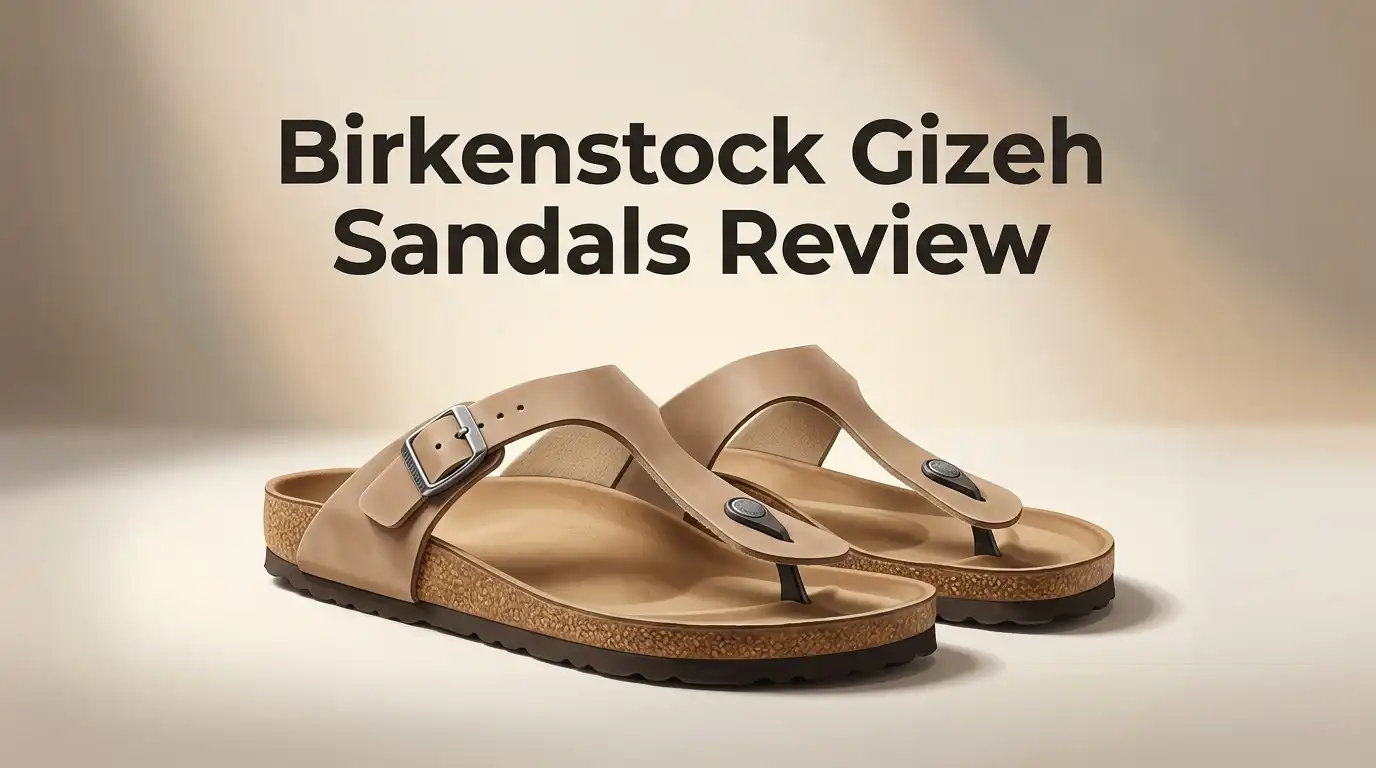
The Gizeh has four layers working together. The top layer is suede lining that touches your skin and wicks moisture. Under that sits a cork and latex core that softens with body heat and pressure. A jute layer adds stability, and a flexible EVA outsole roughly ten millimeters thick handles the ground.
The strap crosses the forefoot and loops around the big toe, held by a buckle you can loosen or tighten. That adjustability is the main advantage over a standard flip flop.


Last update on 2026-04-11 / Affiliate links / Images from Amazon Product Advertising API Some of the links on this website are affiliate links, which means that at no additional cost to you, I earn a commission if you click through and make a purchase. I only recommend products and services that I believe will add value to my readers. Thank you for your support!
Raised edges run all the way around the footbed. They stop your foot from sliding off and protect your toes from stubbing. A toe grip ridge at the front encourages your toes to spread naturally instead of gripping.
Birkenstock makes it in Birko Flor, a synthetic leather look material with a fleece backing, and in real oiled nubuck or smooth leather.
Top 3 Alternative for Birkenstock Gizeh

- Anatomically shaped cork-latex footbed
- Upper: Birko-Flor nubuck
- Footbed lining: suede
Last update on 2026-09-25 / Affiliate links / Images from Amazon Product Advertising API Some of the links on this website are affiliate links, which means that at no additional cost to you, I earn a commission if you click through and make a purchase. I only recommend products and services that I believe will add value to my readers. Thank you for your support!
Birkenstock Mayari

- Anatomically shaped cork-latex footbed
- Upper: oiled nubuck leather
- Insole: suede
Last update on 2026-10-07 / Affiliate links / Images from Amazon Product Advertising API Some of the links on this website are affiliate links, which means that at no additional cost to you, I earn a commission if you click through and make a purchase. I only recommend products and services that I believe will add value to my readers. Thank you for your support!


Last update on 2026-04-11 / Affiliate links / Images from Amazon Product Advertising API Some of the links on this website are affiliate links, which means that at no additional cost to you, I earn a commission if you click through and make a purchase. I only recommend products and services that I believe will add value to my readers. Thank you for your support!
Birkenstock Arizona

- TRUE TO SIZE: Wide fit, high arch, order your regular size. If you are in-between sizes we recommend...
- ALL-DAY COMFORT & ARCH SUPPORT: Features an anatomically contoured footbed designed to mimic the...
- FAST DRYING & WATER RESISTANT: Designed for easy transitions from water to dry land, these flip...
Last update on 2026-10-07 / Affiliate links / Images from Amazon Product Advertising API Some of the links on this website are affiliate links, which means that at no additional cost to you, I earn a commission if you click through and make a purchase. I only recommend products and services that I believe will add value to my readers. Thank you for your support!
OluKai Ohana
Comfort and the Break In Period
Let me be blunt. Anyone who tells you Birkenstocks feel great immediately is either lucky or lying.
The recommended approach is short sessions. Wear them one or two hours a day for the first week. Walk on flat ground. Skip the eight hour shift and the theme park day.
The cork needs your body heat to flex. Your arch needs time to accept support it has never had. Most people reach full comfort in one to two weeks. Soft footbed versions take closer to three to seven days. A few people need a month.
After break in, the footbed holds a faint print of your own foot. That imprint is why Birkenstock fans buy the same model again and again. The sandal becomes yours in a way foam never manages.
My own test: by week three I wore them for a nine hour travel day without complaint.
Sizing Guide: Regular Versus Narrow
Birkenstock sizing confuses almost everyone. Sizes run in European numbers, and the brand offers two widths.
Check the stamp inside the footbed. A narrow footprint icon means narrow width. A wide footprint icon means regular, which is actually fairly generous.
Here is the fit test that matters. Your heel should sit fully inside the heel cup with a small gap behind it. Your longest toe should stop about four to five millimeters before the front edge. Your arch should rest right on the raised ridge, not in front of it or behind it.
Many reviewers with average feet report that narrow fits better than regular, since the regular width suits broader feet. A size 38 usually matches a US women’s 7 to 7.5.
Measure your foot in centimeters before ordering.
Arch Support and Foot Health
The contoured footbed copies the shape of a healthy footprint in soft sand. Four distinct zones do the work: a deep heel cup, a longitudinal arch support, a transverse arch support, and a raised toe bar.
This design keeps your foot in a neutral position instead of letting it flatten. People with mild plantar fasciitis often report relief after the break in stage, though results vary and a podiatrist should guide any real foot problem.
The flip side deserves mention. If your arch is very high or very flat, a stock Birkenstock footbed may not match your anatomy. The support sits where Birkenstock decided, not where your body needs it.
These are not medical devices. They are well shaped sandals. Treat them that way, and keep expectations sensible.
Toe Post Problems: The Honest Truth
This is the most common Gizeh complaint, and it deserves its own section.
The toe post sits between your big toe and second toe. During break in, the material is stiff and the edges have not softened. Rubbing, redness, and small blisters happen often.
Most cases trace back to three causes. A loose strap lets your foot slide forward and back, which saws the skin. The wrong width lets your foot sit off center. Or you simply wore them too long too soon.
Fixes that work: tighten the buckle so your foot stops sliding, seat your heel properly before walking, and rub a little leather conditioner or petroleum jelly on the post. Wear socks around the house for two evenings.
Still, some people never get along with a toe post. If flip flops always hurt you, the Arizona two strap model is the safer buy.
What the Gizeh Does Not Do Well
Authentic reviews cover failures, so here they are.
Water ruins them. Cork swells, suede stains, and the footbed can crack after repeated soaking. Do not swim in these, and do not leave them in rain.
They are heavy for packing. A pair eats real space in a carry on bag.
The cork cracks at the forefoot flex point if you push them hard. Hiking, beach volleyball, and years of rough use lead to breakage right where the toes bend.
They stain. Light colors and the suede lining pick up dirt and foot marks quickly. Dark footbed shadows appear within weeks.
They are loud. The hard sole slaps on tile floors.
And they offer zero support during the first week, which means the product you paid for does not exist yet on day one.
Durability After One Full Season
My pair logged roughly four months of near daily wear. The outsole showed even tread loss at the heel and ball, with plenty of rubber left. The cork sidewall picked up scuffs and one small surface chip.
The suede footbed darkened at the heel and forefoot. That is cosmetic and normal. The strap held its shape with no stretching or cracking in the Birko Flor material.
The repair path is the real durability story. Birkenstock and independent cobblers replace worn soles and even full footbeds. A pair can last five to ten years with two resoles.
Compare that to foam flip flops that flatten out in one summer. The math favors the Gizeh if you actually get them repaired. Many owners never do, which weakens the value argument.
Birko Flor Versus Leather Versus EVA
No products found.
Three material choices change the experience completely.
Birko Flor is synthetic with a fleece backing. It costs less, resists water better than leather, wipes clean, and breaks in faster. It also feels slightly plastic and can get sweaty in heat.
Oiled nubuck or smooth leather feels softer against skin over time and ages with real character. It costs more, needs conditioning, and takes longer to soften.
EVA is a single piece of molded foam. It is fully waterproof, washable, light, and cheap at around fifty dollars. It gives you the Gizeh look for pool decks and rainy days. It offers less contoured support and no custom molding.
My advice: Birko Flor for first time buyers, leather for long term lovers, EVA as a second pair.
Styling the Gizeh in 2026
The Gizeh works because it looks deliberate. The thick strap and chunky cork edge balance wide leg trousers, which still dominate in 2026.
Easy combinations that look good: straight leg jeans with a white tank, a midi slip dress with the black Birko Flor pair, linen shorts with a loose shirt, and ankle length cargo pants.
Neutral colors do the heaviest lifting. Black, stone, taupe, and mocha go with almost everything. Metallics and patent finishes dress the sandal up for dinner.
Socks with Gizeh remain a divided topic. Thin crew socks under the strap look intentional on younger wearers and odd on everyone else. Your call.
Pedicure visibility is high with a thong sandal, so keep feet tidy.
Price and Value in 2026
Expect roughly one hundred ten to one hundred twenty dollars for Birko Flor, more for leather, and about fifty dollars for the EVA version. Sales appear in late summer and around holiday weekends.
That price stings next to a fifteen dollar flip flop. The value case rests on lifespan and foot comfort, not on the sticker.
Buy from a seller with free returns. Sizing mistakes are common, and you may need one exchange to land the right fit and width. Counterfeit pairs circulate, so check for the stamped logo on the footbed, clean stitching, and a crisp cork edge.
Secondhand pairs sell cheaply, but a footbed already molded to someone else’s foot rarely feels right. Buy new if you can.
Pros and Cons
Pros
- Excellent arch support from a contoured cork footbed that molds to your foot shape over time
- Adjustable buckle gives a custom fit that standard flip flops cannot match
- Deep heel cup and raised edges improve stability on uneven ground
- Thick EVA outsole grips well on pavement, cobblestone, and park paths
- Repairable and resoleable, so one pair can last many years
- Huge color and material range, including a cheap waterproof EVA option
- Reduces leg fatigue during long walking days once broken in
Cons
- Painful and stiff for the first one to two weeks
- Toe post irritation between the toes is a frequent complaint
- Not water friendly, since cork and suede suffer from soaking
- Heavy and bulky compared with packable flip flops
- Footbed stains and darkens quickly
- Cork can crack at the forefoot under rough use
- High upfront price and confusing European sizing with two widths
Care and Cleaning Tips
A little maintenance doubles the life of these sandals.
Brush the suede footbed with a dry suede brush weekly. For built up grime, use a Birkenstock footbed cleaner or a damp cloth with mild soap, then let them air dry away from sun.
Never soak them and never put them in a washing machine. Heat and water destroy cork.
Seal the cork edge once or twice a season with cork sealer. This stops drying and cracking.
Condition leather straps with a leather balm two or three times a year. Wipe Birko Flor straps with a damp cloth.
Store them flat in a cool, dry spot. Avoid car trunks in summer, since heat warps the footbed.
Rotate between two pairs if you wear sandals daily. Dry sandals last longer.
Who Should Buy and Who Should Skip
Buy the Gizeh if you walk a lot, want arch support in a sandal, like a polished casual look, and have the patience for a break in stage. Travelers, teachers, market shoppers, and anyone with tired feet get real benefit here.
Skip the Gizeh if you need a beach or pool sandal. Get the EVA version instead.
Skip it if toe posts always hurt you. The Arizona or Mayari solve that.
Skip it if you want comfort out of the box with no effort. Foam recovery sandals feel better immediately.
The Gizeh rewards commitment. It is not an impulse purchase, and it does not pretend to be one.
Frequently Asked Questions
Do Birkenstock Gizeh sandals hurt at first?
Yes, usually. Stiff cork and a new arch ridge cause discomfort for one to two weeks. Wear them one to two hours a day at first and the feeling fades.
Should I size up or down in the Gizeh?
Order your normal size in European conversion, then check placement. Your heel must sit inside the heel cup and your toes must stay behind the front edge with a small gap.
Is narrow or regular width better?
Regular suits broad feet. Many average and slim feet fit better in narrow. Check the footprint icon stamped inside the footbed before buying.
Can I wear the Gizeh in water?
Not the cork version. Water swells cork and stains suede. Choose the Gizeh Essentials EVA model for water use.
How long do Gizeh sandals last?
Two to four years of daily wear is typical, and much longer with resoling or footbed replacement.
Why does the toe post rub my skin?
Usually a loose strap, a wrong width, or too much wear too soon. Tighten the buckle, seat your heel properly, and soften the post with a little balm.
Are Birkenstocks good for plantar fasciitis?
Many wearers report relief from the arch support, but results vary. Speak with a podiatrist for any ongoing foot pain.
Gizeh or Mayari: which is better?
Mayari adds a second strap over the instep and reduces toe post pressure. Gizeh looks sleeker and more classic. Both use the same footbed.

Mia Smith is the founder of Shoe Storyteller, a blog that celebrates the art and stories behind shoes. With a passion for fashion and a flair for storytelling, Mia brings a unique perspective to the world of footwear.