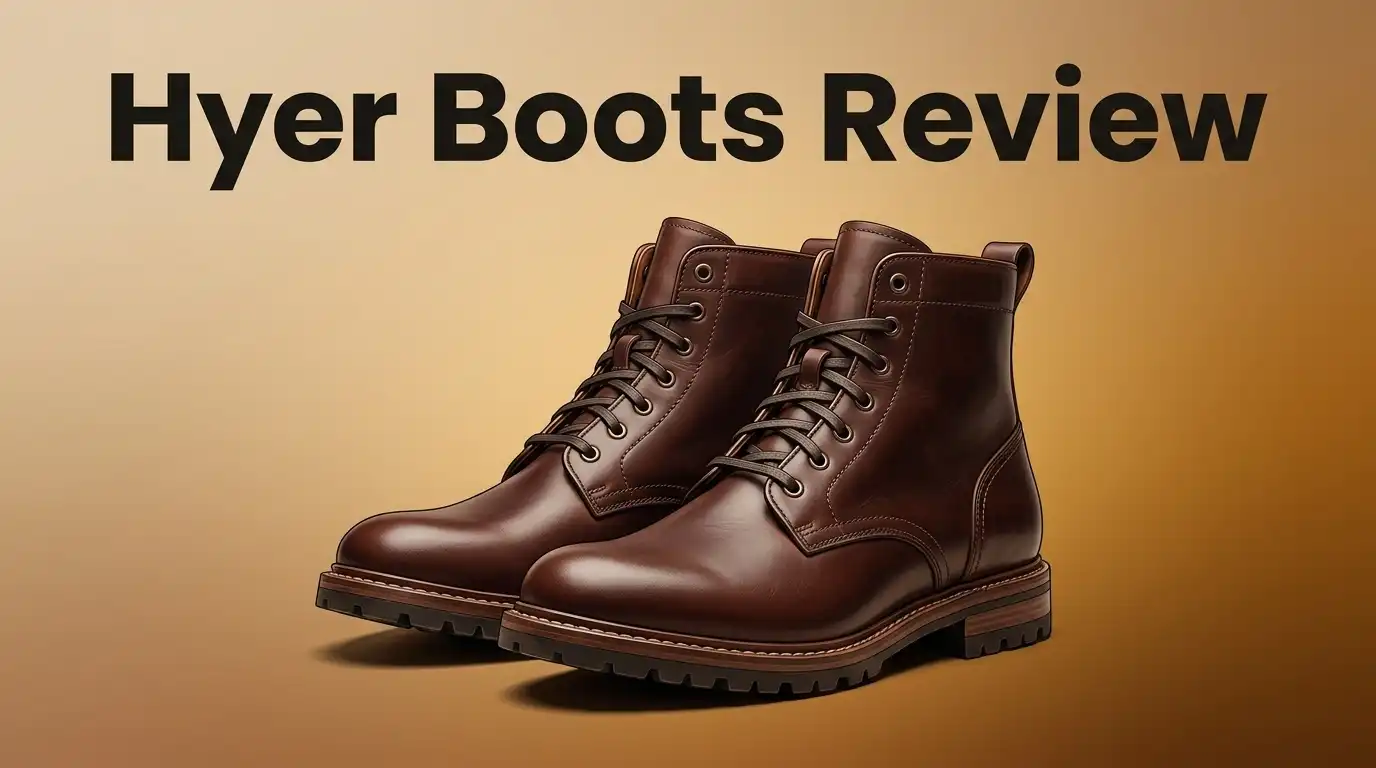
Hyer Boots Review 2026: Worth Buying It?
Cowboy boots carry stories. Hyer Boots carries one of the oldest stories in the business, and in 2026 that story is louder than ever.
The brand claims it made the first boot ever marketed as a “cowboy boot” back in 1875. Charles H. Hyer started the shop in Olathe, Kansas. The company ran for over a century, then closed, then came back in 2022 under his great great great grandson.
So the history is real. But history does not protect your feet on a long day.
In A Nutshell:
- Build quality is genuinely strong. Hyer uses channel welted construction, full grain leather uppers, cow skin lining, and a butyl rubber outsole that lasts roughly twice as long as an untreated sole. These are resoleable boots, not throwaway boots.
- Comfort out of the box surprises most buyers. The dual density insole with a leather cover beats the cloth topped inserts used by many rivals. Several owners report wearing them all day on day one without blisters.
- The square toe dominates the lineup. If you want a pointed or classic round toe, your options stay limited. This is the single most common complaint from boot collectors.
- They are made in Leon, Mexico, not Kansas. The craftsmanship there is excellent. Still, buyers who expected an American made boot from an American heritage brand feel let down.
- Pricing sits around $290 to $400 per pair. That puts Hyer against Anderson Bean and R Watson, both respected names. You pay premium money for a young brand.
- Sizing runs slightly generous in the shaft. Some owners find the shaft wider than they like, and a few report stretch over time.
Hyer Sawyer Vintage Goat Top Cowboy Boot

- Tan oiled shrunken shoulder leather vamp is tough and long lasting
- HYER red vintage goat upper is soft and vibrant
- 13" shaft
Last update on 2026-08-22 / Affiliate links / Images from Amazon Product Advertising API Some of the links on this website are affiliate links, which means that at no additional cost to you, I earn a commission if you click through and make a purchase. I only recommend products and services that I believe will add value to my readers. Thank you for your support!
The Sawyer is the boot most people meet first. It is also the one that converts the most skeptics.
The vamp uses tan oiled shrunken shoulder leather. That leather is thick, slightly pebbled, and it hides scuffs well. The 13 inch shaft uses red vintage goat leather, which feels soft and looks vibrant without turning flashy.
The toe is a broad square. Hyer calls it a wide square, and it is genuinely wide. Riders with roomy feet love this. Anyone with narrow feet should read the sizing section further down.
Pull straps sit inside the shaft rather than outside. They are sturdy, though a handful of owners say the interior tabs stay stuck upright after a few dozen wears.
The stitching deserves real praise. The pattern is tight, even, and centered. Nothing looks rushed, which is not always true at this price.
The Sawyer carries a 12mm spur ledge with a PVC cap over it. That cap stops the ledge from curling, which is a small detail working cowboys notice within a season.
One owner on Reddit bought Sawyers, wore them two straight days, and ordered a second Hyer pair the next week. Another owner went through two pairs of Sawyers and had both stretch out too large.
That split is the honest story of this boot. When the fit lands, it lands hard. When it does not, the leather gives more than you want.
The Unboxing Experience
Hyer ships in a sturdy branded box with the red branding iron logo on the lid. The box feels heavy in your hands, which sets the tone.


Last update on 2026-04-11 / Affiliate links / Images from Amazon Product Advertising API Some of the links on this website are affiliate links, which means that at no additional cost to you, I earn a commission if you click through and make a purchase. I only recommend products and services that I believe will add value to my readers. Thank you for your support!
Inside, each boot sits wrapped in tissue paper with a paper form inside the shaft. The forms keep the shaft upright during shipping, and they are worth saving for storage.
You get a small care card and a brand story insert. The insert leans hard on the 1875 origin story, which some buyers love and others skim past.
The smell hits first. Real oiled leather has a deep, slightly sweet scent that cheap corrected grain leather never produces. Hyer nails this.
The leather feels substantial the moment you lift a boot. There is weight there. These are not lightweight fashion boots, and you notice that before you even try them on.
Pull the paper form out and check the interior. The lining is cow skin, stitched cleanly, with no exposed glue seams. The insole has a leather top cover that you can lift out entirely.


Last update on 2026-04-11 / Affiliate links / Images from Amazon Product Advertising API Some of the links on this website are affiliate links, which means that at no additional cost to you, I earn a commission if you click through and make a purchase. I only recommend products and services that I believe will add value to my readers. Thank you for your support!
That removable insole matters. Hyer builds a dual fit system. Leave the insole in for a snugger feel, pull it out for a roomier fit on a channeled leather footbed.
Free shipping applies on all boots from the brand site, which softens the sting of the price a little.
Hyer Topeka Tan And Blue Western Boot

- Vamp: Tan Crazy Cowhide
- Upper: Robin's Egg Blue Burnished Cowhide
- Shaft Height: 11 inches
Last update on 2026-08-22 / Affiliate links / Images from Amazon Product Advertising API Some of the links on this website are affiliate links, which means that at no additional cost to you, I earn a commission if you click through and make a purchase. I only recommend products and services that I believe will add value to my readers. Thank you for your support!
The Topeka is the flashier cousin of the Sawyer. It pairs a tan vamp with a blue shaft, and the contrast reads well in person.
This boot leans more casual than the working models. You can wear it to a wedding, a bar, or a rodeo without looking out of place in any of them.
The leather quality matches the rest of the lineup. Full grain on the vamp, softer leather on the shaft, and the same tight stitch pattern Hyer uses across every model.
The shaft height sits in the standard 12 to 13 inch range. The stitch design is bolder than the Sawyer, with more visible thread work running up the sides.
The blue holds up better than expected. Dyed shafts often fade with sun and sweat. Early owner reports suggest the color stays true through the first year.
The same square toe applies here. Hyer went square across the board for the relaunch because square toes sell in volume at western retailers.
Comfort mirrors the Sawyer. Same insole, same lining, same butyl outsole. If you liked one, you will like the other.
The one gap is versatility. This is a statement boot. If you own only one pair of cowboy boots, a plain brown or tan model serves you better every single day.
Top 3 Alternative For Hyer Boots
No products found.
Ariat Men’s Sport Herdsman Western Boot

- SCIENCE OF INNOVATION: Ariat excels in advanced technologies to deliver products that outperform in...
Last update on 2026-08-22 / Affiliate links / Images from Amazon Product Advertising API Some of the links on this website are affiliate links, which means that at no additional cost to you, I earn a commission if you click through and make a purchase. I only recommend products and services that I believe will add value to my readers. Thank you for your support!
Ariat Men’s Heritage Roughstock Square Toe Cowboy Boot
No products found.
Justin Driller 11 Inch Work Boot Stampede Collection
Leather Quality And Materials
Leather makes or breaks a boot, and this is where Hyer earns most of its reputation.
The vamps use full grain leather. Full grain keeps the top layer of the hide intact, so the surface develops character instead of flaking apart.
Shrunken shoulder leather appears on several models. This hide has a natural pebbled texture from the shoulder area of the cow. It resists creasing badly and it hides ranch damage.
Goat leather shows up on shaft uppers. Goat is soft, strong for its weight, and takes dye beautifully. That is why the red and purple shafts look so rich.
The lining is cow skin rather than pigskin or synthetic. Cow skin lining costs more and lasts longer, especially in a boot that gets sweaty daily.
Roughout options exist too. Roughout turns the hide flesh side out, which means scratches simply blend into the nap instead of scarring the finish.
Here is the honest critique. Several owners report the leather stretching more than expected over the first three months. Two separate Sawyer owners said their boots went from a great fit to too large.
That points to soft, supple hides rather than stiff ones. Soft leather feels amazing early and gives more later. You trade one for the other.
If you sit between sizes, size down. The leather will meet you halfway within a month.
Construction And Sole Details
Hyer builds with channel welted construction. The welt is stitched into a channel cut in the leather insole rather than glued.
This is the traditional method. It costs more, takes longer, and allows the boot to be resoled multiple times over its life.
The outsole is butyl rubber. Butyl is denser than standard rubber compounds and the brand claims roughly double the wear life of an untreated leather or rubber sole.
That claim holds up reasonably well in owner reports. People working cattle daily are getting more than a year out of soles that would be worn through faster on cheaper boots.
The heel is a standard walking or riding heel depending on model. All current models carry a 12mm spur ledge.
The PVC cap over the spur ledge is a smart touch. Spur ledges curl upward on most boots after a few hundred hours of spur contact. The cap prevents that.
Now the criticism. One owner described the sole as thin, which created forward pronation and pressure on the ball of the foot.
He liked the boots enough to add a Vibram outsole rather than return them. That is loyalty, but it is also a real design note.
The sole is built for riding, not for concrete. If you spend eight hours a day standing on hard floors, budget for an aftermarket insole.
Comfort And Break In Period
Most quality cowboy boots hurt for two weeks. Hyer largely avoids this.
The dual density insole does the heavy lifting. It has a firm base layer for support and a softer top layer for cushioning, wrapped in a leather cover.
Cloth topped inserts wear through and shred. Leather covered inserts do not. This is one of the clearest advantages Hyer holds over similarly priced competitors.
Owner feedback on day one comfort is consistently strong. Multiple people report full day wear straight out of the box with no hot spots.
One buyer soaked his pair in warm water and wore them until dry. That is an old ranch trick that molds the leather to your foot in a single day. It works, but it is not for the cautious.
The break in that remains is mostly in the shaft and the vamp flex point. Expect two to three weeks of daily wear before the vamp creases naturally.
Where comfort falters is arch support. The footbed is fairly flat by modern standards.
People with high arches or plantar issues should plan on an insert. The removable insole makes swapping easy, which helps.
Width is another comfort variable. Hyer offers D and EE in men’s, plus B width in women’s up to size 12.
Men with narrow feet can size into women’s B width. Subtract 1.5 sizes. It only works up to a men’s 10.5.
Sizing And Fit Guide
Sizing is the biggest source of Hyer returns, so read this section twice.
Hyer runs close to true to size for most people. If you wear a 10.5D in Ariat, start at 10.5D in Hyer.
The shaft is wide. Multiple owners call it the widest shaft they have encountered. If you tuck jeans in, that is a bonus. If you wear slim jeans over the boot, expect bulk.
The toe box is genuinely broad. Wide footed riders finally get room. Narrow feet slide around inside.
The dual fit insole is your adjustment tool. Insole in for a tighter fit, insole out for extra volume.
Here is the pattern in owner complaints. Boots that fit perfectly in week one sometimes feel loose by month three.
That happens because the leather is supple and it stretches lengthwise and across the vamp. Buy for a snug initial fit, not a comfortable one.
Your heel should slip slightly when new. A quarter inch of heel lift on a fresh cowboy boot is normal and correct.
If your heel does not lift at all, the boot is too small in the instep. If it lifts half an inch, size down.
Try them on late in the day. Feet swell, and afternoon sizing gives you a more honest read.
Durability After Six Months
Long term reports are where Hyer separates from fashion western brands.
One owner wears his Hays model almost daily and says they take abuse better than most boots he has owned, and he has owned plenty.
Another compared his pair directly to Anderson Bean. His verdict was that quality matches, with the only difference being the country of manufacture.
A 16 year old rider went through two pairs of Ariats where the heels pulled off both. His Hyer pair held after a month of hard use.
The butyl outsole is the standout durability feature. Sole wear is the number one reason working boots get retired, and Hyer buys you extra time here.
Stitching holds. There are very few reports of blowouts at the welt or the vamp seam, which is where cheaper boots fail first.
Now the failures. Shaft stretch is the recurring issue, particularly on goat leather uppers.
Interior pull tabs get criticism too. One owner described them staying upright inside the shaft after 25 wears, which makes pulling the boot on awkward.
A teardown video found the heel counter shorter than some reviewers prefer. A short heel counter offers less lateral support over years of wear.
None of these are catastrophic. They are the kind of details a brand three years into its relaunch is still refining.
What Hyer Boots Do Not Do Well
Every review that only lists positives is selling you something. Here are the real weak points.
Toe shape variety is poor. The entire relaunch lineup went square. Collectors who wanted 1950s to 1970s inspired pointed and round toes are still waiting.
The CEO has acknowledged this publicly. He built vintage samples first, but retailers would not stock them, so square won.
The made in Mexico issue divides buyers. The craftsmanship in Leon is world class. That is not in question.
The problem is expectation. A brand that markets Kansas heritage this heavily invites disappointment when the box says Mexico.
Stock availability is inconsistent. Popular models like the Maize and the Culver have gone on months long backorder. One buyer waited three months for an 11D.
The sole runs thin for pavement use. Forward pronation and ball of foot pressure show up in owner reports.
There is no flagship store in Olathe, the town the brand was born in. Local fans find that genuinely odd.
Price is a hurdle. At $290 to $400, you are paying Anderson Bean money for a brand with three years of modern track record.
Finally, nothing about the design is distinctive yet. One retailer said the boots seemed well made but showed nothing that set them apart from Top Hand Horsepowers.
Hyer Boots Pros And Cons
Here is the balanced summary.
Pros
- Channel welted construction that allows resoling for years, not a glued sole that ends the boot’s life
- Full grain leather uppers with excellent hide selection, including shrunken shoulder and goat
- Butyl rubber outsole that lasts roughly twice as long as untreated outsoles
- Leather covered dual density insole that does not shred like cloth topped inserts
- Dual fit system lets you adjust volume by removing the insole
- 12mm spur ledge on every model with a PVC cap that prevents curling
- Cow skin lining rather than cheaper synthetic or pigskin
- Very short break in period with strong day one comfort reports
- Genuine 1875 heritage with an owner who responds directly to customers online
- Women’s B width available, which men up to size 10.5 can also use
Cons
- Square toe only across nearly the entire current lineup
- Made in Mexico despite heavy American heritage marketing
- Leather stretches noticeably over the first three months on some pairs
- Shaft is wider than most competing brands
- Sole runs thin for extended pavement or concrete work
- Interior pull tabs stay upright and get stiff for some owners
- Heel counter is shorter than premium standards
- Frequent stock shortages on popular models and sizes
- Priced against Anderson Bean and R Watson without the same track record
- Little visual distinction from R Watson and similar brands
Price And Value For Money
Hyer boots run roughly $290 to $400 depending on model and leather.
The Sawyer sits around $369 to $390 at full retail. Some retailers list it near $290 on sale.
That price puts Hyer in serious company. Anderson Bean, R Watson, and Rios of Mercedes all live in this range, and several of them are made in Texas.
The value argument depends on what you weigh. Stitch for stitch, the construction genuinely competes. The owner himself makes exactly that claim, and owner feedback backs it more often than not.
Compare it downward and Hyer wins clearly. An Ariat Heritage Roughstock costs less but uses cemented construction on many models and cannot be resoled the same way.
Compare it upward and the picture tightens. For $400 you can find American made boots with longer reputations behind them.
Resoling changes the math. A resoleable boot that lasts eight years beats three pairs of glued boots over the same period.
Factor in free shipping and the removable insole system, and the value holds. Just do not expect a bargain.
If your budget stops at $200, buy Ariat or Justin and be happy. If you can reach $350, Hyer deserves a look.
Who Should Buy Hyer Boots
These boots suit specific people very well and other people poorly.
Buy Hyer if you ride. The spur ledge, the walking heel, and the durable outsole are built around time in the saddle.
Buy them if you have wide feet. The broad square toe and EE width option solve a problem most brands ignore.
Buy them if you like square toes. This should be obvious, but it eliminates a large group of buyers immediately.
Buy them if brand story matters to you. Zach Lawless answers customers personally on Reddit and Instagram, which is rare and genuine.
Buy them if you want a resoleable boot. Cheap boots get thrown away. These get repaired.
Skip Hyer if you need American manufacturing. No amount of heritage marketing changes where the boots are made today.
Skip them if you want a pointed or classic round toe. Wait for future releases instead.
Skip them if you stand on concrete all day. The sole is too thin without modification.
Skip them if you have narrow feet and cannot use women’s sizing. You will fight the fit forever.
Casual wearers get good value too. One buyer bought for casual wear only and said the leather quality beat every other boot he owned.
Care And Resoling Tips
Good boots reward good care. These respond well to basic maintenance.
Brush off dust and dirt after each wear. A horsehair brush takes ten seconds and prevents grit from cutting the leather.
Condition every two to three months. Use a cream conditioner on smooth leather. Products like Skidmore’s work well and add water resistance.
Do not condition roughout the same way. Brush roughout with a suede brush and use a spray protectant instead.
Let wet boots dry slowly at room temperature. Never put them near a heater or a fire. Heat cracks leather permanently.
Use cedar boot trees or the paper forms from the box. They absorb moisture and hold the shaft shape.
Rotate pairs if you can. Leather needs 24 hours to dry out fully between wears.
Resole before you wear through to the welt. Once the welt stitching goes, the repair gets far more expensive.
A good cobbler can resole a channel welted boot for $80 to $150. That is a fraction of a new pair.
If the sole feels thin for your work, add a Vibram half sole early. At least one owner did exactly this and kept boots he otherwise loved.
Check the spur ledge cap annually. Replace it if it splits, before the leather underneath starts curling.
Final Verdict
Hyer Boots in 2026 is a very good boot company still growing into a legendary name.
The construction is honest. Channel welted, full grain leather, butyl sole, cow skin lining, resoleable. Nothing here is cut rate.
Comfort out of the box is genuinely impressive, and the leather covered dual density insole is better than what most rivals include.
The flaws are real too. Square toes only, stretch over time, thin soles, stock shortages, and a Mexico build that clashes with the Kansas story.
Would we recommend them? Yes, with conditions.
If you ride, have wide feet, and like square toes, Hyer competes with anything at this price. Buy snug, condition regularly, and expect years of service.
If you want pointed toes or American manufacturing, wait. The brand has signaled that new styles are coming, and the owner listens to feedback more than almost anyone in this industry.
The 150 year anniversary lineup shows ambition. Limited runs and a reconnection with Olathe suggest the company knows what its fans want.
Hyer earns a solid recommendation for the right buyer. It does not yet earn a universal one.
Frequently Asked Questions
Where are Hyer Boots made?
Hyer Boots are made in Leon, Mexico. The brand was founded in Olathe, Kansas in 1875, but modern production happens in Mexico because domestic factories quoted prices that would have pushed retail past $1,000 per pair. Leon is widely considered the boot making capital of the world.
Do Hyer Boots run true to size?
Yes, for most people. Order your usual boot size and consider sizing down half a size if you fall between sizes, because the leather stretches over the first few months. The removable insole lets you adjust volume without changing size.
Are Hyer Boots good for working cowboys?
Yes. Every model carries a 12mm spur ledge with a protective cap, a butyl rubber outsole, and channel welted construction. Multiple daily riders report the boots outlasting other brands they have owned.
Can Hyer Boots be resoled?
Yes. Channel welted construction means a cobbler can replace the sole multiple times. Resoling typically costs $80 to $150 and extends the boot’s life by years.
How much do Hyer Boots cost?
Most models run between $290 and $400. The Sawyer sits around $369 to $390 at full retail, with occasional retailer discounts closer to $290.
Does Hyer offer narrow widths?
Men’s boots come in D and EE only. Women’s boots come in B width up to size 12. Men who wear 10.5 or smaller can size up 1.5 into a women’s B width.
Are Hyer Boots better than Ariat?
Hyer uses better construction and materials at a higher price. Ariat offers more styles, wider availability, and lower cost. For riding and long term durability, Hyer wins. For budget and variety, Ariat wins.
Did Hyer really invent the cowboy boot?
Hyer claims the first boot marketed as a “cowboy boot” in 1875, and order records for “Cow Boy Boots” exist from 1876. Historians debate the origin, and Mexican vaqueros developed similar boots centuries earlier.

Mia Smith is the founder of Shoe Storyteller, a blog that celebrates the art and stories behind shoes. With a passion for fashion and a flair for storytelling, Mia brings a unique perspective to the world of footwear.