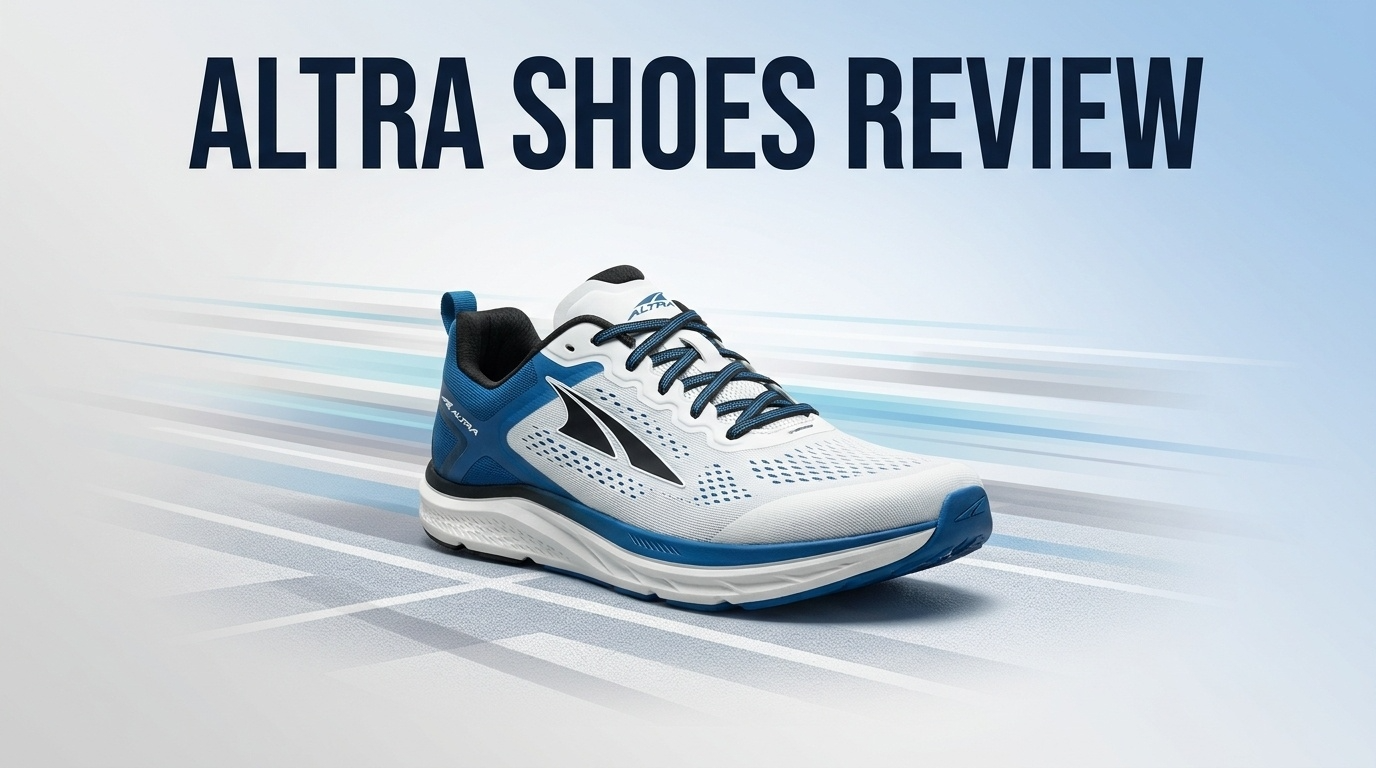
Altra Shoes Review 2026: Worth Switching?
Most runners who land on Altra arrive with the same problem: their toes hurt. Not their arches, not their knees, their toes. Years of tapered shoe lasts squeeze the forefoot into a shape no human foot actually has, and the result is numb pinky toes, bruised nails, and bunions that keep growing.
Altra built its entire catalog around fixing that one complaint. The brand pairs a foot-shaped toe box with a zero drop platform, meaning the heel and forefoot sit at exactly the same height off the ground.
That combination is either the best thing that has happened to your feet or a fast track to a strained calf. There is very little middle ground, and most reviews gloss over that.
In a Nutshell
- The toe box is the real product. Lab measurements put the Lone Peak 9 at 85.3 mm across the big toe against a 74.1 mm category average. If you have wide feet, bunions, or Morton’s neuroma, nothing else on the mainstream market comes close.
- Zero drop demands a transition. Your Achilles and calves absorb load that a raised heel used to hide. Plan four to six weeks of reduced mileage, or expect soreness.
- The cushioning is firm, not plush. Altra EGO foam sits at 23.3 mm stack with low measured shock absorption. That means excellent ground feel and poor joint protection on long, hard-surface days.
- Grip is genuinely good. 3.8 mm lugs handle dry dirt, loose gravel, wet roots, and moderate mud. The 9+ upgrade swaps in Vibram Megagrip for fifteen dollars more.
- Breathability is the weak spot. The reinforced mesh scored 2 out of 5 in smoke testing. Hot climates will notice.
- Price is fair. At $140, it undercuts the $157 category average while lasting a typical 350 to 450 miles.
Altra Lone Peak 9 Trail Running Shoe

- Our grippy MaxTrac outsole provides the perfect combination of grip, traction, and durability on all...
- A StoneGuard provides underfoot protection on the trail, over rocks, debris, and tough terrain with...
- This product received the American Podiatric Medical Association (APMA) Seal of Acceptance, awarded...
Last update on 2026-06-08 / Affiliate links / Images from Amazon Product Advertising API Some of the links on this website are affiliate links, which means that at no additional cost to you, I earn a commission if you click through and make a purchase. I only recommend products and services that I believe will add value to my readers. Thank you for your support!
The Lone Peak has been Altra’s anchor model since 2012, and the ninth version is the most refined one so far. It sits at 25 mm of stack height, which lands between minimalist and cushioned.
What you get is a shoe that works as a trail runner, a thru-hiking shoe, a travel shoe, and a daily walker. Pacific Crest Trail hikers have voted with their wallets for a decade.
The midsole uses Altra EGO, a standard EVA compound rather than the brand’s newer supercritical foams. It is firm, predictable, and slow to bottom out.
Underfoot protection comes from a StoneGuard insert instead of a full rock plate. Sharp granite still registers, but you avoid the stone bruises that plague thinner shoes.
The upper is a dense engineered mesh with welded overlays at the toe and midfoot. It sheds trail debris well and resists the abrasion that killed earlier versions.
Weight is the honest downside. My size 10 pair scaled 10.9 ounces, which is heavy for a low-stack shoe and up noticeably from version eight.
Unboxing, Feel, and First Steps
The box is plain recycled cardboard with no tissue paper, no branded dust bag, no marketing insert. Altra spends nothing on presentation, which I appreciate at this price.
Out of the box the shoes smell faintly of rubber cement and nothing else. There is no chemical off-gassing, and the smell disappears within a day of wear.
Pick one up and the first thing you notice is the shape. The forefoot looks almost cartoonishly wide compared to a normal running shoe, like a duck foot.


Last update on 2026-04-11 / Affiliate links / Images from Amazon Product Advertising API Some of the links on this website are affiliate links, which means that at no additional cost to you, I earn a commission if you click through and make a purchase. I only recommend products and services that I believe will add value to my readers. Thank you for your support!
Sliding a foot in, the sensation is immediate room. Toes splay sideways with no resistance, and the sock liner feels flat rather than contoured.
The heel collar is low cut and softly padded. The fully gusseted tongue attaches on both sides, which keeps grit out and prevents tongue slide.
First steps feel odd if you come from a 10 mm drop trainer. Your heel sits lower than your brain expects, and the ground feels closer than it should.
Laces are flat and trail-grade with reinforced punched eyelets. A finger loop at the heel makes pulling them on fast, and a GaiterTrap hook accepts Altra’s strapless gaiters.
Top 3 Alternative for Altra Lone Peak 9

- The Altra Footwear Torin 8 sneaker is your ideal companion for both daily runs and long-distance...
- Ethylene-Vinyl Acetate insole.
- Branding at the tongue and lateral side.
Last update on 2026-08-03 / Affiliate links / Images from Amazon Product Advertising API Some of the links on this website are affiliate links, which means that at no additional cost to you, I earn a commission if you click through and make a purchase. I only recommend products and services that I believe will add value to my readers. Thank you for your support!


Last update on 2026-04-11 / Affiliate links / Images from Amazon Product Advertising API Some of the links on this website are affiliate links, which means that at no additional cost to you, I earn a commission if you click through and make a purchase. I only recommend products and services that I believe will add value to my readers. Thank you for your support!
Altra Torin 8

- Go Further: Our original Altra EGO foam is designed to provide added energy return and a responsive...
- To The MAX: Our Altra EGO MAX midsole foam gives you all the light and luxurious performance with a...
- Get Comfortable: Signature Altra Balanced Cushioning and FootShape toe boxes allow your toes to...
Last update on 2026-08-03 / Affiliate links / Images from Amazon Product Advertising API Some of the links on this website are affiliate links, which means that at no additional cost to you, I earn a commission if you click through and make a purchase. I only recommend products and services that I believe will add value to my readers. Thank you for your support!
Altra Escalante 4

- Go Further: Our original Altra EGO foam is designed to provide added energy return and a responsive...
- To The MAX: Our Altra EGO MAX midsole foam gives you all the light and luxurious performance with a...
- Get Comfortable: Signature Altra Balanced Cushioning and FootShape toe boxes allow your toes to...
Last update on 2026-08-03 / Affiliate links / Images from Amazon Product Advertising API Some of the links on this website are affiliate links, which means that at no additional cost to you, I earn a commission if you click through and make a purchase. I only recommend products and services that I believe will add value to my readers. Thank you for your support!
Altra Provision 8
The FootShape Toe Box, Honestly Assessed
This is the reason to buy Altra, so it deserves scrutiny rather than praise. The toe box is not merely wide; it is shaped like an actual foot, widest at the big toe rather than the middle.
Gel mold testing confirms a non-tapered silhouette. Your big toe stays in line with your first metatarsal instead of angling inward.
For anyone with bunions, hammertoes, or a wide forefoot, this changes daily comfort more than any cushioning technology. Several podiatrists recommend the shape for post-surgical recovery.
There is a limit worth knowing. Vertical toe box height measures 26.8 mm, which is dead average, so people with high-volume feet or thick toes may still feel pressure from above.
The width also creates a trade-off on technical ground. Your foot can slide laterally inside the shoe during off-camber descents, which some runners read as instability.
Removing the 4.4 mm insole buys extra vertical room if you need it. Third-party orthotics rarely fit well because of the unusual outline.
Two width options exist, standard and wide. Most people do not need the wide version, and choosing it by default leads to sloppy fit.
Zero Drop and What It Does to Your Calves
Zero drop means the heel sits at the same height as the forefoot, and Altra measures at exactly 0.0 mm in lab testing. The stated benefit is a natural standing posture and a midfoot landing.
No products found.
The real effect is a load transfer. Your calf complex and Achilles tendon now handle stress that a raised heel previously offloaded.
For runners with healthy, strong lower legs, this builds resilience over time. For anyone with a history of Achilles tendinopathy or chronic calf tightness, it is a genuine injury risk.
The transition protocol matters more than the shoe. Start with short walks, add a mile or two of easy running per week, and keep your old shoes in rotation.
Four to six weeks is a realistic timeline. People who ignore this and run a long effort in week one are the ones posting angry reviews.
Heel strikers get the least benefit. A zero drop platform does not complement that stride, and the low stack offers almost no heel protection on impact.
Plantar fasciitis is a mixed story. Some sufferers report relief from the wider forefoot, while others find the lack of arch support and heel lift makes symptoms worse.
Cushioning and Ground Feel Over Long Days
Lab testing recorded 96 SA of heel shock absorption against a 123 SA category average. In plain terms, this shoe protects your joints less than most trail shoes.
That is deliberate rather than a flaw. The Lone Peak sells a grounded, connected ride, and adding foam would destroy the thing people buy it for.
Energy return sits at 57.9 percent, which is unremarkable. Altra EGO gives moderate bounce and no propulsive snap, so this is not a shoe for fast efforts.
Midsole firmness measured 40.8 AC, slightly firmer than average. It stays consistent across a run rather than packing out in the second hour.
On smooth dirt and rolling singletrack the ride is excellent. You feel terrain, adjust quickly, and the low center of gravity inspires confidence.
On rocky descents and long road sections the story changes. Past twenty miles on hard ground, my feet ached in a way that a cushioned shoe would have prevented.
There is no aggressive rocker, which preserves the natural flex feel. Flexibility measured 12.0N, still flexible but stiffer than older Lone Peaks.
Grip, Outsole, and Terrain Range
The standard Lone Peak 9 uses Altra’s MaxTrac rubber with 3.8 mm arrow-shaped lugs. The 9+ version substitutes Vibram Megagrip for roughly fifteen dollars more.
Lug depth beats the 3.5 mm category average, and the multidirectional pattern climbs and brakes well. Loose gravel and dry dirt are where it feels best.
Wet roots and slick rock are handled competently by the Vibram version and adequately by MaxTrac. Neither is a mud shoe; deep clay clogs the tread quickly.
Outsole durability impressed me. Abrasion testing showed only 0.8 mm of wear, better than average, and my pair looked barely used after three months.
Outsole thickness measures 2.0 mm, giving useful protection given the absent rock plate. The trade-off is reduced flex through the forefoot.
Road performance is acceptable for connector sections. The lugs wear faster on pavement, so treat asphalt as a necessary evil rather than a habit.
If your trails are steep, wet, and technical, spend the extra money on the 9+. If you mostly hike moderate terrain, the standard version is plenty.
Sizing, Lockdown, and Lacing Tricks
Altra runs true to size by a wide margin of user votes, and my experience matches. Order your normal running size rather than sizing up out of habit.
The exception is thru-hiking. Feet swell over consecutive long days, so half a size up is standard practice among distance hikers.
Length feels correct but volume feels generous. If you have a narrow or low-volume foot, the shoe will feel loose no matter how hard you pull the laces.
Heel lockdown is the most common complaint. The heel counter is deliberately soft, rated 2 out of 5 for stiffness, which prioritizes comfort over security.
The fix is the extra eyelet at the top. A runner’s knot pulls the heel back into the collar and eliminates most slippage on climbs.
Thin socks make the volume issue worse. A midweight merino sock fills the shoe properly and reduces internal foot movement.
Break-in is minimal. The upper softens within two or three wears, and there are no hot spots or seams positioned to cause blisters.
Durability, Breathability, and Weight
Expect 350 to 450 miles from a pair, with hikers often reporting more. That is respectable but not exceptional for a $140 shoe.
Toe box abrasion testing returned a middling 3 out of 5. The upper resists rock scuffs better than version eight, though sidewall tears still appear in user reports around the 400-mile mark.
Heel padding scored 3 out of 5 as well. Wear appears gradually rather than suddenly, and it rarely affects function.
Breathability is the clear weakness at 2 out of 5. Microscope inspection found essentially no airflow pathways in the mesh.
In hot, humid conditions your feet will sweat. The upside is that the same dense weave keeps dust and fine grit out.
Weight is up to 10.9 ounces, a 21-gram jump from the previous version. That is heavy for a low-stack shoe and the most legitimate criticism of this update.
Reflective elements are absent entirely. For a shoe marketed to early-morning trail users, that omission is hard to defend.
Pros and Cons
Pros
- The FootShape toe box at 85.3 mm is the widest in mainstream running, and it genuinely resolves toe crowding, numbness, and bunion pressure.
- Vibram Megagrip on the 9+ delivers reliable traction across dry dirt, gravel, wet roots, and moderate mud.
- Outsole durability tested well above average at only 0.8 mm of abrasion wear.
- The fully gusseted tongue blocks trail debris, and the GaiterTrap hook adds a clean gaiter solution.
- At $140 it undercuts the $157 trail shoe average while covering running, hiking, and everyday wear.
- Standard and wide options exist, and the removable insole frees extra volume.
Cons
- Zero drop carries a real Achilles and calf adaptation cost that heel strikers and previously injured runners should take seriously.
- Shock absorption sits well below average, so long days on hard ground leave your feet sore.
- Breathability rated 2 out of 5, which makes hot-weather use uncomfortable.
- Weight climbed to 10.9 ounces, heavy for this stack height.
- Heel lockdown is soft and requires a runner’s knot for many feet.
- No reflective detailing anywhere on the shoe.
Who Should Skip Altra Shoes
Skip these if you are a committed heel striker. The zero drop geometry works against that stride, and the thin heel offers almost no impact protection.
Skip them if you have active Achilles tendinopathy or chronic calf strain. Adding load to an already irritated tendon is a bad trade for a roomier toe box.
Skip them if you have narrow or low-volume feet. The interior space that liberates wide feet turns into sliding, blisters, and lost energy for everyone else.
Skip them if you need maximum cushioning for high-mileage road weeks. The Olympus line or a cushioned competitor serves that goal far better.
Skip them if you run in consistent heat above 85 degrees. The upper traps warmth, and there is no ventilated alternative in the Lone Peak family.
Skip them if you race technical alpine terrain. The roomy fit reduces precision on off-camber rock where a locked-down foot matters.
Everyone else, particularly people with wide feet, bunions, or toe pain, has a strong reason to try a pair.
Frequently Asked Questions
Are Altra shoes good for plantar fasciitis?
Results split. The wide forefoot reduces mechanical irritation for some, while the absent heel lift and minimal arch support aggravate symptoms for others. Try a pair with a generous return window rather than committing on a recommendation.
How long does the zero drop transition take?
Four to six weeks for most runners. Begin with walking and short easy runs, keep your previous shoes in rotation, and add calf and Achilles strength work. Stop and back off if you feel sharp tendon pain rather than ordinary muscle soreness.
Should I buy the Lone Peak 9 or the 9+?
Buy the 9+ if you run wet, steep, or technical trails, since Vibram Megagrip meaningfully outgrips MaxTrac on slick surfaces. Buy the standard 9 for moderate terrain, better flex, and slightly more ground feel at a lower price.
Do Altra shoes fit true to size?
Yes, based on a large majority of user votes and my own testing. Order your normal running size. Thru-hikers commonly go half a size up to accommodate foot swelling across consecutive long days.
Can I wear Altra shoes for walking and everyday use?
Absolutely, and many owners buy them for exactly that. The flat platform and roomy forefoot suit standing work, travel, and casual wear. Apply the same gradual transition rule if you are new to zero drop.
How many miles will a pair last?
Plan on 350 to 450 miles. The Vibram outsole typically outlives the midsole foam, so the ride flattens before the tread disappears. Hikers on softer surfaces often report longer service life.
Are wide feet required to benefit from Altra?
No, but they help. Runners with average width feet still gain from natural toe splay. People with genuinely narrow feet usually find the fit too loose and are better served elsewhere.

Mia Smith is the founder of Shoe Storyteller, a blog that celebrates the art and stories behind shoes. With a passion for fashion and a flair for storytelling, Mia brings a unique perspective to the world of footwear.